
Web Design Program
This is where it all began — with curiosity, a PC, and a decision to learn something new. The Web Design Program in 1998 was my first encounter with the digital world. Without realizing it at the time, I was laying the foundation for an understanding of technology, structure, and user experience that would later shape my entire professional journey.

A PC, an Upgrade — and a New Way of Thinking
It is easy to forget just how different everything was in the late 1990s. Today, technology is something we take for granted. It is seamless, integrated, and always available. But that was not the case back then.
For me, it began with a very specific event: buying my first PC — an Olivetti. It was not a strategic decision. It was driven by curiosity and a sense that something new was beginning to happen. The computer came with an older operating system, but included an upgrade to Windows 95. The transition from Windows 3.11 to Windows 95 was more than a technical improvement. It was a shift from something fragmented to something more integrated, from the technical toward the more user-friendly. Suddenly, there was a graphical interface that made it possible to navigate, understand, and explore in an entirely new way.
This was also the period when the internet began to move from being a niche phenomenon to something more people could access. Connections were slow. Getting online was unreliable. The sound of the modem connecting was part of the experience. Yet there was something about it all that made a lasting impression.
It was not just technology. It was a new way to communicate. A new way to share information. A new way to think.
This was where the seed was planted.
The Program — Learning What Had Yet to Be Named
Alongside my full-time job as a marketing consultant with SAS EuroBonus, I decided to enroll in a Web Design Program in 1998. Not many people were doing that at the time. Nor was there any clear career path associated with the field. But that was precisely what made it interesting.
The program was practical in its approach, and from the very beginning it was clear that this was not about theory alone. We were going to build. We were going to test. We were going to understand how digital interfaces actually worked.
What is striking in retrospect is that we were learning things that, at the time, did not yet have a clearly established professional vocabulary. We did not learn “UX.” We did not learn “interaction design.” We did not learn “digital customer journeys.”
But we were working with all of these things.
We learned how a page had to be structured to make sense. We learned how users needed to be guided through a digital experience without becoming confused. We learned how visual elements influence understanding and experience.
It was learning that was concrete, practical, and directly connected to what we were actually creating.
The Tools — The Craft Behind the First Websites
An important part of the program was working with software — not simply as supporting tools, but as the gateway to understanding the craft behind digital development.
Through image editing in Photoshop, we learned how visual expressions could be shaped. We worked with colors, contrast, composition, and adapting content for the screen. These were not merely aesthetic choices. They were about how information is presented and how users perceive what they see.
At the same time, we worked on building the websites themselves. Everything had to be created manually. There were no ready-made solutions to handle structure or navigation. Every page had to be planned, every link had to be created, and every connection had to be understood.
This created a completely different level of closeness to what we were developing. There were no systems to hide behind. You had to understand what you were doing.
Animations were also used as part of the visual experience. At the time, this was a relatively new element, and it required a thoughtful approach. Too much animation created noise. Too little made the experience feel static. Finding the right balance was essential.
It was through this work that an important understanding began to emerge:
It is not about what you can do technically — but what you should do for the user.

The Case Project — When Everything Has to Work Together
One of the most demanding, but also most valuable, parts of the program was the practical case project. We were asked to develop a complete web solution for a fictional furniture company — an assignment that initially seemed relatively straightforward, but quickly proved to involve far more dimensions than we had anticipated.
This was where theory — or what we thought of as theory — met reality. Suddenly, it was no longer about individual elements such as images, text, or structure in isolation. It was about how all of these elements had to work together, simultaneously, as one coherent solution.
The design had to be more than visually appealing. It also had to help users intuitively understand where they were. The structure had to be logical, yet flexible enough to accommodate different types of content. Navigation had to be simple enough to require no explanation — while also being clear enough to avoid misunderstanding.
Along the way, an important realization emerged:
The quality of a digital solution is not determined by its individual elements. It is determined by how they work together.
The project also required us to think carefully about priorities. What matters most? What needs to appear first? How do we guide users forward without overwhelming the page with information? We did not necessarily have an established vocabulary for these questions at the time, but we worked with them — concretely, practically, and continuously.
The feedback on the solution confirmed that this holistic approach worked.
Having the solution described as “beautiful and good” was important in itself, but perhaps even more interesting was what lay behind those words. It was not simply about aesthetics. It was about balance. About control. About understanding.
The fact that the animations were considered entertaining without being distracting demonstrated an early understanding of something that is fundamental today:
Design elements should support the experience — not dominate it.
The fact that the menus were described as clean and easy to navigate pointed directly to the ability to structure information in a way that made sense to the user.
None of this happened by accident. It was the result of practical work, reflection, and an emerging understanding of how digital solutions actually work.

The Insight — What We Learned Without Realizing It
Looking back at the program through the lens of today’s terminology, it becomes clear that what we learned went far beyond what was explicitly taught.
We did not simply learn how to build websites. We learned to understand how people interact with digital interfaces.
It happened gradually, almost without us noticing. Through small adjustments. Through trial and error.
Through experiencing what worked — and what did not.
-
We learned that poor structure creates uncertainty.
-
We learned that unclear navigation creates frustration.
-
We learned that good design is not simply attractive — it is understandable.
Today, these insights form the very foundation of fields such as user experience and interaction design. But at the time, these were not yet clearly defined as separate disciplines. They were not things you could simply learn from a textbook in the same way. They had to be experienced.
And it is precisely this kind of learning that often leaves the deepest impression — learning that comes not from theory alone, but through experience.
In retrospect, this can be seen as a form of “tacit knowledge” — an understanding embedded in the way we think, without necessarily being expressed in clearly defined concepts.
This is also where we can see the beginning of something that would later become a recurring theme throughout my professional journey:
The ability to see the whole — not just the individual components.
Relevance — From 1998 to Today
When we step back and look at the development from 1998 to today, it is easy to focus on just how much has changed. Technology has evolved at a pace few could have predicted. The tools have become more advanced, more accessible, and far more user-friendly. Yet at the same time, something has remained unchanged.
The fundamental principles still stand.
Today, a website can be built in just a few hours. We can use ready-made templates, automated solutions, and advanced content management systems. Yet time and again, we still encounter digital solutions that do not work as well as they should.
Why?
Because technology does not determine quality. Understanding does.
What we learned in 1998 — about structure, navigation, and user needs — remains the foundation of good digital solutions. The difference is that complexity has increased. Users expect more.
There are more choices. Competition for attention is greater.
In this environment, the fundamental principles become even more important.
It is not enough to be online.
You have to work well online.
This is a distinction that is still not clear enough in many organizations, and this is precisely where that early experience provides an advantage. It offers an understanding that does not depend on specific tools, but on principles.

The Foundation — The Beginning of a Professional Direction
When viewed from a longer-term perspective, it becomes clear that this program represents more than a single period of learning. It marks the beginning of a direction — a professional path that would later develop through experience, further studies, and work.
What was established here was not simply a set of skills. It was a way of thinking.
A way of approaching problems by seeking to understand the connections before finding solutions. A way of working in which structure and user needs come before technical possibilities. A way of assessing quality in which the whole matters more than the individual elements.
This understanding has proven remarkably resilient over time. It has endured technological shifts, new platforms, and new ways of working.
It is also this understanding that underpins the idea that value is created through interaction.
Not through isolated initiatives or individual projects, but through the interaction between people, technology, and organizations.
The Web Design Program in 1998 may not have been intended as the beginning of a long professional journey. But that is exactly what it became.
Not because the technology was advanced.
But because the understanding that emerged proved to be lasting.

When Chance Opened the Door
When the Web Design Program was over, I did not really have a clear plan for how I would put what I had learned into practice. There were few established roles in this field at the time, and the path forward was far from obvious.
One day, I was sitting in the SAS cafeteria at Fornebuveien with Thomas Havnegjerde, who was the Marketing Director at the time. During an informal conversation, he asked what I had been working on alongside my job, and I told him that I had recently completed a Web Design Program.
He immediately asked whether I had seen that SAS Norway was advertising a position for an Internet Manager. I had not.
That conversation made me aware of an opportunity I might otherwise have missed. I applied for the position through the regular recruitment process, and shortly afterward I was offered the role.
What until then had been an interest and a course of study alongside my job suddenly became a new professional direction.
But it did not stop there.
Just a week and a half after I had started in the role, Thomas approached me again. He told me that I would be joining a major project in Stockholm — a project to develop SAS’s first commercial online solution. It would involve a great deal of travel and become a long-term assignment.
It was the beginning of something far bigger than I could have imagined at the time.
For a year and a half, I commuted regularly to Stockholm. Every Tuesday morning, I traveled to SAS headquarters at Frösundavik, returning on Wednesday. There, at the SAS Royal Hotel in Frösundavik, we gathered as a Nordic team and worked intensively with our suppliers to develop what would become one of the company’s earliest major digital initiatives.
It was a period defined by pace, learning, and close collaboration. Together with talented and dedicated colleagues from Sweden and Denmark — including Ola Strangeways and Christian Mejlvang — we were not only building a solution. We were also developing an understanding of what digitalization could become.
It was not simply a journey in the physical sense. It was a journey into a new professional field. A journey that began with curiosity, continued through a course of study — and, through a seemingly chance conversation in a cafeteria, developed into a career that has continued all the way to the present day.

From Studies and Seminars to Today’s Knowledge Hub
The studies, seminars, and professional journeys documented on this page form part of the knowledge foundation behind The Invisible Capital. Topics such as customers, technology, innovation, digitalization, and value creation have been part of this journey for several decades — while these fields have continued to evolve.
At The Invisible Capital, we therefore continue to explore these questions through dedicated professional series. Here, earlier theories, research, and experience are connected with newer knowledge, emerging technologies, and the challenges facing people and organizations today.
Innovation
Innovation is not just about new ideas. Value is created when knowledge, technology, and ideas are developed into products, services, processes, organizational models, and business models that are actually put into practice. The series on innovation ranges from Schumpeter to modern innovation research and explores incremental, radical, disruptive, open, and user-driven innovation, among other approaches.
→ Explore the Innovation Series
The Customer
The customer is not simply the recipient of what an organization produces. In a competitive market, the customer plays a decisive role in determining whether the organization actually succeeds in creating value. The Customer Series explores customer orientation, customer insight, customer experience, satisfaction, loyalty, trust, and the interaction between people.
→ Explore the Customer Series
Value Creation
What does it really mean to create value — and who creates it? The Value Creation Series ranges from economic theory and influential researchers to a broader understanding of how people, expertise, institutions, businesses, and the public sector contribute to value creation.
→ Explore the Value Creation Series
Digitalization
Digitalization has evolved from individual technologies into a fundamental part of how organizations operate and create value. The Digitalization A–Z series follows this evolution through the internet, the web, e-commerce, search, UX, social media, mobile, omnichannel, cloud, data, platforms, and digital transformation — leading to today’s AI First era.
→ Explore the Digitalization A–Z Series
Artificial Intelligence
Artificial intelligence represents the next chapter in digital development. In our dedicated AI knowledge hub, we explore how artificial intelligence works, how AI finds and uses information, how it evaluates sources and websites, and what these developments may mean for people, organizations, and value creation.
→ Explore the Articles on Artificial Intelligence
Recommended Professional Literature
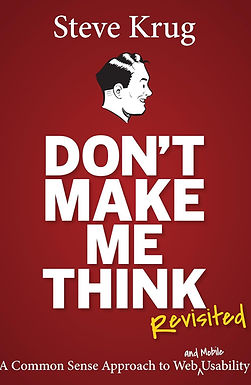
Don't Make Me Think
One of the most influential books on usability and web design. Steve Krug explains how simple navigation and intuitive solutions create better digital experiences for everyday users. The book became an important early reference in modern web design and remains highly relevant today.


