
Recreational boats in Norway - what do the statistics show about Norwegians' boating?

Over one million boats, 617,000 boat-owning households and a leisure fleet valued at more than NOK 83 billion
Published: Status Norway
Norwegians own more than one million recreational boats . They are used for fishing, outdoor activities, transportation, vacations and community activities along the entire coast and on lakes throughout the country. At the same time, recreational boats represent large private investments and create economic activity for marinas, workshops, marinas, insurance companies, equipment suppliers and tourism. These statistics show the size of the Norwegian recreational boat fleet, which boats Norwegians own, how boat ownership has developed, and what economic values lie behind them.

Norway has just over 5.6 million inhabitants and around 2.4 million households. The statistics on this page show the scope of the topic from a Norwegian perspective.
Introduction
Norway is shaped by the sea. Along the coast, in the fjords and on the country's many lakes, boats have been a tool for work, transport and fishing for generations. As prosperity and leisure time increased, boats also became an increasingly important part of Norwegians' leisure life.

Today, the Norwegian leisure fleet includes everything from canoes, kayaks, rowboats and traditional wooden boats to archipelago SUVs, sailboats, cabin cruisers, RIBs and jet skis. Boating therefore encompasses much more than the large motorboats we often see in the harbors in the summer.

The most comprehensive national survey is the Boating Survey 2023 , which describes Norwegian recreational boating in 2022.
The survey is based on interviews with more than 7,300 people and provides a representative picture of boat ownership, use, costs and value creation.
What do the statistics show?
The statistics show, among other things:
How many recreational boats are there in Norway?
What types of boats do Norwegians own?
how many households own one or more boats
How the leisure fleet has developed since 2011
the estimated value of the boats
How much do Norwegians spend on boating each year?
The figures also include canoes, kayaks and jet skis. This means that the statistics describe the entire range of Norwegian recreational boating – not just traditional motor and sailboats.

Key figures for Norwegian boating
Key figures | Value |
Recreational boats in Norway | 1,067,220 |
Norwegian households that own a boat | 617,000 |
Proportion of households that own a boat | 26.1% |
Estimated value of the recreational boat fleet | approximately 83.5 billion kroner |
Annual expenses related to recreational boating | approximately 7.5 billion kroner |
Stated average value per valued boat | approximately 161,000 kroner |
Increase in the number of boats from 2017 to 2022 | about 119,000 boats |
Increase from 2011 to 2022 | about 315,000 boats |
The boating survey thus estimates that more than every fourth Norwegian household owned one or more recreational boats in 2022. The total fleet was valued at approximately NOK 83.5 billion, while the annual expenses related to boating were estimated at around NOK 7.5 billion.

What recreational boats do Norwegians own?
Number of recreational boats by boat type
Boat type | Number | Share of the fleet |
Motorboat without accommodation | 451,849 | 42.3% |
Canoe and kayak | 269,980 | 25.3% |
Dinghy and rowboat without motor | 146 149 | 13.7% |
Motorboat with accommodation | 135,292 | 12.7% |
Sailboat with accommodation | 30,530 | 2.9% |
Sailing boat without accommodation | 16,934 | 1.6% |
Jet ski | 16,486 | 1.5% |
Total | 1,067,220 | 100% |
The figures show that motorboats without accommodation facilities are by far the largest group. They make up more than four out of ten recreational boats in Norway. At the same time, over a quarter of the fleet consists of canoes and kayaks. This underlines that Norwegian boating is not only about expensive boats and large engines, but also about simple and accessible outdoor activities.

Motorboats without accommodation
With 451,849 boats, this is the largest category in the Norwegian recreational fleet.
The group includes, among others:
small open motor boats
archipelago jeep
day cruisers without a fixed place to stay
smaller RIBs
traditional carpenter without furnished cabin
boats used for fishing and short trips
These boats are often easier to use and store than larger cabin cruisers. Many are used for day trips, fishing, transportation to cabins and islands, or short trips along the coast.

Canoes and kayaks
Norway has an estimated 269,980 canoes and kayaks. The category accounts for about a quarter of the entire recreational fleet.
This part of boating often requires less financial investment than motorboats, but still creates activity in:
production and sales
paddling equipment
clothing and safety equipment
courses and organized trips
nature-based tourism
transportation and rental
The figures show that canoeing has gained a significant place in Norwegian outdoor life.
Dinghys and rowboats without engines
There are an estimated 146,149 dinghies and rowboats without engines.
These are often simple boats that are used:
at cabins
on smaller lakes
for recreational fishing
as light boats to larger boats
for short trips near shore
of children and young people learning boating
The rowboat also represents a direct connection between today's leisure life and the long Norwegian tradition of travel and fishing at sea.
Motorboats with accommodation
Norwegian households own approximately 135,292 motorboats with accommodation facilities.
This includes, among other things:
cabin cruisers
larger day cruisers with cabins
motor sailors
larger carpenter
tour boats with galley, toilet and berths
Although this category only accounts for around 13 percent of the number of boats, it is reasonable to assume that it represents a significant portion of the total economic value of the fleet. Larger boats typically require more capital for purchase, dockage, insurance, storage, fuel, and maintenance. This is an analysis based on the characteristics of the boats, not a separate public value figure for the category.
Sailboats
In total, there are an estimated 47,464 sailboats in Norway:
Type of sailboat | Number |
Sailboat with accommodation | 30,530 |
Sailing boat without accommodation | 16,934 |
Total | 47,363 |
Jet skis
The survey estimates that there are 16,486 personal watercraft in Norway.
Personal watercraft make up a small portion of the total fleet, but represent a newer and faster-moving part of the recreational boating industry. The category has also contributed to increased demand for service, training, safety equipment, storage and insurance.
Historical development
The Norwegian leisure fleet has grown significantly since 2011.
Year | Estimated number of recreational boats | Change from previous measurement |
2011 | 752,079 | - |
2017 | 948,309 | 196,230 |
2022 | 1,067,220 | 118,911 |
From 2011 to 2022, the number of recreational boats increased by about 315,000 , equivalent to almost 42 percent . From 2017 to 2022, the growth was about 12.5 percent .
The growth does not necessarily mean that Norwegians have primarily purchased increasingly larger and more expensive boats. An important part of the development can also be linked to more canoes, kayaks and smaller boats. The composition of the leisure fleet has changed, and the Boating Survey points to significant structural changes over time.

617,000 Norwegian households own a boat
Approximately 617,000 Norwegian households owned one or more recreational boats in 2022. This corresponded to 26.1 percent of households.
This does not mean that every household only owns one boat. For example, many may have:
a motorboat
a rowboat at the cottage
a canoe or kayak
a smaller dinghy
a jet ski
The difference between around 617,000 boat-owning households and over 1.06 million boats shows that many households own more than one type of boat.
What does a boat purchase represent?
The price of the boat itself is only one part of the economic activity that boating creates. Boat ownership can also involve expenses for:
Cost range | Examples |
Purchase and financing | Purchase price, loans and interest |
Boat mooring | Marina, harbor, circulation and membership |
Winter storage | Indoor or outdoor storage |
Maintenance | Antifouling, polishing, woodworking and repairs |
Engine and technology | Service, spare parts, batteries and electronics |
Insurance | Liability, hull insurance and rescue |
Fuel and energy | Petrol, diesel or charging |
Equipment | Vests, ropes, chartplotter, anchors and navigation |
Tourism | Guest harbors, dining, shops and activities |
Transportation | Trailer, crane lifting, launching and recovery |
The individual boat thus creates an economic chain that can last throughout its entire lifespan.
A leisure fleet worth over 83 billion kroner
The Norwegian leisure boat fleet was valued at around NOK 83–83.5 billion in the survey. This is an estimate based on information from boat owners and the survey's calculations, not a fully recorded market value for each individual boat.
The value nevertheless tells us something important: Norwegian households have tied up significant private capital in recreational boats.
This is in addition to investments in:
piers and boat moorings
boathouse
engines
trailers
electronics
safety equipment
maintenance products
other accessories
The real total capital associated with Norwegian boating will therefore be greater than the value of the boats alone.
7.5 billion kroner in annual expenses
The boating survey estimates that Norwegians spend around 7.5 billion kroner annually on recreational boating.
The money goes to a wide range of private and public enterprises:
boat dealers
boat manufacturers
engine suppliers
workshops
marinas and boat harbors
shipyard
insurance companies
banks and finance companies
equipment stores
fuel suppliers
guest harbors
restaurants
tourism businesses
rescue and security services
Boating is therefore not just leisure. It is also trade, services, jobs, expertise and local value creation.
Value creation along the entire coast
Recreational boats are mainly used during the months when coastal communities also receive the most leisure travelers. Boat owners' purchases can therefore be particularly important for small businesses with seasonal activity.
A boat trip can generate revenue for several players on the same day:
The boat is filled with fuel.
Food and equipment are purchased locally.
The guest harbor receives harbor fees.
Restaurants and shops are visited.
Workshops and marinas follow up on service and maintenance.
Insurance, financing and security services are part of the long-term value chain.
When more than one million boats are included in this economy, the total activity becomes significant.
From rowboat and wooden boat to modern leisure raft
Developments in Norwegian boating are also about technology and changing needs.
The traditional rowboat and wooden dinghy still exist, but today's recreational fleet also includes:
lightweight aluminum boats
fiberglass boats
modern outboard motors
electric motors
advanced navigation systems
automatic rescue and safety solutions
chartplotters and digital nautical charts
modern sailing and motor technology
The wooden boat also represents a living part of Norwegian coastal culture. It shows how craftsmanship, knowledge of materials, local maintenance and traditional technology still have a place in modern boating.
What can statistics be used for? Statistics can provide knowledge for:
municipalities planning marinas
authorities working with maritime safety
rescue service
boat manufacturers and dealers
workshops and marinas
the insurance and finance industry
tourism businesses
researchers and journalists
outdoor and boating organizations

The Royal Norwegian Boating Association itself emphasizes that good data is necessary for planning, among other things, marinas, infrastructure, fairways, fuel supply, sales, safety and rescue services.
In short
Norway had an estimated 1,067,220 recreational boats in 2022. Approximately 617,000 households, or 26.1 percent of all Norwegian households, owned one or more boats.
Motorboats without accommodation were the largest category with 451,849 boats, followed by 269,980 canoes and kayaks and 146,149 dinghies and rowboats without engines.
The number of recreational boats has increased from around 752,000 in 2011 to more than 1.06 million in 2022. The total boat fleet was valued at approximately NOK 83.5 billion, and Norwegians' annual spending on recreational boating was estimated at around NOK 7.5 billion.
The figures show that boating is an extensive part of Norwegian leisure culture, but also a significant source of private investment, business activity and value creation along the entire coast.
Sources
Royal Norwegian Boating Association: National report – Boating Life Survey 2023
Royal Norwegian Boating Association: Boating Life Survey 2023 launched
Norwegian Maritime Directorate: Knowledge base for action plan for recreational boating
Norwegian Maritime Authority: Investigation of mandatory small boat register
Båtmagasinet: We own boats worth 83.5 billion kroner
Note about the numbers
The figures were collected in 2022 and published through the Boating Survey 2023. The article should therefore refer to them as the latest broad, representative survey of the Norwegian recreational boat fleet – not as a direct register figure for 2026.
Status Norway is not about claiming that everything is perfect. It is about documenting what we actually achieve – and why it is worth taking care of.
The knowledge behind The Invisible Capital
Invisible Capital is not built on one book or one idea. It has been developed through many years of study, research, international seminars, and practical experience from working life.
The books below represent some of the most important professional sources of inspiration behind the project. They have shaped the way I think about leadership, innovation, digitalization, customer experiences, value creation and – not least – the importance of the people who create the values.
Each book has contributed new perspectives. Together, they have helped develop the knowledge base for The Invisible Capital and the book project Value-Creating People.
I hope they can give you the same professional inspiration that they have given me.
Recommended books from our library

Content Strategy for the Web (2nd Edition)
Author/authors: Kristina Halvorson and Melissa Rach
Short review
How do you create content that actually helps people – and at the same time supports your business goals? Content Strategy for the Web is considered one of the most influential books in the field of content strategy and digital communications. The book shows how good content does not arise by chance, but through a deliberate strategy where user needs, the organization's goals, structure, work processes and management are closely linked.
The authors take the reader through the entire process – from planning and organizing to publishing, managing and continuously improving content on websites and digital services. Although technology has evolved since the book was published, the principles of quality, relevance, management and long-term content work are at least as relevant in an era where search engines and artificial intelligence assess the credibility and usefulness of content.
Why we recommend the book
At The Invisible Capital, we believe that good content is one of the most important forms of invisible value creation. A website is far more than design and technology – it is the content that builds trust, creates great customer experiences and helps people find the answers they are looking for.
This book is perfect for leaders, communications consultants, content producers, web editors, UX designers, and anyone working with digital services. It shows why a clear content strategy leads to better user experiences, more effective interactions, and stronger digital results over time.
In an era where artificial intelligence is increasingly important in how information is discovered, understood, and communicated, this book is more relevant than ever. It reminds us that technology alone never creates value – it is good, structured, and relevant content that makes the difference.

Don't Make Me ThinkAuthor: Steve Krug
Short review
Don't Make Me Think is one of the world's most influential books on usability and web design. Since its first edition in 2000, the book has helped designers, developers, content producers, and managers understand a simple but powerful principle: Good digital services should be intuitive. The user should be able to complete their task without having to stop and think about how the website works.
Why we recommend the book
This is one of the books that has had the greatest impact on my own work with digital services. Over the years – from SAS and the Norwegian Opera & Ballet to working on Bærum Municipality’s website – the principles in this book have been an important reminder that technology is never an end in itself. The goal is to make everyday life easier for the people who use the services. Despite the fact that the book was published many years ago, the message is just as relevant today.
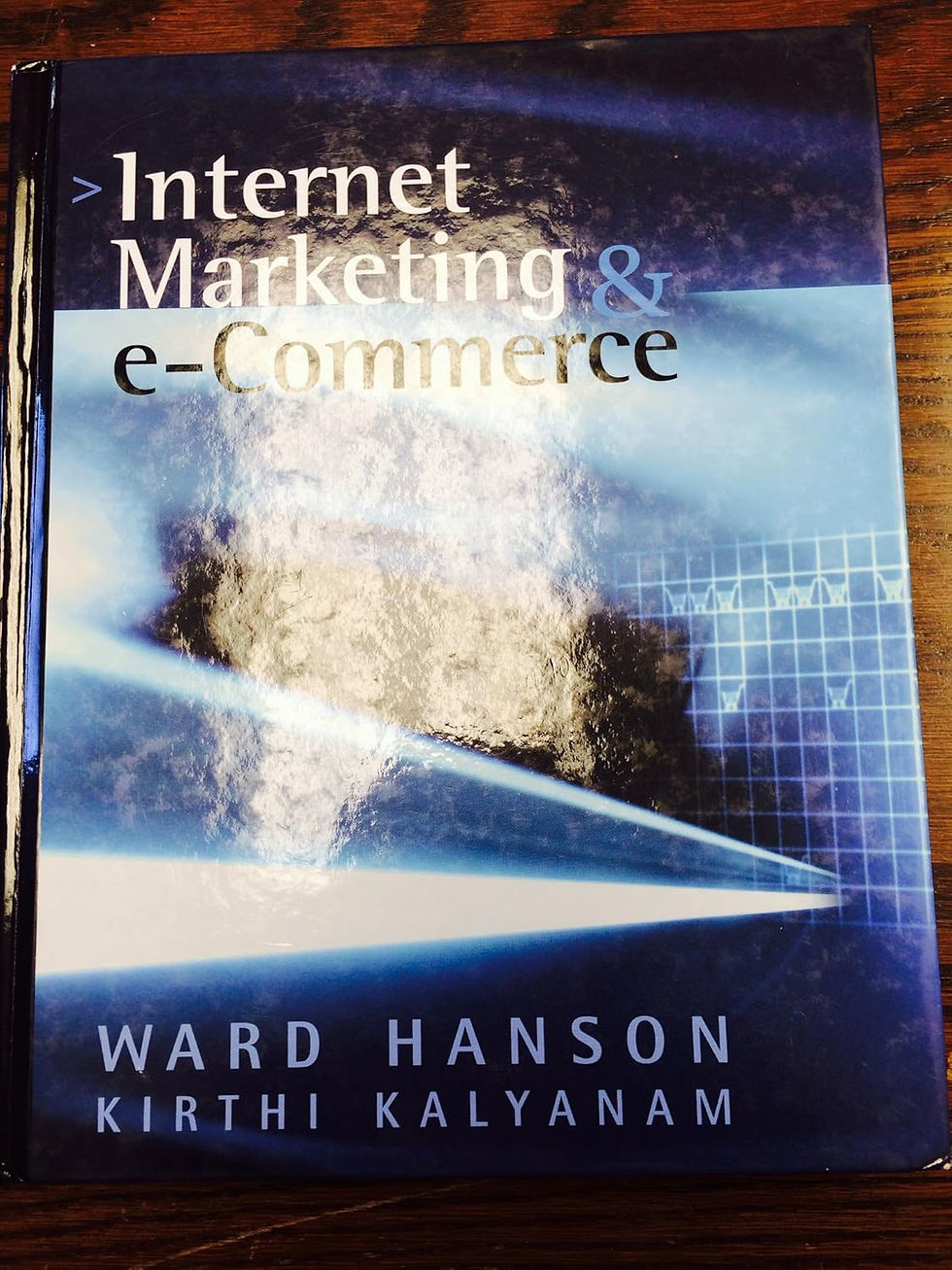
Internet Marketing & eCommerce
Authors: Ward Hanson and Kirthi Kalyanam
Short review
Internet Marketing & eCommerce provides a thorough introduction to how the internet has changed marketing, commerce, and business development. The book combines theory and practical examples in digital marketing, e-commerce, customer behavior, value creation, and digital business models. Although written at a time when the internet was still in its infancy, many of the fundamental principles are still highly relevant.
Why we recommend the book
This book was an important part of my own learning journey in digital marketing and e-commerce. It helped build my understanding of how technology, customer experiences and business strategy are interconnected – an insight that later became very important in my work with SAS, the Norwegian Opera & Ballet, Bærum Municipality and eventually the project The Invisible Capital. Many of the ideas about customer value, digitalization and innovation presented on the website have their roots in the knowledge this book conveys.

The Innovator's Dilemma: When New
Technologies Cause Great Firms to Fail
Author: Clayton M. Christensen
Short review
The Innovator's Dilemma is one of the most influential books on innovation and technological change. Clayton Christensen introduces the concept of "disruptive innovation" and shows how even the most successful businesses can fail when new technologies and business models change the market. Through a series of examples, he explains why established companies often have difficulty adapting to radical change - even when they do "everything right."
Why we recommend the book
This book has had a major impact on how I view innovation, digitalization, and change management. It provided a new perspective on why established businesses are challenged by new players, and why the ability to think differently is crucial in a world characterized by continuous technological development. Many of the reflections in The Invisible Capital on innovation, digital transformation, and value creation are based on the insights Clayton Christensen conveys in this classic.

© 2025 - 2026 Portico Publish | The invisible capital Privacy and use of the website | Developed and operated by Magne Bjella | Powered and secured by Wix


Comments