
Norway has never had more knowledge and value creation – how do we create more?

Statistics Norway's figures show that Norwegians have never had a higher level of education. Yet it is not the number of credits that determines whether we succeed as a society. What is crucial is how we convert knowledge into innovation, jobs and value creation .

Norway is a country rich in natural resources. We have hydropower, oil and gas, fisheries resources and large ocean areas.
But our most important resource is neither oil, minerals nor technology.
The most important resource is people.
For the first time in history, we have a population with a higher level of education than any generation before us. More and more people are completing higher education, and about four in ten adult Norwegians now have a university or college education. About one in ten has a master's degree or equivalent.
At the same time, over 300,000 people study at Norwegian universities and college campuses.
The numbers tell a story of a society that invests heavily in knowledge.
But they also raise an important question:
How do we turn knowledge into value creation?
Knowledge and value creation are Norway's most important natural resource
We often talk about the oil wealth, the Petroleum Fund and capital in the business sector.
Far less often do we talk about the most important capital of all:
the competence
the experience
creativity
curiosity
collaboration
trust between people
This is the invisible capital.
It is not in balance.
It cannot be measured in quarterly reports.
Yet it is this capital that determines whether technology is adopted, whether services are improved, and whether new ideas are turned into jobs.
Value is not created by technology alone.
Value is created when people use technology to solve problems.
From education to value creation
Norway has many of the prerequisites needed to succeed in the global knowledge economy.
We have:
high confidence
good public services
high digital maturity
high labor force participation
strong research environments
high level of education in the population
Yet many people experience that good ideas come to a standstill.
Too often we talk about innovation as something that happens in technology.
In reality, innovation happens in the encounter between people.
Between employees and managers.
Between researchers and business.
Between public and private sectors.
Between users and developers.
The challenge is therefore not necessarily to create more knowledge.
The challenge is to create better interaction.
What can Norway learn from Oxford?

Through seminars and studies in Oxford, I saw how knowledge can act as an engine for regional development.
The University of Oxford is not just a university.
It's an entire ecosystem.
The university collaborates closely with research communities, investors, entrepreneurs and established businesses.
Through commercialization of research, incubators and technology transfer, the university has helped to establish a large number of start-ups and spin-out companies.
Research parks, investment environments, and technology companies have emerged around the university, attracting talent from all over the world.
Oxford doesn't just educate students.
The city develops people, ideas and businesses.
Knowledge turns into action.
Action turns into innovation.
Innovation turns into value creation.
What can Norway learn from San Francisco and Silicon Valley?

The same pattern is found in the area around Stanford University and Silicon Valley.
Here we meet:
students
researchers
entrepreneurs
investors
business
public sector
Collaboration between academia, business, and government has been crucial to the development of Silicon Valley. Stanford played a central role as early as the 1950s through the establishment of research parks and a culture that encouraged students and researchers to start their own companies.
It is no coincidence that so many technology companies have emerged in this environment.
Innovation rarely happens alone.
It occurs in ecosystems.
Norway needs more bridges
We don't necessarily need more strategies.
We need more bridges.
Bridges between:
education and working life
research and business
public and private sector
technology and people
management and employees
We need to be better at asking the question:
How can we make it easier to translate knowledge into action?
Too many good ideas stall because organizations are built around silos, not collaboration.
Too many employees find that insights from users do not reach decision-makers.
Too many leaders are measured by short-term results rather than long-term learning.
Value creation is about people
The more technology we use, the more important people become.
Artificial intelligence can analyze data.
But people create trust.
Technology can streamline processes.
But people create meaning.
Digitalization is not primarily about technology.
It is about people learning, collaborating and developing new solutions.
That is why the most important capital remains invisible.
And that's why it's so valuable.
The question is not whether we have the knowledge
Norway has never had more students.
We have never had a higher level of education.
We have never had better access to technology.
The question is therefore not whether we have the knowledge.
The question is whether we can use it.
Because in the economy of the future, the most valuable resources will not be those that can be dug out of the ground.
They will be the ones who are developed in the encounter between people.
This is where future value creation happens.
That's where the invisible capital is found.
Further reading
Recommended books from our library

Short review
Don't Make Me Think is one of the world's most influential books on usability and web design. Since its first edition in 2000, the book has helped designers, developers, content producers, and managers understand a simple but powerful principle: Good digital services should be intuitive. The user should be able to complete their task without having to stop and think about how the website works.
Why we recommend the book
This is one of the books that has had the greatest impact on my own work with digital services. Over the years – from SAS and the Norwegian Opera & Ballet to working on Bærum Municipality’s website – the principles in this book have been an important reminder that technology is never an end in itself. The goal is to make everyday life easier for the people who use the services. Despite the fact that the book was published many years ago, the message is just as relevant today.
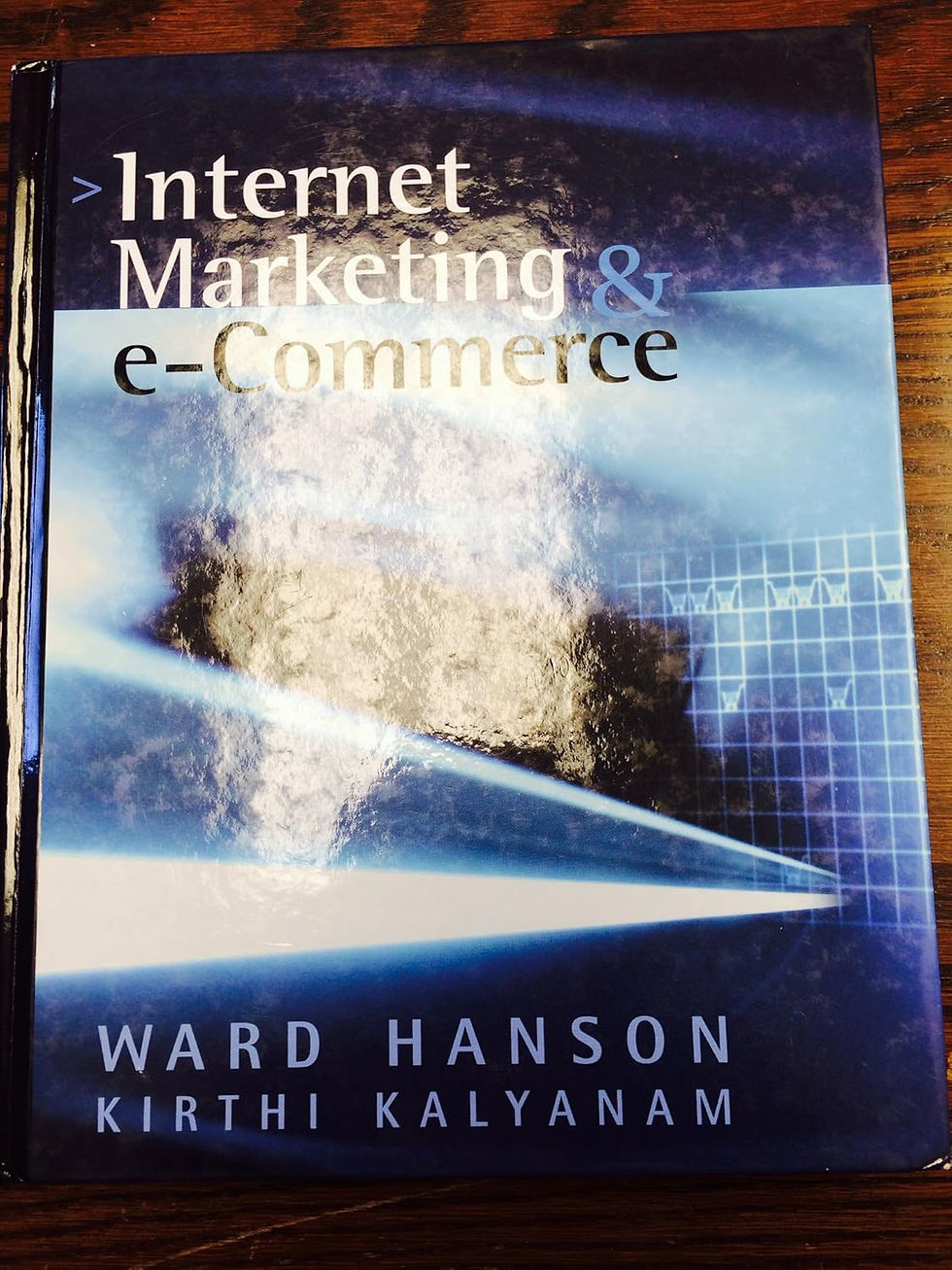
Authors: Ward Hanson and Kirthi Kalyanam
Short review
Internet Marketing & eCommerce provides a thorough introduction to how the internet has changed marketing, commerce, and business development. The book combines theory and practical examples in digital marketing, e-commerce, customer behavior, value creation, and digital business models. Although written at a time when the internet was still in its infancy, many of the fundamental principles are still highly relevant.
Why we recommend the book
This book was an important part of my own learning journey in digital marketing and e-commerce. It helped build my understanding of how technology, customer experiences and business strategy are interconnected – an insight that later became very important in my work with SAS, the Norwegian Opera & Ballet, Bærum Municipality and eventually the project The Invisible Capital. Many of the ideas about customer value, digitalization and innovation presented on the website have their roots in the knowledge this book conveys.

Authors: Clayton M. Christensen and Michael E. Raynor
Short review
In this sequel to The Innovator's Dilemma, Clayton Christensen shows how businesses can translate innovation theory into practical strategy. The book explains how companies can identify new growth opportunities, develop disruptive innovations, and build organizations that thrive in rapidly changing markets.
Why we recommend the book
While The Innovator's Dilemma explains why established businesses are often challenged, The Innovator's Solution provides concrete advice on how to meet the challenges. The book is therefore a natural next step for anyone who wants to understand innovation, strategy and long-term value creation.

Authors: Jeff Dyer, Hal Gregersen and Clayton M. Christensen
Short review
What characterizes people who create groundbreaking innovations? The authors identify five key skills – observation, questioning, experimentation, networking and association – that are common to the world's most innovative leaders and entrepreneurs.
Why we recommend the book
This book shifts the focus from organizations to the people behind innovation. It shows that creativity and innovation can be developed through deliberate training and experience. The perspectives align well with the philosophy behind Invisible Capital, where human competence and curiosity are the most important drivers of development.

Authors: Clayton M. Christensen, Taddy Hall, Karen Dillon and David S. Duncan
Short review
In this book, Clayton Christensen further develops the theory of Jobs to Be Done – the idea that customers do not primarily buy products, but "hire" them to solve specific needs. Through practical examples, the authors show how businesses can develop products and services that address customers' real-world challenges.
Why we recommend the book
For anyone working in customer experience, service design, and innovation, this is one of the most insightful books ever written. It reminds us that value creation always starts with understanding the people we are developing solutions for – a fundamental principle of Invisible Capital.

Author: Clayton M. Christensen
Short review
The Innovator's Dilemma is considered one of the most influential books on innovation and technological change. Clayton M. Christensen introduces the theory of disruptive innovation and explains why even the most successful businesses can fail when new technologies and business models challenge established markets. Through a series of examples, he shows how companies often focus on today's customers and incremental improvements, while overlooking innovations that later change entire industries.
Why we recommend the book
This is one of the books that has had the greatest impact on modern innovation thinking. When I first read it, it gave me a whole new perspective on why some businesses succeed in transformation, while others lag behind – even when they are well led. The insight has been an important part of my own understanding of digitalization, innovation and change management, and many of the reflections in The Invisible Capital build on the ideas Clayton Christensen presents in this classic. The book is as relevant today, in the face of artificial intelligence and digital transformation, as it was when it was published.

Author: Henry Chesbrough
Short review
Henry Chesbrough introduced the concept of Open Innovation and changed the way many businesses think about research and development. He shows how companies can create more innovation through collaboration with customers, universities, start-ups, suppliers and other external partners.
Why we recommend the book
Open Innovation has had a major influence on modern innovation thinking and was also an important topic during the seminars in Oxford and San Francisco. The book shows why future value creation occurs in the interaction between people, businesses and knowledge environments – not within closed organizations alone.

Authors: W. Chan Kim and Renée Mauborgne
Short review
Blue Ocean Strategy challenges businesses to shift their focus away from fierce competition and instead create new markets with little or no competition. The authors present strategies and models that help organizations develop innovative products, services, and business models.
Why we recommend the book
This book has inspired leaders around the world to rethink strategy and innovation. Instead of competing for the same customers, it shows how businesses can create new value through creativity and differentiation. The perspectives align very well with the themes of innovation, digitalization, and long-term value creation in Invisible Capital.

Authors: Patricia B. Seybold
Short review
Patricia Seybold shows how businesses can create better products and services by actively involving customers in the innovation process. The book describes how dialogue, co-creation and close collaboration with users can provide better solutions and stronger competitiveness.
Why we recommend the book
Customers often hold the most important insights into how products and services can be improved. This book emphasizes the importance of listening, involving, and learning from users – a perspective that is echoed in many of the articles on The Invisible Capital. Innovation rarely happens alone; it is created in the interaction between people.

Authors: Philip Evans and Thomas S. Wurster
Short review
This book analyzes how digital information is changing competitive conditions, markets, and business strategies. The authors explain how the internet is disrupting established structures and creating new opportunities for businesses that are able to think differently.
Why we recommend the book
Although written early in the internet revolution, the book describes many of the developments that still characterize business today. It provides valuable perspective on how digitalization affects value chains, competition, and innovation – themes that are central to Invisible Capital.

Authors: Don Tapscott and Anthony D. Williams
Short review
Wikinomics shows how openness, sharing and collaboration across organizations create new forms of innovation and value creation. Through a number of international examples, the authors describe how digital networks make it possible to develop products, services and knowledge together.
Why we recommend the book
This book was groundbreaking when it was first published, and many of the ideas have since become a natural part of everyday digital life. The perspectives on collaboration, knowledge sharing, and open innovation processes align very well with the philosophy behind Invisible Capital, where people and networks are at the center of value creation.

© 2025 - 2026 Portico Publish | The invisible capital Privacy and use of the website | Developed and operated by Magne Bjella | Powered and secured by Wix


Comments