
The customer is no longer searching. The customer tells us what he wants.

For over thirty years, the digital customer journey has been built around search, menus and product catalogs. Now, a fundamental shift is taking place. A recent Reuters article describes how grocery chain Pick'n Pay has launched an AI assistant that lets customers tell you what they want, while artificial intelligence builds the shopping cart. It may be one of the clearest examples of how the future of e-commerce is moving from product search to needs-based advice – and why this will also be important for Norwegian small and medium-sized businesses.

"I'll have a conversation with you; it will be all on my terms. Your product is going to have to be visually beautiful, technically perfect, and distinctive. And it has to be available where I shop at a price I'm willing to pay."
"Now, if it is all of those things, you gain the permission, in the one minute the consumer deals with your brand, to devote about 10 seconds to the issue of values. And if you miss any step along the way, you are talking to yourself, which is a terribly sad place to be."
Jeff Swartz - President and Chief Executive Officer, Timberland - Fast Company , August 2008
For more than thirty years, we have built websites, online stores and digital services around one fundamental idea:
The customer is searching.
The customer then clicks through categories, filters the results, compares products, and adds them to the shopping cart. The entire digital customer journey has been built around this model.
But now something is about to change.
Not gradually.
Fundamentally.
The digital customer journey has taken a new direction
For many years, the customer journey has looked something like this:
Customer → Search → Filter → Compare → Shopping Cart → Payment
Now we see the beginning of a new model:
Customer → Tells what he wants → AI builds the shopping cart →
Customer approves → Payment
The difference may seem small.
In reality, it is enormous.
The customer is not necessarily looking for products anymore. The customer describes a need.
“The customer is no longer searching for products. The customer is describing a need.”

A real-life example
When I retired, I was going to invest in a new laptop that would be my work tool for many years to come.
The needs were quite specific.
I was going to be working with Photoshop and Lightroom. I wanted a powerful processor, plenty of memory, a good screen, a docking station, and a solution that would last for many years. At the same time, I had a specific budget.
Previously, this process would have involved many hours of searching.
I had to visit a number of online stores, read tests, compare specifications, and try to figure out which products matched.
This time I did something different.
I described my needs.
From there, the dialogue developed. We discussed different options, weighed the pros and cons, looked at the monitor, docking station, and accessories, before landing on a comprehensive solution that suited my needs exactly.
I didn't just buy a PC.
I got help making a decision.
It is precisely this change that we are now seeing in more and more industries.

From search engine to advisor
The first online stores were about making products available online.
Then came the search engines.
Then came filtering, product reviews, recommendations, and personalization.
Now we are moving towards something new.
Artificial intelligence becomes a digital advisor.
Instead of searching through hundreds of products, the customer can say:
"I need a gift for a ten-year-old boy who likes technology. The budget is 500 kroner."
or:
"I'm going to cook a vegetarian dinner for four people. One of the guests is gluten intolerant."
The customer does not need to know what products exist.
The customer describes the situation.
Artificial intelligence does the rest.
"The most important task will not be finding products. It will be understanding the customer."
What does this mean for small and medium-sized businesses?
Many businesses still associate artificial intelligence with text production, images or chatbots.
There are useful tools.
But the really big change is happening somewhere else.
It occurs in the meeting between the business and the customer.
When the customer tells you what he or she wants, the business must be able to provide good answers.
A short product description is no longer enough.
The business must have knowledge.
It must be able to explain.
Guide.
Compare.
Recommend.
The better the business knows its products, services and customers, the better artificial intelligence can help.
The invisible capital becomes visible
Throughout the digital evolution, one thing has remained constant.
Technology alone rarely creates lasting competitive advantages.
People do that.
Competence.
Experience.
Customer insights.
Trust.
Artificial intelligence does not change this.
It makes it more important than ever.
Businesses that invest in good technical articles, clear product descriptions, guides, frequently asked questions, videos, and other quality information also build a knowledge base that artificial intelligence can use.
This means that content is not just something customers read.
It will be the fuel that makes artificial intelligence smarter.
"The most important AI investment may not be a new technology. It is the knowledge on which the technology will be built."
The digital customer journey of the future
We are probably at the beginning of the biggest change in digital commerce since the first online stores were launched.
Not because artificial intelligence is taking over trading.
But because it makes it easier for people to make good choices.
The businesses that are most successful in the coming years will probably not be those with the most products or the most advanced technology.
They become the ones who know their customers best.
And who has built up the most important resource of all:
Knowledge.
It is precisely this knowledge – the invisible capital – that is now becoming increasingly visible as artificial intelligence becomes a natural part of the customer journey.
Do you want to understand the technology behind the development?
This article is about how artificial intelligence is changing e-commerce and customer experiences. If you want to understand how the technology actually works, you can read our series "AI-Kompis", where we explain artificial intelligence step by step - in a language that everyone can understand.
Recommended other articles


Recommended books from our library

Co-Intelligence: Living and Working with AI
Author: Ethan Mollick
Short review
One of the most recommended introductory books on artificial intelligence. Ethan Mollick explains in an easy-to-understand way how humans and AI can collaborate, what opportunities the technology offers, and why understanding artificial intelligence is becoming an important skill for everyone – not just technologists.
Why we recommend the book
This is one of the best books to start with if you want a practical and understandable introduction to artificial intelligence. It is a perfect fit as the first book in our blog series about AI.

The AI Advantage: How to Put the Artificial Intelligence Revolution to Work
Author: Thomas H. Davenport
Short review
A practical and insightful book that shows how artificial intelligence can be used to create value in businesses. Thomas H. Davenport combines research and concrete examples to explain how AI can improve decisions, streamline work processes, and contribute to innovation.
Why we recommend the book
This book is well suited for managers, employees, and decision-makers who want to understand how artificial intelligence can be used in practice. It bridges the gap between technology and value creation, and therefore fits well with the philosophy behind The Invisible Capital.

Artificial Intelligence: A Guide for Thinking Humans
Author: Melanie Mitchell
Short review
Melanie Mitchell provides a balanced and easy-to-understand introduction to what artificial intelligence is, how the technology works, and what limitations it still has. The book distinguishes between myth and reality and makes complex topics accessible to a wide audience.
Why we recommend the book
This book is perfect for those who want a deeper understanding of artificial intelligence without having to be a programmer or data scientist. It complements the other recommendations by placing today's AI developments in a larger academic and historical perspective - exactly the understanding we want to build through this blog series.

Generative Engine Optimization: The Definitive Guide to AI Visibility
Author: Dixon Jones
Short review
This book provides a practical introduction to optimizing websites for generative search engines and artificial intelligence. It explains how ChatGPT, Gemini, Claude, and other AI-based services find, understand, and use content—and what businesses can do to become more visible in the new search landscape.
Why we recommend the book
One of the first books to systematize artificial intelligence search. Perfect for anyone who wants to understand how traditional SEO is evolving into AI Search Optimization and Generative Engine Optimization.

GEO: Generative Engine Optimization – How to Rank in ChatGPT, Perplexity & AI
Author: Chris Carr
Short review
A practical guide that shows how businesses can adapt content and websites to be recommended by generative search engines. The book focuses on how visibility is changing as more and more users get answers directly from artificial intelligence.
Why we recommend the book
This book is well suited for marketers, content producers, and businesses who want to understand how they can work purposefully with visibility in ChatGPT, Perplexity, and other AI-based search services.

Optimizing for AI Search: Mastering AIO & GEO
Author: Amit Kothiyal
Short review
The book shows how traditional search engine optimization is evolving towards AI Search Optimization (AIO) and Generative Engine Optimization (GEO). Through practical advice, the author explains how structure, content, and semantics can make websites more relevant to the search engines and language models of the future.
Why we recommend the book
An exciting book for anyone who wants to stay ahead of the curve. It bridges the gap between classic SEO and the new reality where artificial intelligence is becoming an increasingly important source of information and recommendations.

Prediction Machines: The Simple Economics of Artificial Intelligence
Authors: Ajay Agrawal, Joshua Gans and Avi Goldfarb
Short review
This book shows how artificial intelligence is primarily about making better predictions. The authors explain how cheaper and more accurate predictions can change decisions, business models, and the way organizations create value.
Why we recommend the book
One of the most important books for understanding the economic significance of artificial intelligence. It helps the reader see why AI impacts far more than technology – it changes how people and businesses make decisions.

Competing in the Age of AI
Authors: Marco Iansiti and Karim R. Lakhani
Short review
The book explains how artificial intelligence is changing competition, organizations, and business models. Through practical examples, the authors show how data, digital platforms, and AI are creating new opportunities for businesses.
Why we recommend the book
This book is especially suitable for leaders and decision-makers who want to understand how AI will impact the businesses of the future. It shows that artificial intelligence is as much about strategy and organization as it is about technology.

The Alignment Problem: Machine Learning and Human Values
Author: Brian Christian
Short review
Brian Christian explores how artificial intelligence can be developed in line with human values. Combining technology, philosophy, and ethics, the book provides an engaging introduction to one of the most important questions in modern AI research.
Why we recommend the book
A thought-provoking book for anyone who wants to understand why responsible development of artificial intelligence is so important. It shows that the AI of the future is not just about what the technology can do, but also about what values it should be built on.

AI Engineering
Author: Chip Huyen
Short review
AI Engineering is one of the most relevant books on how artificial intelligence is developed and put into practice. Chip Huyen explains how language models, data, machine learning, and modern work processes can be combined to build robust AI solutions. The book provides both a strategic and practical perspective on how businesses can create value with artificial intelligence.
Why we recommend the book
This is a book for those who want to move from understanding artificial intelligence to understanding how it is actually developed, implemented, and creates value. One of the strongest books we have found on the practical use of artificial intelligence.
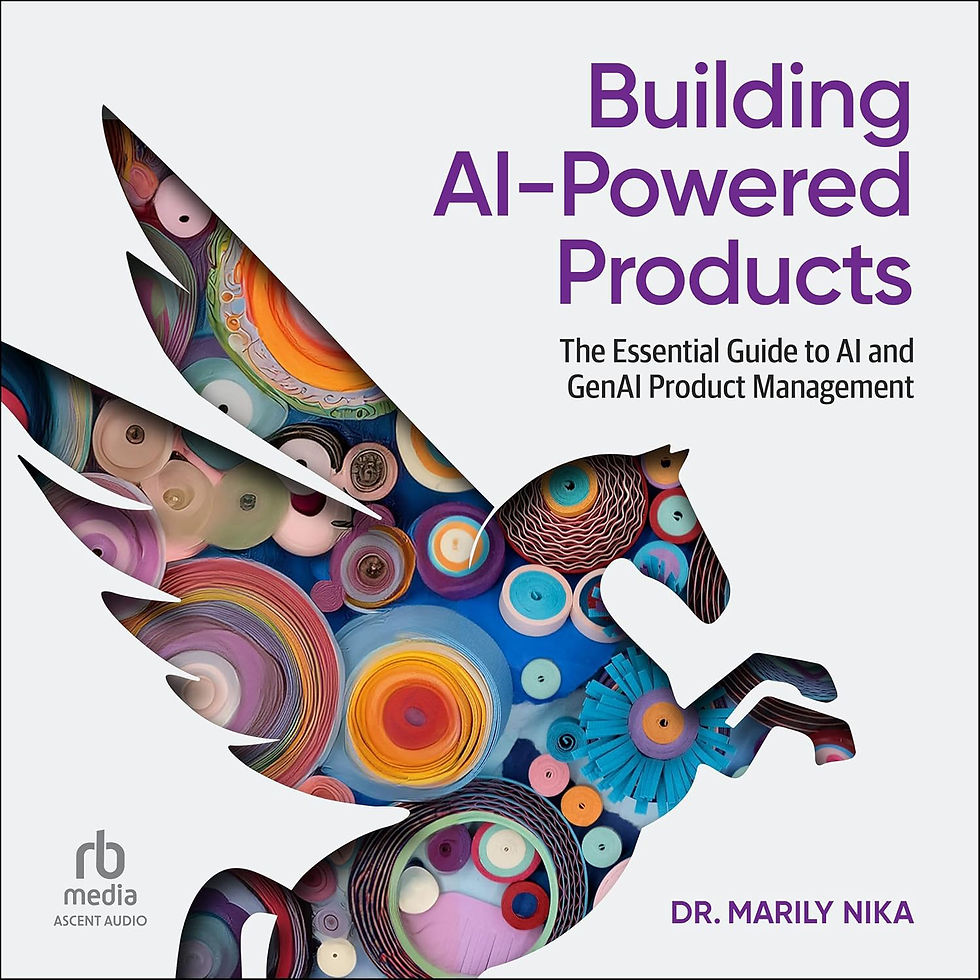
Building AI Powered Products
Author: Marily Nika
Short review
Building AI Powered Products shows how artificial intelligence can be used to develop smarter products, services, and digital customer experiences. Marily Nika combines technology, product development, and innovation in an easy-to-read book full of practical, real-world examples.
Why we recommend the book
A book that is perfect for anyone working with digitalization, innovation, product development and user experiences. It shows how artificial intelligence can be used to create products people actually want to use.

Prompt Engineering for Generative AI
Writers: James Phoenix and Mike Taylor
Short review
Prompt Engineering for Generative AI is a practical guide that teaches you how to communicate better with language models like ChatGPT, Claude, Gemini, and other generative AI tools. Through concrete examples, the authors show how good prompts produce more precise, creative, and useful responses.
Why we recommend the book
One of the most practical books on prompt engineering. Perfect for anyone who wants to work more effectively with artificial intelligence and get significantly better results through smarter questions and clearer instructions.

© 2025 - 2026 Portico Publish | The invisible capital Privacy and use of the website | Developed and operated by Magne Bjella | Powered and secured by Wix


Comments