
Value creation begins with security

What do health centers mean for children, parents and society? In Norway, most families visit the health center before or shortly after birth. Here, pregnant women, new parents and children from 0 to 5 years old receive support, vaccinations, guidance and safe follow-up from midwives, public health nurses, doctors and other professionals. This article is about why health centers are one of Norway's most important investments in children, families, public health and human capital.

Health centers in Norway – where life begins
There are moments that change a person's life forever.
A small line on a pregnancy test.
A beating heart on an ultrasound screen.
Two people looking at each other with a smile they will never forget.
From that moment on, everything changes.
Dreams become plans. Joy mixes with anticipation. At the same time, questions arise that no education can fully prepare us for.
Is the child healthy?
How will the birth be?
How do we become good parents?
What do we do when we come home with a little person who is completely dependent on us?
No one is born as a parent.
There is no answer.
There is no manual that can answer all the questions.
Therefore, it is perhaps not so strange that some of the most important things a society can offer are not a building or technology, but people with knowledge, experience and care.
People who meet us with confidence when life is at its most vulnerable.
This is where the story of the health centers begins.
Not as a public service.
Not as an organization.
Not as an item in a state budget.
But as a meeting between people.
A meeting between expectant parents and midwives.
Between new parents and health nurses.
Between professionals and families who need advice, support and guidance through one of the most important phases of life.
In Norway, this is a given.
Most of us barely think about it.
We almost take it for granted that someone follows us through pregnancy, helps us when the child is born, answers our questions, monitors the child's development, offers vaccinations, detects challenges early, and supports us when everyday life becomes more demanding than we had imagined.
But it is far from a given.
Behind every meeting are people with high competence, extensive experience and a strong desire to give children the best possible start in life.
They don't just measure height and weight.
They see the whole child.
They see their parents.
They see the family.
They often discover what no one else has seen.
They catch developmental challenges, language delays, psychological distress, nutritional challenges, and illness at a time when early help can make a huge difference.
Equally important are all the things that never become statistics.
The conversation that gives an insecure mother new security.
The advice that helps a father find his role.
The smile that makes a family feel seen.
Prevention that ensures that problems never develop.
These are values that can rarely be measured in dollars and cents.
Yet they are among the most valuable investments a society can make.

For every child who gets a safe start, we also lay the foundation for better health, better learning, stronger mental health, greater coping skills and a better quality of life throughout life.
That is why the health centers are far more than a municipal health service.
They are an investment in people.
An investment in families.
An investment in the future of society.
In this article, we will take a closer look at why Norway has health centers, who the people behind the service are, what research tells us about the importance of the first years of life, and why health centers represent some of the most important – but often most invisible – capital we have.
Because the most important value creation does not begin when we start school.
It doesn't start when we enter the workforce.
It starts long before.
It begins with a new life.
And with the people who are there to give that life the safest start possible.
Why does Norway have health centers?
Health centers are one of those services that most of us encounter, but that few people think much about. They have become a natural part of having children in Norway – so natural that we almost take them for granted.
It hasn't always been this way.
A little over a hundred years ago, the reality was completely different.
Child mortality was higher, infectious diseases claimed many young lives, and many parents were left alone with questions they had no one to ask. Knowledge about nutrition, hygiene, and child development was limited, and help was often haphazard and uneven from place to place.
Gradually, a realization emerged that would have enormous significance for Norway.
If we were to build a society with good public health, we would have to start at the very beginning of life.
Prevention had to come before treatment.
Security had to come before problems could grow bigger.
Knowledge had to be shared with everyone – not just a few.
This is how health centers gradually emerged as one of the pillars of the Norwegian welfare model.
The goal was never just to treat illness.
The goal was to help prevent disease from occurring.
The goal was to support parents, monitor their children's development and detect challenges as early as possible. Through guidance, vaccinations, health examinations and close follow-up, the health centers have become an important part of the children's first years of life - and of the parents' first years as mom and dad.
What makes the Norwegian model special is that the offer is universal. All families should be able to receive the same follow-up, regardless of where they live, what education they have or what kind of economy they live on. Whether the child grows up in a small mountain village, on an island along the coast or in the middle of a big city, the goal is the same: to give all children a safe and good start in life.
This is not just good health policy.
It is good social policy.
Because when we invest in the first years of life, we are also investing in future health, learning, quality of life and participation in society.
That is why health centers are so much more than a health service.
They are an investment in people.
And perhaps that is precisely why they fit so well into the story of Invisible Capital. Because the most important capital a society can build is not buildings or budgets. The most important capital is people who are given the opportunity to grow up with security, care and support – from the very first days of life.
The people who meet us when life begins
It's easy to think of a health center as a place.
A building.
A waiting room.
A room where children are weighed and measured.
But it's not the building that makes the health center important.
It's the people.
Behind every door we meet professionals who have chosen a profession where the most important task is not to fix what has already gone wrong, but to help children and families get a safe start in life.
For many, the journey begins even before the child is born.
The midwife follows the pregnant woman throughout her pregnancy. She answers questions, monitors the baby's development, provides advice on diet, health and childbirth, and helps create security during a period that can be filled with both joy and uncertainty.
When the child is born, the health nurse takes on a central role.
Through home visits, health checks and regular meetings, the health nurse follows the child through the first years of life. The child's growth and development are closely monitored, but equally important are the conversations with the parents. How is everything going at home? How is breastfeeding or feeding working? Is the child sleeping well? How is the mother doing? How is the father doing?
Often it is precisely these conversations that make the biggest difference.
Sometimes they are about very simple questions.
Other times they become crucial because they uncover challenges at a time when help can be provided early.
At many health centers, families also meet doctors, physiotherapists and other professionals with varying expertise.
Together they form an interdisciplinary environment where the goal is always the same: to give the child the best conditions to grow up with good health, security and self-mastery.
It is easy to notice the vaccinations, health examinations, and regular check-ups.
What's harder to see is everything that happens between them.
The conversation that gives an insecure first-time mother new confidence.
Advice that helps a father understand his child's signals.
The encouragement that makes parents dare to trust their own choices.
The extra time spent when some people need it a little more than others.
The early observation that allows a child to receive help long before the challenges become significant.
All of this is work that rarely makes headlines.
It is not recorded in the national accounts.
It can be difficult to measure in dollars and cents.
Still, the value is enormous.
Because when professionals at health centers succeed, the results are about far more than good health figures.
They contribute to safer parents.
Children who are developing well.
Early detection of challenges.
Better public health.
Stronger local communities.
And perhaps most importantly of all – they help children grow up with a sense of security and care during one of the most crucial periods of their lives.
This is precisely what makes the people at the health centers value-creating people.
They create values that are often invisible in the moment, but which can have significance throughout a lifetime.
And perhaps that is precisely why they deserve far more attention than they usually receive.
Because when we talk about investments in the future, they often begin here – in the meeting between a small child, a family, and a person who has chosen to use their knowledge to give others the safest start in life.

The first years of life shape the rest of life
The first years of life are among the most crucial periods in a person's life.
These are the years when the brain develops faster than at any other time. Children learn to bond with other people, develop language, motor and social skills, and lay the foundation for learning, coping and good mental and physical health later in life.
Therefore, the first years are far more than a transition between birth and starting school.
They are the very foundation on which the rest of life is built.
Over several decades, both Norwegian and international research communities have documented the great importance of early intervention. Secure relationships, good health, proper nutrition, stimulation and support for parents not only contribute to the child's development here and now – they can influence health, education, working life and quality of life many decades later.
That doesn't mean that a child's future is decided in the first few years.
People develop throughout their lives.
But the research is clear on one thing:
A safe start provides a stronger starting point.
That is why the work of health centers is so important.
They don't just track children's height and weight.
They follow the development.
They follow the interaction between children and parents.
They help ensure that questions are answered before uncertainty grows.
They discover challenges while it is still possible to make a difference.
They support families through periods that can be both wonderful and demanding.
This is prevention in the best sense of the word.
Not because you expect something to go wrong.
But because we know that good support early on can yield big gains later.
Research shows that investing in children's early development is among the most effective investments a society can make. When children grow up with security, care and good development opportunities, they are more likely to have good health, better learning, higher participation in the workforce and a richer social life.
At the same time, early follow-up can help reduce the need for more extensive help later. Challenges that are detected early can often be addressed before they develop into larger problems.
That is why health centers are not just a health service.
They are an investment in the future of society.
Every conversation.
Every health checkup.
Every home visit.
Every vaccine.
Every piece of advice.
Everything is a small building block in a much bigger picture.
An image that is about giving all children – regardless of where they are born and what their family circumstances are – the opportunity to grow up with security, care and equal opportunities.
It is this idea that underlies the Norwegian health center model.
Not to treat as many diseases as possible.
But to help more children get a good start in life.
And perhaps it is precisely here that we find one of the most important forms of value creation in society.
Because when we invest in children's first year of life, we are also investing in the people of the future.
And is there really any more important investment than that?

Health centers in numbers – when the people behind the service meet hundreds of thousands of children
There we will use Statistics Norway statistics in a way that tells a story, not just presents numbers. We will show how many children are actually followed up each year, and how enormously important the health centers are for Norwegian families. This will be the transition from research to documented facts – exactly how we want to build the entire Invisible Capital.
Health centers in numbers – when the people behind the service meet hundreds of thousands of children
Numbers can never tell the whole story about a child.
They can't describe the feeling of becoming a parent for the first time.
They can't measure the security a family feels when someone takes the time to listen.
They cannot show the importance of advice that comes just when it is needed most.
Nevertheless, numbers can help us understand the extent of the work that is carried out every day at the country's health centers.
Every year, around 55,000 children are born in Norway.
For each of these births, a new story begins.
A new family.
A new life.
But the health centers' task does not stop after the first check.
On the contrary.
Throughout the child's first year of life – and on until the start of school – the health centers follow the development of several hundred thousand children across the country.
Behind every year group, there are children learning to crawl, walk, talk and explore the world.
Parents who experience both joy and uncertainty.
Grandparents who become part of the child's upbringing.
Siblings who are given a new role in the family.
And professionals who follow developments with knowledge, experience and care.
When we look at the statistics, the scale becomes clear.
Not just one cohort.
But six cohorts.
Children who are newborns.
Children turning one year old.
Two years.
Three years.
Four years.
And five years.
Together, these children represent a significant portion of Norway's youngest population.
It also means that every year the health centers meet hundreds of thousands of children and an even larger number of parents and guardians.
Every consultation is more than an appointment on the calendar.
It is an investment in a person.
An opportunity to discover something early.
An opportunity to give advice.
A conversation that can create security.
A meeting that can have significance far beyond the minutes the family spends together
spend at the health center.
Therefore, we should not view the statistics as anonymous numbers.
Behind every number there is a child.
A name.
A family.
A story.
And a person who has chosen to use his knowledge to help others.
In the fact box below we have collected some of the most important key figures about children and the target group of health centres in Norway. The figures are updated annually with statistics from Statistics Norway and other public sources, so that this page is always based on the latest available facts.
Key figures about children and the health centers' target group in Norway
The health centers do not just follow up on this year's newborns. They follow children throughout the entire period from birth to the start of school. Therefore, it is important to look at both the number of births and how many children actually belong to the age group 0–5 years.

Births
Children born in 2025: 55,401
Children born so far in 2026: Updated when Statistics Norway publishes preliminary annual figures.
Children aged 0–5 years (January 1, 2026)
Age | Number of children |
0 years | 55,578 |
1 year | 54,634 |
2 years | 53,386 |
3 years | 53,700 |
4 years | 58,702 |
5 years | 56,053 |
Total 0 5 years | 331,053 |
The figures are based on Statistics Norway's population statistics as of 1 January 2026. The total of approximately 331,000 children also corresponds well with Statistics Norway's family and household statistics for children aged 0–5 years.
What do these numbers tell us?
When we talk about health centers, it's easy to think of newborn babies.
But the reality is far greater.
Every year, around 55,000 new children are born in Norway. At the same time, the health centers follow the development of around 331,000 children between the ages of 0 and 5 – and are in contact with an even larger number of parents, guardians and families.
Behind these numbers are not just statistics.
People are hiding.
A child taking his first steps.
A mother who needs advice about breastfeeding.
A father who wonders if his child's development is normal.
A family that needs someone to talk to.
And professionals who meet them every day with knowledge, experience and confidence.
That is why health centers are so much more than a public service.
They are one of Norway's most important investments in children, families and future public health.
What do these numbers represent?
These numbers are not just about statistics.
They are about hundreds of thousands of children.
About parents who are finding security in a new role.
About grandparents, siblings and families.
And about midwives, nurses, doctors, physiotherapists and other professionals who use their knowledge every day to give children
the best possible start in life.
Behind every number there is a person.
And behind every person there is a story.
It is this story that the health centers are a part of.
An investment that cannot be measured in kroner alone
We humans have an easy time measuring what can be counted.
We count budgets.
We count buildings.
We count consultations.
We count vaccines.
We count births.
All of this is important.
But some of the most important work carried out at the country's health centers cannot be measured in statistics alone.
How do we measure the security a first-time mother feels when she goes home with answers to her questions?
How do we measure the relief of a father who discovers that the worry he has been carrying can be shared with someone who both listens and has the knowledge to help?
How do we measure the value of a child getting help early enough so that small challenges never develop into big problems?
Or the value of a family receiving support before uncertainty turns into despair?
These are values that rarely make headlines.
They can be difficult to enter into an accounting.
Yet they are among the most important values a society can create.
Every day, health centers invest in people.
Not through big words or spectacular measures.
But through knowledge.
Through time.
Through care.
Through trust.
Through small meetings that can mean everything to the individual family.
And perhaps this is precisely what characterizes invisible capital.
It is not built in one big decision.
It is built through thousands of small actions.
A piece of advice.
A smile.
A conversation.
A hand to hold.
A professional who sees a child – and the parents – exactly when they need it most.
When we later see children who thrive in kindergarten, learn at school, complete their education, participate in the workforce, and contribute to society, it is easy to forget that the journey began long before.
It started with people who invested time, knowledge and care in the very first years of life.
That is why health centers are far more than a public service.
They are an investment in the people of the future.
And perhaps that is precisely why they deserve a much greater place in the story of how Norway creates value.
Because the most important value creation does not begin with financial investments.
It begins with investments in people.
The social mission of health centers
Approximately 55,000 new children are born each year.
Approximately 331,000 children between the ages of 0 and 5 are included in the health centers' target group.
This means that the service affects hundreds of thousands of parents and guardians every year.
Through prevention, guidance and early follow-up, the health centers contribute to better health, safer families and a good start in life.
It is precisely facts like these that make the reader truly understand how big and important this service is. This is not a small municipal service – it is one of the most extensive preventive investments we make in Norway.

What does the research say?
The fact that health centers play an important role in children's upbringing is not just a good idea. It is well-established in national guidelines, public reports, and international research.
The Norwegian Directorate of Health's national professional guidelines for health centres and school health services describe the health centre for children aged 0–5 as a central part of health promotion and prevention work for children and families. Through the health centre programme, parents will receive systematic guidance on topics such as breastfeeding, diet, interaction, accidents and injuries. The aim is to strengthen children's health, prevent and identify abnormal development, and provide an opportunity to detect children who are exposed to violence, abuse or neglect.
The Norwegian Institute of Public Health has also highlighted the importance of early intervention. In connection with its report on the mental health of children and adolescents, the Norwegian Institute of Public Health points out that the health centre and school health service can help prevent mental ill health through early follow-up, low threshold and contact with children and families.
An older, but still relevant, public report describes the health centre and school health service as one of the cornerstones of health promotion and prevention work for children and young people. The report points out that close contact with children and families gives the service a good starting point for meeting needs early.
Internationally, the WHO, UNICEF and the World Bank point out in the Nurturing Care Framework that young children need good health, nutrition, safe care, early learning opportunities and protection. The framework describes how services and policies can support parents, families and communities in providing children with good development opportunities.
This gives us a clear professional basis:
Health centers are not just a place for check-ups and vaccinations. They are a preventive service that closely follows children and parents in the first years of life – precisely during the period when safety, support and early intervention can be important for the rest of their lives.
An investment in the people of the future
Some investments can be measured in kroner.
Others can be measured in the number of buildings, roads or machines.
But some of the most important investments a society makes cannot be weighed or counted in the same way.
They happen in the encounter between people.
Every day, midwives, nurses, doctors, physiotherapists and other professionals meet expectant parents, newborns and families with young children all over Norway. Through knowledge, experience and care, they help create security during a period of life that matters more than perhaps any other.
They prevent disease.
They detect challenges early.
They strengthen the parenting role.
They build trust.
They lay the foundation for good health and development.
Much of this work is never mentioned in the newspapers.
It rarely makes headlines.
Yet it is difficult to imagine a more important investment than that made in a child's first year of life.
When we discuss value creation, the conversation often revolves around business, technology, productivity, and economic growth. All of these are important.
But all value creation begins with people.
And people don't get off to a good start on their own.
They need adults who watch them.
Parents who receive support.
And professionals who use their knowledge to create safety, health and development.
This is exactly what the health centers do.
They don't just invest in the child sitting on the examination bench.
They are investing in a person who will one day start kindergarten, go to school, participate in the workforce, and help shape society.
Therefore, the health centers are far more than a municipal health and care service.
They are one of the most important investments we make in human capital.
They remind us that the most valuable capital a society has is not found in the accounts.
It exists in humans.
And perhaps that is precisely why the story of the health centers is also the story of Invisible Capital.
Norwegian authorities and research communities
Directorate of Health
National professional guideline for health center and school health services
The most important Norwegian guideline for the work of health centers. Describes the health center's tasks, recommended consultations, parental guidance, vaccination, early detection of developmental challenges and interdisciplinary collaboration.
National Institute of Public Health (NIPH)
Research on child health, mental health, early intervention, parental support and public health.
Statistics Norway (SSB)
The basis for statistics on:
births
children 0–5 years
population development
families
Ministry of Health and Care Services
Legislation, reports to the Storting and national strategies for pregnancy, childbirth and maternity care as well as health centre and school health services.
KS
Reports on municipal health and care services, early intervention and preventive work.
International research
World Health Organization (WHO)
Nurturing Care Framework
One of the most important international frameworks for early childhood development, WHO shows how good health, nutrition, safe care, early learning and protection form the foundation for children's development from pregnancy and the first years of life.
UNICEF
Early Childhood Development – Vision for Every Child
UNICEF describes why investments in the first years of life are crucial for children's health, learning, security and life chances, and why support for parents is key to good development.
Harvard University
Center on the Developing Child
One of the world's leading research groups on early childhood development. The research shows how the brain develops most rapidly in the first years of life, and why safe relationships, care and stimulating environments lay the foundation for learning, mental health and lifelong development.
James J. Heckman
Nobel Prize winner in economics
Heckman's research shows that investing in children's early development yields some of the highest socio-economic returns we know of. Early intervention leads to better health, higher education, stronger connections to the workforce, and less need for costly interventions later in life.
Recommended link:
For a professional blog about health centers, I would also use these specific resources:
Why Early Investment Matters – explains why the first years of life are the most important.
The Heckman Curve – illustrates that the return on investments is greatest the earlier in life they occur.
Research Summary – The Lifecycle Benefits of an Influential Early Childhood Program – summarizes the research showing that high-quality programs from birth to five years can provide significant socio-economic returns
OECD
Starting Strong
The OECD's Starting Strong report series is among the world's most important sources of evidence on early childhood. The reports show how quality in the first years of life affects children's learning, development, health and future participation in society, and point to the importance of competent professionals and early intervention.
The Lancet
Early Childhood Development Series
One of the most cited research series internationally on early childhood. The series documents how the first years of life affect health, learning and social participation throughout the life course, and forms an important scientific basis for WHO and UNICEF recommendations.
This is why we have chosen these sources
This article is based on research from Norwegian authorities and some of the world's leading research and knowledge communities in child development, public health and early intervention. They all have one clear conclusion in common: the first years of life have a major impact on health, learning, quality of life and social participation later in life.
It is this knowledge that forms the basis for the work of health centers in Norway – and which makes the service one of the most important investments we make in children, families and society's human capital.
Where life begins – and the future is shaped
Health centers are one of the services that most of us encounter, but that few people talk about.
They are there when a new life is on the way.
They are there when parents need advice, support and reassurance.
They follow children through the first years of life – a period that research from, among others, the Norwegian Directorate of Health, the Norwegian Institute of Public Health, WHO, UNICEF, OECD, Harvard University and Nobel Prize winner James J. Heckman shows is crucial for health, learning and quality of life later in life.
Nevertheless, the work of health centers is about more than research and statistics.
It's about people.
About the midwives who follow the pregnant woman throughout her pregnancy.
About the health nurses who meet families with knowledge and care.
About the doctors, physiotherapists and other professionals who work together to give every child the best possible start in life.
Every day they invest in something that cannot be entered into an accounting.
Security.
Trust.
Mastery.
Health.
Life opportunities.
These are values that may be invisible in the moment, but which can follow a person throughout their entire life.
Therefore, the health centers are far more than a municipal health and care service.
They are one of Norway's most important investments in human capital.
And perhaps that is precisely why they fit so well into the story of Invisible Capital.
Because the most important capital a society has is not buildings, technology or financial values.
The most important capital is people.
And it starts growing even before a child is born.
Next article in the series
This article has been about why health centers exist, who the people behind the service are, and what research tells us about the importance of the first years of life.
In the next article we will take a closer look.
We present a comprehensive overview of the health centers in Norway, county by county and municipality by municipality. At the same time, we take a closer look at the scope of the service, the number of children followed up, the development of birth rates, the organization of the health centers and the important efforts carried out by thousands of professionals across the country.
Because behind every health center there are people who – every single day – help give children the safest start in life.
And perhaps there is no more important form of value creation than that.
Do you want to see all the health centers in Norway?
This article has shown why health centers are one of Norway's most important investments in children, families and human capital.
But where are all the health centers located?
We have created a complete overview of the health centers in Norway – county by county and municipality by municipality.
The knowledge behind The Invisible Capital
Invisible Capital is not built on one book or one idea. It has been developed through many years of study, research, international seminars, and practical experience from working life.
The books below represent some of the most important professional sources of inspiration behind the project. They have shaped the way I think about leadership, innovation, digitalization, customer experiences, value creation and – not least – the importance of the people who create the values.
Each book has contributed new perspectives. Together, they have helped develop the knowledge base for The Invisible Capital and the book project Value-Creating People.
I hope they can give you the same professional inspiration that they have given me.
Recommended books from our library

Content Strategy for the Web (2nd Edition)
Author/authors: Kristina Halvorson and Melissa Rach
Short review
How do you create content that actually helps people – and at the same time supports your business goals? Content Strategy for the Web is considered one of the most influential books in the field of content strategy and digital communications. The book shows how good content does not arise by chance, but through a deliberate strategy where user needs, the organization's goals, structure, work processes and management are closely linked.
The authors take the reader through the entire process – from planning and organizing to publishing, managing and continuously improving content on websites and digital services. Although technology has evolved since the book was published, the principles of quality, relevance, management and long-term content work are at least as relevant in an era where search engines and artificial intelligence assess the credibility and usefulness of content.
Why we recommend the book
At The Invisible Capital, we believe that good content is one of the most important forms of invisible value creation. A website is far more than design and technology – it is the content that builds trust, creates great customer experiences and helps people find the answers they are looking for.
This book is perfect for leaders, communications consultants, content producers, web editors, UX designers, and anyone working with digital services. It shows why a clear content strategy leads to better user experiences, more effective interactions, and stronger digital results over time.
In an era where artificial intelligence is increasingly important in how information is discovered, understood, and communicated, this book is more relevant than ever. It reminds us that technology alone never creates value – it is good, structured, and relevant content that makes the difference.

Don't Make Me ThinkAuthor: Steve Krug
Short review
Don't Make Me Think is one of the world's most influential books on usability and web design. Since its first edition in 2000, the book has helped designers, developers, content producers, and managers understand a simple but powerful principle: Good digital services should be intuitive. The user should be able to complete their task without having to stop and think about how the website works.
Why we recommend the book
This is one of the books that has had the greatest impact on my own work with digital services. Over the years – from SAS and the Norwegian Opera & Ballet to working on Bærum Municipality’s website – the principles in this book have been an important reminder that technology is never an end in itself. The goal is to make everyday life easier for the people who use the services. Despite the fact that the book was published many years ago, the message is just as relevant today.
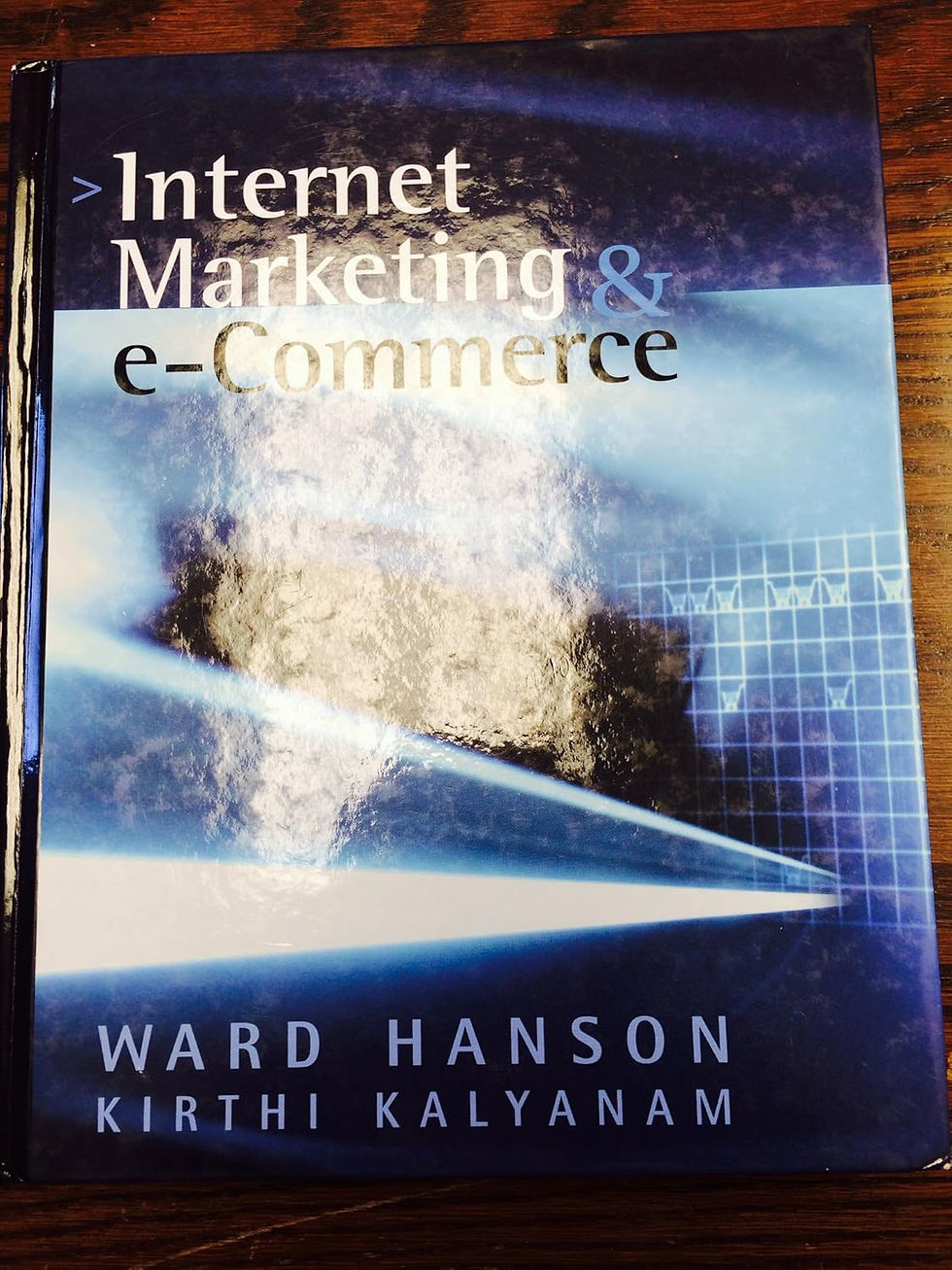
Internet Marketing & eCommerce
Authors: Ward Hanson and Kirthi Kalyanam
Short review
Internet Marketing & eCommerce provides a thorough introduction to how the internet has changed marketing, commerce, and business development. The book combines theory and practical examples in digital marketing, e-commerce, customer behavior, value creation, and digital business models. Although written at a time when the internet was still in its infancy, many of the fundamental principles are still highly relevant.
Why we recommend the book
This book was an important part of my own learning journey in digital marketing and e-commerce. It helped build my understanding of how technology, customer experiences and business strategy are interconnected – an insight that later became very important in my work with SAS, the Norwegian Opera & Ballet, Bærum Municipality and eventually the project The Invisible Capital. Many of the ideas about customer value, digitalization and innovation presented on the website have their roots in the knowledge this book conveys.

The Innovator's Dilemma: When New
Technologies Cause Great Firms to Fail
Author: Clayton M. Christensen
Short review
The Innovator's Dilemma is one of the most influential books on innovation and technological change. Clayton Christensen introduces the concept of "disruptive innovation" and shows how even the most successful businesses can fail when new technologies and business models change the market. Through a series of examples, he explains why established companies often have difficulty adapting to radical change - even when they do "everything right."
Why we recommend the book
This book has had a major impact on how I view innovation, digitalization, and change management. It provided a new perspective on why established businesses are challenged by new players, and why the ability to think differently is crucial in a world characterized by continuous technological development. Many of the reflections in The Invisible Capital on innovation, digital transformation, and value creation are based on the insights Clayton Christensen conveys in this classic.

© 2025 - 2026 Portico Publish | The invisible capital Privacy and use of the website | Developed and operated by Magne Bjella | Powered and secured by Wix


Comments