
eMarketing eMarketing Studies BI
Module I - Fall 2000
The Fundamentals of Digital Marketing - eMarketing Strategies

Introduction – When digitalization became structure, not hype
In the fall of 2000, we were in the midst of the dot.com era. The Internet had become a commercial promise. Investors were chasing growth. New companies were being established almost overnight. Many believed that old business models were irrelevant in the new digital economy.
But the teaching of eMarketing was not characterized by euphoria. It was analytical. Structured. Sober.
Module I wasn't about campaigns or online advertising. It was about understanding the Internet as a new economic and relational infrastructure. This is where the foundation was laid – not for marketing in the narrow sense, but for digital value creation as a discipline.
Day 1 – What is eMarketing?
Strategy before tactics
From the very first day, the concept of eMarketing was challenged. It became clear that this was not about “online marketing”, but about a strategic understanding of how digital networks change the entire value chain – from communication to distribution, relationships and learning.
Marketing was elevated from campaign level to management level. The Internet was presented as a structure that influences how businesses organize relationships, create value, and learn from the market.
This is where the distinction was established between tactical visibility and strategic system understanding.
Key perspectives Day 1:
-
eMarketing as a strategic discipline
-
The Internet as infrastructure – not just a channel
-
Relationship over transaction
-
Digitalization as structural change
Academic implication:
-
Marketing must be connected to the business model
-
Technology must be understood in the context of organization and market
-
Digital strategy must be rooted in management

Day 2 – The Internet as a medium and the economics of the network
Day 2 delved into the architecture itself. The Internet was analyzed as a medium – and it quickly became clear that it did not fit into traditional media categories. It combined mass communication, personal dialogue and transaction in one and the same structure.
Based on Hoffman and Novak (Marketing in Hypermedia Computer-Mediated Environments: Conceptual Foundations (1996), the Internet was described as a hypermedia environment. Interactivity was divided into several forms, and machine-to-machine interaction in particular appeared as something new and potentially revolutionary.
This was before APIs, before cloud-based ecosystems – but the foundation was already there.
At the same time, the economics of the network were analyzed. Metcalfe's law was introduced, but with important nuances. The value of a network increases with the number of participants – but only if the relationships are meaningful
Key academic topics Day 2:
-
The Internet as a hypermedia structure
-
Interactivity: person–person, person–machine, machine–machine
-
Metcalfe's Law and Network Effects
-
Network structure: centralized, decentralized, distributed
-
Information overload and need for structure
Analytical meaning:
-
Whoever controls the structure controls the value stream
-
Information organization is power
-
Network quality is more important than size
Day 3 – Relationship economics, CLV and personalization
Day 3 represented a crucial shift in thinking. The focus shifted from attraction to value management. Customer Lifetime Value was introduced as a management model, and marketing was redefined as an investment in relationships over time.
This was a paradigm shift. Marketing was no longer seen as a cost associated with campaigns, but as an investment in long-term customer value.
Furthermore, personalization was analyzed as a technological opportunity – but also as a strategic and ethical challenge.
Amazon was used as an example of collaborative filtering. This was the beginning of algorithmic recommendation – long before artificial intelligence became an everyday concept.
Key academic topics Day 3:
-
Customer Lifetime Value (CLV)
-
Retention and profitability
-
Relational logic vs. campaign logic
-
Channel conflict and power shift
-
Personalization: endorsement, collaborative filtering, rule-based
Strategic implication:
-
Small improvements in loyalty have big financial implications
-
Personalization must be balanced against trust
-
Digital distribution changes power relations in the value chain

Day 4 – Dot.com, business model and realism
The last day brought together perspectives. The Dot.com companies were analyzed – not as fairy tales, but as business models. Traffic alone does not create value. Value arises in relationships, learning and operational execution.
The Attract – Engage – Relationship – Reward – Retain – Learn model illustrated a holistic digital lifecycle. This model was in effect a strategic management model for digital business.
It also analyzed why online purchases were abandoned. Slowness, complexity, and poor user experience were key reasons. This was early insight into what we now call UX and conversion optimization.
Key themes Day 4:
-
Digital life cycle model
-
Conversion issues
-
User experience as a competitive advantage
-
Established players' strengths: brand and logistics
Professional conclusion:
-
Technology alone does not provide competitive advantage
-
Digital strategy must be connected to operational realism
-
Structure and discipline win over hype

Relevance today
When we read Module I in 2000, it is striking how few of the core principles are outdated. Technology has advanced enormously – but the issues remain the same:
-
Platform economy
-
Network effects
-
Information power
-
Relationship building
-
Personalization and algorithms
-
Sustainability of the business model
The difference is maturity – not principle.
Professional importance for my development
Module I gave me an analytical language for digital structure. From the first websites in Microsoft FrontPage in SAS , via Episerver solutions and global brand structures in Navico , to today's work with public digitization and universal design - the understanding of networks, relationships and structure has been consistent.
What started as eMarketing in 2000 has now evolved into digital strategy, platform economics and artificial intelligence. But the core is the same:
Digitalization is about structure, relationships and value management over time.
From studies and seminars to today's professional universe
The studies, seminars and field trips documented on this page are part of the knowledge base behind The Invisible Capital. Topics such as customers, technology, innovation, digitalization and value creation have followed developments over several decades – but the disciplines have also continued to develop.
At The Invisible Capital, we are therefore continuing to work on these questions in our own subject series. Here, we connect previous theory, research and experiences with newer knowledge, new technologies and today's challenges for people and businesses.
Innovation
Innovation is not just about new ideas. Value is created when knowledge, technology and ideas are developed into products, services, processes, organizational forms and business models that are actually used. The series on innovation goes from Schumpeter to modern innovation research and covers, among other things, incremental, radical, disruptive, open and user-driven innovation.
→ Explore the Innovation Series
The customer
The customer is not just the recipient of what the business produces. In a competitive market, the customer is a crucial determinant of whether the business actually succeeds in creating value. The series about the customer goes deeper into customer orientation, customer insight, customer experience, satisfaction, loyalty, trust and the encounter between people.
→ Read the customer series
Value creation
What does it really mean to create value – and who creates it? The series on value creation moves from economic theory and key researchers to a broader understanding of how people, expertise, institutions, businesses and the public sector contribute to value creation.
→ Read the series on value creation
Digitization
Digitalization has evolved from stand-alone technologies to a fundamental part of how businesses work and create value. The Digitalization from A–Z series follows developments through internet, web, e-commerce, search, UX, social, mobile, omnichannel, cloud, data, platforms and digital transformation – up to today’s AI First developments.
→ Read the series Digitization from A–Z
Artificial intelligence
Artificial intelligence represents the next chapter in digital evolution. In our own AI universe, we investigate how artificial intelligence works, how AI finds and uses information, how it evaluates sources and websites, and what the development can mean for people, businesses, and value creation.
→ Go to the articles about artificial intelligence
Recommended literature

Internet Marketing and e-Commerce
A seminal book from the early eMarketing era written by Ward Hanson and Kirthi Kalyanam , the book shows how the Internet began to transform marketing, CRM, and digital commerce through new digital business models and customer journeys.


Marketing Management
Philip Kotler's best-known book and one of the world's most widely used textbooks in marketing and strategy. The book provides a comprehensive understanding of how businesses build value through customer insight, segmentation, branding, relationships, and long-term strategy.
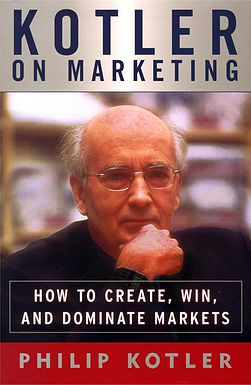
Kotler on Marketing: How to Create, Win, and Dominate Markets
A practical and strategic book in which Kotler summarizes key principles in modern marketing, customer orientation, and competitive strategy. The book combines theory and experience with reflections on how markets and customers evolve over time.

Marketing 4.0: Moving from Traditional to Digital
In this book, Kotler explores how digitalization, social media, and mobile platforms are changing customer behavior and marketing. The book describes the transition from traditional marketing to a more digital, social, and human-centered customer experience.


