
San Francisco seminar 2005
The seminar in San Francisco 2005 built on the experiences from the previous year and addressed how companies could combine CRM, multichannel strategy and innovation in practice.

Introduction and reflection
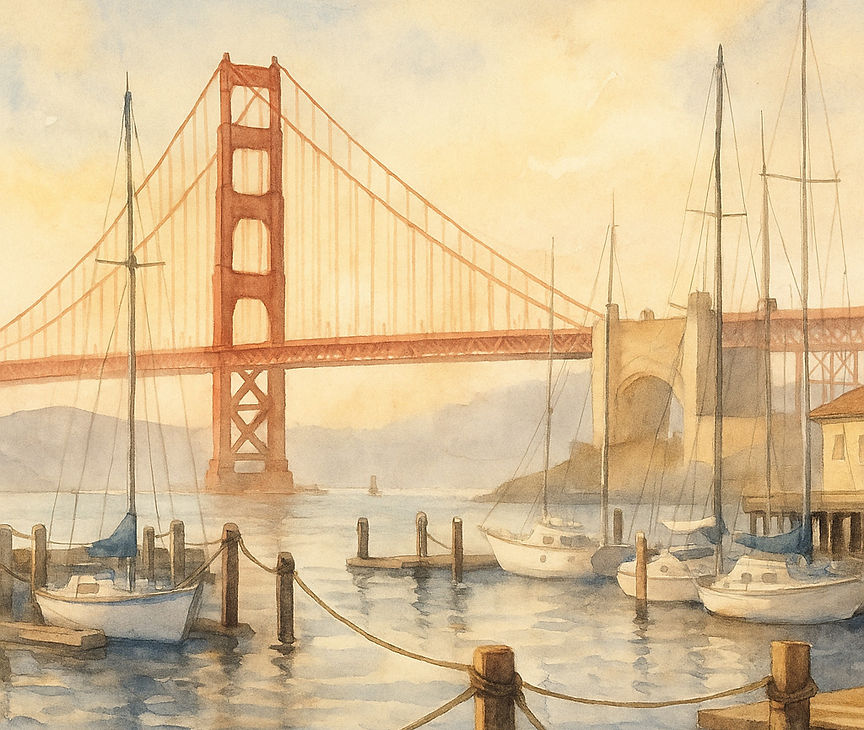
March 2005, San Francisco. The digital transformation had really taken off, and the dotcom bust was already history. In this landscape, leaders, researchers, and innovators gathered to explore how companies could build profitable growth through customer centricity, omnichannel strategy, and technology integration.
The seminar marked a shift in the understanding of what eBusiness was all about. From technology and websites – to culture, data and customer experience. “Think Big – Start Small – Scale Fast” was the mantra that was repeated.
Program overview
The seminar lasted five days, with lectures and company visits to, among others:
-
Oracle
-
IBM
-
Harrah's Entertainment
-
Hilton.
Lectures from academic heavyweights such as Florian Zettelmeyer, Kirthi Kalyanam, Dale Achabal and Phillip Gordon gave participants a deeper understanding of the connection between strategy, technology and customer insights.
Main academic topics
Three main threads ran through all the presentations:
1. How to build customer orientation across channels.
2. How to use data to create value and loyalty.
3. How to anchor innovation as a culture, not a project.
-
Zettelmeyer showed that CRM often fails because it is reduced to an IT project.
-
Kalyanam developed the four-step model for Multi-Channel Retail Optimization.
-
Oracle and IBM showed how architecture and integration enable scaling.
-
Achabal introduced the concept of Intelligent Retailing.
Case studies
Phillip Gordon - Lessons Learned from Online Innovators
He summed up the dotcom era with clear language: “The Internet is not a strategy – it is a channel.” Those who survived thought integration – not isolation.
-
Staples: Removed 7 clicks in checkout – +491% sales.
-
Nordstrom: Transferred the service culture to online.
-
Lands' End: Virtual tryout reduced returns.

Learning: Usability and brand consistency deliver results.
Florian Zettelmeyer – Why CRM Fails
CRM fails when the organization doesn't change. He introduced the IDIC model (Model in Customer Relationship Management - Identify, Differentiate, Interact, Customize) and showed how companies like American Airlines and Safeway used customer data for loyalty and upselling.
Learning: CRM is a cultural project – not an IT system.
Kirthi Kalyanam – Multi-Channel Systems
He described the journey from Presence to Optimization, and how integration between store, online and customer service creates value.
Learning: Interaction between channels = competitive advantage.
Dale Achabal – Intelligent Retailing
Achabal showed how data-driven decisions change the entire value chain:
Price, assortment, promotions and logistics must be guided by analysis.
Learning: Analysis = Profitability
Wells Fargo – Eskander Matta
With over six million online banking customers in 2005, Wells Fargo was a textbook example of early digital maturity. They combined automated credit scoring, real-time alerts, and data-driven insights.
Learning: Integration increases loyalty – digital and physical channels reinforce each other.
Harrah's Entertainment – CRM as a competitive advantage
Through its Total Rewards loyalty program, Harrah's used predictive models to predict gaming behavior and tailor offers. The result: increased customer value, more visits, and measurable ROI.
Learning: Customer data as strategic capital.
Hilton – OnQ CRM
An early CRM system that brought together all hotel experiences into one interface, used for personalization and loyalty management.
Sherwin-Williams – Brand Equity and Channel Strategy
Showed how the brand is measured as financial value, and how branding is integrated into the channel strategy.
IBM and Oracle
IBM highlighted the importance of “One view of the customer”, while Oracle showed how the right architecture enables scalable growth.
Reflections and discussion
San Francisco 2005 showed that leadership, organization and data analysis were crucial – technology was just an enabler. A culture of experimentation and a willingness to fail distinguished the American players from the Norwegian ones.
International perspectives
American companies thought globally from the start. Norwegian participants gained insight into how the Silicon Valley mindset – collaboration, risk-taking and pace – could be applied at home.

What did we take home with us?
CRM must be a business strategy, not an IT project.
Customer insights are fuel for growth.
Seamlessness in the customer journey creates loyalty.
Data = decision-making power.
Relevance today
Much of what was groundbreaking in 2005 is now hygiene factors. Yet many Norwegian businesses still struggle with seamlessness, personalization, and KPIs that measure lifetime value.
San Francisco 2005 reminds us that digitalization is about people, culture and continuous learning.
Peder Inge Furseth
Peder Inge Furseth was a central academic driving force behind the San Francisco seminars and helped make the meeting with Silicon Valley relevant for Norwegian and European businesses. Through his role as professor at BI and as academic director of the program, he helped the participants put the lectures into a larger context – where technology, innovation, business development and people had to be seen in context.
In San Francisco, participants met entrepreneurs, researchers, technology leaders and investors from some of the world's most innovative environments. Furseth's strength was his ability to connect these experiences to practical challenges and opportunities in Norwegian businesses. He helped translate Silicon Valley's ideas and working methods into a Nordic context where collaboration, trust and long-term value creation are strong.
Throughout the entire seminar series, he was an important bridge builder between research, business and technology. For many participants, he therefore became more than a professional leader – he also became a mentor who inspired new thinking about innovation, digitalization and commercialization.
Read more about Peder Inge Furseth here
From studies and seminars to today's professional universe
The studies, seminars and field trips documented on this page are part of the knowledge base behind The Invisible Capital. Topics such as customers, technology, innovation, digitalization and value creation have followed developments over several decades – but the disciplines have also continued to develop.
At The Invisible Capital, we are therefore continuing to work on these questions in our own subject series. Here, we connect previous theory, research and experiences with newer knowledge, new technologies and today's challenges for people and businesses.
Innovation
Innovation is not just about new ideas. Value is created when knowledge, technology and ideas are developed into products, services, processes, organizational forms and business models that are actually used. The series on innovation goes from Schumpeter to modern innovation research and covers, among other things, incremental, radical, disruptive, open and user-driven innovation.
→ Explore the Innovation Series
The customer
The customer is not just the recipient of what the business produces. In a competitive market, the customer is a crucial determinant of whether the business actually succeeds in creating value. The series about the customer goes deeper into customer orientation, customer insight, customer experience, satisfaction, loyalty, trust and the encounter between people.
→ Read the customer series
Value creation
What does it really mean to create value – and who creates it? The series on value creation moves from economic theory and key researchers to a broader understanding of how people, expertise, institutions, businesses and the public sector contribute to value creation.
→ Read the series on value creation
Digitization
Digitalization has evolved from stand-alone technologies to a fundamental part of how businesses work and create value. The Digitalization from A–Z series follows the development through internet, web, e-commerce, search, UX, social, mobile, omnichannel, cloud, data, platforms and digital transformation – up to today’s AI First development.
→ Read the series Digitization from A–Z
Artificial intelligence
Artificial intelligence represents the next chapter in digital evolution. In our own AI universe, we investigate how artificial intelligence works, how AI finds and uses information, how it evaluates sources and websites, and what the development can mean for people, businesses, and value creation.
→ Go to the articles about artificial intelligence
Recommended literature

Disrupting Class
Here, Christensen applies the theory of disruptive innovation to education and learning. The book describes how technology and digitalization can challenge traditional educational models and create new forms of learning and knowledge sharing.


