
eMarketing Program at BI Norwegian Business School
Module I — Fall 2000
The Foundations of Digital Marketing — eMarketing Strategies

Introduction — When Digitalization Became Structure, Not Hype
In the fall of 2000, we were right in the middle of the dot-com era. The internet had become a commercial promise. Investors were chasing growth. New companies were being launched almost overnight. Many believed that traditional business models had become irrelevant in the new digital economy.
But the eMarketing program was not driven by euphoria. It was analytical. Structured. Grounded.
Module I was not about campaigns or online advertising. It was about understanding the internet as a new economic and relational infrastructure. This was where the foundation was laid — not for marketing in the narrow sense, but for digital value creation as a discipline.
Day 1 — What Is eMarketing?
Strategy Before Tactics
From the very first day, the concept of eMarketing was challenged. It became clear that this was not simply about “marketing online,” but about developing a strategic understanding of how digital networks were transforming the entire value chain — from communication and distribution to relationships and learning.
Marketing was elevated from the campaign level to the strategic management level. The internet was presented as a structure that influences how organizations manage relationships, create value, and learn from the market.
This was where the distinction between tactical visibility and strategic understanding of systems was established.
Key Perspectives — Day 1:
-
eMarketing as a strategic discipline
-
The internet as infrastructure — not simply a channel
-
Relationships over transactions
-
Digitalization as structural change
Professional Implications:
-
Marketing must be connected to the business model
-
Technology must be understood in the context of the organization and the market
-
Digital strategy must be anchored in leadership

Day 2 — The Internet as a Medium and the Economics of Networks
Day 2 focused on the architecture itself. The internet was analyzed as a medium — and it quickly became clear that it did not fit neatly into traditional media categories. It combined mass communication, personal dialogue, and transactions within a single structure.
Drawing on Hoffman and Novak’s Marketing in Hypermedia Computer-Mediated Environments: Conceptual Foundations (1996), the internet was described as a hypermedia environment. Interactivity was divided into several forms, with machine-to-machine interaction in particular emerging as something new and potentially revolutionary.
This was before APIs, before cloud-based ecosystems — but the foundations were already there.
At the same time, the economics of networks were explored. Metcalfe’s Law was introduced, but with important nuances. The value of a network increases with the number of participants — but only when the connections between them are meaningful.
Key Topics — Day 2:
-
The internet as a hypermedia structure
-
Interactivity: person-to-person, person-to-machine, and machine-to-machine
-
Metcalfe’s Law and network effects
-
Network structures: centralized, decentralized, and distributed
-
Information overload and the need for structure
Analytical Implications:
-
Those who control the structure influence the flow of value
-
The organization of information is a form of power
-
The quality of a network matters more than its size
Day 3 — Relationship Economics, CLV, and Personalization
Day 3 represented a decisive shift in thinking. The focus moved from customer acquisition to value management. Customer Lifetime Value was introduced as a management framework, and marketing was redefined as an investment in relationships over time.
This represented a paradigm shift. Marketing was no longer viewed simply as a cost associated with campaigns, but as an investment in long-term customer value.
Personalization was also explored as a technological opportunity — but at the same time as a strategic and ethical challenge.
Amazon was used as an example of collaborative filtering. This marked the beginning of algorithmic recommendations — long before artificial intelligence became part of everyday language.
Key Topics — Day 3:
-
Customer Lifetime Value (CLV)
-
Retention and profitability
-
Relationship logic vs. campaign logic
-
Channel conflict and shifts in market power
-
Personalization: endorsement, collaborative filtering, and rule-based approaches
Strategic Implications:
-
Small improvements in customer loyalty can have significant financial impact
-
Personalization must be balanced with trust
-
Digital distribution changes the balance of power within the value chain

Day 4 — Dot-Com, Business Models, and Realism
The final day brought the different perspectives together. Dot-com companies were analyzed not as success stories or adventures, but as business models. Traffic alone does not create value. Value emerges through relationships, learning, and operational execution.
The model Attract — Engage — Build Relationships — Reward — Retain — Learn illustrated a complete digital lifecycle. In practice, this was a strategic management framework for digital business.
The reasons why online purchases were abandoned were also analyzed. Slow performance, complexity, and poor user experience were among the key causes. This provided early insight into what we today call UX and conversion optimization.
Key Topics — Day 4:
-
Digital lifecycle model
-
Conversion challenges
-
User experience as a competitive advantage
-
The strengths of established companies: brand and logistics
Professional Conclusions:
-
Technology alone does not create competitive advantage
-
Digital strategy must be connected to operational reality
-
Structure and discipline outperform hype

Relevance Today
When we look back at Module I from 2000, it is striking how few of the core principles have become outdated. Technology has evolved enormously — but the fundamental issues remain the same:
-
Platform economics
-
Network effects
-
Information power
-
Relationship building
-
Personalization and algorithms
-
Business model sustainability
The difference is maturity — not principle.
Professional Significance for My Development
Module I gave me an analytical language for understanding digital structures. From the first websites built in Microsoft FrontPage at SAS, through Episerver solutions and global brand structures at Navico, to today’s work with public-sector digitalization and digital accessibility, an understanding of networks, relationships, and structure has been a consistent thread.
What began as eMarketing in 2000 has since evolved into digital strategy, platform economics, and artificial intelligence. But the core remains the same:
Digitalization is about structure, relationships, and managing value over time.
From Studies and Seminars to Today’s Knowledge Hub
The studies, seminars, and professional journeys documented on this page form part of the knowledge foundation behind The Invisible Capital. Topics such as customers, technology, innovation, digitalization, and value creation have been part of this journey for several decades — while these fields have continued to evolve.
At The Invisible Capital, we therefore continue to explore these questions through dedicated professional series. Here, earlier theories, research, and experience are connected with newer knowledge, emerging technologies, and the challenges facing people and organizations today.
Innovation
Innovation is not just about new ideas. Value is created when knowledge, technology, and ideas are developed into products, services, processes, organizational models, and business models that are actually put into practice. The series on innovation ranges from Schumpeter to modern innovation research and explores incremental, radical, disruptive, open, and user-driven innovation, among other approaches.
→ Explore the Innovation Series
The Customer
The customer is not simply the recipient of what an organization produces. In a competitive market, the customer plays a decisive role in determining whether the organization actually succeeds in creating value. The Customer Series explores customer orientation, customer insight, customer experience, satisfaction, loyalty, trust, and the interaction between people.
→ Explore the Customer Series
Value Creation
What does it really mean to create value — and who creates it? The Value Creation Series ranges from economic theory and influential researchers to a broader understanding of how people, expertise, institutions, businesses, and the public sector contribute to value creation.
→ Explore the Value Creation Series
Digitalization
Digitalization has evolved from individual technologies into a fundamental part of how organizations operate and create value. The Digitalization A–Z series follows this evolution through the internet, the web, e-commerce, search, UX, social media, mobile, omnichannel, cloud, data, platforms, and digital transformation — leading to today’s AI First era.
→ Explore the Digitalization A–Z Series
Artificial Intelligence
Artificial intelligence represents the next chapter in digital development. In our dedicated AI knowledge hub, we explore how artificial intelligence works, how AI finds and uses information, how it evaluates sources and websites, and what these developments may mean for people, organizations, and value creation.
→ Explore the Articles on Artificial Intelligence
Recommended Professional Literature

Internet Marketing and e-Commerce
A key book from the early eMarketing era, written by Ward Hanson and Kirthi Kalyanam. The book explores how the internet began to transform marketing, CRM, and digital commerce through new digital business models and customer journeys.


Marketing Management
Philip Kotler’s best-known book and one of the world’s most widely used textbooks on marketing and strategy. The book provides a comprehensive understanding of how organizations create value through customer insights, segmentation, brand building, relationships, and long-term strategy.
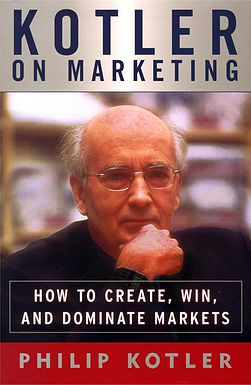
Kotler on Marketing: How to Create, Win, and Dominate Markets
A practical and strategic book in which Kotler summarizes key principles of modern marketing, customer orientation, and competitive strategy. The book combines theory and experience with reflections on how markets and customers evolve over time.

Marketing 4.0: Moving from Traditional to Digital
In this book, Kotler explores how digitalization, social media, and mobile platforms are changing customer behavior and marketing. The book describes the shift from traditional marketing toward a more digital, social, and human-centered customer experience.


