
Part 4 - Customer Insights – how does the business learn what the customer actually needs?

Customer focus requires knowledge. A business may want to put the customer at the center, but if it does not understand what the customer is trying to achieve, what problems the customer faces, and how needs are changing, customer focus can easily become an ambition without substance.
Customer insights are therefore about more than collecting information about customers. It is about developing a better understanding of why people act the way they do, what they are trying to achieve, and where the business can create greater value.
There is an important difference.
The business can know how many customers visited the website yesterday, what products they purchased, how long they stayed on a page, and how many abandoned the purchase. This is valuable information. But the numbers don't necessarily explain why the customer acted the way she did.
Customer insights arise when the business manages to move from data and observations to understanding .

From customer data to customer insights
Digitalization has made it possible to collect far more information about customer behavior than ever before. Businesses can analyze purchases, searches, clicks, returns, customer service inquiries, reviews, loyalty, usage patterns, and a wide range of other factors.
Peter Fader at Wharton has called the data that businesses already have about their customers:
"pure gold" – Peter Fader
The point is not that all data is automatically valuable. Value arises when the business is able to ask good questions of the information and use it to better understand its customers.
A simple example illustrates the difference.
An online store may notice that many customers abandon their shopping cart before completing the payment. The analysis shows what is happening .
But it does not necessarily explain why .
Perhaps the shipping cost comes surprisingly late in the process.
Maybe the customer can't find the payment method they want. Maybe the delivery time is too long. Maybe the customer just used the shopping cart as a to-do list.
To understand this, business needs more than statistics.
It needs insight.
Data often answers what – insights try to understand why
Customer data can be very precise. It can show how thousands or millions of people actually behave.
But the data must be interpreted.
For example, an increase in the number of customer service calls could mean that the business has gained more customers. It could also mean that a digital solution has become more difficult to use.
A drop in sales may be due to price, availability, competition, changing needs or a number of other factors.
The same data point can therefore have several possible explanations.
The business must combine data with an understanding of the customer's situation.
This is where customer insights begin.
The customer must have a voice in the business
One of the most established ideas in customer insights is Voice of the Customer.
The term describes the work of collecting, structuring and using information about customers' needs, experiences, expectations and problems.
This voice can be expressed through many different channels.
The customer can tell the business directly what they think in a customer service conversation. They can write a review, answer a survey, return a product, or leave a comment.
But the customer also communicates through action.
She can:
cancel a subscription
abandon a shopping cart
buy the same product again
choose a competitor
call customer service
search for information that the company has not made available
use the product in a way the developers never intended
The customer's voice is therefore found both in what the customer says and in what the customer does .
This makes customer insights a multidisciplinary effort. Customer service may be on one side of the picture. The analytics department on another. Sales, UX, product development, and logistics may have additional pieces.
The challenge is to put them together.
The customer can tell a lot – but not everything
It's tempting to think that businesses can simply ask customers what they want.
Customer surveys, interviews and focus groups can provide very valuable knowledge. The customer can describe problems, expectations and experiences in a way that no database can.
But people also have limitations when it comes to explaining their own behavior.
We don't always remember exactly what we did.
We may have difficulty explaining why we chose something.
We can describe what we think we are going to do, and then act on it.
different.
And perhaps most importantly: We can hardly demand solutions we don't yet know are possible.
This is one of the reasons why Dorothy Leonard and Jeffrey Rayport introduced empathic design as a method for innovation. Their point was that businesses can discover needs by observing people as they actually use products and services in their natural environments – especially needs that customers themselves may not be able to articulate.
See what people are doing
Observation can reveal other things than a questionnaire.
A customer may say that a product is easy to use. But when the researcher observes its use, the customer may still hesitate, make mistakes, or develop their own workarounds around the solution.
These small actions can be very interesting.
They can show:
where the customer becomes uncertain
which parts of the solution require unnecessary work
which features the customer overlooks
what alternative uses arise
what needs the product does not meet
how the context affects usage
IDEO similarly describes insight as something more than a single observation or fact. Insight occurs when observations are put together into a new understanding that can open up action or new ideas.
This is an important point.
An observation is not necessarily an insight.
That five customers make the same mistake is an observation.
Insight occurs when the business understands why they make the mistake and what this tells them about the product, information or situation the customer is in.

Customer insights require multiple methods
There is no single method that provides a complete picture of the customer.
Good customer insight environments therefore combine different types of information.
The conversation adds depth
Interviews and conversations make it possible to ask follow-up questions. The business can investigate what the customer was trying to achieve, why something was found difficult, and what expectations the customer had.
A good conversation can reveal matters the business hadn't thought to ask about beforehand.
This is an important strength of qualitative methods.
The observation shows the behavior
Observation makes it possible to see what the customer actually does.
This is especially valuable when the business works with products, services, stores or digital solutions where people are not necessarily able to explain all their actions.
Data shows the patterns
Quantitative data makes it possible to investigate whether a problem affects a few people or large parts of the customer base.
If one customer reports a problem, the business can investigate whether the same pattern exists in the data.
The combination is powerful.
The conversation can explain a problem. The data can show how big it is.
The complaint is also customer insight
Complaints are easily treated as individual cases that should be concluded as quickly as possible.
It's understandable from an operational perspective. The customer wants a solution, and the business wants to handle the matter efficiently.
But the complaint often contains more than a problem that needs to be solved.
It contains information.
If many customers complain about the same thing, the business has received a signal that something in the product, service or process should be investigated.
A complaint can tell you something about quality.
An inquiry may reveal unclear information.
A return may show that the product description creates incorrect expectations.
A termination may indicate that the customer's needs are no longer being met.
The problem arises if the business solves every single customer case
without investigating the pattern behind the cases.
Then it treats the symptoms without learning about the cause.
The front line hears what customer data doesn't always capture
Customer insights don't just exist in the systems.
It is also found among employees.
The customer service representative who has a hundred calls in a week can detect changes long before they appear in a monthly report.
The store employee can hear which product customers are constantly asking for.
The seller can register a new objection.
The advisor may discover that the clients' priorities have changed.
These experiences are qualitative and can be difficult to standardize, which is precisely why they can be underestimated.
Richard Branson has emphasized the importance of listening to both customers and employees, pointing out that businesses do not get real feedback if they do not actually listen to them.
Here two forms of knowledge meet.
The customer knows his own situation.
The employee knows the patterns that arise through many customer meetings.
When these perspectives are combined, the business can discover problems and opportunities that are not visible from the boardroom.
Customer insights must be able to move throughout the organization
It doesn't help much that the customer service representative discovers a problem if the knowledge stops there.
This is one of the biggest organizational challenges in customer insights.
Businesses may have very good systems for distributing decisions from management down the organization, but learning also requires information to move the other way.
An employee discovers something.
The observation must be able to be recorded.
Other observations must be able to be connected to it.
Someone needs to consider whether there is a pattern.
And if the information is important, the business must be able to act on it.
That means customer insights need mechanisms , not just good intentions.
This could include regular reviews of customer feedback, systematic categorization of inquiries, meetings between customer service and product development, or analysis of which problems are recurring.
The point is not which system the business chooses.
The point is that the customer's experience must be able to become organizational knowledge .
When too much information creates too little insight
A modern business can have enormous amounts of data and still have a poor understanding of its customers.
It happens when attention shifts from the questions to the measurements.
The business measures what is easy to measure because technology makes it possible.
The dashboard is filled with key figures.
The reports are becoming increasingly detailed.
But no one asks the fundamental question:
What does this mean for the customer?
Many data points are not the same as a lot of knowledge.
Therefore, the business should start with the questions it wants to understand.
Why do customers leave the service?
Where does friction occur?
What makes some customers come back?
Which problems generate the most inquiries?
What needs are we unable to meet?
The data can then be used to investigate the questions.
Not vice versa.
Measurements can influence what the organization sees
All measurement systems have a limitation: They focus attention on what is being measured.
If customer service is primarily measured by how quickly the employee ends the call, the organization can become very efficient at handling calls.
But it can also overlook what customers are actually saying.
If a digital team only measures the number of clicks, it may miss the fact that the customer had to click ten times because the navigation was poor.
If a store only measures sales, it may overlook questions from customers who couldn't find the product they were looking for.
Measurements are necessary.
But they must be interpreted in the context of the business's purpose and the needs of its customers.
Otherwise, the business may optimize a number while the customer experience deteriorates.
Customer insights and UX meet in actual human needs
Digitalization has made user experience an important part of customer insight.
A website, an app or a digital service is not just technology. For the customer, the solution is part of the business.
Don Norman and Jakob Nielsen define user experience as the entire end user interaction with the business, services and products. Their starting point is clear:
"The first requirement for an exemplary user experience is to meet the exact needs of the customer." - Don Norman and Jakob Nielsen
This gives customer insights a practical consequence.
The business must understand the task the person is trying to solve.
It is not enough that the system technically works.
If the customer cannot find the information, does not understand the language, is unable to navigate or has to spend unnecessary time on the task, there is a customer problem even if the system does not have any technical errors.
UX research therefore makes the actual behavior of the customer or user a central source of knowledge. Nielsen Norman Group also emphasizes that good user experience requires coordination between multiple disciplines, including product development, development, marketing, content and customer service.
Customer insight is therefore not just the knowledge of the marketing department.
It affects the entire business.
The customer knows the problem – the business must also be able to imagine the solution
At the same time, there is an important limit to how far a business can go by simply listening to explicit customer requests. Jeff Bezos described this challenge in Amazon’s 2018 shareholder letter.
He emphasized that Amazon should listen carefully to the customer, but at the same time added:
"The biggest needle movers will be things that customers don't know to ask for." -Jeff Bezos
Therefore, customer insight and innovation must work together.
The customer may be very good at describing the problem.
The customer may say that it takes too long, that the solution is difficult, that information is missing or that a need is not being met.
But it is not necessarily the customer's task to develop the technical solution.
The business must combine the customer's experience with:
competence, technology, creativity, research and professional judgment.
This is an important balance.
The business should not ignore the customer because the customer cannot describe the future solution.
But it should also not reduce innovation to fulfilling customers' wish lists.
Latent needs – what the customer has not yet expressed
Some of the most interesting innovation opportunities are found in needs that the customer has not clearly articulated.
The customer may have accepted a problem because "it's always been like this."
A cumbersome process can be perceived as normal.
A product can be used in an improvised way because no better solution exists.
This is where observation can be particularly valuable.
Leonard and Rayport's research on empathetic design was based precisely on the fact that traditional market research can overlook needs that the customer does not express because the customer does not expect that another solution is possible.
The business must therefore not only listen to wishes.
It must look for problems, frustrations, detours, and patterns .
That's where new solutions can begin.

Customer insight is not the same as privacy freedom
The more information the business can collect, the more important the question becomes of what it should actually collect.
Customer focus cannot be used as a justification for unlimited surveillance of people.
The trust between the customer and the business also depends on how customer data is handled.
The business must therefore distinguish between:
what is technically possible to collect, and what is necessary and prudent to use.
It is a question of principle.
A customer-centric business should not just ask how data can provide value to the business.
It should also ask whether the use of data is understandable, proportionate and trustworthy for the customer.
Customer insight without trust can, in the long term, damage the very relationship the business is trying to understand.
Artificial intelligence is changing customer insights
AI gives businesses new opportunities to analyze large amounts of unstructured information.
Thousands of customer conversations can be analyzed for recurring themes.
Product reviews can be grouped.
Customer feedback can be summarized.
Patterns in searches and purchases can be discovered more quickly.
This can make it possible to highlight signals that were previously drowned in the data volumes.
But AI doesn't change the fundamental problem.
The model must still have access to relevant information.
The analysis must be considered.
The patterns must be interpreted.
And the business must decide what to do with the knowledge.
AI can therefore make customer insight efforts more powerful, but it does not replace human judgment.
On the contrary, more analysis can make the need for good questions even greater.
From information to understanding – and from understanding to action
We can now describe customer insights as a continuous process.
The business observes what its customers do.
It listens to what they say.
It collects data.
Employees share experiences.
The information is analyzed.
Patterns are identified.
The company is trying to understand why they occur.
Then comes the crucial point:
What does the business do with what it has learned?
If no decision is influenced, no process is improved, and no idea is tried out, the insight has little value.
Therefore, customer insights are not the end point.
It is input for learning, development and innovation.
Customer insight is part of a business's invisible capital
Here the customer article meets one of the main themes in Invisible Capital.
A business may own machinery, buildings, technology, and financial assets.
But it can also own – or more precisely possess – extensive knowledge of the market and the people for whom it creates products and services.
This knowledge is found in the data.
But it is also found in the experiences of people.
The customer service representative who has listened to thousands of customers over ten years may possess an understanding that is not reflected in any accounting.
The product developer who has observed users may know problems that have never come up in a survey.
The salesperson can know why customers choose the competitor.
The UX designer can understand where people become insecure.
This is knowledge that the business can use to improve products,
services and processes.
It is invisible capital .
But it only has value if the business manages to preserve, share and use it.
From customer insight to the meeting between the customer and the employee
Part 3 showed that customer focus must be part of the business's way of working.
This article has shown how customer insights arise through a combination of data, conversations, observation, feedback, and employee experiences.
The most important thing is not the amount of information.
It is the business's ability to turn information into understanding.
Good customer insight therefore means that the business:
listening to what customers say
observe what they actually do
combines qualitative and quantitative methods
analyzes complaints and problems as patterns, not just single incidents
uses first-line experiences as a source of knowledge
investigates needs the customer has not yet formulated
uses technology and AI to enhance, not replace, understanding
protects trust around customer data
ensures that knowledge moves through the organization
turns insight into action
This leads us to one of the most concrete places where customer insight arises.
Not in the boardroom.
Not necessarily in the analysis tool.
But in the meeting between two people.
Recommended literature
Customer focus, customer insight and customer relationships cannot be understood in isolation from developments in digitalisation, innovation and user experience. The way a business interacts with its customers is shaped today by people, technology, digital services, organisation and the ability to develop new solutions.
Therefore, this bibliography currently contains books that highlight several of these perspectives.
Here you will find literature on digitalization, innovation, user experience, usability and the development of digital services, among other things. Steve Krug's Don't Make Me Think is a natural example: The book is about usability on the web, but at the same time touches on a fundamental question in the entire Customer series – how easy or difficult the business makes it for people to succeed in what they are trying to do.
Similarly, literature on innovation can help us understand how observations, needs and problems of customers and users can be developed into better products, services and work processes.
The literature list will eventually be expanded with more books that specifically address customer focus, customer insight, customer relations, customer loyalty, e-commerce, service and customer experience.
The goal is not to collect as many books as possible, but to build a literature base that makes it possible to understand the customer from multiple professional perspectives.
From San Francisco and Oxford to the customer
Experiences from professional seminars and study trips in San Francisco and Oxford are also part of the background for this professional universe. Topics such as innovation, digitalization, e-commerce, user experience and new business models have over time contributed to a broader understanding of how technology and organizations must take as their starting point the people the solutions will actually work for.
The Customer Series continues this perspective: Technology is a tool. Innovation is a tool. Value arises when solutions actually work for the people they are designed for.

The Long Tail: Why the Future of Business Is Selling Less of More
Author(s): Chris Anderson
Short review
The Long Tail is one of the most influential books on how the internet has transformed commerce, marketing, and consumer behavior. Chris Anderson introduces the theory of the “Long Tail,” which explains how digital markets enable significant value creation through a large number of niche products, rather than relying on a few bestsellers.
The book shows how digital distribution, low inventory costs, search engines, and intelligent recommendation systems have made it profitable to offer an almost unlimited product range. Where traditional stores were limited by physical shelf space, online stores can offer millions of products and let customers find exactly what they are looking for.
Chris Anderson illustrates the theory with examples from Amazon, Netflix, Google, and the digital music industry, showing how the internet has changed the rules of competition for businesses around the world. Many of the insights have since become even more relevant through artificial intelligence, personalization, and modern search technology.
The authors take the reader through the entire process – from planning and organizing to publishing, managing and continuously improving content on websites and digital services. Although technology has evolved since the book was published, the principles of quality, relevance, management and long-term content work are at least as relevant in an era where search engines and artificial intelligence assess the credibility and usefulness of content.
Why we recommend the book
At The Invisible Capital, we consider The Long Tail to be one of the most important books in e-commerce, digitalization, and modern value creation.
The book explains why customers no longer just buy the most popular products, but increasingly find value in specialized products and services that meet individual needs. This insight has had enormous impact on the development of online stores, digital marketplaces, search engine optimization (SEO), information architecture, and content strategy.
Today we see that the theory also fits very well into the development of artificial intelligence. AI helps people discover relevant content, products and knowledge that were previously difficult to find. This has given the Long Tail principle a new dimension, where well-structured content and high professional quality are increasingly important for visibility, trust and value creation.
This is a book we believe everyone who works with e-commerce, digital marketing, customer experience, innovation, digital strategy or artificial intelligence should read.

Content Strategy for the Web (2nd Edition)
Author/authors: Kristina Halvorson and Melissa Rach
Short review
How do you create content that actually helps people – and at the same time supports your business goals? Content Strategy for the Web is considered one of the most influential books in the field of content strategy and digital communications. The book shows how good content does not arise by chance, but through a deliberate strategy where user needs, the organization's goals, structure, work processes and management are closely linked.
The authors take the reader through the entire process – from planning and organizing to publishing, managing and continuously improving content on websites and digital services. Although technology has evolved since the book was published, the principles of quality, relevance, management and long-term content work are at least as relevant in an era where search engines and artificial intelligence assess the credibility and usefulness of content.
Why we recommend the book
At The Invisible Capital, we believe that good content is one of the most important forms of invisible value creation. A website is far more than design and technology – it is the content that builds trust, creates great customer experiences and helps people find the answers they are looking for.
This book is perfect for leaders, communications consultants, content producers, web editors, UX designers, and anyone working with digital services. It shows why a clear content strategy leads to better user experiences, more effective interactions, and stronger digital results over time.
In an era where artificial intelligence is increasingly important in how information is discovered, understood, and communicated, this book is more relevant than ever. It reminds us that technology alone never creates value – it is good, structured, and relevant content that makes the difference.

Don't Make Me Think
Author: Steve Krug
Short review
Don't Make Me Think is one of the world's most influential books on usability and web design. Since its first edition in 2000, the book has helped designers, developers, content producers, and managers understand a simple but powerful principle: Good digital services should be intuitive. The user should be able to complete their task without having to stop and think about how the website works.
Why we recommend the book
This is one of the books that has had the greatest impact on my own work with digital services. Over the years – from SAS and the Norwegian Opera & Ballet to working on Bærum Municipality’s website – the principles in this book have been an important reminder that technology is never an end in itself. The goal is to make everyday life easier for the people who use the services. Despite the fact that the book was published many years ago, the message is just as relevant today.
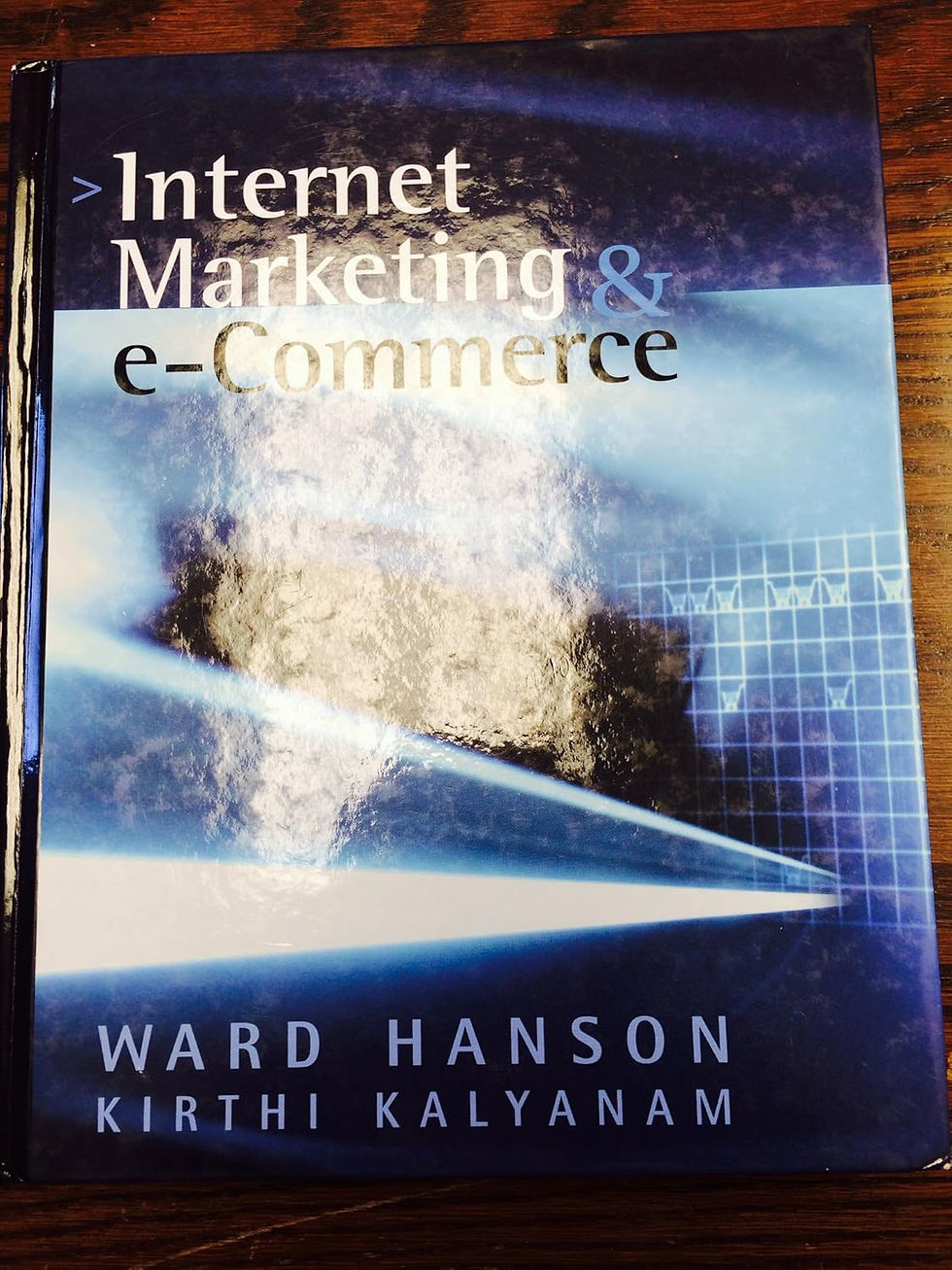
Internet Marketing & eCommerce
Authors: Ward Hanson and Kirthi Kalyanam
Short review
Internet Marketing & eCommerce provides a thorough introduction to how the internet has changed marketing, commerce, and business development. The book combines theory and practical examples in digital marketing, e-commerce, customer behavior, value creation, and digital business models. Although written at a time when the internet was still in its infancy, many of the fundamental principles are still highly relevant.
Why we recommend the book
This book was an important part of my own learning journey in digital marketing and e-commerce. It helped build my understanding of how technology, customer experiences and business strategy are interconnected – an insight that later became very important in my work with SAS, the Norwegian Opera & Ballet, Bærum Municipality and eventually the project The Invisible Capital. Many of the ideas about customer value, digitalization and innovation presented on the website have their roots in the knowledge this book conveys.

The Innovator's Solution: Creating and Sustaining Successful Growth
Authors: Clayton M. Christensen and Michael E. Raynor
Short review
In this sequel to The Innovator's Dilemma, Clayton Christensen shows how businesses can translate innovation theory into practical strategy. The book explains how companies can identify new growth opportunities, develop disruptive innovations, and build organizations that thrive in rapidly changing markets.
Why we recommend the book
While The Innovator's Dilemma explains why established businesses are often challenged, The Innovator's Solution provides concrete advice on how to meet the challenges. The book is therefore a natural next step for anyone who wants to understand innovation, strategy and long-term value creation.

The Innovator's DNA: Mastering the Five Skills of Disruptive Innovators
Authors: Jeff Dyer, Hal Gregersen and Clayton M. Christensen
Short review
What characterizes people who create groundbreaking innovations? The authors identify five key skills – observation, questioning, experimentation, networking and association – that are common to the world's most innovative leaders and entrepreneurs.
Why we recommend the book
This book shifts the focus from organizations to the people behind innovation. It shows that creativity and innovation can be developed through deliberate training and experience. The perspectives align well with the philosophy behind Invisible Capital, where human competence and curiosity are the most important drivers of development.

Competing Against Luck: The Story of Innovation and Customer Choice
Authors: Clayton M. Christensen, Taddy Hall, Karen Dillon and David S. Duncan
Short review
In this book, Clayton Christensen further develops the theory of Jobs to Be Done – the idea that customers do not primarily buy products, but "hire" them to solve specific needs. Through practical examples, the authors show how businesses can develop products and services that address customers' real-world challenges.
Why we recommend the book
For anyone working in customer experience, service design, and innovation, this is one of the most insightful books ever written. It reminds us that value creation always starts with understanding the people we are developing solutions for – a fundamental principle of Invisible Capital.

The Innovator's Dilemma: When New Technologies Cause Great Firms to Fail
Author: Clayton M. Christensen
Short review
The Innovator's Dilemma is considered one of the most influential books on innovation and technological change. Clayton M. Christensen introduces the theory of disruptive innovation and explains why even the most successful businesses can fail when new technologies and business models challenge established markets. Through a series of examples, he shows how companies often focus on today's customers and incremental improvements, while overlooking innovations that later change entire industries.
Why we recommend the book
This is one of the books that has had the greatest impact on modern innovation thinking. When I first read it, it gave me a whole new perspective on why some businesses succeed in transformation, while others lag behind – even when they are well led. The insight has been an important part of my own understanding of digitalization, innovation and change management, and many of the reflections in The Invisible Capital build on the ideas Clayton Christensen presents in this classic. The book is as relevant today, in the face of artificial intelligence and digital transformation, as it was when it was published.

Open Innovation: The New Imperative for Creating and Profiting from Technology
Author: Henry Chesbrough
Short review
Henry Chesbrough introduced the concept of Open Innovation and changed the way many businesses think about research and development. He shows how companies can create more innovation through collaboration with customers, universities, start-ups, suppliers and other external partners.
Why we recommend the book
Open Innovation has had a major influence on modern innovation thinking and was also an important topic during the seminars in Oxford and San Francisco. The book shows why future value creation occurs in the interaction between people, businesses and knowledge environments – not within closed organizations alone.

Blue Ocean Strategy: How to Create Uncontested Market Space and Make the Competition Irrelevant
Authors: W. Chan Kim and Renée Mauborgne
Short review
Blue Ocean Strategy challenges businesses to shift their focus away from fierce competition and instead create new markets with little or no competition. The authors present strategies and models that help organizations develop innovative products, services, and business models.
Why we recommend the book
This book has inspired leaders around the world to rethink strategy and innovation. Instead of competing for the same customers, it shows how businesses can create new value through creativity and differentiation. The perspectives align very well with the themes of innovation, digitalization, and long-term value creation in Invisible Capital.

Outside Innovation: How Your Customers Will Co-Design Your Company's Future
Authors: Patricia B. Seybold
Short review
Patricia Seybold shows how businesses can create better products and services by actively involving customers in the innovation process. The book describes how dialogue, co-creation and close collaboration with users can provide better solutions and stronger competitiveness.
Why we recommend the book
Customers often hold the most important insights into how products and services can be improved. This book emphasizes the importance of listening, involving, and learning from users – a perspective that is echoed in many of the articles on The Invisible Capital. Innovation rarely happens alone; it is created in the interaction between people.

Blown to Bits: How the New Economics of Information Transforms Strategy
Authors: Philip Evans and Thomas S. Wurster
Short review
This book analyzes how digital information is changing competitive conditions, markets, and business strategies. The authors explain how the internet is disrupting established structures and creating new opportunities for businesses that are able to think differently.
Why we recommend the book
Although written early in the internet revolution, the book describes many of the developments that still characterize business today. It provides valuable perspective on how digitalization affects value chains, competition, and innovation – themes that are central to Invisible Capital.

Wikinomics: How Mass Collaboration Changes Everything
Authors: Don Tapscott and Anthony D. Williams
Short review
Wikinomics shows how openness, sharing and collaboration across organizations create new forms of innovation and value creation. Through a number of international examples, the authors describe how digital networks make it possible to develop products, services and knowledge together.
Why we recommend the book
This book was groundbreaking when it was first published, and many of the ideas have since become a natural part of everyday digital life. The perspectives on collaboration, knowledge sharing, and open innovation processes align very well with the philosophy behind Invisible Capital, where people and networks are at the center of value creation.

© 2025 - 2026 Portico Publish | The invisible capital Privacy and use of the website | Developed and operated by Magne Bjella | Powered and secured by Wix


Comments