
Part 7 - Customer satisfaction, loyalty and trust

"I'll have a conversation with you; it will be all on my terms. Your product is going to have to be visually beautiful, technically perfect, and distinctive. And it has to be available where I shop at a price I'm willing to pay."
"Now, if it is all of those things, you gain the permission, in the one minute the consumer deals with your brand, to devote about 10 seconds to the issue of values. And if you miss any step along the way, you are talking to yourself, which is a terribly sad place to be."
Jeff Swartz - President and Chief Executive Officer, Timberland - Fast Company , August 2008
A satisfied customer is valuable. But a satisfied customer is not necessarily a loyal customer, and a loyal customer is not necessarily a customer who has a strong relationship with the business.
Customer satisfaction, loyalty and trust are related, but describe different aspects of the customer relationship.
Satisfaction is about how the customer evaluates their experience with the business, product or service. Loyalty is about the tendency to continue the relationship, buy again or choose the business over alternatives. Trust goes deeper. It is about whether the customer expects the business to act reliably, keep its promises and maintain the relationship even when something goes wrong.
For businesses, this is far more than a question of marketing. Customer relationships affect repeat purchases, recommendations, reputation, costs, learning and long-term value creation.
But relationships cannot be reduced to one number either.
A business can have high customer satisfaction and still lose customers. It can have many customers who stay without actually being particularly satisfied. And it can find that many years of trust built up are quickly eroded if the business violates the expectations it has created.
Therefore, customer satisfaction, loyalty and trust must be understood in context.

Customer satisfaction begins with expectations
The customer does not encounter the business without expectations.
Expectations can be created by advertising, previous experiences, reviews, price, brand, recommendations or experiences from other businesses.
Therefore, when the customer later evaluates the experience, it does not happen in a vacuum.
The product must function as the customer expected.
The service must deliver what was promised.
Delivery should happen when the business said it would.
The customer service representative should be able to help.
The digital solution must be understandable.
The price should be perceived as reasonable in relation to the value the customer receives.
Customer satisfaction therefore arises in the meeting between expectation and experience .
It also means that the business itself influences the expectations against which it will later be assessed. A promise can help create a sale, but the promise also creates an expectation that must be fulfilled.
Excessive promises can therefore provide a short-term advantage while also laying the foundation for a poor customer experience.
Norway has been measuring customer satisfaction for thirty years
The Norwegian Customer Barometer at BI Norwegian School of Management provides us with an interesting Norwegian perspective. The research project has measured customer satisfaction and loyalty among Norwegian consumers for thirty years. In the 2026 survey, 3,616 consumers rated 164 businesses from 36 industries and gave a total of 17,007 ratings.
The results also illustrate how large differences there can be between businesses.
Vipps topped customer satisfaction in 2026 with 87.9 points, ahead of Vinmonopolet with 87.4 and Toyota with 85.9. The average for the businesses was 73.5 points, the highest level recorded throughout the thirty-year history of the Customer Barometer.
BI particularly highlights simplification as an important explanation for Vipps' results. This is interesting because customer satisfaction is not only associated with traditional service.
Making something easier for the customer is customer service .
A payment solution that saves time can create value.
An understandable ordering process can create value.
A digital service that reduces the need for help can create value.
Customer satisfaction is therefore about the entire business's delivery, not just the encounter with the customer service representative.
Satisfaction and loyalty are not the same thing
It's easy to assume that a very satisfied customer is automatically loyal.
That is not necessarily the case.
The Norwegian Customer Barometer measures customer satisfaction and loyalty separately. The results for 2026 illustrate the difference. FINN.no had a satisfaction score of 83.8, while the loyalty score was 93.5. Mester
Green had 81.2 in satisfaction, but 91.5 in loyalty.
The differences do not mean that one goal is better than the other.
They show that the goals describe different things.
A customer may be satisfied with one restaurant and still choose a different restaurant next week because she wants variety.
A customer may be very satisfied with their car and yet choose a different brand next time because their needs have changed.
A customer may be moderately satisfied with their bank and still stay because it is perceived as cumbersome to move all the services.
The last example also shows why loyalty must be interpreted carefully.
Just because the customer stays doesn't always mean the customer will stay.
Customers may stay for various reasons.
Some stay because they truly prefer the business.
Others stay because the alternatives are not attractive.
Some stay because of price.
Others stay because it is difficult to switch.
A customer may be bound by subscriptions, contract periods, bonus programs, technical standards, or products that work best with other products from the same supplier.
Therefore, the business must ask a difficult question:
Is the customer loyal because she wants to stay – or because it's hard to leave?
These are two fundamentally different forms of customer retention.
One builds the relationship.
The other builds a barrier.
Barriers can work commercially for a long time, but they should not
confused with trust or genuine preference.

Loyalty has economic significance
Fred Reichheld has been one of the most influential researchers and consultants in the field of customer loyalty. Through his work at Bain & Company and books such as The Loyalty Effect, he argued that long-term relationships between businesses, customers, and employees can have great economic significance.
Bain summarizes the core of this thinking as follows:
"Creating value for customers builds loyalty." —Frederick F. Reichheld
This is an important perspective.
Loyalty should not begin with the question of how the business can retain the customer .
It should begin with the question of why the customer would want to continue the relationship.
An existing customer knows the business.
The business can understand the customer's needs better.
The customer may not need to re-examine the market.
The business can learn from past transactions.
Through repeated meetings, the relationship can become easier and more effective for both parties.
That's why loyalty can create value.
However, if the business begins to view loyal customers as customers who can be taken for granted, the same mechanism can work in reverse.
The loyal customer must still be earned
Loyalty is not something the business owns.
It only exists as long as the customer continues to choose the relationship.
This makes existing customers interesting in a different way than new customers.
Businesses often spend significant resources on acquiring new customers. Promotions, advertising, introductory offers and discounts are visible tools.
At the same time, existing customers may face a completely different reality.
They may find that the new customer gets a better price.
They may have to wait a long time for help.
They may find that the business becomes more difficult to contact.
They may experience a gradual deterioration in service because the business assumes that the customer will stay.
This can be dangerous.
An existing customer doesn't just compare your business to your competitors.
The customer also compares the business to what the business itself used to be .
Thus, poor service or quality may be experienced more strongly by a customer who has had a good relationship with the business over a long period of time.
Trust is more than satisfaction
Satisfaction can arise after one good transaction.
Trust is usually built over time.
The customer learns how the business behaves.
Will the product arrive as promised?
Is the invoice correct?
Is the product information correct?
Is the business available when something goes wrong?
Is the complaint being handled properly?
Is customer data used in a way the customer can accept?
Does the company take responsibility when it makes mistakes?
The answers to such questions create experience.
And experience creates expectations for future behavior.
This is what makes trust so important.
The customer does not need to check everything if the business previously
has proven reliable.
The reduced uncertainty has its own value.
Trust reduces friction
Trust can make financial relationships easier.
When the customer trusts the business, she needs less
information and fewer insurances before each new purchase.
She knows the brand.
She knows the product.
She expects the payment to work.
She expects the business to handle the problem if something goes wrong.
This predictability reduces friction.
This doesn't mean that the customer stops considering alternatives, but trust can make the existing relationship easier to continue.
Amazon has just made trust an explicit part of the company's Customer Obsession principle :
"They work vigorously to earn and keep customer trust." - Amazon Leadership Principles
The words earn and keep are important.
Trust must be earned.
And it must be maintained.
Trust is most evident when something goes wrong.
No business delivers perfectly all the time.
Products can fail.
Deliveries may be delayed.
Systems can go down.
Employees can make mistakes.
Invoices may be incorrect.
What is interesting is therefore not only how rarely the business makes mistakes.
It is also what the business does when the error occurs .
A customer who encounters a problem may experience two different businesses.
The first is trying to find out who internally is to blame.
The second one first tries to solve the customer's problem.
For the customer, the difference is significant.
A mistake can weaken trust.
But good problem management can also show the customer what
the business actually stands for.
Here, the customer service representative again plays a crucial role.
The account manager manages trust in real time
When something goes wrong, the customer often doesn't meet the CEO or the product developer.
The customer meets the customer service representative.
This means that an employee who may be far down in the organizational hierarchy can be given responsibility for one of the company's most important assets:
customer trust.
The customer service representative must understand the problem.
She must have access to the right information.
She needs to know what solutions are possible.
And she often has to deal with a person who is already irritated or worried.
If the employee lacks the authority to solve even simple problems, a paradoxical situation arises.
The business may say that the customer is at the center, while the person who actually meets the customer is not authorized to help.
Therefore, employee experience and customer experience are interconnected.
Customer focus doesn't just require good employees.
It requires that the business enables its employees to be good .
Loyalty cannot be bought with bonus points alone
Many businesses have loyalty programs.
The customer gets points.
Discounts.
Member prices.
Personal offers.
Benefits on your next purchase.
Such programs can be effective and can provide the business with valuable information about customer behavior.
But a loyalty program is not the same as customer loyalty.
The customer may use the program because the benefits are financially attractive without having any strong preference for the business.
If the competitor offers better benefits, the customer may move.
Real customer relationships must therefore be built on more than just rewards.
It may be related to, among other things:
quality
simplicity
reliability
service
availability
good experiences
relevant communication
trust
Bonus points can support the relationship.
They can't replace it.
Net Promoter Score – one indicator, not the whole customer
Fred Reichheld is also known as the originator of the Net Promoter Score, NPS.
The method is based on a simple question about how likely the customer is to recommend the business to others. Reichheld and later Rob Markey developed this into a system for working with customer and employee loyalty.
One strength of NPS is its simplicity.
A complicated topic is given a goal that can be followed over time and discussed within the organization.
But simplicity also creates a danger.
One number can never describe the entire customer relationship.
A high NPS score doesn't necessarily explain why customers
Recommend the business.
A low number does not automatically identify the problem.
Furthermore, differences between industries, cultures, customer types, and situations can affect how people use the scale.
Therefore, NPS, customer satisfaction, and other indicators should be used as signals that need to be investigated , not as a substitute for customer insights.
The question after the measurement should be:
Why?
That's where the learning begins.

What the business measures affects what the business does
Measurements affect organizations.
When a goal becomes important, people start working to improve it.
That can be positive.
But if the measurement becomes detached from the purpose, the business may end up optimizing the number instead of the customer relationship.
A call center can have shorter call times while requiring more customers to call back.
A business can get more responses to a customer satisfaction survey without the customer experience itself improving.
Employees can encourage satisfied customers to respond and thus influence the outcome.
This does not mean that the business should stop measuring.
This means that measurement must be linked to understanding and action .
The numbers should help the business ask better questions.
They are not going to end the discussion.
The Norwegian Customer Barometer shows that customer judgment is changing
The Norwegian Customer Barometer is also interesting because it measures developments over time.
BI describes customer satisfaction as more “fresh” than before, with greater impact on more businesses. The project also points out that customers choose the businesses that give them the greatest value, and that future winners must develop products and services that better meet their needs.
This fits directly into the argument throughout the Kunde series.
A business cannot be done without customer focus.
Customers are changing.
Competitors are changing.
Technology is changing.
The experiences the customer has elsewhere affect expectations.
A solution that excited five years ago may be the expected standard today.
Customer satisfaction must therefore be understood dynamically.
The digital experience impacts trust across the entire business
Digitalization has made trust more complex.
Previously, the customer relationship could largely occur between the customer and a human being.
Today, customers often encounter businesses through:
the website, the app, the payment solution, the chatbot, the email, the order confirmation and the automated customer service.
All of these touchpoints affect trust.
If the customer does not understand why the business needs certain information, uncertainty may arise.
If the system provides conflicting information, credibility is weakened.
If the chatbot prevents the customer from getting help from a human, streamlining can be perceived as rejection.
If personal recommendations become too precise, personalization can be perceived as surveillance.
Digital customer experience is therefore not just about usability.
It is also about predictability, transparency and trust .
AI makes trust even more important
Artificial intelligence makes it possible to automate more and more parts of the customer relationship.
AI can recommend products.
Answer questions.
Analyze customer data.
Predict needs.
Customize prices and offers.
Summarize customer history.
Help the customer service representative find solutions.
This can improve the customer experience.
But it can also make business decisions more difficult for
the customer to understand.
Why did I get this offer?
Why was the application rejected?
Why am I seeing this price?
Am I talking to a human or a machine?
What is my information used for?
Thus, trust does not become less important as technology becomes more advanced.
It becomes more important.
The business must be able to explain what it does, why it does it and how the customer's interests are safeguarded.
Trust can take years to build and minutes to weaken
Customer relationships are built through many small experiences.
One delivery.
One conversation.
One invoice.
One return.
One app update.
One complaint.
Each event may seem insignificant in isolation.
Together they create an image of the business.
Is it reliable?
Is it easy to deal with?
Does it deliver on its promises?
Does it take responsibility?
Does it treat customers properly?
Over time, these experiences turn into reputation and trust.
But the asymmetry is important.
Many good experiences can build trust gradually, while one serious incident can weaken it quickly.
Therefore, trust is a valuable but vulnerable part of a business's invisible capital.
Trust is invisible capital
Trust is not like a machine in balance.
It cannot be counted in the warehouse.
It cannot be purchased without further ado.
Nevertheless, it influences customers' choices.
A business with high trust may find that the customer is willing to
buying a new product because previous experiences have been good.
The customer can recommend the business to others.
She may be more willing to give the business the opportunity to correct a mistake.
She can spend less time researching alternatives.
This has economic value.
But the economic value arises because the relationship has first created human and social value .
Reichheld's point about the connection between customer value and loyalty is therefore also important here: loyalty should be understood as a consequence of the fact that the business has, over time, given the customer good reasons to continue the relationship.
The customer must be able to walk
There is also an ethical and strategic point that is worth emphasizing.
The strongest customer relationship is not necessarily the one where the business makes it the most difficult to leave.
On the contrary, easy termination, clear terms and conditions, and streamlined processes can strengthen trust.
The customer then knows that the relationship exists because the customer chooses it .
This is an important difference between loyalty and lock-in.
The business should try to make it attractive to stay.
Not unreasonably difficult to walk.
Customer satisfaction is a result – and a source of learning
We can thus return to the starting point.
Customer satisfaction is important.
But it shouldn't just be used as a grade book.
A weak score is information.
A strong score is also information.
The business must understand what lies behind it.
What makes the most satisfied customers happy?
Why are some customers less satisfied?
Which touchpoints impact the experience the most?
What problems drive customers away?
Why do others come back?
Where is trust built?
Where does it weaken?
When the business asks these questions, the measurement becomes part of customer insights.
And customer insight can in turn become the basis for improvement and innovation.
Satisfaction, loyalty and trust build long-term value creation
Throughout the previous articles we have followed a chain.
The business tries to understand the customer.
Customer insights reveal problems and needs.
Employees bring knowledge into the organization.
Innovation seeks to create better solutions.
But the long-term test comes afterwards.
Does the customer experience that the business actually creates value?
If the answer is repeatedly yes, satisfaction can arise.
Good experiences can make customers come back.
Repeated reliability can build trust.
And trust can make the relationship stronger.
The connection can be described simply:
customer value → good experiences → satisfaction → trust → greater likelihood of loyalty → long-term value creation
But the chain is not automatic.
The business must earn it anew through every encounter with the customer.
This makes the customer relationship something far greater than a completed transaction.
It becomes part of the business's knowledge, reputation and invisible capital.
And as customer relationships increasingly take place through websites, apps and digital services, a new question arises:
How does the customer experience the business when the meeting takes place through a screen?
This leads us further to:
Recommended literature
Customer focus, customer insight and customer relationships cannot be understood in isolation from developments in digitalisation, innovation and user experience. The way a business interacts with its customers is shaped today by people, technology, digital services, organisation and the ability to develop new solutions.
Therefore, this bibliography currently contains books that highlight several of these perspectives.
Here you will find literature on digitalization, innovation, user experience, usability and the development of digital services, among other things. Steve Krug's Don't Make Me Think is a natural example: The book is about usability on the web, but at the same time touches on a fundamental question in the entire Customer series – how easy or difficult the business makes it for people to succeed in what they are trying to do.
Similarly, literature on innovation can help us understand how observations, needs and problems of customers and users can be developed into better products, services and work processes.
The literature list will eventually be expanded with more books that specifically address customer focus, customer insight, customer relations, customer loyalty, e-commerce, service and customer experience.
The goal is not to collect as many books as possible, but to build a literature base that makes it possible to understand the customer from multiple professional perspectives.
From San Francisco and Oxford to the customer
Experiences from professional seminars and study trips in San Francisco and Oxford are also part of the background for this professional universe. Topics such as innovation, digitalization, e-commerce, user experience and new business models have over time contributed to a broader understanding of how technology and organizations must take as their starting point the people the solutions will actually work for.
The Customer Series continues this perspective: Technology is a tool. Innovation is a tool. Value arises when solutions actually work for the people they are designed for.

The Long Tail: Why the Future of Business Is Selling Less of More
Author(s): Chris Anderson
Short review
The Long Tail is one of the most influential books on how the internet has transformed commerce, marketing, and consumer behavior. Chris Anderson introduces the theory of the “Long Tail,” which explains how digital markets enable significant value creation through a large number of niche products, rather than relying on a few bestsellers.
The book shows how digital distribution, low inventory costs, search engines, and intelligent recommendation systems have made it profitable to offer an almost unlimited product range. Where traditional stores were limited by physical shelf space, online stores can offer millions of products and let customers find exactly what they are looking for.
Chris Anderson illustrates the theory with examples from Amazon, Netflix, Google, and the digital music industry, showing how the internet has changed the rules of competition for businesses around the world. Many of the insights have since become even more relevant through artificial intelligence, personalization, and modern search technology.
The authors take the reader through the entire process – from planning and organizing to publishing, managing and continuously improving content on websites and digital services. Although technology has evolved since the book was published, the principles of quality, relevance, management and long-term content work are at least as relevant in an era where search engines and artificial intelligence assess the credibility and usefulness of content.
Why we recommend the book
At The Invisible Capital, we consider The Long Tail to be one of the most important books in e-commerce, digitalization, and modern value creation.
The book explains why customers no longer just buy the most popular products, but increasingly find value in specialized products and services that meet individual needs. This insight has had enormous impact on the development of online stores, digital marketplaces, search engine optimization (SEO), information architecture, and content strategy.
Today we see that the theory also fits very well into the development of artificial intelligence. AI helps people discover relevant content, products and knowledge that were previously difficult to find. This has given the Long Tail principle a new dimension, where well-structured content and high professional quality are increasingly important for visibility, trust and value creation.
This is a book we believe everyone who works with e-commerce, digital marketing, customer experience, innovation, digital strategy or artificial intelligence should read.

Content Strategy for the Web (2nd Edition)
Author/authors: Kristina Halvorson and Melissa Rach
Short review
How do you create content that actually helps people – and at the same time supports your business goals? Content Strategy for the Web is considered one of the most influential books in the field of content strategy and digital communications. The book shows how good content does not arise by chance, but through a deliberate strategy where user needs, the organization's goals, structure, work processes and management are closely linked.
The authors take the reader through the entire process – from planning and organizing to publishing, managing and continuously improving content on websites and digital services. Although technology has evolved since the book was published, the principles of quality, relevance, management and long-term content work are at least as relevant in an era where search engines and artificial intelligence assess the credibility and usefulness of content.
Why we recommend the book
At The Invisible Capital, we believe that good content is one of the most important forms of invisible value creation. A website is far more than design and technology – it is the content that builds trust, creates great customer experiences and helps people find the answers they are looking for.
This book is perfect for leaders, communications consultants, content producers, web editors, UX designers, and anyone working with digital services. It shows why a clear content strategy leads to better user experiences, more effective interactions, and stronger digital results over time.
In an era where artificial intelligence is increasingly important in how information is discovered, understood, and communicated, this book is more relevant than ever. It reminds us that technology alone never creates value – it is good, structured, and relevant content that makes the difference.

Don't Make Me Think
Author: Steve Krug
Short review
Don't Make Me Think is one of the world's most influential books on usability and web design. Since its first edition in 2000, the book has helped designers, developers, content producers, and managers understand a simple but powerful principle: Good digital services should be intuitive. The user should be able to complete their task without having to stop and think about how the website works.
Why we recommend the book
This is one of the books that has had the greatest impact on my own work with digital services. Over the years – from SAS and the Norwegian Opera & Ballet to working on Bærum Municipality’s website – the principles in this book have been an important reminder that technology is never an end in itself. The goal is to make everyday life easier for the people who use the services. Despite the fact that the book was published many years ago, the message is just as relevant today.
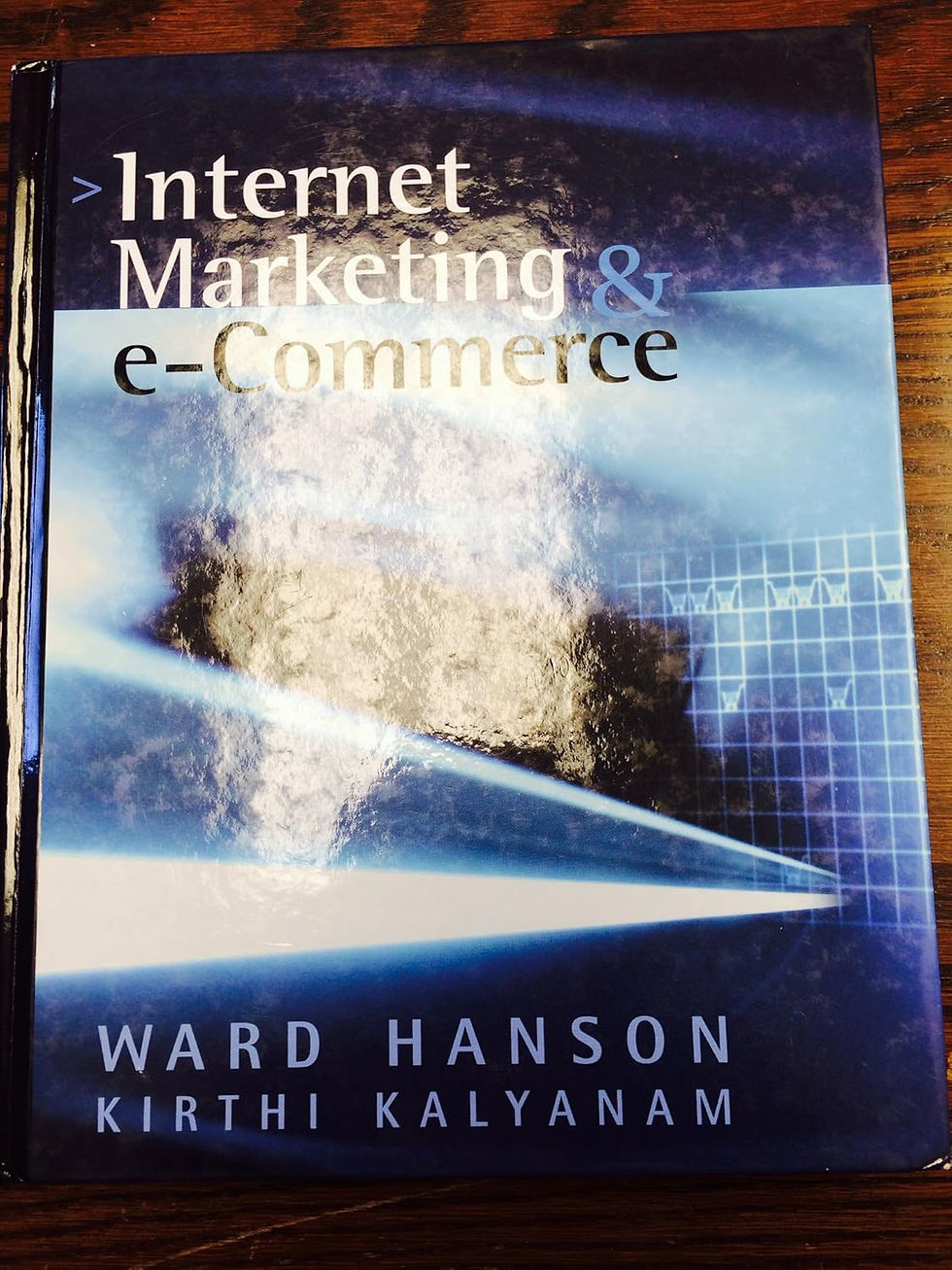
Internet Marketing & eCommerce
Authors: Ward Hanson and Kirthi Kalyanam
Short review
Internet Marketing & eCommerce provides a thorough introduction to how the internet has changed marketing, commerce, and business development. The book combines theory and practical examples in digital marketing, e-commerce, customer behavior, value creation, and digital business models. Although written at a time when the internet was still in its infancy, many of the fundamental principles are still highly relevant.
Why we recommend the book
This book was an important part of my own learning journey in digital marketing and e-commerce. It helped build my understanding of how technology, customer experiences and business strategy are interconnected – an insight that later became very important in my work with SAS, the Norwegian Opera & Ballet, Bærum Municipality and eventually the project The Invisible Capital. Many of the ideas about customer value, digitalization and innovation presented on the website have their roots in the knowledge this book conveys.

The Innovator's Solution: Creating and Sustaining Successful Growth
Authors: Clayton M. Christensen and Michael E. Raynor
Short review
In this sequel to The Innovator's Dilemma, Clayton Christensen shows how businesses can translate innovation theory into practical strategy. The book explains how companies can identify new growth opportunities, develop disruptive innovations, and build organizations that thrive in rapidly changing markets.
Why we recommend the book
While The Innovator's Dilemma explains why established businesses are often challenged, The Innovator's Solution provides concrete advice on how to meet the challenges. The book is therefore a natural next step for anyone who wants to understand innovation, strategy and long-term value creation.

The Innovator's DNA: Mastering the Five Skills of Disruptive Innovators
Authors: Jeff Dyer, Hal Gregersen and Clayton M. Christensen
Short review
What characterizes people who create groundbreaking innovations? The authors identify five key skills – observation, questioning, experimentation, networking and association – that are common to the world's most innovative leaders and entrepreneurs.
Why we recommend the book
This book shifts the focus from organizations to the people behind innovation. It shows that creativity and innovation can be developed through deliberate training and experience. The perspectives align well with the philosophy behind Invisible Capital, where human competence and curiosity are the most important drivers of development.

Competing Against Luck: The Story of Innovation and Customer Choice
Authors: Clayton M. Christensen, Taddy Hall, Karen Dillon and David S. Duncan
Short review
In this book, Clayton Christensen further develops the theory of Jobs to Be Done – the idea that customers do not primarily buy products, but "hire" them to solve specific needs. Through practical examples, the authors show how businesses can develop products and services that address customers' real-world challenges.
Why we recommend the book
For anyone working in customer experience, service design, and innovation, this is one of the most insightful books ever written. It reminds us that value creation always starts with understanding the people we are developing solutions for – a fundamental principle of Invisible Capital.

The Innovator's Dilemma: When New Technologies Cause Great Firms to Fail
Author: Clayton M. Christensen
Short review
The Innovator's Dilemma is considered one of the most influential books on innovation and technological change. Clayton M. Christensen introduces the theory of disruptive innovation and explains why even the most successful businesses can fail when new technologies and business models challenge established markets. Through a series of examples, he shows how companies often focus on today's customers and incremental improvements, while overlooking innovations that later change entire industries.
Why we recommend the book
This is one of the books that has had the greatest impact on modern innovation thinking. When I first read it, it gave me a whole new perspective on why some businesses succeed in transformation, while others lag behind – even when they are well led. The insight has been an important part of my own understanding of digitalization, innovation and change management, and many of the reflections in The Invisible Capital build on the ideas Clayton Christensen presents in this classic. The book is as relevant today, in the face of artificial intelligence and digital transformation, as it was when it was published.

Open Innovation: The New Imperative for Creating and Profiting from Technology
Author: Henry Chesbrough
Short review
Henry Chesbrough introduced the concept of Open Innovation and changed the way many businesses think about research and development. He shows how companies can create more innovation through collaboration with customers, universities, start-ups, suppliers and other external partners.
Why we recommend the book
Open Innovation has had a major influence on modern innovation thinking and was also an important topic during the seminars in Oxford and San Francisco. The book shows why future value creation occurs in the interaction between people, businesses and knowledge environments – not within closed organizations alone.

Blue Ocean Strategy: How to Create Uncontested Market Space and Make the Competition Irrelevant
Authors: W. Chan Kim and Renée Mauborgne
Short review
Blue Ocean Strategy challenges businesses to shift their focus away from fierce competition and instead create new markets with little or no competition. The authors present strategies and models that help organizations develop innovative products, services, and business models.
Why we recommend the book
This book has inspired leaders around the world to rethink strategy and innovation. Instead of competing for the same customers, it shows how businesses can create new value through creativity and differentiation. The perspectives align very well with the themes of innovation, digitalization, and long-term value creation in Invisible Capital.

Outside Innovation: How Your Customers Will Co-Design Your Company's Future
Authors: Patricia B. Seybold
Short review
Patricia Seybold shows how businesses can create better products and services by actively involving customers in the innovation process. The book describes how dialogue, co-creation and close collaboration with users can provide better solutions and stronger competitiveness.
Why we recommend the book
Customers often hold the most important insights into how products and services can be improved. This book emphasizes the importance of listening, involving, and learning from users – a perspective that is echoed in many of the articles on The Invisible Capital. Innovation rarely happens alone; it is created in the interaction between people.

Blown to Bits: How the New Economics of Information Transforms Strategy
Authors: Philip Evans and Thomas S. Wurster
Short review
This book analyzes how digital information is changing competitive conditions, markets, and business strategies. The authors explain how the internet is disrupting established structures and creating new opportunities for businesses that are able to think differently.
Why we recommend the book
Although written early in the internet revolution, the book describes many of the developments that still characterize business today. It provides valuable perspective on how digitalization affects value chains, competition, and innovation – themes that are central to Invisible Capital.

Wikinomics: How Mass Collaboration Changes Everything
Authors: Don Tapscott and Anthony D. Williams
Short review
Wikinomics shows how openness, sharing and collaboration across organizations create new forms of innovation and value creation. Through a number of international examples, the authors describe how digital networks make it possible to develop products, services and knowledge together.
Why we recommend the book
This book was groundbreaking when it was first published, and many of the ideas have since become a natural part of everyday digital life. The perspectives on collaboration, knowledge sharing, and open innovation processes align very well with the philosophy behind Invisible Capital, where people and networks are at the center of value creation.

© 2025 - 2026 Portico Publish | The invisible capital Privacy and use of the website | Developed and operated by Magne Bjella | Powered and secured by Wix


Comments