
Part 4 – From multichannel to unified commerce

When physical and digital commerce become one trading system
For many years, businesses have been building multiple sales channels as customers began to move between stores, online stores, mobile and customer service. First, it was about being present in multiple channels. Then, it was about making the channels better connected. In 2026, the development has gone one step further. The customer not only expects the channels to cooperate, but also expects the business to act as one whole. This is the background for the development from multichannel via omnichannel to unified commerce.

Table of contents
From multiple channels to one customer experience
Multichannel – the business becomes available in multiple locations
Omnichannel – channels begin to collaborate
Why omnichannel isn't always enough
Unified commerce – one trading system around the customer
The customer moves without thinking about the channel
Inventory status becomes part of the customer experience
The store gets a new role
The mobile connects the physical and digital trade together
Customer data and history must follow the customer
The organization must also be cohesive
Technology enables the whole
Unified commerce and value creation
What does this mean for the future of trade?
From multiple channels to one customer experience
The evolution from multichannel to unified commerce may at first glance appear to be a technological development. More systems are being connected, data flows faster and information becomes available across touchpoints. But the real driving force lies elsewhere: Customer behavior has changed.
Unified commerce means that a business brings together commerce across online, physical, mobile, inventory, payment, and customer service into one cohesive system. The goal is for the customer to encounter the same information, inventory, orders, and service no matter where they are in the customer journey.
The customer doesn’t necessarily move through a neat channel structure. She might discover a product on her mobile phone, research it further on a laptop, visit a physical store to view the item, order it digitally later that evening, and return it to the store a few days later. For the customer, these aren’t five different channels. It’s one transaction with one business.
This reality creates a problem if the business still organizes the customer journey by internal channels. The online store may have one inventory, the store another, and customer service may not have access to either. Then the business’s internal division becomes visible to the customer as friction.
"The customer moves between touchpoints. It is the business that has chosen to call them channels."
The development towards unified commerce is therefore about making the business's technology, data, processes and organization more similar to the reality the customer already lives in.
Multichannel – the business becomes available in multiple locations
Multichannel was an important step in the development of modern commerce. Businesses established multiple channels because customers wanted more ways to communicate and shop. The physical store was joined by the online store. Later came mobile, social media, apps and other digital touchpoints.
The advantage was obvious. The business became available in more places and could meet the customer in more ways. A customer who did not want to visit the store could shop online. Another could examine the products digitally before meeting in person.
The problem was that the channels were often developed separately. The online store could have its own systems, goals and employees, while the stores had theirs. Customer service could be organized like a third world. Each channel could work relatively well on its own without the business necessarily creating a cohesive experience.
This could lead to situations where the online store had different prices than the store, a product was available digitally without the store employee being able to see it, or a customer who had purchased online could not get help with their purchase physically.
Multichannel solved accessibility, but not necessarily coherence.
Omnichannel – channels begin to collaborate
Omnichannel emerged as an answer to this problem. Instead of simply offering many channels, businesses sought to make them work together around the customer.
This could involve the customer ordering online and picking up in store, checking local stock status digitally, or physically returning an online purchase. Customer service could gain greater access to information about the customer's digital purchases, and marketing could try to create more coherence between different touchpoints.
This represented an important shift. The question was no longer just how many channels the business had, but how the customer could move between them.
Omnichannel thus made the customer experience a more central organizing principle.
At the same time, it turned out that it is challenging to create a truly seamless customer journey if the infrastructure behind it still consists of separate systems. A business may want to offer one holistic experience, but if inventory, orders, customer information and prices are handled separately, the connection often has to be built through complicated connections between the systems.
This is one of the reasons why development has moved forward.

Why omnichannel isn't always enough
Omnichannel can in practice become an attempt to make many separate systems act as if they were one system.
This can work well, but the complexity increases as the number of touchpoints and systems grows. An online store may be connected to a separate ordering system, which in turn communicates with the store’s POS solution, inventory management, customer database, and carriers. Information must move quickly and accurately between all of these solutions if the customer is to receive a consistent response.
The problem becomes especially visible when something happens in real time. If the last item is sold in-store, how quickly is the online store updated? If the customer changes an order on their mobile, is the store notified? If the customer returns an item physically, are inventory, payment, and customer history updated simultaneously?
The more separate systems that need to be synchronized, the more places information can stop or be delayed.
Unified commerce attempts to reduce this fragmentation by building commerce around more common data and common transaction logic.
Unified commerce – one trading system around the customer
Unified commerce can be described as a further development of omnichannel where the business not only connects the channels together, but attempts to collect key parts of the trade in a common infrastructure.
This does not necessarily mean that the business uses only one software system. Modern commerce is too complex to always have everything in one solution. Instead, the principle is that the customer, order, inventory, and transaction are treated as part of the same commerce, regardless of where the customer is located.
An order can start on mobile and be completed in-store. A product can be reserved digitally and picked up in person. Customer service can see the same order as the store associate. Inventory can be treated as a single resource instead of separate inventories for online and physical stores.
This changes the business’s perspective. Instead of asking which channel “owns” the customer or transaction, the business can ask how it can most effectively solve the customer’s needs.
“Unified commerce is not about having more channels. It’s about stopping letting channels limit the customer experience.”
The customer moves without thinking about the channel
From the customer's perspective, much of the discussion about channels is artificial.
When a customer is researching a product on their mobile phone on their way to work, they are unlikely to think that they are now in the company’s mobile channel. When they later enter the store, this is not necessarily the start of a new customer journey. They are simply continuing what they were already doing.
This perspective is especially evident for customers who move quickly between digital and physical touchpoints. The customer may be standing inside the store with the website open on their phone. She may have information about the product that the employee does not have access to. She may also be able to compare prices with competitors while standing in front of the item.
Thus, digital and physical commerce are no longer sequential worlds. They exist simultaneously.
Businesses that manage to exploit this can turn the transition between touchpoints into a strength. Businesses that fail to do so risk the customer discovering the differences between the systems.
Inventory status becomes part of the customer experience
One of the most concrete examples of unified commerce is inventory information.
For the customer, the question seems simple: Is the item available or not?
For the business, the answer can be far more complicated. The product may be located in a central warehouse, in a store a few miles away, in a regional warehouse, or already reserved by another customer.
If the business manages to collect this information, the warehouse can be used much more flexibly. The customer can see where the item is, reserve it, pick it up locally or have it shipped from the nearest location.
Then inventory becomes not just an internal operating variable. It becomes part of the customer experience and competitiveness.
It can also create value for the business. Goods can be sold from places where they would otherwise be left lying around. Delivery distances can be reduced. Stores can be used as distribution points.
But this assumes that the inventory data is very good. If the customer travels to a store because the system says the item is available and it is not, the technology becomes a source of distrust.
Unified commerce therefore reinforces the importance of data quality.
The store gets a new role
The rise of e-commerce has long led to discussions about whether online stores would replace physical stores. The development has become more nuanced.
The store can have several roles at the same time. It can be a place for shopping, advice, inspiration, product testing, collection, returns, service and storage.
In a unified commerce perspective, the store therefore becomes part of a larger commerce infrastructure.
An associate can help a customer with a product that is not available locally and order it from another warehouse. A customer can pick up an online shopping order and make another purchase at the same time. A return can be processed on-site even if the purchase was originally made digitally.
This development can also change how businesses measure the value of a store. If a customer tries a product physically and then buys it digitally later, the store still has an impact on sales. If a store associate helps a customer with an online order, the value can’t be understood through the store’s checkout alone.
Thus, unified commerce challenges not only technology, but also the way businesses measure and organize value creation.
The mobile connects the physical and digital trade together
The mobile phone is perhaps the clearest symbol of why the distinction between physical and digital commerce has become difficult to maintain.
The customer carries the internet with them into the store.
She can search for information, read reviews, compare prices, find discount codes, check stock status and pay digitally while physically standing in front of the product.
The mobile phone can also be used by the business to connect the experience. The customer can receive information about an order, retrieve a digital membership card, identify themselves at pick-up, or use mobile payment in the store.
This fusion has been crucial to the development towards more connected commerce. When e-commerce was mainly done on a desktop PC at home, the distinction between online and in-store was clearer. Mobile made the two worlds simultaneous.
This development is now continuing with artificial intelligence. The customer may eventually have an intelligent assistant available on their mobile phone while they move through the physical store.
Customer data and history must follow the customer
A consistent customer experience often requires the business to recognize the customer across touchpoints.
For example, the customer expects customer service to be able to find her order, even if it was completed through another channel. A loyalty customer may expect benefits to apply both physically and digitally. If an item is returned in store, the information should also be available digitally.
This makes customer identity and customer data important parts of unified commerce.
But here too, an important dilemma arises. Technology makes it possible to connect ever more information about the customer, but the opportunity does not give the business an unlimited right to do so.
Privacy, security, and trust must be part of the architecture.
A seamless customer experience should make life easier for the customer, not create the feeling of being monitored.
Therefore, businesses must find a balance between personalization and respecting customer boundaries. This becomes even more important as artificial intelligence and more advanced analytics enable more and more inferences to be drawn from customer information.
The organization must also be cohesive
Technology alone does not create unified commerce.
If the online store, stores, marketing, customer service, and logistics are still working towards different goals, the systems can be integrated without the customer experience being.
For example, an employee in a store may perceive online shopping as a competitor if internal measurement rewards the store's own sales. In this case, the business can technically offer online ordering and in-store pickup, while the organization's incentives pull in the opposite direction.
This shows why channel strategy is also organizational strategy.
The business must define what it is collectively trying to achieve for the customer and how value creation will be measured. Employees need access to information, but they also need mandate, expertise and work processes that make it possible to use it.
“A business can integrate its systems in a few months. Integrating the organization can take much longer.”
This is where the invisible capital comes into play again. Collaboration, trust, culture, expertise and leadership are crucial if technological integration is to actually translate into a better customer experience.
Technology enables the whole
Unified commerce relies on the technological infrastructure we described in Part 3. Product information, payment, orders, inventory, logistics, and customer data must be able to work together.
The difference lies in what the infrastructure is intended to achieve.
In a traditional channel model, systems can be optimized for each individual channel. In unified commerce, they must be optimized to a greater extent for the customer and the overall transaction.
This requires rapid information flow and often more real-time data.
If the customer is to see the correct stock status, updates must be made quickly. If an order can be changed in store after it was started digitally, the systems must understand that it is still the same order.
The technology thus becomes a foundation that makes it possible to abstract the channels from the customer's perspective.
It's an important principle: The more complex the trading apparatus becomes behind the scenes, the simpler it should ideally be perceived on the outside.
Unified commerce and value creation
Unified commerce can create value on multiple levels.
For the customer, the value can lie in flexibility. She can choose where she searches, buys, picks up, returns or asks for help without having to understand how the business is organized.
For the business, better coherence can provide more efficient use of inventory, fewer duplicate systems, better data, and greater opportunity to optimize overall commerce.
It can also affect revenue. If the customer can easily find the item in another store or order it there and then, the business can avoid losing a sale. If returns are made easier, the customer may be more willing to shop again.
At the same time, unified commerce can be demanding and expensive to establish. Legacy systems may need to be replaced or integrated, processes changed, and the organization adapted.
Therefore, unified commerce is not automatically value-adding. As with other digitalization, the value must be assessed against customer needs, the business strategy, and the costs of the change.
The crucial thing is not to implement a modern concept.
The crucial thing is whether the business actually creates better and more efficient trade.
What does this mean for the future of trade?
The evolution from multichannel via omnichannel to unified commerce tells a larger story about digitalization.
First, the business adopted new technologies as its own channels. Then, it tried to connect the channels together. Eventually, the distinction between channels began to lose meaning.
The customer has already come a long way on this journey. She effortlessly shifts between physical and digital and expects the information to follow suit.
Businesses must now try to organize themselves in the same way.
In 2026, the question is not just how the online store works together with the physical store. It is about how the entire business can create one cohesive commerce around the customer.
And just as the business begins to get this infrastructure in place, a new shift occurs.
Artificial intelligence may begin to act between the customer and the trading system.
That brings us to the final planned installment of this series.

Next part: Part 5 – AI is changing e-commerce – from search and recommendations to intelligent shopping assistants and agent-based commerce
In the next part, we explore how AI is already impacting product search, recommendations, personalization, content, and customer service—and why the move toward AI agents could change the customer journey itself. When an intelligent assistant can understand a customer’s needs, compare products, and eventually take actions on their behalf, businesses may face a new question: What happens to e-commerce when the customer no longer has to navigate the entire shopping experience themselves?
Academic background and further specialization
This section builds on several academic tracks in The Invisible Capital . The study in eMarketing at BI Norwegian School of Business provides an early perspective on how the internet created new contact points between business and customer, while Innovation and Commercialization connects developments to innovation, implementation and new business models. The professional seminars in Oxford provide important perspectives on retail, customer behavior and customer experience, while San Francisco represents the meeting of technology, platforms and digital innovations that over time have blurred the boundaries between channels. Together, these perspectives show why modern commerce should not be primarily organized around the technology or channel, but around the customer and the value the business creates throughout the entire customer journey .
Recommended literature
The literature presented here spans several disciplines and periods. The books provide perspectives on digitalization, innovation and strategy , and show how technology, markets, organizations and people have been understood and developed over time. Some of the works are classics, others represent newer academic perspectives, but together they provide a useful basis for further in-depth study of the topics we work with at The Invisible Capital .

The Long Tail: Why the Future of Business Is Selling Less of More
Author(s): Chris Anderson
Short review
The Long Tail is one of the most influential books on how the internet has transformed commerce, marketing, and consumer behavior. Chris Anderson introduces the theory of the “Long Tail,” which explains how digital markets enable significant value creation through a large number of niche products, rather than relying on a few bestsellers.
The book shows how digital distribution, low inventory costs, search engines, and intelligent recommendation systems have made it profitable to offer an almost unlimited product range. Where traditional stores were limited by physical shelf space, online stores can offer millions of products and let customers find exactly what they are looking for.
Chris Anderson illustrates the theory with examples from Amazon, Netflix, Google, and the digital music industry, showing how the internet has changed the rules of competition for businesses around the world. Many of the insights have since become even more relevant through artificial intelligence, personalization, and modern search technology.
The authors take the reader through the entire process – from planning and organizing to publishing, managing and continuously improving content on websites and digital services. Although technology has evolved since the book was published, the principles of quality, relevance, management and long-term content work are at least as relevant in an era where search engines and artificial intelligence assess the credibility and usefulness of content.
Why we recommend the book
At The Invisible Capital, we consider The Long Tail to be one of the most important books in e-commerce, digitalization, and modern value creation.
The book explains why customers no longer just buy the most popular products, but increasingly find value in specialized products and services that meet individual needs. This insight has had enormous impact on the development of online stores, digital marketplaces, search engine optimization (SEO), information architecture, and content strategy.
Today we see that the theory also fits very well into the development of artificial intelligence. AI helps people discover relevant content, products and knowledge that were previously difficult to find. This has given the Long Tail principle a new dimension, where well-structured content and high professional quality are increasingly important for visibility, trust and value creation.
This is a book we believe everyone who works with e-commerce, digital marketing, customer experience, innovation, digital strategy or artificial intelligence should read.

Content Strategy for the Web (2nd Edition)
Author/authors: Kristina Halvorson and Melissa Rach
Short review
How do you create content that actually helps people – and at the same time supports your business goals? Content Strategy for the Web is considered one of the most influential books in the field of content strategy and digital communications. The book shows how good content does not arise by chance, but through a deliberate strategy where user needs, the organization's goals, structure, work processes and management are closely linked.
The authors take the reader through the entire process – from planning and organizing to publishing, managing and continuously improving content on websites and digital services. Although technology has evolved since the book was published, the principles of quality, relevance, management and long-term content work are at least as relevant in an era where search engines and artificial intelligence assess the credibility and usefulness of content.
Why we recommend the book
At The Invisible Capital, we believe that good content is one of the most important forms of invisible value creation. A website is far more than design and technology – it is the content that builds trust, creates great customer experiences and helps people find the answers they are looking for.
This book is perfect for leaders, communications consultants, content producers, web editors, UX designers, and anyone working with digital services. It shows why a clear content strategy leads to better user experiences, more effective interactions, and stronger digital results over time.
In an era where artificial intelligence is increasingly important in how information is discovered, understood, and communicated, this book is more relevant than ever. It reminds us that technology alone never creates value – it is good, structured, and relevant content that makes the difference.

Don't Make Me Think
Author: Steve Krug
Short review
Don't Make Me Think is one of the world's most influential books on usability and web design. Since its first edition in 2000, the book has helped designers, developers, content producers, and managers understand a simple but powerful principle: Good digital services should be intuitive. The user should be able to complete their task without having to stop and think about how the website works.
Why we recommend the book
This is one of the books that has had the greatest impact on my own work with digital services. Over the years – from SAS and the Norwegian Opera & Ballet to working on Bærum Municipality’s website – the principles in this book have been an important reminder that technology is never an end in itself. The goal is to make everyday life easier for the people who use the services. Despite the fact that the book was published many years ago, the message is just as relevant today.
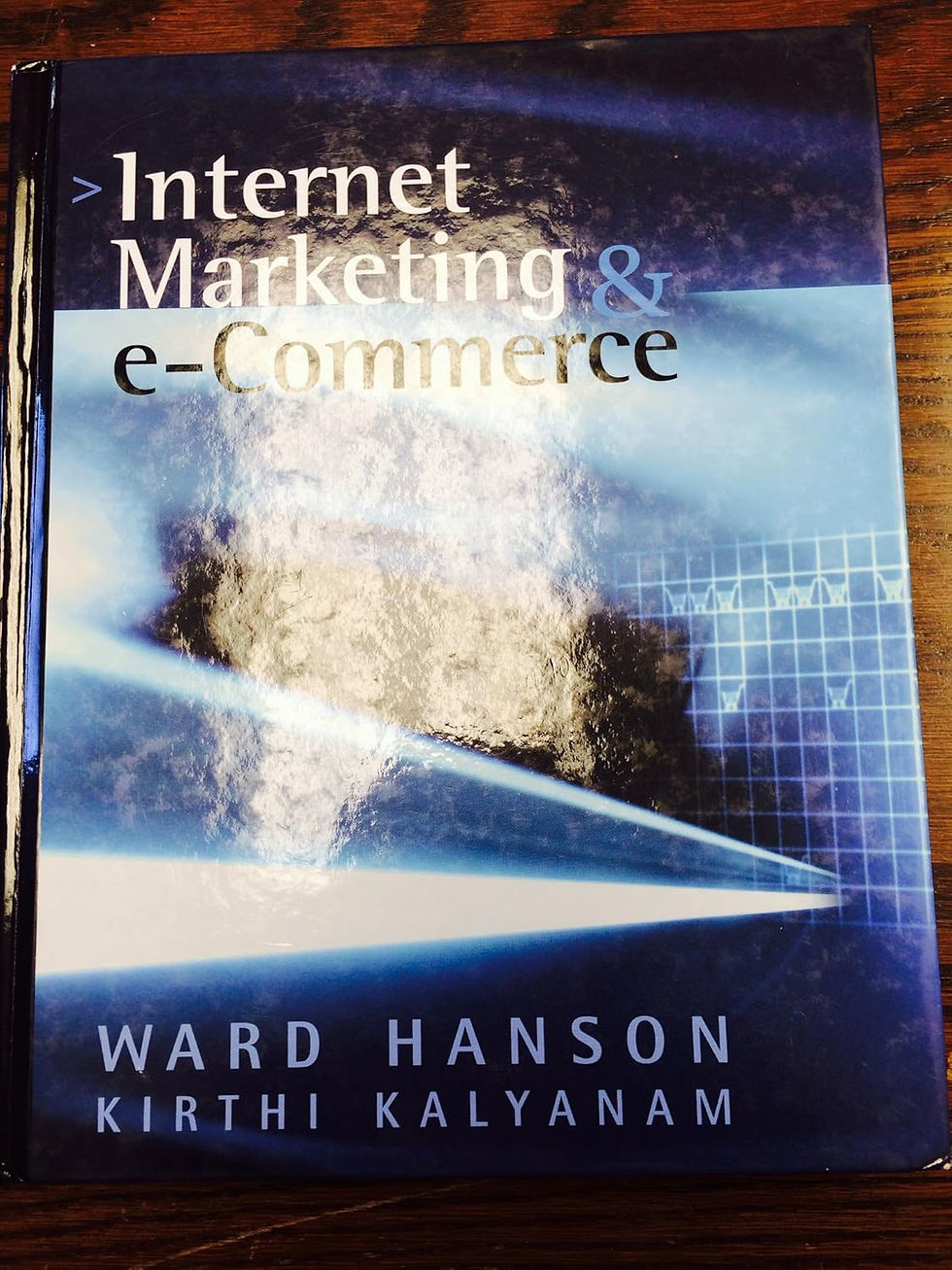
Internet Marketing & eCommerce
Authors: Ward Hanson and Kirthi Kalyanam
Short review
Internet Marketing & eCommerce provides a thorough introduction to how the internet has changed marketing, commerce, and business development. The book combines theory and practical examples in digital marketing, e-commerce, customer behavior, value creation, and digital business models. Although written at a time when the internet was still in its infancy, many of the fundamental principles are still highly relevant.
Why we recommend the book
This book was an important part of my own learning journey in digital marketing and e-commerce. It helped build my understanding of how technology, customer experiences and business strategy are interconnected – an insight that later became very important in my work with SAS, the Norwegian Opera & Ballet, Bærum Municipality and eventually the project The Invisible Capital. Many of the ideas about customer value, digitalization and innovation presented on the website have their roots in the knowledge this book conveys.

The Innovator's Solution: Creating and Sustaining Successful Growth
Authors: Clayton M. Christensen and Michael E. Raynor
Short review
In this sequel to The Innovator's Dilemma, Clayton Christensen shows how businesses can translate innovation theory into practical strategy. The book explains how companies can identify new growth opportunities, develop disruptive innovations, and build organizations that thrive in rapidly changing markets.
Why we recommend the book
While The Innovator's Dilemma explains why established businesses are often challenged, The Innovator's Solution provides concrete advice on how to meet the challenges. The book is therefore a natural next step for anyone who wants to understand innovation, strategy and long-term value creation.

The Innovator's DNA: Mastering the Five Skills of Disruptive Innovators
Authors: Jeff Dyer, Hal Gregersen and Clayton M. Christensen
Short review
What characterizes people who create groundbreaking innovations? The authors identify five key skills – observation, questioning, experimentation, networking and association – that are common to the world's most innovative leaders and entrepreneurs.
Why we recommend the book
This book shifts the focus from organizations to the people behind innovation. It shows that creativity and innovation can be developed through deliberate training and experience. The perspectives align well with the philosophy behind Invisible Capital, where human competence and curiosity are the most important drivers of development.

Competing Against Luck: The Story of Innovation and Customer Choice
Authors: Clayton M. Christensen, Taddy Hall, Karen Dillon and David S. Duncan
Short review
In this book, Clayton Christensen further develops the theory of Jobs to Be Done – the idea that customers do not primarily buy products, but "hire" them to solve specific needs. Through practical examples, the authors show how businesses can develop products and services that address customers' real-world challenges.
Why we recommend the book
For anyone working in customer experience, service design, and innovation, this is one of the most insightful books ever written. It reminds us that value creation always starts with understanding the people we are developing solutions for – a fundamental principle of Invisible Capital.

The Innovator's Dilemma: When New Technologies Cause Great Firms to Fail
Author: Clayton M. Christensen
Short review
The Innovator's Dilemma is considered one of the most influential books on innovation and technological change. Clayton M. Christensen introduces the theory of disruptive innovation and explains why even the most successful businesses can fail when new technologies and business models challenge established markets. Through a series of examples, he shows how companies often focus on today's customers and incremental improvements, while overlooking innovations that later change entire industries.
Why we recommend the book
This is one of the books that has had the greatest impact on modern innovation thinking. When I first read it, it gave me a whole new perspective on why some businesses succeed in transformation, while others lag behind – even when they are well led. The insight has been an important part of my own understanding of digitalization, innovation and change management, and many of the reflections in The Invisible Capital build on the ideas Clayton Christensen presents in this classic. The book is as relevant today, in the face of artificial intelligence and digital transformation, as it was when it was published.

Open Innovation: The New Imperative for Creating and Profiting from Technology
Author: Henry Chesbrough
Short review
Henry Chesbrough introduced the concept of Open Innovation and changed the way many businesses think about research and development. He shows how companies can create more innovation through collaboration with customers, universities, start-ups, suppliers and other external partners.
Why we recommend the book
Open Innovation has had a major influence on modern innovation thinking and was also an important topic during the seminars in Oxford and San Francisco. The book shows why future value creation occurs in the interaction between people, businesses and knowledge environments – not within closed organizations alone.

Blue Ocean Strategy: How to Create Uncontested Market Space and Make the Competition Irrelevant
Authors: W. Chan Kim and Renée Mauborgne
Short review
Blue Ocean Strategy challenges businesses to shift their focus away from fierce competition and instead create new markets with little or no competition. The authors present strategies and models that help organizations develop innovative products, services, and business models.
Why we recommend the book
This book has inspired leaders around the world to rethink strategy and innovation. Instead of competing for the same customers, it shows how businesses can create new value through creativity and differentiation. The perspectives align very well with the themes of innovation, digitalization, and long-term value creation in Invisible Capital.

Outside Innovation: How Your Customers Will Co-Design Your Company's Future
Authors: Patricia B. Seybold
Short review
Patricia Seybold shows how businesses can create better products and services by actively involving customers in the innovation process. The book describes how dialogue, co-creation and close collaboration with users can provide better solutions and stronger competitiveness.
Why we recommend the book
Customers often hold the most important insights into how products and services can be improved. This book emphasizes the importance of listening, involving, and learning from users – a perspective that is echoed in many of the articles on The Invisible Capital. Innovation rarely happens alone; it is created in the interaction between people.

Blown to Bits: How the New Economics of Information Transforms Strategy
Authors: Philip Evans and Thomas S. Wurster
Short review
This book analyzes how digital information is changing competitive conditions, markets, and business strategies. The authors explain how the internet is disrupting established structures and creating new opportunities for businesses that are able to think differently.
Why we recommend the book
Although written early in the internet revolution, the book describes many of the developments that still characterize business today. It provides valuable perspective on how digitalization affects value chains, competition, and innovation – themes that are central to Invisible Capital.

Wikinomics: How Mass Collaboration Changes Everything
Authors: Don Tapscott and Anthony D. Williams
Short review
Wikinomics shows how openness, sharing and collaboration across organizations create new forms of innovation and value creation. Through a number of international examples, the authors describe how digital networks make it possible to develop products, services and knowledge together.
Why we recommend the book
This book was groundbreaking when it was first published, and many of the ideas have since become a natural part of everyday digital life. The perspectives on collaboration, knowledge sharing, and open innovation processes align very well with the philosophy behind Invisible Capital, where people and networks are at the center of value creation.

The Competitive Strategy: Techniques for Analyzing Industries and Competitors
Author(s): Author: Michael E. Porter
Short review
Competitive Strategy is Michael E. Porter's classic work on how companies can understand the competition they find themselves in and develop a position that provides a basis for long-term profitability. Porter shifts the focus from the individual competitor to the structure of the entire industry and shows how competition is affected by customers, suppliers, new entrants, substitutes and the rivalry between existing companies. This forms the basis for what has later become known as Porter's Five Forces. The book is also about how companies can choose a competitive strategy on the basis of this analysis. It thus established an analytical language for strategy that has gained great importance in both research, teaching and practical strategy work.
Why we recommend the book
We recommend Competitive Strategy because it provides the analytical foundation for much of the thinking Porter later develops in What Is Strategy?. If a company is to choose a unique strategic position, it must also understand the competitive forces, the industry structure and the factors that affect the ability to create and retain value. The book is particularly useful because it reminds us that strategy is not just about internal goals, plans and ambitions. Strategy must be developed in the face of customers, competitors, suppliers, technology and structural changes in the market. Together with What Is Strategy?, the book therefore provides a much richer picture: First, the company must understand the competitive arena. Then, it must choose how to be different.

Competitive Advantage: Creating and Sustaining Superior Performance
Author(s): Author: Michael E. Porter
Short review
In Competitive Advantage, Porter moves the analysis from the industry to the business itself. The main question is how competitive advantage is actually created. One of the book's most important contributions is the value chain, where the business is understood as a system of activities that collectively develop, produce, market, deliver and support a product or service. Competitive advantage cannot therefore be understood only through products or overall strategies; one must examine the activities that create costs, differentiation and value. This understanding later becomes central to Porter's argument about strategic fit: the activities must not only be good in isolation, but also fit together and reinforce each other.
Why we recommend the book
We recommend Competitive Advantage because it brings strategy right down to where value is actually created: in the activities the business performs. This makes the book particularly relevant together with What Is Strategy?. When Porter argues in 1996 that strategy consists of performing different activities than competitors, or performing similar activities in other ways, this builds on the thinking he developed here. For our perspective on value creation, this is particularly interesting. Value does not arise because the business has formulated a strategy on a document, but through people, expertise, technology, processes, collaboration and activities that together enable the business to create something that customers value. The book therefore provides an important connection between strategy, competitive advantage and actual value creation.

The Competitive Advantage of Nations
Author(s): Author: Michael E. Porter
Short review
In The Competitive Advantage of Nations, Porter raises the perspective from business to countries, regions and business environments. The book is based on extensive studies of the competitiveness of ten leading trading nations and examines why certain countries and business clusters are particularly successful in certain industries. A central premise is that national prosperity is not simply something a country inherits through natural resources or other given conditions. It is created, and productivity, innovation, competence, competition and the quality of the environment in which businesses operate are crucial. Here, Porter also develops the well-known diamond model to explain how different national and regional conditions can interact and stimulate competitiveness.
Why we recommend the book
We recommend The Competitive Advantage of Nations because here Porter extends the strategy perspective to the ecosystem surrounding the business itself. Value creation does not occur in a vacuum. Businesses develop in societies with education, research, infrastructure, capital, suppliers, demanding customers, competing businesses and public institutions. This makes the book particularly interesting for understanding value creation as an interaction between people, businesses and society. It also provides an important corrective to the notion that a country's competitiveness can mainly be understood through low costs or access to natural resources. Innovation, productivity and the ability to continuously develop are far more central to Porter's explanation.

Understanding Michael Porter: The Essential Guide to Competition and Strategy
Author: Joan Magretta
Short review
Understanding Michael Porter brings together and explains the most important parts of Michael Porter's strategic thinking in one accessible whole. Joan Magretta herself worked on strategy at the Harvard Business Review and organizes Porter's ideas around two fundamental questions: What is competition, and what is strategy? She explains, among other things, the Five Forces, competitive advantage, the value chain, value creation, trade-offs, fit, and strategic continuity. This makes the connection between Porter's various works clearer than when the concepts are studied separately. The book also includes an interview with Porter.
Why we recommend the book
We recommend Understanding Michael Porter because it helps the reader see the whole picture of Porter's understanding of strategy. Porter is often reduced to the Five Forces or a few models used in isolation. Magretta shows why this is too simple. Competition, value creation, strategic positioning, trade-offs, activity systems, fit and continuity are interconnected. This makes the book a particularly good supplement after reading What Is Strategy?. It makes it easier to understand why Porter does not view strategy as a plan or a collection of goals, but as a coherent system of choices about how the business will create value and compete over time.

HBR's 10 Must Reads on Strategy
Authors: Harvard Business Review, Michael E. Porter, W. Chan Kim, Renée A. Mauborgne and more
Short review
HBR's 10 Must Reads on Strategy brings together some of Harvard Business Review's most influential writings on strategy. The original collection from 2011 features Michael E. Porter's What Is Strategy? as its main article and combines it with works on competitive forces, Blue Ocean Strategy, the organization's vision, business models, strategy execution, and the Balanced Scorecard, among others. The result is not one unified theory of strategy, but multiple perspectives on how organizations can develop, formulate, and execute strategy.
Why we recommend the book
We recommend HBR's 10 Must Reads on Strategy because it places Porter in a broader strategic context. After reading What Is Strategy?, it will be interesting to encounter other central perspectives and see how they complement, challenge, or extend Porter's understanding. The collection also shows why strategy cannot be reduced to a single model. Competitive position, choice, innovation, business model, execution, priorities, and measurement must be seen in context. For the reader who wants to move on from Porter and into the strategy discipline more generally, this is therefore a very good introduction.

Creating a Learning Society: A New Approach to Growth, Development, and Social Progress
Author: Joseph E. Stiglitz and Bruce C. Greenwald
Short review:
Creating a Learning Society examines how knowledge, learning, and technological development contribute to economic growth and long-term value creation. Joseph E. Stiglitz and Bruce C. Greenwald challenge the notion that economic development is primarily about accumulating more physical capital. They argue that society’s ability to create, disseminate, and apply knowledge is crucial to productivity growth and improved living standards. A key point is that learning does not only occur in schools and universities. It also occurs in businesses, through work, production, innovation, and the interaction between people and organizations. Knowledge can also spread from one business and one part of the economy to others.
The book thus provides an important perspective on why human capital, competence, innovation and learning must be understood as central parts of a society's ability to create value over time.
Why we recommend the book
We recommend Creating a Learning Society because it expands the understanding of what lies behind economic value creation.
Machines, technology and financial capital are important, but they do not create productivity growth alone. Behind the development are people who learn, develop knowledge, improve work processes, share experiences and find new solutions.
This makes the book particularly relevant to Invisible Capital and our perspective on value creation: A significant part of society's value-creating capacity is found in the knowledge, competence, and learning ability of the people who participate in the economy.
Stiglitz and Greenwald thus provide an academic foundation for one of the most important relationships in modern value creation:

The Value of Everything: Making and Taking in the Global Economy
Author: Mariana Mazzucato
Short review
In The Value of Everything, Mariana Mazzucato asks a fundamental question: What exactly is value – and who creates it? Mazzucato returns to the historical discussions of value in economics and shows how the understanding of value creation has changed. She challenges the notion that high income, high prices or large profits necessarily mean that correspondingly large values have been created. One of the book's most important contributions is the distinction between value creation and value extraction . Mazzucato examines the financial sector, the pharmaceutical industry, innovation and the public sector, among others, and argues that we must become better at distinguishing between activities that actually create new values, and activities that primarily extract values that have already been created.
The book also challenges the traditional notion that the private sector creates value while the public sector mainly consumes or redistributes it. Innovation and economic development often arise through a complex interaction between public investment, research, businesses, capital and people.

The Power of Creative Destruction: Economic Upheaval and the Wealth of Nations
Author: Philippe Aghion, Céline Antonin and Simon Bunel
Short review
The Power of Creative Destruction is about one of the most important drivers of long-term economic growth: innovation.
Philippe Aghion, Céline Antonin and Simon Bunel build on Joseph Schumpeter's classic idea of "creative destruction" – the process by which new technologies, businesses, products and ideas challenge and replace existing solutions.
But the book is not just about the disappearance of the old. The authors examine why some economies manage to create continuous innovation and productivity growth, while others stagnate. Competition, entrepreneurship, research, education, institutions and public policy thus become important parts of the explanation.
Creative destruction also comes at a cost. New technologies and businesses create opportunities and jobs, but can also make existing skills, tasks and business models less relevant. The challenge is therefore to create societies that both promote innovation and enable people to participate in the transition.
Why we recommend the book
We recommend The Power of Creative Destruction because it shows why innovation is a fundamental driver of value creation .
Value creation is not just about producing more of what we already produce. It also occurs when people develop new ideas, technology, and ways of working that enable us to solve tasks better than before.
This makes the book particularly relevant to The Invisible Capital. Behind innovation are people with knowledge, expertise, creativity and experience. But Aghion's perspective also shows that human capital must be part of a larger system where competition, institutions, research, investment and policy create the conditions for new ideas to actually turn into economic and social development.
The book thus provides an important context in our understanding of value creation:
Knowledge → new ideas → innovation → productivity growth → long-term value creation.

Institutions, Institutional Change and Economic Performance
Author: Philippe Aghion, Céline Antonin and Simon Bunel
Short review
Institutions, Institutional Change and Economic Performance is one of Douglass C. North's most important works on why some societies are more successful than others in creating economic development over time.
North shifts attention from traditional factors of production such as capital and labor to the institutions that shape how people, businesses, and governments act and cooperate. Institutions are society's formal and informal rules of the game – including laws, regulations, norms, traditions, and established ways of organizing interaction.
These rules of the game affect the incentives that people and organizations face. They also affect investments, knowledge development, cooperation, transaction costs, and which economic activities emerge.
North also shows that institutions develop over time. History therefore matters: Today's economic opportunities are influenced by institutional choices and development paths that can stretch far back in time.
Why we recommend the book
We recommend Institutions, Institutional Change and Economic Performance because it explains a crucial aspect of value creation that easily becomes invisible:
Value creation needs good rules of the game.
People may have knowledge. Businesses may have capital. Entrepreneurs may have great ideas. A society may have natural resources and advanced technology. But outcomes are also influenced by the institutions that determine how people can collaborate, invest, compete, make deals, and develop businesses.
This makes North particularly interesting for our understanding of trust as part of invisible capital. Trust is not the same as institutions, but stable rules of the game, credible agreements, and well-functioning institutions can reduce uncertainty and make economic interaction easier.
North thus gives us another important part of the value creation picture:
Institutions → predictability and incentives → cooperation and investment → productive activity → long-term value creation.

© 2025 - 2026 Portico Publish | The invisible capital Privacy and use of the website | Developed and operated by Magne Bjella | Powered and secured by Wix


Comments