
Part 47 - AI-Buddy.....How do we build theme clusters?

From individual articles to coherent knowledge

A good article can answer a single question very well. A topic page can provide an overview of a larger subject area. But as the universe of knowledge grows, we also need a way to show which articles belong together academically .
This is where theme clusters come in.
A topic cluster gathers content around a clear main theme. Each article addresses its own question, but the articles are connected because they illuminate different parts of the same knowledge.
A thematic cluster is therefore not primarily about producing more content. It is about organizing existing and new content so that the connections become clear.
For the reader, this can make it easier to move from one question to the next. For the website, it creates a clearer information architecture. And for search engines and other systems that analyze content, clear headings, descriptive links, and logical connections can make the relationships between pages easier to interpret.
A topic cluster is thus not just a collection of articles.
It becomes a network of knowledge .
Magne & the Friend
Magne
Friend...
In the previous article, we built theme pages.
And I actually thought we had gotten our knowledge pretty well organized.
Now you come and say that we also need theme clusters.
Haven't we organized enough soon?
The buddy
Heh heh.
The theme page and the theme cluster actually solve two slightly different tasks.
Magne
How then?
The buddy
The theme page gives the reader the overview .
The theme cluster shows the connections between the content .
Magne
Give me an example.
The buddy
Let's use artificial intelligence.
We can have an overall theme page about AI.
But under it we can have a group of articles about how AI learns.
Another group could be about how AI finds and uses information.
A third could be about AI and content strategy.
Magne
And each of these groups is a thematic cluster?
The buddy
Yes.
They consist of different articles.
But the articles answer questions that are academically related.
Magne
So we don't group articles just because they contain the same words?
The buddy
No.
And that's important.
A good topic cluster is based on semantic coherence , not just on similar keywords.
Magne
I like that.
Because two articles can use different words and still be about almost the same thing.
The buddy
Exactly.
And the opposite can also happen.
Two articles may contain the same word, but actually be about completely different things.
We start with a main theme
Magne
How do we build the cluster itself?
The buddy
We begin with a clear main theme.
Not with the articles.
Magne
Why that?
The buddy
Because we first need to know what area of knowledge we are trying to explain .
Let's say:
AI and content strategy.
So we ask:
What does a person need to understand in this area?
Magne
Theme pages?
Theme clusters?
Internal links?
How is knowledge organized?
The buddy
Yes.
And eventually perhaps content planning, updating existing content and how AI can be used in the work process itself.
Now we are starting to see the cluster.
One question per article

Magne
But why not just write one giant article about everything?
The buddy
Because different questions often deserve different answers.
If one article tries to explain everything...
It becomes more difficult to go into depth.
Magne
So one article should still have one clear main thesis?
The buddy
Yes.
For example:
How do we build theme pages?
is one question.
How do we build theme clusters?
is another.
And:
How do we create good internal links?
could be a third.
Each article should be able to stand on its own two feet.
But together they should provide greater understanding.
Magne
That's where I start to see the point.
The value lies both in each article...
and in the connections between them.
The buddy
Just.
That is the very idea behind a theme cluster.
Internal links create the connections
Magne
Then internal links will come back again.
The buddy
Of course, heh heh.
But now we see more clearly why they are important.
An internal link shouldn't just say:
Click here.
It should help the reader understand why another article is relevant .
Magne
So does the link text matter?
The buddy
Yes.
Consider the difference between:
Read more here
and:
Read how we build themed pages
The second tells both humans and machine systems more about what the connection is about.
Magne
Then the link becomes almost a small professional explanation.
The buddy
It could be.
Good internal links create pathways through knowledge.
A theme cluster is not necessarily a hierarchy
Magne
But are all the articles under one main article?
The buddy
Not necessarily.
It's tempting to draw everything as a perfect tree:
Main page.
Underside.
Underside.
Underside.
But knowledge doesn't always behave like that.
Magne
No.
We discovered that when we built the theme pages.
The buddy
Yes.
An article about trust may be relevant to customer experience.
But also for management.
AI.
Brand.
And value creation.

Magne
So can one article be included in several academic contexts?
The buddy
Absolutely.
As long as the connections are real and useful to the reader.
Thematic clusters should therefore not become artificial boxes into which we push knowledge.
They should make natural professional connections visible .
Academic specialization
From topic clusters to knowledge structure
The term topic cluster is widely used in digital content strategy and SEO. The classic model often consists of a broad main topic, a central page, and several more specific pages that are connected through internal links.
The model is useful because it shifts attention from individual pages to systematic coverage of a subject area .
But a modern topic cluster should be understood more broadly than a pure SEO technique.
When we build a universe of knowledge, the goal is not to produce a certain number of articles around a keyword. The goal is to identify the questions, concepts, and contexts a person needs to understand a subject area.
This means that the thematic cluster should be built academically before it is built technically .
Start with the questions – not the keywords
Keywords can provide valuable insight into how people formulate needs and questions. But keywords alone do not necessarily tell how a subject area should be organized.
A better start might be to ask:
What is the reader trying to understand?
What basic concepts need to be explained?
Which questions naturally follow one another?
Where does the reader need in-depth information?
Which articles have a real academic connection?
Then we build the structure around the user's knowledge needs , not just around words that appear in a search tool.
Theme page and theme cluster are not the same
This distinction is important.
A topic page is a specific page that provides an overview of a subject area and leads to relevant content.
A topic cluster is the actual group or network of related content.
We can therefore think:
The theme page shows the landscape.
The theme cluster describes which parts of the landscape belong together.
And internal links build the paths between them.
From hierarchy to network
Traditional websites are often organized hierarchically:
Website → category → subpage → article
It is still a useful structure.
But knowledge also has a network structure.
An article can be relevant in multiple contexts, and a single concept can connect multiple disciplines. Therefore, a knowledge universe should combine an understandable hierarchy with meaningful connections across disciplines.
This is where theme clusters get their strength.
They help us see content as a network of relationships , not just as pages placed in folders.
What does this mean for search engines and AI?
Here again we should be careful with strong claims.
There is no simple rule that a particular topic cluster model automatically gives good rankings in search engines or causes content to be used in AI-generated answers.
But clearly organized content has several general benefits.
Descriptive headings make the topic clearer. Good internal links make relevant connections visible. Consistent terminology reduces ambiguity. Theme pages provide context. And articles that actually cover different parts of a subject area create greater scholarly breadth.
This is primarily good for people.
But it also creates a clearer information structure that search and AI systems can analyze.

The most important test
When considering whether an article belongs in a topic cluster, we can ask one simple question:
Will this connection help the reader understand the topic better?
If the answer is yes, the connection probably has a function.
If the answer is simply:
"We want an extra internal link"
We probably started at the wrong end.
A good theme cluster is not built for the algorithm.
It is built for understanding .
From single article to topic cluster
How the knowledge structure grows
Level | Task | Example |
Question | Identifies what the reader wants to understand | How do we build theme pages? |
Article | Answers one specific question thoroughly | A professional article about theme pages |
Theme cluster | Collects professionally related articles | AI and content strategy |
Theme page | Provides overview and inputs to knowledge | Content strategy overview |
Knowledge universe | Connects multiple disciplines and theme clusters together | The entire KI series |
What characterizes a good thematic cluster?
From random linking to professional context
Characteristics | What does that mean? | Why is it important? |
Clear main theme | The cluster has a clear academic center | Make it understandable what the content is all about |
Bounded questions | Each article has its own main task | Reduces unnecessary overlap |
Academic context | The articles highlight different aspects of the same topic. | Creates wholeness and immersion |
Natural internal links | The pages are linked when the connection is relevant | Helps the reader further |
Descriptive link texts | The link explains what the reader will find next. | Provides better context |
Good coverage | Important questions within the topic are identified | Reveals knowledge gaps |
Opportunity for development | New articles can be linked as knowledge grows. | Make the structure come alive over time |
Technical terms
Key concepts when building thematic clusters
English technical term | Explanation |
Topic Cluster | A group of professionally related articles and pages that collectively cover different questions and perspectives within a larger topic. |
Cluster Content | A more specific article or page that addresses one specific question within a larger topic cluster. |
Pillar Content | Broad and general content that provides an introduction or overview of a larger topic and can act as a central hub to more specific pages. |
Semantic Relationship | A semantic connection between concepts, questions or content that is based on what they are actually about, not just on identical words. |
Internal Linking | The use of links between pages on the same website to help the user find related content and highlight connections between knowledge elements. |
Anchor Text | The visible and clickable text in a link. Descriptive link text can make it clearer what the target page is about. |
Topic Coverage | How well a website or topic cluster addresses the relevant questions and sub-areas within a particular topic. |
Content Gap / Knowledge Gap | A relevant question, perspective, or subtopic that is not yet sufficiently explained in the existing knowledge structure. |
Information Architecture | Organizing and structuring information so that content, relationships, and navigation are easier to understand and use. |
Knowledge Network | A structure where articles, concepts and topics are understood as interconnected knowledge elements rather than isolated documents. |
We have only just begun.
Magne
Friend...
Now I'm starting to see our website in a slightly different way.
Before, I mostly thought:
Here is an article.
And there lies another one.
The buddy
While now?
Magne
Now I see the connections.
An article answers one question.
Several questions form a theme.
The themes form clusters.
And the clusters begin to form an entire universe of knowledge.
The buddy
Then you have got the most important thing.
Magne
But there's one thing I'm still wondering about.
We've talked a lot about internal links.
If they are indeed the paths between knowledge...
Surely it must matter quite a bit how we make them?
The buddy
Very much.
Because a bad internal link can be almost meaningless.
While a good internal link can help the reader discover exactly the knowledge needed to understand the next step.
Magne
So it's not enough to just sprinkle "read more" links around?
The buddy
Heh heh.
No.
We need to understand where we should link, why we should link and what the link text itself should say .
Magne
Then I think I know what we need to investigate further.
The buddy
You probably do.
Because once we have built the theme clusters...
We must build good paths between knowledge.
And buddy...
We have only just begun.


Recommended literature
Developments in artificial intelligence are moving faster than perhaps any other field of study in our time. No single book can provide all the answers, but good books can provide a solid foundation for understanding the technology, the opportunities, and the challenges.
In the KI-Kompis series, we therefore recommend a selection of books that illuminate artificial intelligence from different perspectives – technology, strategy, management, innovation, ethics, digitalization and practical application. Together, they provide a broader understanding of how artificial intelligence affects people, businesses and society.
Click on the book icon to see the full literature overview with recommended books on artificial intelligence.
Recommended books from our library

AI Engineering
Author: Chip Huyen
Short review
AI Engineering is one of the most relevant books on how artificial intelligence is developed and put into practice. Chip Huyen explains how language models, data, machine learning, and modern work processes can be combined to build robust AI solutions. The book provides both a strategic and practical perspective on how businesses can create value with artificial intelligence.
Why we recommend the book
This is a book for those who want to move from understanding artificial intelligence to understanding how it is actually developed, implemented, and creates value. One of the strongest books we have found on the practical use of artificial intelligence.
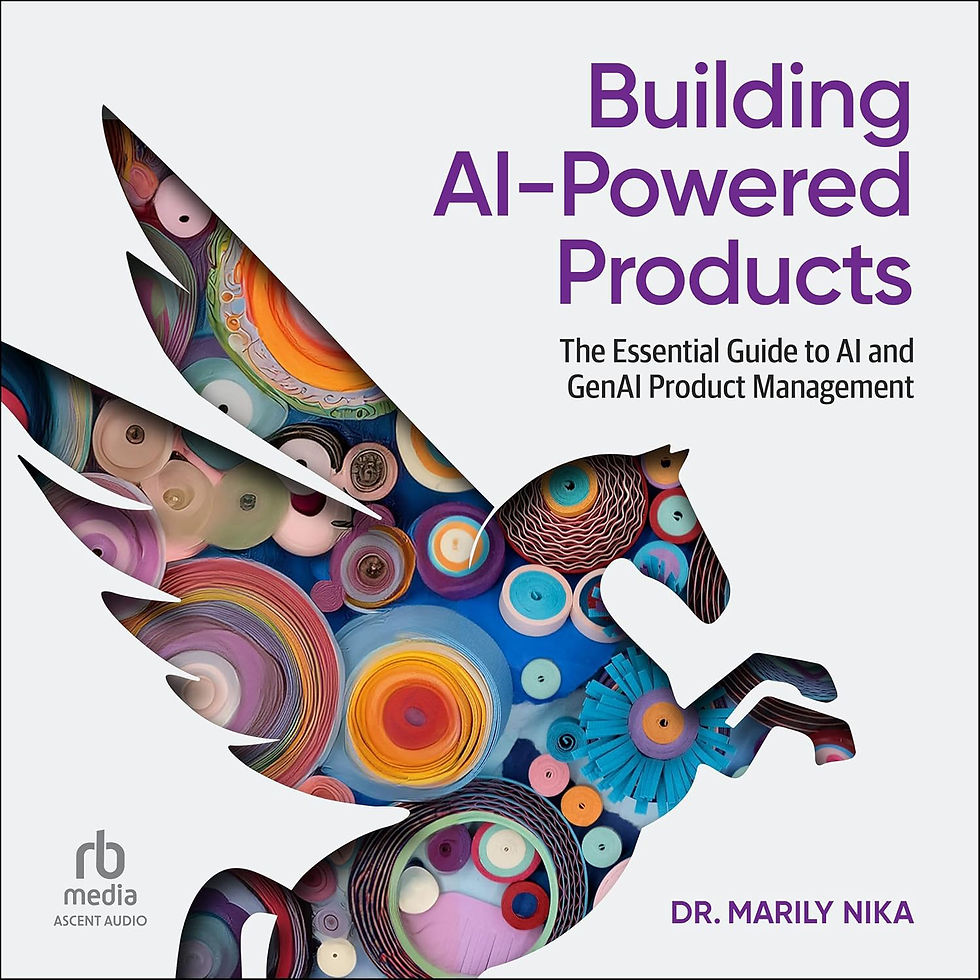
Building AI Powered Products
Author: Marily Nika
Short review
Building AI Powered Products shows how artificial intelligence can be used to develop smarter products, services, and digital customer experiences. Marily Nika combines technology, product development, and innovation in an easy-to-read book full of practical, real-world examples.
Why we recommend the book
A book that is perfect for anyone working with digitalization, innovation, product development and user experiences. It shows how artificial intelligence can be used to create products people actually want to use.

Prompt Engineering for Generative AI
Writers: James Phoenix and Mike Taylor
Short review
Prompt Engineering for Generative AI is a practical guide that teaches you how to communicate better with language models like ChatGPT, Claude, Gemini, and other generative AI tools. Through concrete examples, the authors show how good prompts produce more precise, creative, and useful responses.
Why we recommend the book
One of the most practical books on prompt engineering. Perfect for anyone who wants to work more effectively with artificial intelligence and get significantly better results through smarter questions and clearer instructions.

© 2025 - 2026 Portico Publish | The invisible capital Privacy and use of the website | Developed and operated by Magne Bjella | Powered and secured by Wix


Comments