
Part 46 -AI-Buddy...How do we build theme pages?

A good topic page is not just a table of contents. It shows how the knowledge is interconnected.

As a website grows, a new problem arises.
It won't necessarily be difficult to create more content. It will be more difficult to find, understand, and navigate the knowledge that already exists.
A single article can provide a very good answer to a question. But when a subject area consists of ten, twenty, or a hundred related articles, the reader needs something more: a place that creates an overview.
This is where the theme page comes in.
A good topic page doesn't just collect links. It explains the subject area, shows the most important subtopics, and helps the reader navigate to the relevant knowledge.
At the same time, the theme page creates a clearer structure on the website. It can make the connections between content easier to understand for people, search engines, and systems that analyze and retrieve information from the web.
The theme page thus becomes a map of knowledge.
Magne & the Friend
Magne
Friend...
Now we have spent quite a lot of time writing articles.
And gradually there are starting to be many of them.
The buddy
Hehe...
It's usually a pleasant problem.
Magne
Yes.
But that's actually a problem too.
Because how is a new reader supposed to know where to start?
The buddy
There you have the entire rationale for theme pages.
Magne
So a theme page is a kind of table of contents?
The buddy
Partial.
But if we just make a long list of links...
We've really just moved the problem.
Magne
How then?
The buddy
Imagine you enter a library for the first time.
And the librarian says:
"Here are 500 books. Good luck."
Magne
hahaha
Not the best librarian in the world.
The buddy
Exactly.
A good theme page should do the opposite.
It should say:
This is what the subject area is about.
This is where you should start.
These are the most important parts.
And here you can continue if you want to learn more.
Magne
So the theme page should actually explain something itself?
The buddy
Absolutely.
There is an important difference.
A theme page shouldn't just be navigation.
It should also give the reader enough context to understand what the subject area is about and how the parts are connected.
Magne
Let's use artificial intelligence as an example.
We have many articles about AI.
The buddy
Perfect example.
A reader may ask the question:
What is artificial intelligence?
Another wants to know:
How does artificial intelligence learn?
A third:
How does AI use information?
And a fourth one might be interested in:
How should businesses use AI?

Magne
And if all those articles are just piled up...
The buddy
...the reader must find the connection themselves.
A theme page does that job for the reader.
From articles to structure
Magne
How do we start then?
The buddy
Not with the design.
We start with knowledge.
Magne
That sounds familiar.
The buddy
Hehe...
First we ask:
What is the main theme?
Then:
What subthemes does it consist of?
And then:
What questions do we need to answer within each sub-theme?
Magne
So if the main topic is artificial intelligence…
For example, can we have sub-themes about how AI works, how people learn, how AI uses knowledge, and how businesses can use the technology?
The buddy
Exactly.
Then we start to get a structure.
We start from:
a collection of articles
to:
an organized field of study.
The theme page is the map.
Magne
I'm starting to understand why you call the theme page a map.
The buddy
Yes.
Consider a tourist coming to Oxford for the first time.
The map is not Oxford itself.
Magne
It would have been a pretty big map.
he he
The buddy
But the map shows how to find your way.
Where the city center is located.
Where the universities are located.
Where the river goes.
And which roads connect the places.
Magne
And the theme page does the same with the knowledge?
The buddy
Just.
The articles contain the knowledge.
The theme page shows the landscape.
A theme page needs hierarchy
Magne
But can't we just put all the articles on the same level?
The buddy
We can.
But then we miss much of the point.
Some questions are basic.
Others require the reader to already know the basics.

Magne
As in teaching.
The buddy
Yes.
You don't usually start an economics course with the most advanced model.
You build understanding gradually.
A good theme page can do the same.
For example:
Start here
↓
Basic understanding
↓
Immersion
↓
Practical application
↓
Further learning
Magne
Then the theme page becomes almost a learning journey.
The buddy
That is exactly what it can become.
Internal links tie knowledge together
Magne
But now your favorite word comes up again.
Internal links.
The buddy
he he
Of course.
But internal links have an important task.
They should not just move people from side A to side B.
They must show professional connections.
Magne
Example?
The buddy
If we write about continuous learning...
It might be natural to link to an article about knowledge sharing.
And from there perhaps on to psychological security.
The link actually says:
These knowledges are interconnected.
Magne
And the theme page brings together all these connections?
The buddy
Yes.
It acts as a hub.
What about search engines and AI?

Magne
Then comes the question I know you're waiting for.
The buddy
I have no idea what you mean.
Magne
he he
What does this mean for Google and artificial intelligence?
The buddy
We need to be a little precise here.
A good structure is primarily made for people.
But clear headings, descriptive links, logical content groups, and clear relationships between pages also give machine systems more structure to work with.
Magne
But we shouldn't create themed pages just because we think an AI likes them, right?
The buddy
No.
That would be starting at the wrong end.
First, create a structure that makes the knowledge understandable to people.
At the same time, we create many of the signals that make the content easier to interpret by machine.
Magne
I like that.
Human first.
The buddy
Always.
Academic specialization
A topic page can be understood as a central level in a website's information architecture. It organizes a larger subject area into smaller, meaningful parts and creates connections between the overall context and more specific articles.
It is important to distinguish between a topic page and a regular article. An article should normally deal in depth with a specific question or topic. The topic page has a different purpose: It should provide an overview of a larger area of knowledge and help the user choose where to go next.
A good topic page should therefore contain more than a list of articles. It should explain what the subject area encompasses, organize the content into understandable subtopics, and provide short descriptions that make it clear what the reader will find behind each link.
From hierarchy to coherence
Traditional information architecture is often described hierarchically:
Website → main topic → subtopic → article
This is still useful, but a modern universe of knowledge is rarely a pure tree.
Knowledge crosses disciplines.
For example, an article about psychological safety can be relevant to management, innovation, organizational learning, and artificial intelligence in the workplace.
Therefore, a good universe of knowledge needs both hierarchy and connections.
The theme page provides the hierarchy.
Internal links create the connections.
The theme page as learning architecture
When thematic pages are built consciously, they can also function as a form of learning architecture. The reader does not necessarily have to encounter the content in random order. We can help the person from basic questions to increasingly deeper understanding.
For example, a theme page can be organized as follows:
What is this?
↓
How does it work?
↓
Why is it important?
↓
How is it used?
↓
What should I learn next?
This makes the theme page more than just navigation.
It becomes an educational structure.
Theme pages in the face of artificial intelligence
Developments in artificial intelligence make structured and clear content interesting for yet another reason.
AI systems do not interact with a website in the same way as a human who sees a menu and clicks around visually. Different systems use different methods to retrieve, index, analyze, and represent information.
We should therefore be cautious about sweeping claims that one particular page structure automatically provides better visibility in AI-generated responses.
But one general principle stands strong:
Clear structure makes the relationships in the content more explicit.
Descriptive headings, understandable link texts, clear concepts and logical connections make the content less ambiguous – both for humans and for machine systems trying to analyze it.
The most important rule
A topic page should therefore never begin with the question:
How do we get the most clicks possible?
It should start with:
What does a person need to understand this field?
When we answer that question well, we begin to build something far more valuable than a collection of websites.
We are starting to build knowledge architecture.
Article or topic page?
Regular article | Theme page |
Answers a specific question thoroughly | Provides an overview of a larger subject area |
Has a clear main theme | Brings together several related topics and subtopics |
Can be read as a standalone text | Serves as an introduction to many articles |
Going in depth | Shows the breadth and connections |
Please direct me to a few relevant articles. | Systematically leads to several parts of the subject area |
Emphasis on explanation | Combines explanation, structure, and navigation |
Is an element of knowledge | Organizes multiple knowledge elements |
Answers the question: “What does this mean?” | Also answer: “How does all this fit together?” |
The last point is perhaps the most important.
A good article provides the reader with knowledge.
A good topic page gives the reader an overview of the knowledge.
The building blocks of a good theme page
Building block | Function | Value for the reader |
Clear main theme | Defines what the page is about | Make it quick to understand whether the content is relevant |
Good introduction | Explains the subject area and why it is important | Provides necessary context before the reader moves on |
Subtopics | Divides a large subject area into smaller parts | Reduces complexity and creates overview |
Logical order | Organizes the content pedagogically | Helps the reader from basic understanding to in-depth understanding |
Short descriptions | Explains what each article contains | Makes it easier to choose the next step |
Internal links | Links relevant knowledge together | Makes it possible to explore connections |
Technical terms | Explains key concepts | Provides greater professional precision and understanding |
Further reading | Opens for immersion | Make the theme page the start of a further learning journey |
An important point
The theme page should therefore not be built around the question:
"How many articles can we fit in?"
But around the question:
“How can we help the reader understand this field?”
That's the difference between a link collection and a knowledge structure.
Technical terms
English technical term | Explanation |
Topic Page | An overarching page that introduces and organizes a larger subject area, divides it into subtopics and directs the reader to relevant in-depth information. |
Information Architecture | Principles and methods for organizing, structuring, and naming information so that people can more easily find, understand, and navigate it. |
Content Cluster / Topic Cluster | A group of professionally related pages that deal with different parts of a larger topic and are connected through a well-thought-out internal link structure. |
Main Topic | The overall subject area that the topic page should organize and explain. |
Subtopic | A more limited area within a main topic that makes complex subject areas easier to organize and understand. |
Taxonomy | A system for classifying and grouping content by categories, themes, or other defined characteristics. |
Internal Links | Links between pages on the same website that help the user find related knowledge and make the connections between content clearer. |
Navigation | The system that helps the user move between different parts of a website and find the desired information. |
Content Hierarchy | The structural organization of content from overarching topics to more detailed subtopics and individual articles. |
Learning Architecture | A deliberate organization of knowledge and learning resources that helps people develop understanding through a logical progression. |
We have only just begun.
Magne
Friend...
Now I think I understand the difference.
We do not create theme pages to accommodate as many links as possible.
The buddy
No.
We create them to help people understand how knowledge is interconnected.
Magne
So when we have a hundred articles...
Isn't the solution to create a page with a hundred links?
The buddy
he he
Preferably not.
Then we have just created a new problem.
Magne
So we have to organize them.
Main themes.
Subtopics.
Articles.
Technical terms.
And natural paths ahead.
The buddy
Yes.
Then we stop publishing content...
to build knowledge.
Magne
But now a new question arises.
If we organize knowledge into themed pages...
How do we actually decide which articles should belong together?
The buddy
That's where things really start to get interesting.
Because two articles can be about different things...
and yet be closely connected professionally.
Magne
Like continuous learning and artificial intelligence?
The buddy
Yes.
Or trust and customer experience.
Innovation and psychological safety.
Digitalization and organizational development.
Knowledge doesn't always follow the menu structure of a website.
Magne
So we need something that can show these connections?
The buddy
Exactly.
We need to start thinking less about pages as isolated documents...
and more on relationships between knowledge elements.
Magne
Wait a minute.
Now this is almost starting to resemble a network.
The buddy
That's exactly what it is.
A theme page gives us the map.
But behind the map lies a whole network of concepts, questions, articles and connections.
Magne
And I have a suspicion that artificial intelligence is coming into the picture again now.
The buddy
he he
That suspicion is probably correct.
Because when we start describing what things are and how they are connected, we move into an area that is very interesting for both information architecture, search and artificial intelligence.
Magne
So we didn't really just build a theme site?
The buddy
No.
We have begun to build the structure behind the knowledge.
Magne
And are we supposed to understand it more now?
The buddy
Of course.
For friend...
We have only just begun.


Recommended literature
Developments in artificial intelligence are moving faster than perhaps any other field of study in our time. No single book can provide all the answers, but good books can provide a solid foundation for understanding the technology, the opportunities, and the challenges.
In the KI-Kompis series, we therefore recommend a selection of books that illuminate artificial intelligence from different perspectives – technology, strategy, management, innovation, ethics, digitalization and practical application. Together, they provide a broader understanding of how artificial intelligence affects people, businesses and society.
Click on the book icon to see the full literature overview with recommended books on artificial intelligence.
Recommended books from our library

The Coming Wave
Author: Mustafa Suleyman
Short review
The Coming Wave explores how artificial intelligence and other breakthrough technologies will transform work, business, and society in the coming decades. Mustafa Suleyman, one of the founders of DeepMind, combines his own experiences from AI development with analyses of the technology's opportunities, risks, and significance for the future.
Why we recommend the book
One of the most important books on the future of artificial intelligence, the book provides a unique insight into how AI will impact people, businesses and society – and why responsible technology development is becoming increasingly important.

Rebooting AI
Authors: Gary Marcus and Ernest Davis
Short review
Rebooting AI challenges many of the myths surrounding artificial intelligence. The authors explain what today's AI can actually do, where its limitations lie, and why human judgment is still crucial. The book bridges the gap between research, technology, and practical application.
Why we recommend the book
A thought-provoking book that provides a balanced perspective on artificial intelligence. Perfect for those who want to understand both the strengths and weaknesses of today's language models and AI systems.
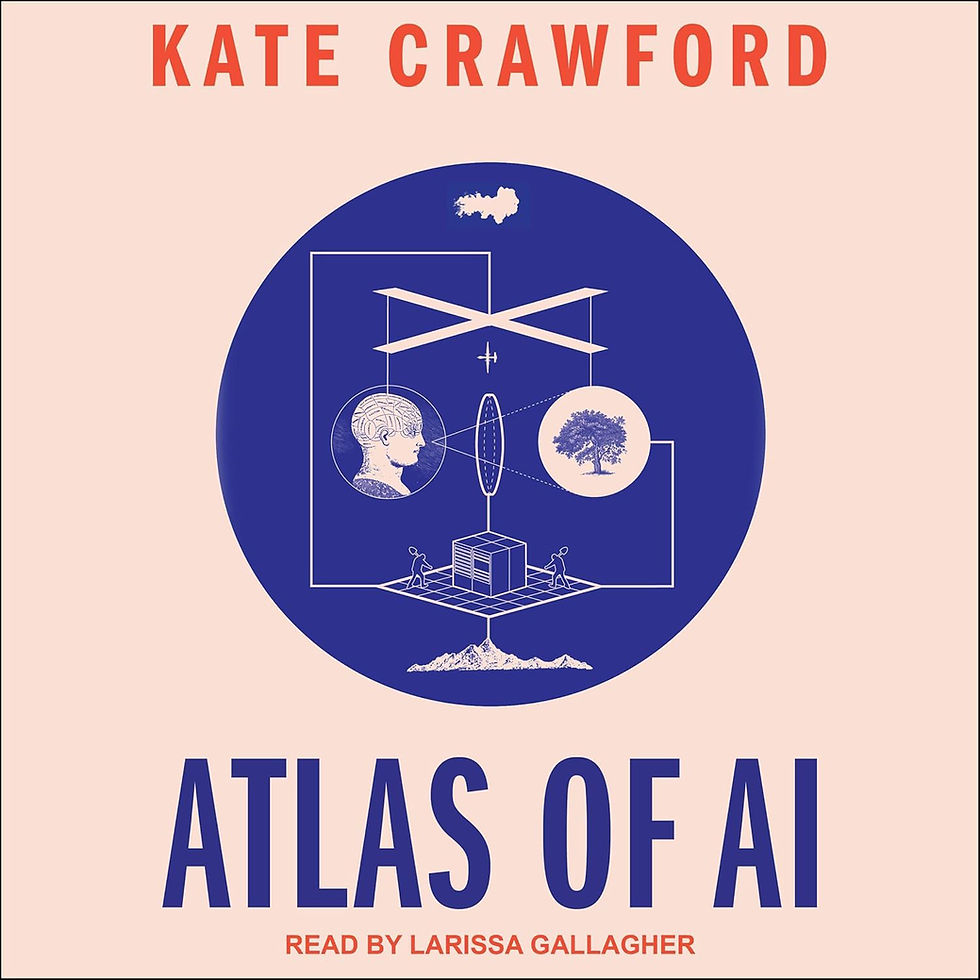
Atlas of AI
Author: Kate Crawford
Short review
Atlas of AI shows that artificial intelligence is about much more than algorithms and technology. Kate Crawford explores how data, energy, people, politics, and economics are interconnected with the development of artificial intelligence. The book places AI in a broader societal perspective.
Why we recommend the book
An essential book for anyone who wants to understand how artificial intelligence is impacting society. It shows that AI is not just about technology – it is also about people, resources, power, knowledge and value creation.

© 2025 - 2026 Portico Publish | The invisible capital Privacy and use of the website | Developed and operated by Magne Bjella | Powered and secured by Wix


Comments