
Operaen.no — a digital drama in a thousand acts

This text is written by Linda Christin Halvorsen and is published in its entirety by agreement with the author.
About the author
This text is written by Linda Christin Halvorsen, Head of Design at Bekk , with broad experience in digital product development, product management and interdisciplinary collaboration.
The blog post you are about to read describes the collaboration between The Norwegian Opera & Ballet, Bekk and the internal professional communities that developed operaen.no – a project where designers, developers, content managers, managers and users worked closely together to create better digital experiences and increased accessibility for the public.
As digital manager at the Norwegian Opera & Ballet, I had the pleasure of being part of this collaboration, together with talented colleagues and professionals across the organizations.


Our concept period lasted six weeks. Visual direction another two weeks. When we were finally ready, the developers had been waiting quite impatiently for quite a while. It was just a matter of getting started — we only had 3.5 months to make operaen.no. With a Christmas break in the middle of it all. What do you do then? You run smoothly. Real smoothly.
My first encounter with the Opera project was a 5 cm thick stack of papers with strategies, values, goals and surveys. It was an extract of “the most interesting” of everything we had been given by the Opera, said our project manager. I received it on my desk in mid-September. Three weeks later, Magnus and I were standing in the foyer of the Opera House during the intermission of Madama Butterfly, interviewing audience members, wondering what had made them go and see that particular performance on that particular day.
In many ways, Operaen.no started like any other interactive project. We set goals and target groups. Needs mapping. Visual direction. Concept. And at the same time a completely different project: it was the Opera. Perhaps the most obvious cultural institution in our entire country. And we were going to redesign the website for this institution. With the fantastic building. And the strange art. In many ways, the dream project. And like most dreams when they come true: sudden and a little scary to hold on to. What if we didn't manage to live up to expectations? Tom Remlov spent three years finding the right sofa to have in his office. How do you make a guy like that happy in five months?
Paradoxically enough: you spend time. Lots and lots of time thinking, fantasizing and creating. Our concept period lasted six weeks. Visual direction another two weeks. When we were finally ready, and Remlov and Co had nodded and said it seemed okay (phew), the developers had been waiting quite impatiently for quite a while. It was just a matter of getting started — we only had 3.5 months to make this. With a Christmas break in the middle of it all. What do you do then? You run smoothly. Real smoothly.
A blubber-free environment
As the design part of a project — interaction designer, graphic designer, concept developer, it is always a bit barren to integrate into the developer part's agile project. That they should work agile was as obvious to them as the concept phase was to us. But we had by no means agreed that the design should be delivered agile. And — agreed? What does it really mean that design should be delivered agile? Daniel and I had an idea about it. For the developers, it came more like a bang. The time of finished, approved, nailed-down deliveries was over — long before it could even start. The developers' “What are we going to make?” was answered with “I don't know yet, we have to test.” It was not well received at first.

The first “bacon” Daniel and I delivered
Guerrilla warfare
During the three and a half months, we didn't deliver a single pixel-perfect design. That is to say — we got pretty far on some page types. But they were never 100%. How could they be? The content came in the nick of time, long after Daniel was asked to finish the concept template. But that didn't stop the developers from pushing for it. At one point, they refused to implement something if we couldn't say it was approved. The tension level in the team was pretty high at the start. The frustration too. Because even if we were sitting in the same room, side by side, close to each other day after day, it wasn't enough. The developers wanted to see something finished. But when user experience is also to be made agile, then nothing is ever finished. Everything is just assumptions, and we need to implement something to test those assumptions — and then we can say whether something is finished or not. Maybe. Most likely not. User experience is not an exact science
But like a butterfly emerging from a cocoon, the guerrilla war turned into symbiosis as we approached launch. Bit by bit, grin by grin, unfinished design was implemented, until we had something that was almost finished. And when something is almost finished, we can suddenly start talking about it. Daniel sat at Sebastian's screen, pointing and looking while Sebastian fixed the front end, until they were both satisfied. I explained the functionality I needed in block Y in EpiServer across the partition between me and Tore. A short fifteen minutes later I had it and could push in new content.
That transition required a lot. And to be a good experience, probably a lot more than what we did.
But here's our list, anyway:
Concept and visual direction
Guerrilla testing
Iteration rounds based on actual change needs, not fixed time periods
A customer who dared to let us work towards the best product we could deliver in the time allotted
Sitting close together
Concept and visual direction
From lean startup we have learned that the process must start with the MVP — minimum viable product. And you should get it out quickly. In a digital project, it is both difficult and easy. Difficult because it is still so difficult to imagine a minimum of a website that is not the whole
the website. Is it an ugly website? Is it the website but minus all the content? What is the smallest, most valuable version of operaen.no?
And at the same time it's easy. Easy when you've done your job and figured out your goals and target groups and created the right concept: you know what your most important website should do then. For operaen.no, the most important functionality is to be able to find the performance you want to see and buy a ticket for it. Our very first version of operaen.no was that too. An overview of performances pulled from the ticket system, you could click on one, and find a purchase link to the ticket system on it. It was super ugly. The purchase link was just blue, underlined text. We didn't have the DNO&B font, and the images were taken straight from Stavanger Concert Hall, which was our test basis from the ticket system. But it worked.
But we wouldn't have known where to start if the concept hadn't defined the most important thing — and thus the starting point for the development process.
Our first version of the front page for the new operaen.no, in November 2012. Not exactly what Daniel wanted — but on the way there.


…and this is what the performance page looked like at that time…
Guerrilla testing
And when we took it to an iPad and asked people to test it, we found out what worked user-wise too. And what didn't work. The scrolling on the front page, with the big "posters" as we call them, has been through 5 redesign rounds. At least. Because they didn't work user-wise, and because they didn't work front-end-wise.
Our left menu, on the other hand, has been there more or less from the start. We've adjusted the font size a bit. Decorated it with some lines. Added bullet points as the information structure became more and more real. But the functionality was set from the first user.
We then expanded with more page types, and the ability to have more content — lots more content — on a performance page. As content production and publishing accelerated, so did the development of functionality. And Daniel and Sebastian were pushed even further. Too quickly, elements had to be redesigned — and reimplemented.
And for the big things, we took it out and showed it to people. In cafes, on a campus, in the foyer of the Opera House. The places that were closest to us. So we could come back quickly and tell. Most of the team was out on the test rounds. Not all at once, of course — but spread out over the different ones. Designers, developers, and the customer at some point. There's something about the feeling of having seen it for yourself. Of having made the query yourself, and seeing a potential audience not find the menu you implemented yourself.
Iteration rounds based on actual change needs
True agile for some may mean inflexible for others. Or — if not inflexible — we deviated from some agile norms. Daily stand-ups, for example. And we had no iteration plans — no specific iterations, for that matter. Not that that was necessarily a success factor. It was rather chaotic at times. But when we got into the rhythm of implementing, adjusting, testing, redesigning and re-implementing, with functionality published so that we could take it out of the house with us in a matter of hours, minutes — then it was also good not to have to put things in a long queue, wait for it to be estimated, planned and then released at the end of a two-week period. It was good to be able to see and test things right away. With a
The first time we suspected something wasn't working. We immediately realized that the content didn't quite fit the form we had initially thought it would fit. And being able to let the product decide what was most important — not a committee approving a prioritization plan. 3.5 months of 2-week iterations should have meant 7 iterations. Instead, we had a thousand.
A customer who dared
Does that sound risky? Someone had to let go and take the plunge. And the customer, the Opera, dared. Dared to let go of the reins and let us get on with creating the best product we could given the time and money constraints. But let me clarify that no one ever turned a blind eye and let us gallop freely, without knowing where it was going. We had monthly demos, weekly meetings and daily contact with the customer. We just weren't burdened with long approval processes where every detail had to be discussed and agreed upon in a large working group before we could — precisely — test it.
Sitting close together
Last on the list, but as the phrase goes, not least, is sitting together. Close together. Not as in sitting in the same building, on the same floor, in the same corridor — but as in next to each other, on top of each other, within eye contact of each other. Delivering agile, ux, development and product, depends on us looking at the same thing together.
Okay, everyone needs time to think. The graphic designer needs time to think when new content has appeared. The front-end programmer needs time to implement what we just discussed. And that's fine. But developing a website is a game of give and take. Wanting and demanding lots of functionality and transitions and connections, and accepting lots of compromises because it requires too much, and other functionality is waiting to be released.
The dynamic you want for that exchange to take place as effectively as possible requires that those exchanging be seated in close proximity to each other. So close that one can look up and look around a little questioningly — and be met with a look that says “what’s the problem?” Close enough that it’s okay to disagree — because we know we have to agree sooner or later — no one has a door to hide behind when the hard choices are made, or the difficult questions are asked.
That dynamic takes time to develop, and it won't come any faster if part of the team sits in one part of the office and another somewhere else. Just the room next door may be far enough away that that dynamic doesn't occur.
The last month, the project manager at Operaen also sat with us, and slipped into our communication flow. An integrated part of the team. And pushed out content in minute-fresh functionality. If we had there — in the last month before launch, been dependent on long feedback loops where someone sat somewhere and tested, gave feedback, received a new speck, had to approve it, waited for implementation and then tested again, operaen.no would have looked quite different. Poorer. And been quite unusable on mobile — approving countless breaking points on a responsive layout would have, well — broken our backs.
The launch went well. We sat and fixed it until the last minute — but it went well. I'm writing this blog post in a kind of post-launch vacuum. It's completely normal for me to feel that way, a colleague told me — that there will be a kind of anticlimax after we've delivered the solution — after months of intense work, in close collaboration, at a high pace, with lots of energy. But there are still things to be done. We'll take them eventually. As smoothly as we can.
As Magne, the project manager at the Opera, says: “It’s about interaction, it’s about collaboration, it’s about high creativity, chaos — and then the constructive work starts…. Then we create. Then we deliver. Then there’s success.”

The opera — a digital drama in a thousand acts — starring:
Concept and information structure: Magnus Revang and Linda Christin Halvorsen
Visual direction, graphic design and interaction design: André Nymoen and Daniel Tveiten
Backend integration: Bent Kristiansen
Frontend: Sebastian Steinmann
EpiServer development: Mats Knutsen and Tore Lervik
Project manager BEKK: Christoffer Arntzen
Project manager and driving force behind the Opera: Magne Bjella
The text is published in its entirety by agreement with the author.
Please share your knowledge further.
Great results are rarely created by individuals.
They are created by teams.
Further reading:
The opera is selling more tickets after revamping its online presence . Now they are honored with the coveted Label for Good Design.
The invisible capital in Norwegian working life We often talk about technology, strategy, results and efficiency. Far less often about the people who make working life and value creation work – every single day.
When ideas stop with the leaders . Why good ideas are rarely lacking – and what it takes for them to actually be realized.
Norway has never had more knowledge and value creation – how do we create more? Statistics Norway's figures show that Norwegians have never had a higher level of education. Yet it is not the number of credits that determines whether we succeed as a society. What is crucial is how we convert knowledge into innovation, jobs and value creation.
Why digitalization is really about people - We often talk about digitalization as if it is primarily about technology. About systems, platforms, artificial intelligence, automation and new digital services. Many of the biggest headlines are about investments, results and technological breakthroughs.
Recommended books from our library

Don't Make Me ThinkAuthor: Steve Krug
Short review
Don't Make Me Think is one of the world's most influential books on usability and web design. Since its first edition in 2000, the book has helped designers, developers, content producers, and managers understand a simple but powerful principle: Good digital services should be intuitive. The user should be able to complete their task without having to stop and think about how the website works.
Why we recommend the book
This is one of the books that has had the greatest impact on my own work with digital services. Over the years – from SAS and the Norwegian Opera & Ballet to working on Bærum Municipality’s website – the principles in this book have been an important reminder that technology is never an end in itself. The goal is to make everyday life easier for the people who use the services. Despite the fact that the book was published many years ago, the message is just as relevant today.
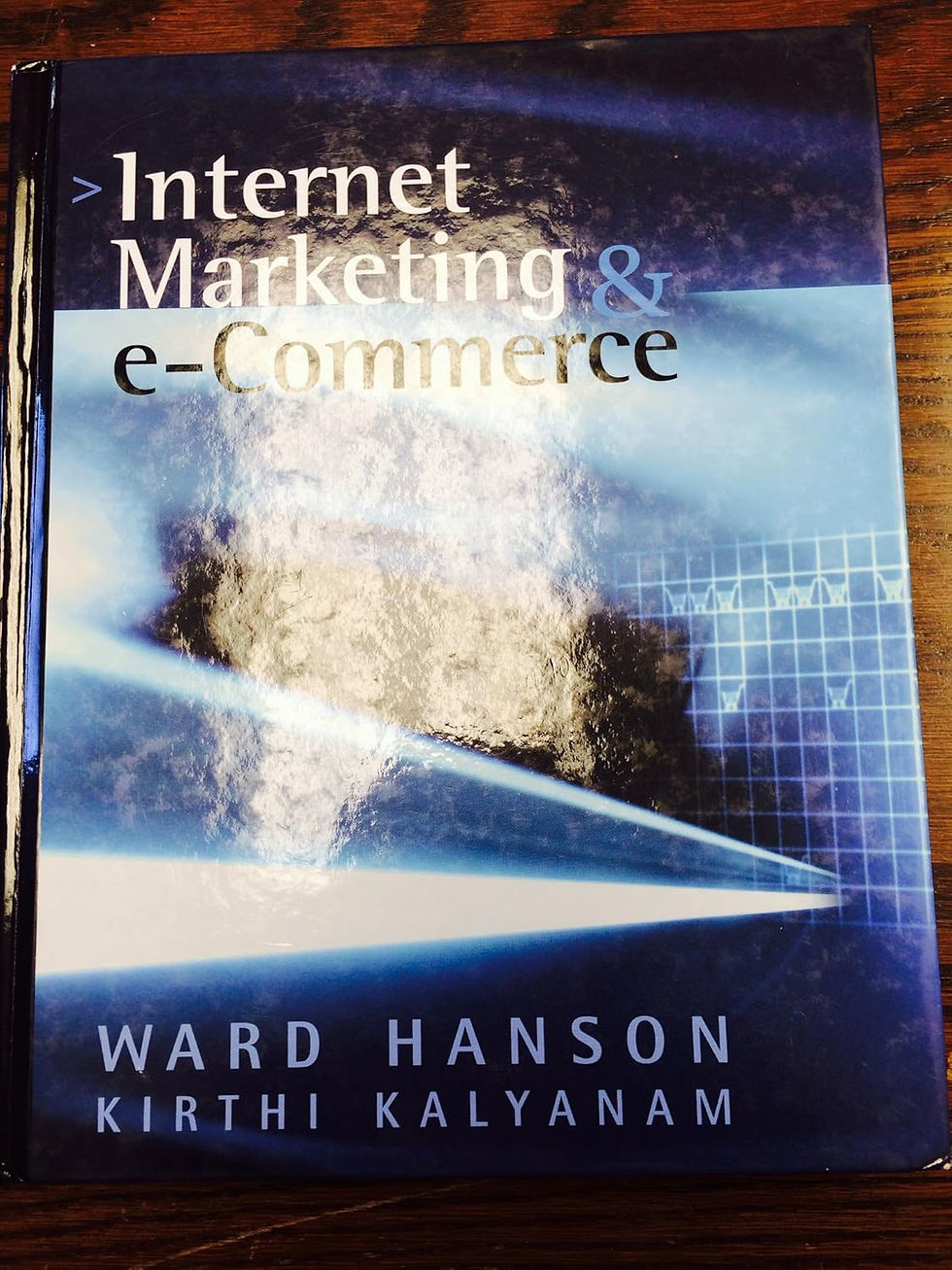
Internet Marketing & eCommerce
Authors: Ward Hanson and Kirthi Kalyanam
Short review
Internet Marketing & eCommerce provides a thorough introduction to how the internet has changed marketing, commerce, and business development. The book combines theory and practical examples in digital marketing, e-commerce, customer behavior, value creation, and digital business models. Although written at a time when the internet was still in its infancy, many of the fundamental principles are still highly relevant.
Why we recommend the book
This book was an important part of my own learning journey in digital marketing and e-commerce. It helped build my understanding of how technology, customer experiences and business strategy are interconnected – an insight that later became very important in my work with SAS, the Norwegian Opera & Ballet, Bærum Municipality and eventually the project The Invisible Capital. Many of the ideas about customer value, digitalization and innovation presented on the website have their roots in the knowledge this book conveys.

The Innovator's Solution: Creating and Sustaining Successful Growth
Authors: Clayton M. Christensen and Michael E. Raynor
Short review
In this sequel to The Innovator's Dilemma, Clayton Christensen shows how businesses can translate innovation theory into practical strategy. The book explains how companies can identify new growth opportunities, develop disruptive innovations, and build organizations that thrive in rapidly changing markets.
Why we recommend the book
While The Innovator's Dilemma explains why established businesses are often challenged, The Innovator's Solution provides concrete advice on how to meet the challenges. The book is therefore a natural next step for anyone who wants to understand innovation, strategy and long-term value creation.

The Innovator's DNA: Mastering the Five Skills of Disruptive Innovators
Authors: Jeff Dyer, Hal Gregersen and Clayton M. Christensen
Short review
What characterizes people who create groundbreaking innovations? The authors identify five key skills – observation, questioning, experimentation, networking and association – that are common to the world's most innovative leaders and entrepreneurs.
Why we recommend the book
This book shifts the focus from organizations to the people behind innovation. It shows that creativity and innovation can be developed through deliberate training and experience. The perspectives align well with the philosophy behind Invisible Capital, where human competence and curiosity are the most important drivers of development.

Competing Against Luck: The Story of Innovation and Customer Choice
Authors: Clayton M. Christensen, Taddy Hall, Karen Dillon and David S. Duncan
Short review
In this book, Clayton Christensen further develops the theory of Jobs to Be Done – the idea that customers do not primarily buy products, but "hire" them to solve specific needs. Through practical examples, the authors show how businesses can develop products and services that address customers' real-world challenges.
Why we recommend the book
For anyone working in customer experience, service design, and innovation, this is one of the most insightful books ever written. It reminds us that value creation always starts with understanding the people we are developing solutions for – a fundamental principle of Invisible Capital.

The Innovator's Dilemma: When New Technologies Cause Great Firms to Fail
Author: Clayton M. Christensen
Short review
The Innovator's Dilemma is considered one of the most influential books on innovation and technological change. Clayton M. Christensen introduces the theory of disruptive innovation and explains why even the most successful businesses can fail when new technologies and business models challenge established markets. Through a series of examples, he shows how companies often focus on today's customers and incremental improvements, while overlooking innovations that later change entire industries.
Why we recommend the book
This is one of the books that has had the greatest impact on modern innovation thinking. When I first read it, it gave me a whole new perspective on why some businesses succeed in transformation, while others lag behind – even when they are well led. The insight has been an important part of my own understanding of digitalization, innovation and change management, and many of the reflections in The Invisible Capital build on the ideas Clayton Christensen presents in this classic. The book is as relevant today, in the face of artificial intelligence and digital transformation, as it was when it was published.

Open Innovation: The New Imperative for Creating and Profiting from Technology
Author: Henry Chesbrough
Short review
Henry Chesbrough introduced the concept of Open Innovation and changed the way many businesses think about research and development. He shows how companies can create more innovation through collaboration with customers, universities, start-ups, suppliers and other external partners.
Why we recommend the book
Open Innovation has had a major influence on modern innovation thinking and was also an important topic during the seminars in Oxford and San Francisco. The book shows why future value creation occurs in the interaction between people, businesses and knowledge environments – not within closed organizations alone.

Blue Ocean Strategy: How to Create Uncontested Market Space and Make the Competition Irrelevant
Authors: W. Chan Kim and Renée Mauborgne
Short review
Blue Ocean Strategy challenges businesses to shift their focus away from fierce competition and instead create new markets with little or no competition. The authors present strategies and models that help organizations develop innovative products, services, and business models.
Why we recommend the book
This book has inspired leaders around the world to rethink strategy and innovation. Instead of competing for the same customers, it shows how businesses can create new value through creativity and differentiation. The perspectives align very well with the themes of innovation, digitalization, and long-term value creation in Invisible Capital.

Outside Innovation: How Your Customers Will Co-Design Your Company's Future
Authors: Patricia B. Seybold
Short review
Patricia Seybold shows how businesses can create better products and services by actively involving customers in the innovation process. The book describes how dialogue, co-creation and close collaboration with users can provide better solutions and stronger competitiveness.
Why we recommend the book
Customers often hold the most important insights into how products and services can be improved. This book emphasizes the importance of listening, involving, and learning from users – a perspective that is echoed in many of the articles on The Invisible Capital. Innovation rarely happens alone; it is created in the interaction between people.

Blown to Bits: How the New Economics of Information Transforms Strategy
Authors: Philip Evans and Thomas S. Wurster
Short review
This book analyzes how digital information is changing competitive conditions, markets, and business strategies. The authors explain how the internet is disrupting established structures and creating new opportunities for businesses that are able to think differently.
Why we recommend the book
Although written early in the internet revolution, the book describes many of the developments that still characterize business today. It provides valuable perspective on how digitalization affects value chains, competition, and innovation – themes that are central to Invisible Capital.

Wikinomics: How Mass Collaboration Changes Everything
Authors: Don Tapscott and Anthony D. Williams
Short review
Wikinomics shows how openness, sharing and collaboration across organizations create new forms of innovation and value creation. Through a number of international examples, the authors describe how digital networks make it possible to develop products, services and knowledge together.
Why we recommend the book
This book was groundbreaking when it was first published, and many of the ideas have since become a natural part of everyday digital life. The perspectives on collaboration, knowledge sharing, and open innovation processes align very well with the philosophy behind Invisible Capital, where people and networks are at the center of value creation.

© 2025 - 2026 Portico Publish | The invisible capital Privacy and use of the website | Developed and operated by Magne Bjella | Powered and secured by Wix


Comments