
Chapter 7: Philippe Aghion – Innovation as a driver of value creation

A research-based review of Philippe Aghion's understanding of innovation, productivity and long-term economic growth
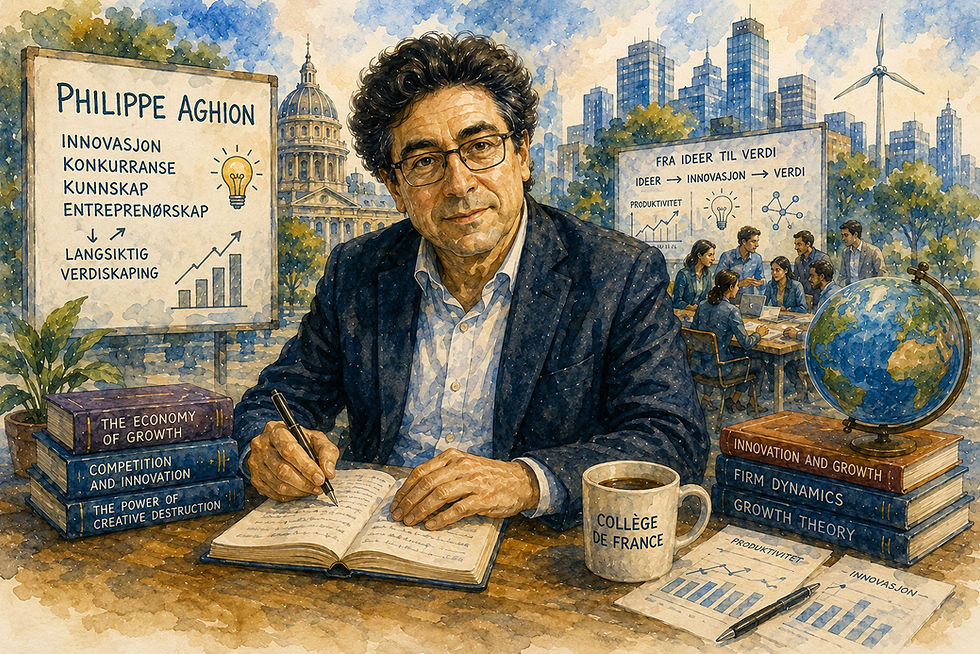
Philippe Aghion is one of the world's leading economists in the fields of innovation, economic growth and productivity development. Over several decades, he has developed theories that explain how innovation, competition, entrepreneurship and knowledge development drive long-term value creation in modern economies.
Aghion is particularly known for his work on the so-called Schumpeterian growth theory , where innovation is at the center of economic development. His research shows how new ideas, technological breakthroughs, and continuous renewal make businesses and societies more productive and competitive over time.
This article draws primarily on Philippe Aghion's own books, scientific articles and research publications. The aim is to present his understanding of value creation as expressed in his research, before placing it in a broader economic and social science context.
Table of contents
Who is Philippe Aghion?
Historical and academic context
Key books and publications
Philippe Aghion's understanding of value creation
What role does the public sector play?
What role does the private sector play?
Criticism and academic debate
What can we learn?
Relevance for The Invisible Capital
Literature
Further reading
Sources that form the basis of this article
This scholarly article is based primarily on Philippe Aghion's own books, scholarly articles, and research publications. These are supplemented by work from the Collège de France, the London School of Economics, Harvard University, the OECD, and other leading research environments. The aim is to present Aghion's research as he develops his own reasoning, before placing it in a broader scholarly context.

1. Who is Philippe Aghion?
Philippe Aghion is a French economist and one of the world's most influential researchers in the field of economic growth and innovation. He has been a professor at Harvard University, the London School of Economics, and the Collège de France, among others, and has published an extensive number of scholarly works on innovation, productivity, entrepreneurship, and economic development.
Throughout his career, Aghion has contributed to the further development of modern growth theory by placing innovation at the center of economic analysis. He builds on the ideas of the Austrian-American economist Joseph Schumpeter, but develops them into a modern theory of how knowledge, research, and technological development create long-term growth.
His research is currently used by universities, international organizations, and governments that want to understand which factors make certain countries and businesses more innovative and productive than others.
2. Historical and academic context
Much of the economic growth theory after World War II explained economic development through increased access to labor, capital, and technological progress.
Technological development was often treated as something that happened outside the economic model – as an external factor that contributed to growth, but which the theory explained to little extent.
Philippe Aghion believed this was insufficient.
He wanted to explain where innovation actually comes from , why some businesses develop new technology faster than others, and how competition, research, and entrepreneurship influence this development.
This became the starting point for the Schumpeterian growth theory, where innovation is no longer considered an external factor, but as the very engine of economic development.
Aghion's research thus shifted the focus from how much is produced to how new knowledge and new ideas continuously improve production and create new markets.

3. Philippe Aghion's understanding of value creation
For Philippe Aghion, value creation is inextricably linked to innovation. Through his extensive research, he argues that long-term economic growth is not primarily created through increased use of labor or capital, but through society's ability to continuously develop new knowledge, new technology, and more productive ways of working.
This perspective places innovation at the center of modern economic development. Value creation is not the result of a single invention or investment, but of an ongoing process in which people, businesses, and institutions continually develop better solutions than those that existed previously.
Aghion's research builds on Joseph Schumpeter's idea that economic development occurs through creative destruction – a process in which new ideas, products and technologies gradually replace older solutions. But where Schumpeter described the mechanism at a higher level, Aghion developed a modern economic theory that explains how innovation occurs, what factors stimulate it, and why it is crucial for long-term value creation.
Innovation as a driver for value creation
Aghion considers innovation to be the most important driver behind productivity growth.
When businesses develop new products, improve production processes or find more efficient ways to organize work, value creation increases. Innovation makes it possible to produce more with the same resources or to develop products and services that did not previously exist.
Value creation is therefore not just about producing more goods.
It is about producing better goods , better services , better solutions and better work processes .
Innovation thus becomes a continuous improvement process that lifts both businesses and society.
Creative destruction drives development
A central concept in Aghion is creative destruction.
New solutions replace old ones.
New technology replaces outdated technology.
New businesses are challenging established market leaders.
Working methods are improved.
Entire industries change over time.
This process can be demanding for businesses that lose their competitiveness, but it is also the very mechanism that makes the economy more productive.
According to Aghion, it is precisely this continuous renewal that explains why modern economies experience higher living standards and stronger economic growth over time.
Competition stimulates innovation
Aghion shows that competition is not just about prices.
Competition also creates incentives for innovation.
When businesses face competition, the need to develop new products, improve quality and streamline production increases.
Companies that fail to innovate risk being outcompeted.
At the same time, Aghion emphasizes that the competition must be balanced.
Too little competition can lead to stagnation and lack of innovation.
Too much and short-term competition can reduce businesses' ability to invest in research and long-term development.
The goal is therefore not competition alone, but competition that stimulates continuous knowledge development.
Research and knowledge development create future values
Innovation rarely occurs by chance.
It is based on research, experimentation, learning and competence development.
Aghion therefore places great emphasis on investments in research and development.
Universities, research institutions and knowledge-intensive businesses play a crucial role in the development of new technology and new production methods.
Knowledge thus becomes a strategic resource.
The better a society succeeds in developing and disseminating new knowledge, the greater its ability to create new values.
Productivity is the result of innovation
For Aghion, productivity is not a goal in itself.
It is the result of continuous innovation.
When new ideas make work processes more efficient, the same resources can create greater value.
This productivity growth forms the basis for higher wages, increased competitiveness and a better standard of living.
Value creation is therefore about increasing society's ability to develop smarter solutions – not just about working more.
Innovation is a continuous process
An important point at Aghion is that innovation never ends.
Businesses cannot rely on past successes.
Technology is developing.
Markets change.
Customer needs are changing.
New competitors arise.
Value creation therefore becomes a continuous process where learning, research and innovation must be continued if businesses and societies are to maintain their competitiveness.
Summary
Philippe Aghion shows that innovation is not an addition to value creation.
It is the very engine behind long-term economic development.
Through research, knowledge development, competition and continuous innovation, higher productivity, stronger competitiveness and increased prosperity are created.
Value creation thus becomes a result of society's ability to continually develop better solutions than those that existed yesterday.
This perspective makes Aghion one of the most central researchers in understanding how modern economies create lasting value through innovation.

4. What role does the public sector play?
Philippe Aghion describes the public sector as an important player in the development of modern economies. He does not argue that the state should replace the market or take over the role of business, but he believes that the public sector has a significant responsibility for creating the framework conditions that make innovation, productivity growth and value creation possible.
In Aghion's research, economic development is the result of the interaction between markets, businesses, research and public institutions. Value creation rarely occurs in a vacuum. It is based on long-term investments in knowledge, education, research, infrastructure and stable institutions - areas where the public sector plays a central role.
Investments in knowledge and research
A recurring theme at Aghion is the importance of public investment in research and education.
Private companies naturally invest in research that is expected to yield financial returns. At the same time, there are many areas of research where the benefits only come many years later, or where the benefits benefit society as a whole.
Here, Aghion believes that the public sector has an important role to play.
Through funding universities, research institutes and basic research, the state contributes to developing knowledge that can later form the basis for innovation, entrepreneurship and new industries.
Such investments therefore do not simply represent expenditures over public budgets.
They are investments in future value creation.
Education as a basis for innovation
Aghion places great emphasis on the importance of education.
A society with high levels of competence is better able to develop new technology, adopt new working methods and adapt to rapid change.
Public investments in primary, secondary, higher education and lifelong learning therefore become a key part of a country's innovation capacity.
Competence enables people to create new solutions.
Thus, education policy also becomes innovation policy.
Competition policy and good framework conditions
One of Aghion's most important contributions is the analysis of how competition affects innovation.
He argues that the authorities must facilitate well-functioning markets where new businesses can establish themselves, grow and challenge established players.
Effective competition policy is therefore not just about protecting competition.
It is also about stimulating innovation and productivity growth.
The public sector has an important role through legislation, competition supervision and regulations that ensure that markets function in a way that promotes long-term value creation.
Institutions that promote investment
Innovation requires predictability.
Businesses invest in research and development when they have confidence that laws are enforced, contracts are respected, and property rights are protected.
Aghion therefore emphasizes the importance of strong public institutions.
Legal certainty, stable political frameworks and efficient public administration help reduce uncertainty and make it easier to invest in the long term.
In this way, institutions become an indirect but crucial source of value creation.
An active – but not dominant – state
Aghion places itself between two extremes.
He argues neither for a minimal state nor for a state that controls all economic activity.
Instead, he describes the public sector as an active partner that invests in knowledge, builds institutions, develops expertise and facilitates innovation.
In his view, value creation occurs best when the public sector creates good framework conditions, while private businesses, research environments and entrepreneurs develop new products, services and technologies.
Summary
Philippe Aghion's research shows that the public sector plays a central role in modern value creation. Through investments in education, research, institutions and competitive framework conditions, the state contributes to developing the conditions that make innovation and productivity growth possible.
The public sector thus does not create value by replacing the market, but by strengthening society's ability for continuous knowledge development, renewal and long-term value creation.

5. What role does the private sector play?
For Philippe Aghion, the private sector is the most important arena where innovation is translated into new products, services, technologies and jobs. It is in businesses that new ideas are tested, investments are made and competition creates incentives for continuous improvement.
At the same time, Aghion emphasizes that the private sector does not create value in isolation from the rest of society. Businesses' innovative capacity is based on access to expertise, research, capital, well-functioning institutions and stable framework conditions. Value creation therefore arises through an interaction between private businesses and the society of which they are a part.
Innovation happens in businesses
Aghion describes private businesses as the engine of practical innovation.
This is where research is translated into commercial products.
This is where new production methods are developed.
This is where technology comes into play.
This is where entrepreneurs establish new businesses.
Innovation thus becomes not just a research result, but a practical process where knowledge is transformed into solutions that create value for customers and society.
Private enterprises therefore play a crucial role in turning research and technological breakthroughs into economic activity.
Competition drives development
One of Aghion's most important research contributions is the analysis of how competition affects innovation.
When businesses compete for customers, market share, and technology, strong incentives for continuous improvement arise.
Companies invest in research.
They develop new products.
They improve quality.
They streamline production.
They are seeking new markets.
This dynamic makes competition a driving force for both innovation and productivity growth.
Value creation is therefore not just about producing more.
It's about producing smarter.
Entrepreneurship creates innovation
Aghion highlights entrepreneurs as key players in modern economies.
New businesses challenge established solutions.
They introduce new technology.
They develop new business models.
They create new markets.
Although many startups fail, entrepreneurship helps the economy continually renew itself.
This process is an important part of the creative destruction that Aghion builds on from Joseph Schumpeter's theory.
Long-term investments create lasting value
Innovation requires investment.
Businesses that want to develop new technology or new products must invest in research, expertise and development work over a long period of time.
Aghion therefore emphasizes the importance of a long-term perspective.
Value creation rarely occurs through short-term gains alone.
It is developed through systematic investments in knowledge, people and technology.
Businesses that continuously invest in innovation are better positioned to maintain competitiveness over time.
Collaboration leads to greater innovation capacity
Although competition is important, Aghion also shows that cooperation plays a central role.
Businesses collaborate with universities.
They collaborate with research institutions.
They participate in international research projects.
They develop supplier networks and partnerships.
In this way, innovation becomes the result of interaction between many actors, rather than isolated individual companies.
This makes modern value creation more network-based than before.
Value creation is about continuous improvement
Aghion describes value creation as a process without an end point.
Businesses cannot base future growth on past innovations alone.
New technology is being developed.
Customer needs change.
International competition is intensifying.
Businesses must therefore continuously learn, develop and invest in new solutions.
The ability to adapt thus becomes one of the most important competitive advantages in modern economies.
Summary
Philippe Aghion sees the private sector as the most important arena where innovation is translated into practical value creation. Through entrepreneurship, competition, research, investment and continuous renewal, businesses develop new products, services and working methods that increase productivity and strengthen society's overall value creation.
However, the private sector does not create value alone. Innovation is based on close interaction between businesses, research environments, educational institutions and a society that facilitates knowledge development and long-term investments.
6. Criticism and professional debate
Philippe Aghion's research has had a major influence on modern economic theory and innovation policy. His work on Schumpeterian growth theory, innovation, and productivity development has contributed to changing the understanding of what drives long-term economic growth. At the same time, several of his theories have been the subject of academic debate and further development.
The criticism is directed to a small extent against the importance of innovation itself. Most economists agree that innovation is a key driver of economic development. The debate is more about which factors create innovation, what role the state should play, and how the benefits of innovation are distributed in society.
Is innovation the most important explanation?
Aghion places great emphasis on innovation as the engine behind economic growth.
Several economists have pointed out that innovation alone cannot explain why some countries develop faster than others.
Institutions, educational level, political stability, natural resources, demographics and international markets also influence a country's economic development.
This criticism does not imply that innovation is less important, but that it must be understood as one part of a larger economic and social system.
Innovation also creates transformations
Aghion's theory is based on creative destruction – that new solutions replace old ones.
This process is an important source of productivity growth, but it can also lead to significant restructuring.
Businesses can be outcompeted.
Jobs may disappear.
Entire industries can change in a short time.
Critics therefore point out that innovation policy must also take into account skills development, adaptability and an inclusive labor market, so that the benefits and costs of innovation are distributed in a sustainable manner.
How big should the state's role be?
Although Aghion argues for an active public sector, there have been differing opinions about how far this role should go.
Some economists believe that the state should first and foremost ensure good framework conditions and well-functioning markets.
Others argue for a more active industrial and innovation policy, where the state contributes to a greater extent to developing new technologies and strategic industries.
In this area, Aghion's research has often been compared to Mariana Mazzucato's work. Both emphasize the importance of public investment in knowledge and research, but Mazzucato generally places greater emphasis on the role of the state as an active innovation actor, while Aghion emphasizes the interaction between competition, markets and public framework conditions.
How do we measure innovation?
Another topic in the research debate is how innovation should actually be measured.
Patents, research investments and productivity growth are often used as indicators, but these do not necessarily capture all forms of innovation.
Many improvements occur through organizational changes, new services, digital working methods or gradual improvements that are not recorded in traditional statistics.
This has led to increased interest in broader measures of innovation and value creation, which also include intangible resources, expertise and organizational development.
Aghion's importance in today's research
Despite academic discussions, Philippe Aghion is considered one of the most important growth economists of our time.
His research has helped shift the focus of economics from traditional factors of production to innovation, knowledge development and productivity growth.
Many of his theories today form the basis for analyses from the OECD, the World Bank, the European Commission and leading research groups working on economic growth, innovation policy and competitiveness.
Summary
The academic debate surrounding Philippe Aghion's research is primarily about how innovation is best promoted, how gains and restructuring costs are handled, and what role public institutions should play in the development of modern economies.
At the same time, there is broad agreement on his most important contribution: Long-term value creation cannot be understood without understanding innovation. Through his research, Aghion has shown how continuous knowledge development, competition and renewal constitute some of the most important driving forces behind economic growth and social development in the 21st century.

7. What can we learn?
Philippe Aghion's research provides an important perspective on how modern societies create lasting value. His main message is that economic growth cannot be taken for granted. Societies that want high productivity, strong competitiveness and rising living standards must continuously invest in innovation, knowledge and people.
Aghion shows that value creation is not primarily about working more, but about working smarter. Through research, technology, entrepreneurship and continuous improvement, the same resources can create greater value than before.
This makes innovation one of the most important driving forces behind modern economic development.
Innovation must be continuous
One of Aghion's most important lessons is that innovation is not a one-time event.
Businesses that stop developing risk being outcompeted.
Technology is evolving.
Markets are changing.
Customer needs are changing.
New competitors arise.
Value creation therefore requires a culture of continuous learning, development and improvement.
Innovation is not a project with an end date.
It becomes a natural part of the business's way of working.
Knowledge is the most important investment
Aghion's research emphasizes that knowledge is the foundation of innovation.
Societies that invest in education, research and skills development also build the foundation for future value creation.
This applies to both private business and the public sector.
Competence makes people better able to develop new solutions, adopt new technology and adapt to change.
This makes investments in people among the most profitable investments a society can make.
Competition and cooperation must go hand in hand
An important message at Aghion is that competition and cooperation are not opposites.
Competition stimulates businesses to develop new solutions.
At the same time, much innovation occurs through collaboration between business, universities, research institutions and the public sector.
Modern value creation is therefore built both on competition and on the ability to share knowledge and develop solutions together.
Restructuring is part of value creation
Innovation involves change.
Some products disappear.
New businesses are emerging.
Job duties change.
Technology is developing.
Aghion's research reminds us that restructuring is not a sign that the economy is performing poorly.
On the contrary, the ability to innovate is one of the most important prerequisites for long-term value creation.
The challenge is therefore not to avoid change, but to develop societies that enable people to master it.
Relevance to today's society
Aghion's research is perhaps more relevant than ever.
Digitalization, artificial intelligence, green transition and global competition place great demands on innovation capacity.
Businesses that succeed are often those that learn the fastest.
Societies that succeed are often those that invest most purposefully in knowledge, research and entrepreneurship.
Innovation thus becomes not just an industrial policy issue.
It becomes a societal issue.
Summary
Philippe Aghion teaches us that value creation is a dynamic process that is based on continuous innovation, knowledge development and restructuring. Economic growth is not created by preserving existing solutions, but by developing new ones.
The most important lesson is therefore that society's future value creation depends on the ability to invest in people, research, technology and innovation – and on the willingness to continuously renew itself in the face of new challenges and new opportunities.
8. What can we learn?
Philippe Aghion's research shows that innovation is one of the most important drivers behind long-term value creation. Through continuous knowledge development, research, entrepreneurship and productivity improvements, both businesses and societies can develop higher competitiveness and better living standards. The most important lesson is that value creation is not a static state, but a continuous process based on renewal.
9. Relevance for The invisible capital
Aghion's research supports the fundamental message of Invisible Capital that people, knowledge, innovation and learning are among the most important sources of modern value creation. His work shows how investments in expertise and research create value that is often less visible than traditional capital, but is crucial for long-term societal development.
10. Literature
Key books by Philippe Aghion
The Economics of Growth
The Power of Creative Destruction
Endogenous Growth Theory (with Peter Howitt)
Selected scientific articles on innovation, productivity and economic growth
11. Further reading
For readers who want a broader understanding of innovation and value creation, the research of:
Recommended literature
Value creation is about much more than economic growth and money. It is about people, knowledge, innovation, productivity, institutions, trust and the interaction between the public and private sectors.
Here we have collected books from some of the world's leading economists and thinkers who explain in various ways how value is created, who contributes to creating it, and what prerequisites make long-term value creation possible.
The books complement each other and provide different perspectives on the same fundamental question:
What really makes people, businesses and societies create greater value over time?
Recommended books from our library

Creating a Learning Society: A New Approach to Growth, Development, and Social Progress
Author: Joseph E. Stiglitz and Bruce C. Greenwald
Short review:
Creating a Learning Society examines how knowledge, learning, and technological development contribute to economic growth and long-term value creation. Joseph E. Stiglitz and Bruce C. Greenwald challenge the notion that economic development is primarily about accumulating more physical capital. They argue that society’s ability to create, disseminate, and apply knowledge is crucial to productivity growth and improved living standards. A key point is that learning does not only occur in schools and universities. It also occurs in businesses, through work, production, innovation, and the interaction between people and organizations. Knowledge can also spread from one business and one part of the economy to others.
The book thus provides an important perspective on why human capital, competence, innovation and learning must be understood as central parts of a society's ability to create value over time.
Why we recommend the book
We recommend Creating a Learning Society because it expands the understanding of what lies behind economic value creation.
Machines, technology and financial capital are important, but they do not create productivity growth alone. Behind the development are people who learn, develop knowledge, improve work processes, share experiences and find new solutions.
This makes the book particularly relevant to Invisible Capital and our perspective on value creation: A significant part of society's value-creating capacity is found in the knowledge, competence, and learning ability of the people who participate in the economy.
Stiglitz and Greenwald thus provide an academic foundation for one of the most important relationships in modern value creation:

The Value of Everything: Making and Taking in the Global Economy
Author: Mariana Mazzucato
Short review
In The Value of Everything, Mariana Mazzucato asks a fundamental question: What exactly is value – and who creates it? Mazzucato returns to the historical discussions of value in economics and shows how the understanding of value creation has changed. She challenges the notion that high income, high prices or large profits necessarily mean that correspondingly large values have been created. One of the book's most important contributions is the distinction between value creation and value extraction . Mazzucato examines the financial sector, the pharmaceutical industry, innovation and the public sector, among others, and argues that we must become better at distinguishing between activities that actually create new values, and activities that primarily extract values that have already been created.
The book also challenges the traditional notion that the private sector creates value while the public sector mainly consumes or redistributes it. Innovation and economic development often arise through a complex interaction between public investment, research, businesses, capital and people.

The Power of Creative Destruction: Economic Upheaval and the Wealth of Nations
Author: Philippe Aghion, Céline Antonin and Simon Bunel
Short review
The Power of Creative Destruction is about one of the most important drivers of long-term economic growth: innovation.
Philippe Aghion, Céline Antonin and Simon Bunel build on Joseph Schumpeter's classic idea of "creative destruction" – the process by which new technologies, businesses, products and ideas challenge and replace existing solutions.
But the book is not just about the disappearance of the old. The authors examine why some economies manage to create continuous innovation and productivity growth, while others stagnate. Competition, entrepreneurship, research, education, institutions and public policy thus become important parts of the explanation.
Creative destruction also comes at a cost. New technologies and businesses create opportunities and jobs, but can also make existing skills, tasks and business models less relevant. The challenge is therefore to create societies that both promote innovation and enable people to participate in the transition.
Why we recommend the book
We recommend The Power of Creative Destruction because it shows why innovation is a fundamental driver of value creation .
Value creation is not just about producing more of what we already produce. It also occurs when people develop new ideas, technology, and ways of working that enable us to solve tasks better than before.
This makes the book particularly relevant to The Invisible Capital. Behind innovation are people with knowledge, expertise, creativity and experience. But Aghion's perspective also shows that human capital must be part of a larger system where competition, institutions, research, investment and policy create the conditions for new ideas to actually turn into economic and social development.
The book thus provides an important context in our understanding of value creation:
Knowledge → new ideas → innovation → productivity growth → long-term value creation.

Competitive Advantage: Creating and Sustaining Superior Performance
Author: Michael E. Porter
Short review
Competitive Advantage is one of Michael E. Porter's most influential works on how businesses create value and develop lasting competitive advantages.
One of the book's most important contributions is the value chain . Porter shows that a business should not be viewed as a single, unified activity, but as a series of interconnected activities – from development and production to logistics, marketing, sales and service. It is through these activities, and the interaction between them, that the business creates value for customers.
Porter also shows how competitive advantage can arise through, among other things, lower costs or differentiation. But behind these results lies the organization of the company's activities, expertise, technology, work processes and the way in which resources are used.
The value chain thus makes it possible to examine where in the business the values are actually created – and how different activities together contribute to the end result.
Why we recommend the book
We recommend Competitive Advantage because Porter gives us a perspective that fits very well into our broader understanding of value creation.
When we talk about a business “creating value,” it may sound as if the business does this as a single entity. Porter opens up the business and shows that value creation occurs through many activities that are interrelated .
And this is where people become particularly interesting.
Behind research, product development, purchasing, production, logistics, marketing, sales, customer service, technology and management are people with knowledge, experience, expertise and the ability to collaborate . The value chain is therefore also a useful way to highlight the human effort behind the company's financial results.
For Invisible Capital, Porter thus gives us another important part of the value creation picture:
People and resources → activities → interaction → customer value → competitiveness → value creation

Institutions, Institutional Change and Economic Performance
Author: Philippe Aghion, Céline Antonin and Simon Bunel
Short review
Institutions, Institutional Change and Economic Performance is one of Douglass C. North's most important works on why some societies are more successful than others in creating economic development over time.
North shifts attention from traditional factors of production such as capital and labor to the institutions that shape how people, businesses, and governments act and cooperate. Institutions are society's formal and informal rules of the game – including laws, regulations, norms, traditions, and established ways of organizing interaction.
These rules of the game affect the incentives that people and organizations face. They also affect investments, knowledge development, cooperation, transaction costs, and which economic activities emerge.
North also shows that institutions develop over time. History therefore matters: Today's economic opportunities are influenced by institutional choices and development paths that can stretch far back in time.
Why we recommend the book
We recommend Institutions, Institutional Change and Economic Performance because it explains a crucial aspect of value creation that easily becomes invisible:
Value creation needs good rules of the game.
People may have knowledge. Businesses may have capital. Entrepreneurs may have great ideas. A society may have natural resources and advanced technology. But outcomes are also influenced by the institutions that determine how people can collaborate, invest, compete, make deals, and develop businesses.
This makes North particularly interesting for our understanding of trust as part of invisible capital. Trust is not the same as institutions, but stable rules of the game, credible agreements, and well-functioning institutions can reduce uncertainty and make economic interaction easier.
North thus gives us another important part of the value creation picture:
Institutions → predictability and incentives → cooperation and investment → productive activity → long-term value creation.

© 2025 - 2026 Portico Publish | The invisible capital Privacy and use of the website | Developed and operated by Magne Bjella | Powered and secured by Wix


Comments