
The most important capital is not in the accounts

"We will live off each other's work."
The quote has become known through Jens Stoltenberg, who again highlighted the words of former Finance Minister Erik Brofoss.

It's a simple message, but also one of the most important we have.
Because what is it that actually creates values in our society?
The public debate often revolves around capital, investments, taxes and framework conditions. These are important topics.
But far too rarely do we talk about the most important capital of all: People.
Because without people, there are no businesses.
Without people, there are no public services.
Without people, there is no innovation.
And without customers, there is no value creation.
We talk a lot about money – and little about knowledge
Norway has access to capital.
We have natural resources.
We have technology.
But our most important competitive advantage is something else:
Competence.
Knowledge.
Trust.
The ability to collaborate.
Perhaps it is time for us to ask ourselves a new question:
Are we as good at managing human capital as financial capital?
Are we investing enough in our employees' skills?
Are we giving people time and space to learn?
Do we reward knowledge sharing?
Do we give employees creative freedom?
Are we building workplaces where people can grow?
Knowledge is the raw material
In a modern working life, knowledge is the most important raw material we have.
Yet, skills development is often treated as a cost – not an investment.
It is short-term.
For organizations that succeed over time, they understand one thing:
Knowledge becomes more valuable when it is shared.
Innovation rarely occurs in closed spaces.
It occurs when people with different experiences, backgrounds and
competence meets.
Values are created through interaction.
The customer is part of the human capital
In the debate about value creation, we often talk about owners, investors and managers.
But we often forget the most important person in the equation:
The customer.
It is the customers' trust, experiences, feedback and money that make value creation possible.
Companies don't just manage their owners' capital.
They also manage customer trust.
The public sector manages taxpayers' money.
The private sector manages customers' money.
Both have a responsibility to manage that trust wisely.
The public and private sectors are interdependent

It is a widespread misconception that value creation only occurs in the private sector.
The truth is that we live off each other's work.
The employee at the health center creates value.
The developer creates value.
The industrial worker creates value.
The teacher creates value.
The entrepreneur creates value.
The funeral home employee creates value.
Value creation occurs in the interaction between people, businesses and society.
No one succeeds alone.
Good leaders manage people – not just budgets

Many businesses have strategies for finances, technology and efficiency.
Fewer have a clear strategy for how to develop their people.
Maybe that's why so many good ideas stall.
Not because the employees lack creativity.
But because organizations lack structures, culture or leadership that make it safe to share ideas.
Good leadership is not about controlling people.
It's about creating the conditions for people to succeed.
It's about trust.
About curiosity.
About listening.
About understanding that the most important capital is not on the balance sheet.
It sits around the meeting table.
What does the research say?
Technologies alone do not create value
Professor emeritus Tor Wallin Andreassen has recently pointed out that many businesses are still managed as industrial companies – even though value creation increasingly occurs through services, customer experiences, data and relationships.
The challenge is not primarily a lack of technology.
The challenge is whether organizations are able to develop the people who will use the technology.
Innovation doesn't happen in spreadsheets.
It arises when people are given time to learn, share experiences, experiment and collaborate across disciplines.
Technology can streamline work tasks.
But it is people who create insight.
It is people who build trust.
It is people who translate knowledge into new services, better customer experiences and sustainable value creation.
Therefore, investments in expertise, leadership and continuous learning are not a cost.
These are investments in the business's most important capital.
The human capital.
When human capital turned into award-winning solutions
I have been lucky and have experienced what happens when people
with different skills can work together towards a common goal.
When we developed the digital solutions for the Norwegian Opera & Ballet, it was never primarily about technology.
It was about people.
About designers, developers, content managers, users and managers who shared knowledge and challenged each other.
It was about trust.
About listening.
About giving professionals the freedom to use their expertise.
The collaboration with BEKK showed what is possible when different professional environments work closely together with a common goal: to create good experiences for the audience.
The result was not just a new website.
The result was a website that made culture more accessible to more people – and which later received the Mark for Good Design.
It is the invisible capital in practice.
Not technology alone.
Not budgets alone.
But people who have the opportunity to learn, share knowledge and create together.
That is also why I have chosen to publish Linda Halvorsen's own story about the project in its entirety.
Great results are rarely created by individuals.
They are created by teams.
Further reading: The story behind the collaboration
This article is about why human capital is crucial for innovation and value creation.
But what does it look like in practice?
In connection with the development of the digital solutions for the Norwegian Opera & Ballet, Linda Halvorsen wrote a personal and professional reflection on the collaboration in BEKK .
The text is published in its entirety and without changes and is linked to at the bottom of the page.

The invisible capital
We need capital.
We need investments.
We need profitable businesses.
But we need to expand our understanding of what capital is.
Because the most important capital is not in the accounts.
It exists in humans.
In the knowledge they share.
In the trust they build.
In the customers they listen to.
And in the collaboration that allows us to live off each other's work.
The Petroleum Fund is important for Norway, but our most important resource is still our people – the knowledge they possess, the trust they build and the work they do every single day.
Because without people, there are no businesses.
No public services.
No innovation.
No value creation.
Values are created through interaction.
And perhaps it is time for us to ask ourselves a new question:
Are we as good at managing human capital as financial capital?
Further reading:
Operaen.no – a digital drama in a thousand acts Linda Christin Halvorsen tells the story of the collaboration between The Norwegian Opera & Ballet and BEKK.
The opera is selling more tickets after revamping its online presence . Now they are honored with the coveted Label for Good Design.
The invisible capital in Norwegian working life We often talk about technology, strategy, results and efficiency. Far less often about the people who make working life and value creation work – every single day.
When ideas stop with the leaders . Why good ideas are rarely lacking – and what it takes for them to actually be realized.
Norway has never had more knowledge and value creation – how do we create more? Statistics Norway's figures show that Norwegians have never had a higher level of education. Yet it is not the number of credits that determines whether we succeed as a society. What is crucial is how we convert knowledge into innovation, jobs and value creation.
Why digitalization is really about people - We often talk about digitalization as if it is primarily about technology. About systems, platforms, artificial intelligence, automation and new digital services. Many of the biggest headlines are about investments, results and technological breakthroughs.
By the way – here's a slightly more personal story about how I actually use AI in everyday life.
Recommended books from our library

Don't Make Me ThinkAuthor: Steve Krug
Short review
Don't Make Me Think is one of the world's most influential books on usability and web design. Since its first edition in 2000, the book has helped designers, developers, content producers, and managers understand a simple but powerful principle: Good digital services should be intuitive. The user should be able to complete their task without having to stop and think about how the website works.
Why we recommend the book
This is one of the books that has had the greatest impact on my own work with digital services. Over the years – from SAS and the Norwegian Opera & Ballet to working on Bærum Municipality’s website – the principles in this book have been an important reminder that technology is never an end in itself. The goal is to make everyday life easier for the people who use the services. Despite the fact that the book was published many years ago, the message is just as relevant today.
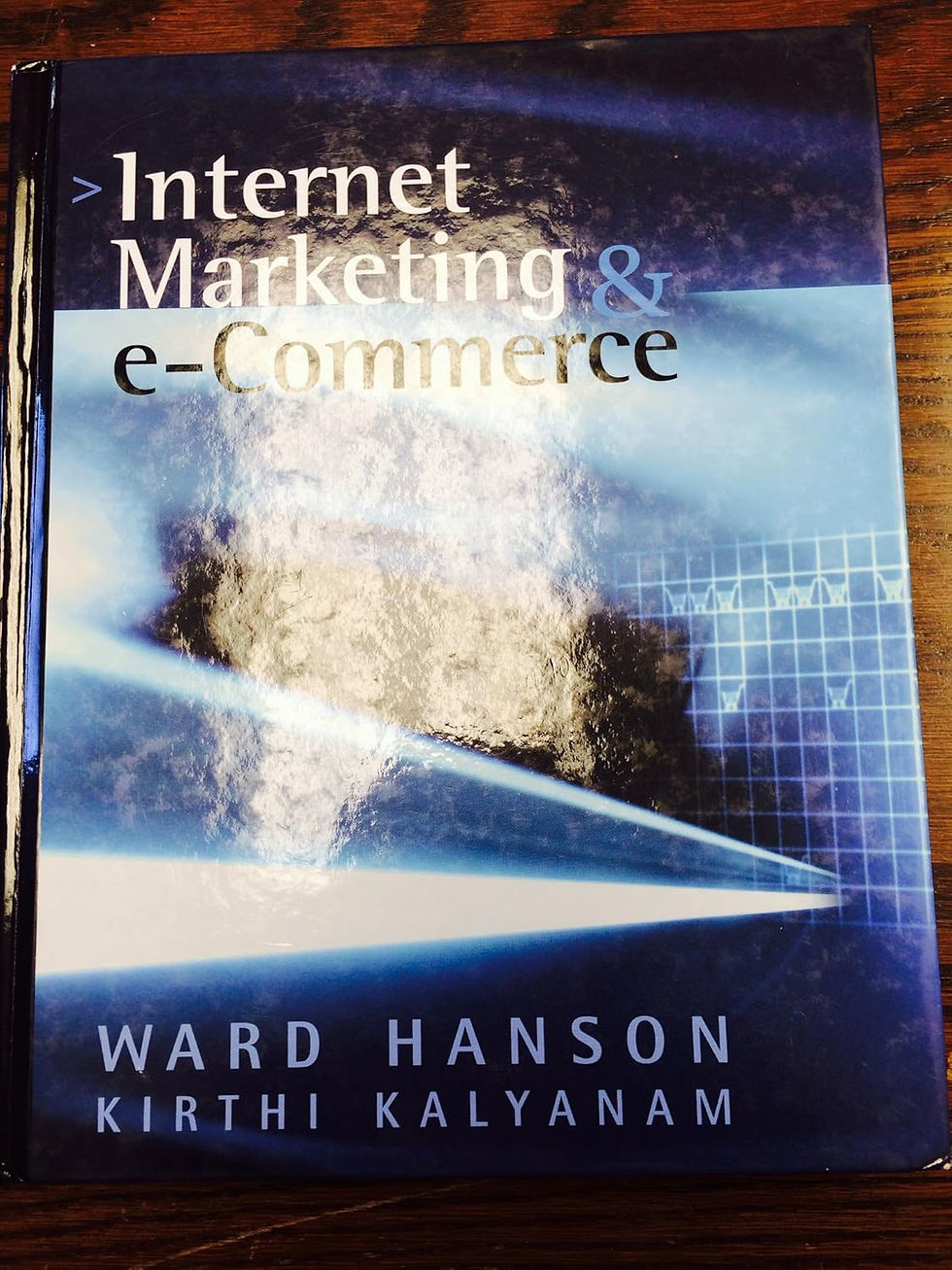
Internet Marketing & eCommerce
Authors: Ward Hanson and Kirthi Kalyanam
Short review
Internet Marketing & eCommerce provides a thorough introduction to how the internet has changed marketing, commerce, and business development. The book combines theory and practical examples in digital marketing, e-commerce, customer behavior, value creation, and digital business models. Although written at a time when the internet was still in its infancy, many of the fundamental principles are still highly relevant.
Why we recommend the book
This book was an important part of my own learning journey in digital marketing and e-commerce. It helped build my understanding of how technology, customer experiences and business strategy are interconnected – an insight that later became very important in my work with SAS, the Norwegian Opera & Ballet, Bærum Municipality and eventually the project The Invisible Capital. Many of the ideas about customer value, digitalization and innovation presented on the website have their roots in the knowledge this book conveys.

The Innovator's Solution: Creating and Sustaining Successful Growth
Authors: Clayton M. Christensen and Michael E. Raynor
Short review
In this sequel to The Innovator's Dilemma, Clayton Christensen shows how businesses can translate innovation theory into practical strategy. The book explains how companies can identify new growth opportunities, develop disruptive innovations, and build organizations that thrive in rapidly changing markets.
Why we recommend the book
While The Innovator's Dilemma explains why established businesses are often challenged, The Innovator's Solution provides concrete advice on how to meet the challenges. The book is therefore a natural next step for anyone who wants to understand innovation, strategy and long-term value creation.

The Innovator's DNA: Mastering the Five Skills of Disruptive Innovators
Authors: Jeff Dyer, Hal Gregersen and Clayton M. Christensen
Short review
What characterizes people who create groundbreaking innovations? The authors identify five key skills – observation, questioning, experimentation, networking and association – that are common to the world's most innovative leaders and entrepreneurs.
Why we recommend the book
This book shifts the focus from organizations to the people behind innovation. It shows that creativity and innovation can be developed through deliberate training and experience. The perspectives align well with the philosophy behind Invisible Capital, where human competence and curiosity are the most important drivers of development.

Competing Against Luck: The Story of Innovation and Customer Choice
Authors: Clayton M. Christensen, Taddy Hall, Karen Dillon and David S. Duncan
Short review
In this book, Clayton Christensen further develops the theory of Jobs to Be Done – the idea that customers do not primarily buy products, but "hire" them to solve specific needs. Through practical examples, the authors show how businesses can develop products and services that address customers' real-world challenges.
Why we recommend the book
For anyone working in customer experience, service design, and innovation, this is one of the most insightful books ever written. It reminds us that value creation always starts with understanding the people we are developing solutions for – a fundamental principle of Invisible Capital.

The Innovator's Dilemma: When New Technologies Cause Great Firms to Fail
Author: Clayton M. Christensen
Short review
The Innovator's Dilemma is considered one of the most influential books on innovation and technological change. Clayton M. Christensen introduces the theory of disruptive innovation and explains why even the most successful businesses can fail when new technologies and business models challenge established markets. Through a series of examples, he shows how companies often focus on today's customers and incremental improvements, while overlooking innovations that later change entire industries.
Why we recommend the book
This is one of the books that has had the greatest impact on modern innovation thinking. When I first read it, it gave me a whole new perspective on why some businesses succeed in transformation, while others lag behind – even when they are well led. The insight has been an important part of my own understanding of digitalization, innovation and change management, and many of the reflections in The Invisible Capital build on the ideas Clayton Christensen presents in this classic. The book is as relevant today, in the face of artificial intelligence and digital transformation, as it was when it was published.

Open Innovation: The New Imperative for Creating and Profiting from Technology
Author: Henry Chesbrough
Short review
Henry Chesbrough introduced the concept of Open Innovation and changed the way many businesses think about research and development. He shows how companies can create more innovation through collaboration with customers, universities, start-ups, suppliers and other external partners.
Why we recommend the book
Open Innovation has had a major influence on modern innovation thinking and was also an important topic during the seminars in Oxford and San Francisco. The book shows why future value creation occurs in the interaction between people, businesses and knowledge environments – not within closed organizations alone.

Blue Ocean Strategy: How to Create Uncontested Market Space and Make the Competition Irrelevant
Authors: W. Chan Kim and Renée Mauborgne
Short review
Blue Ocean Strategy challenges businesses to shift their focus away from fierce competition and instead create new markets with little or no competition. The authors present strategies and models that help organizations develop innovative products, services, and business models.
Why we recommend the book
This book has inspired leaders around the world to rethink strategy and innovation. Instead of competing for the same customers, it shows how businesses can create new value through creativity and differentiation. The perspectives align very well with the themes of innovation, digitalization, and long-term value creation in Invisible Capital.

Outside Innovation: How Your Customers Will Co-Design Your Company's Future
Authors: Patricia B. Seybold
Short review
Patricia Seybold shows how businesses can create better products and services by actively involving customers in the innovation process. The book describes how dialogue, co-creation and close collaboration with users can provide better solutions and stronger competitiveness.
Why we recommend the book
Customers often hold the most important insights into how products and services can be improved. This book emphasizes the importance of listening, involving, and learning from users – a perspective that is echoed in many of the articles on The Invisible Capital. Innovation rarely happens alone; it is created in the interaction between people.

Blown to Bits: How the New Economics of Information Transforms Strategy
Authors: Philip Evans and Thomas S. Wurster
Short review
This book analyzes how digital information is changing competitive conditions, markets, and business strategies. The authors explain how the internet is disrupting established structures and creating new opportunities for businesses that are able to think differently.
Why we recommend the book
Although written early in the internet revolution, the book describes many of the developments that still characterize business today. It provides valuable perspective on how digitalization affects value chains, competition, and innovation – themes that are central to Invisible Capital.

Wikinomics: How Mass Collaboration Changes Everything
Authors: Don Tapscott and Anthony D. Williams
Short review
Wikinomics shows how openness, sharing and collaboration across organizations create new forms of innovation and value creation. Through a number of international examples, the authors describe how digital networks make it possible to develop products, services and knowledge together.
Why we recommend the book
This book was groundbreaking when it was first published, and many of the ideas have since become a natural part of everyday digital life. The perspectives on collaboration, knowledge sharing, and open innovation processes align very well with the philosophy behind Invisible Capital, where people and networks are at the center of value creation.

© 2025 - 2026 Portico Publish | The invisible capital Privacy and use of the website | Developed and operated by Magne Bjella | Powered and secured by Wix


Comments