
Part 2 – The Customer and E-Commerce

How search, information, trust, friction and customer experience affect purchase
E-commerce is not just about technology, platforms and logistics. It is primarily about people trying to solve a need, understand the options and make a choice. In 2026, this assessment will take place across search engines, social media, websites, customer reviews, physical stores and artificial intelligence. Customers expect relevant information, simple processes and an experience that creates trust. Therefore, modern e-commerce is largely determined by what the customer finds, understands and experiences before pressing the buy button.

Table of contents
The customer comes before technology
The need is the beginning of the trade
From search to orientation
"Content is King" – still relevant in 2026
Information reduces uncertainty
Trust influences the purchasing decision
Customer reviews and social verification
Friction can stop a purchase
Price, delivery and returns affect the overall picture
AI is changing how customers search
Customer experience begins before the purchase
What does this mean for value creation?
The customer comes before technology
It's easy to start a discussion about e-commerce with technology. The platform, the payment solution, personalization, analytics tools, and artificial intelligence are visible and tangible. But the technology has no value in itself if it doesn't help the customer solve a need or make the transaction better in some way.
The customer therefore comes before the technology.
This does not mean that technology is unimportant. Quite the opposite. Modern e-commerce is completely dependent on advanced systems. But technology must be evaluated based on the value it creates for the customer and the business. A new feature that makes the solution more complex is not necessarily an improvement. A simpler solution that makes information easier to understand can be far more valuable.
In practice, this means that the business must understand the customer's situation before deciding which digital tools to use. What is the customer trying to achieve? What information is she missing? What makes her insecure? Where does friction arise? And what does it take for her to perceive the business as credible?
"Good e-commerce doesn't start with the question of what the technology can do, but with the question of what the customer is trying to achieve."
The need is the beginning of the trade
The customer journey doesn't necessarily start when the customer opens an online store. It often starts much earlier, at the moment a need arises.
Some needs are concrete. The customer needs a new washing machine because the old one has stopped working. Other needs are less clear. The customer is going on a trip, wants something new for the home or wants to buy a gift, but doesn't yet know what the solution should be.
In this early phase, the customer is often not concerned with products, but with problems and opportunities. She is trying to understand the need, find alternatives and reduce uncertainty. Therefore, e-commerce also becomes an information task.
Businesses that focus only on the product page and the buy button risk arriving too late in the customer journey. The customer may already have formed an image of which products are relevant, which brands she trusts, and which retailers seem relevant.
This is a key reason why content, search, customer reviews and advice have become so important. They help the customer before the purchase intention is necessarily fully developed.
From search to orientation
The search engine fundamentally changed e-commerce because it allowed the customer to find products and businesses without knowing them in advance. Instead of starting with a specific store, the customer could start with a need or product and then research the market.
This development made search visibility a key part of digital competition. Businesses not only had to have great products, they also had to be able to be found.
But search is about more than ranking. For the customer, search is part of the orientation. She compares prices, specifications, alternatives, tests and reviews. Each search result becomes a small meeting between the customer and the business.
In 2026, this orientation has become even broader. The customer can combine traditional search engines with social media, video services, marketplaces, discussion forums and AI assistants. The information exists in many places, and the business controls only a part of it.
This means that the customer's perception of the business is formed across multiple sources. The online store may be well-designed, but if customer reviews are weak or information seems inconsistent elsewhere, it affects trust.
"Content is King" – still relevant in 2026
In 1996, Bill Gates published the essay “Content is King.” The phrase quickly became one of the most famous from the early history of the Internet, often used as an argument that content would become a central part of the digital economy.
Almost thirty years later, the expression has taken on an interesting new relevance.
In the 1990s, content was important because the web needed information that could attract users. In the 2000s, content became increasingly important for search engines, because good content could make websites easier to find. In 2026, we have a third layer: Content should be understood not only by humans and search engines, but also by artificial intelligence.
This does not mean that all content is automatically valuable. Quite the opposite. The amount of digital information has become enormous. Therefore, quality, relevance, structure and credibility become more important.
Product descriptions must be precise. Professional content must be useful. Information must be up-to-date. Claims should be documentable. And the content must be organized in a way that makes it understandable for both humans and digital systems.
"Content is King has not lost its importance. In 2026, content has gained more readers: the customer, the search engine, and artificial intelligence."
This makes content an essential part of the e-commerce infrastructure. Content can reduce uncertainty, explain differences, build trust, and empower the customer to make a choice.
Information reduces uncertainty
A purchase almost always involves some form of uncertainty. The customer does not necessarily know if the product is suitable, if the quality is good enough or if the delivery will arrive as promised.
Information reduces this uncertainty.
Good product images, precise measurements, material information, size guides, delivery times, stock status and clear return policies can all make the customer feel more confident. Similarly, comparisons, guides and professional content can help the customer understand which product is the best fit.
Poor information has the opposite effect. Missing product data, unclear prices or incomprehensible terms create friction and doubt.
This is one of the reasons why product data has become so important in modern e-commerce. Product information shouldn't just fill a page. It should help the customer understand the product and reduce the risk of the purchase.
Good information can also reduce costs for the business. When the customer chooses the right product, the return rate can fall. When the terms and conditions are clear, the number of questions to customer service can be reduced.
This way, information becomes both customer experience and value creation.
Trust influences the purchasing decision
E-commerce requires trust because the customer often has to pay before the item is received. The customer must trust that the business exists, that the payment is secure, that the product matches the description, and that she will get help if something goes wrong.
This trust is built through many small signals.
Professional information, clear contact information, familiar payment solutions, realistic delivery promises, customer reviews, and clear return policies can all help reduce uncertainty. As can a well-known brand name or previous good experiences with the business.
However, trust can be broken quickly. A hidden cost at checkout, a delivery that doesn't arrive, or customer service that's hard to reach can damage the relationship.
Therefore, trust is not just a communication issue. It must be supported by the business's actual delivery.
The customer cannot be expected to trust a promise that the business constantly breaks.

Customer reviews and social verification
One of the most obvious changes in digital commerce is that the business is no longer alone in describing the product.
Customers do it too.
Customer reviews, tests, discussions and recommendations have become an important part of the information environment surrounding a product. For many customers, the experiences of others are perceived as particularly valuable because they represent perspectives outside the company's own marketing.
This is often referred to as social validation. When other people have purchased a product and been satisfied, it can reduce perceived risk.
But customer reviews can also create problems. Fake reviews, manipulation, and highly polarized experiences can make the information picture more difficult to interpret. Businesses must therefore be careful about how reviews are presented and used.
Perhaps most importantly, customer reviews show how the balance of power has shifted. The business no longer controls the entire narrative about the product or brand.
The customer has received a public vote.
Friction can stop a purchase
Friction is anything that makes the customer journey more difficult than necessary.
It could be a page that loads slowly, navigation that is difficult to understand, a form that requires unnecessary information, or a payment process that suddenly introduces costs the customer did not expect.
Some friction is necessary. For example, a business needs to obtain sufficient information to complete payment and delivery. But unnecessary friction can cause the customer to abandon the process.
That's why simplification has been a key goal in e-commerce for many years. One-click, fast checkout, autofill and digital wallets are all examples of solutions that attempt to reduce the effort the customer has to make.
But friction isn't just about the number of clicks.
Uncertainty is also friction.
If the customer doesn't understand the price, delivery time, or return policy, the mental strain increases. The customer has to spend more time and energy assessing the risk.
Good customer experience is therefore about both technical simplicity and cognitive simplicity.

Price, delivery and returns affect the overall picture
Price is of course important, but the customer rarely considers price in isolation. She also considers what comes with the purchase.
How quickly is the item delivered? What is the shipping cost? Is it easy to return? Can the item be picked up in store? How long is the right of return valid? Is customer service available if something goes wrong?
Thus, the real value the customer experiences is composed of several factors.
A product may be cheaper with one provider, but the customer may still choose another if delivery is faster, returns are easier, or trust is greater.
This shows why competition in e-commerce is not just a price competition.
It is a competition for the whole.
AI is changing how customers search
Artificial intelligence is changing search from a list of results to a conversation.
Instead of typing “best rain jacket for women,” the customer can explain the situation and ask the AI assistant for help. The assistant can ask follow-up questions, compare options, and explain which products fit different needs.
This can make the search process more personal and less dependent on the customer knowing the product category themselves.
At the same time, AI can move part of the customer journey away from the business's own website. The customer can get answers, recommendations and comparisons before visiting the online store.
This makes it even more important that the company's information is correct, structured and credible. AI can only work with the information it has access to.
This also makes the competition for visibility more complex. Businesses must still be visible to people, but increasingly also understandable to the systems that help them.
Customer experience begins before the purchase
When we look at the entire customer journey together, it becomes clear that customer experience does not begin when the customer puts an item in the shopping cart.
It begins when the customer first encounters the business or product.
A search result, a product description, an advertisement, a customer review, or a response from customer service can all be the start of the relationship.
Therefore, customer experience must be understood more broadly than the design of the online store. It is about the sum of all the encounters between the customer and the business.
“Customer experience starts before the purchase, continues throughout the transaction, and is often only decided when the business has delivered what it promised.”
This perspective also makes it easier to understand why e-commerce cannot be organized as an isolated digital function. Marketing, content, technology, customer service, and logistics all impact the same experience.
What does this mean for value creation?
When the business makes it easier for the customer to find, understand and choose the right product, value is created on several levels.
The customer saves time, reduces risk and gets a better experience. The business can also increase conversion, reduce returns, strengthen loyalty and reduce the burden on customer service.
Trust can contribute to repeat purchases. Good information can reduce wrong purchases. A simpler customer journey can make it more likely that the customer will complete the transaction.
Value creation in e-commerce therefore doesn't just happen through more transactions. It also happens through better decisions, lower friction, and stronger relationships.
And it is precisely here that the customer becomes the most important yardstick.
The technology may be advanced. The content may be comprehensive. The systems may be effective.
But if the customer cannot find what she needs, does not understand the information or does not trust the business, little value is created.
Next part: Part 3 – The technology behind modern e-commerce – platforms, payment, data, logistics and integrations
In the next part, we go behind the visible customer experience and take a closer look at the technology that makes modern e-commerce possible. We examine how platforms, payment solutions, product data, warehouses, logistics and integrations must work together to make shopping a simple experience for the customer. The goal is not to create a technical manual, but to explain why the infrastructure behind the online store has become an increasingly important part of both the customer experience and value creation.
Academic background and further specialization
This section builds on several academic tracks in The Invisible Capital . The study in eMarketing at BI Norwegian School of Business provides an early perspective on how digital information, search and customer behavior changed marketing. Innovation and commercialization connect developments to innovation and new business models. The Oxford seminars provide important perspectives on retail, the customer, trust and customer experience, while San Francisco represents developments in technology, digitization and new digital services. Together, they illustrate a common principle: The customer does not create value because the technology is advanced. Value arises when technology makes the customer's choices easier, safer and better.
Recommended literature
The literature presented here spans several disciplines and periods. The books provide perspectives on digitalization, innovation and strategy , and show how technology, markets, organizations and people have been understood and developed over time. Some of the works are classics, others represent newer academic perspectives, but together they provide a useful basis for further in-depth study of the topics we work with at The Invisible Capital .

Author(s): Chris Anderson
Short review
The Long Tail is one of the most influential books on how the internet has transformed commerce, marketing, and consumer behavior. Chris Anderson introduces the theory of the “Long Tail,” which explains how digital markets enable significant value creation through a large number of niche products, rather than relying on a few bestsellers.
The book shows how digital distribution, low inventory costs, search engines, and intelligent recommendation systems have made it profitable to offer an almost unlimited product range. Where traditional stores were limited by physical shelf space, online stores can offer millions of products and let customers find exactly what they are looking for.
Chris Anderson illustrates the theory with examples from Amazon, Netflix, Google, and the digital music industry, showing how the internet has changed the rules of competition for businesses around the world. Many of the insights have since become even more relevant through artificial intelligence, personalization, and modern search technology.
The authors take the reader through the entire process – from planning and organizing to publishing, managing and continuously improving content on websites and digital services. Although technology has evolved since the book was published, the principles of quality, relevance, management and long-term content work are at least as relevant in an era where search engines and artificial intelligence assess the credibility and usefulness of content.
Why we recommend the book
At The Invisible Capital, we consider The Long Tail to be one of the most important books in e-commerce, digitalization, and modern value creation.
The book explains why customers no longer just buy the most popular products, but increasingly find value in specialized products and services that meet individual needs. This insight has had enormous impact on the development of online stores, digital marketplaces, search engine optimization (SEO), information architecture, and content strategy.
Today we see that the theory also fits very well into the development of artificial intelligence. AI helps people discover relevant content, products and knowledge that were previously difficult to find. This has given the Long Tail principle a new dimension, where well-structured content and high professional quality are increasingly important for visibility, trust and value creation.
This is a book we believe everyone who works with e-commerce, digital marketing, customer experience, innovation, digital strategy or artificial intelligence should read.

Author/authors: Kristina Halvorson and Melissa Rach
Short review
How do you create content that actually helps people – and at the same time supports your business goals? Content Strategy for the Web is considered one of the most influential books in the field of content strategy and digital communications. The book shows how good content does not arise by chance, but through a deliberate strategy where user needs, the organization's goals, structure, work processes and management are closely linked.
The authors take the reader through the entire process – from planning and organizing to publishing, managing and continuously improving content on websites and digital services. Although technology has evolved since the book was published, the principles of quality, relevance, management and long-term content work are at least as relevant in an era where search engines and artificial intelligence assess the credibility and usefulness of content.
Why we recommend the book
At The Invisible Capital, we believe that good content is one of the most important forms of invisible value creation. A website is far more than design and technology – it is the content that builds trust, creates great customer experiences and helps people find the answers they are looking for.
This book is perfect for leaders, communications consultants, content producers, web editors, UX designers, and anyone working with digital services. It shows why a clear content strategy leads to better user experiences, more effective interactions, and stronger digital results over time.
In an era where artificial intelligence is increasingly important in how information is discovered, understood, and communicated, this book is more relevant than ever. It reminds us that technology alone never creates value – it is good, structured, and relevant content that makes the difference.

Short review
Don't Make Me Think is one of the world's most influential books on usability and web design. Since its first edition in 2000, the book has helped designers, developers, content producers, and managers understand a simple but powerful principle: Good digital services should be intuitive. The user should be able to complete their task without having to stop and think about how the website works.
Why we recommend the book
This is one of the books that has had the greatest impact on my own work with digital services. Over the years – from SAS and the Norwegian Opera & Ballet to working on Bærum Municipality’s website – the principles in this book have been an important reminder that technology is never an end in itself. The goal is to make everyday life easier for the people who use the services. Despite the fact that the book was published many years ago, the message is just as relevant today.
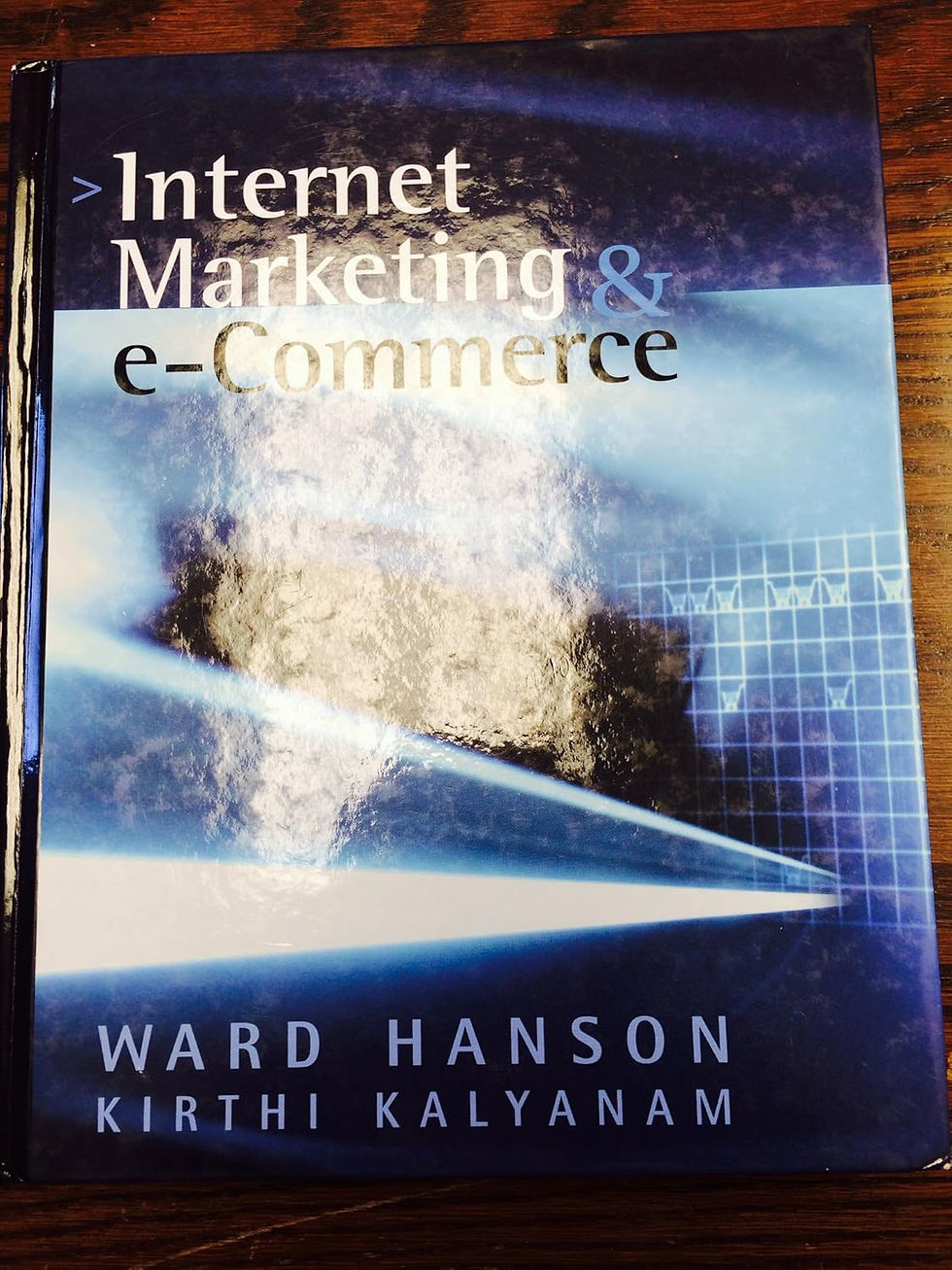
Authors: Ward Hanson and Kirthi Kalyanam
Short review
Internet Marketing & eCommerce provides a thorough introduction to how the internet has changed marketing, commerce, and business development. The book combines theory and practical examples in digital marketing, e-commerce, customer behavior, value creation, and digital business models. Although written at a time when the internet was still in its infancy, many of the fundamental principles are still highly relevant.
Why we recommend the book
This book was an important part of my own learning journey in digital marketing and e-commerce. It helped build my understanding of how technology, customer experience and business strategy are interconnected – an insight that later became very important in my work with SAS, the Norwegian Opera & Ballet, Bærum Municipality and eventually the project The Invisible Capital. Many of the ideas about customer value, digitalisation and innovation presented on the website have their roots in the knowledge this book conveys.

Authors: Clayton M. Christensen and Michael E. Raynor
Short review
In this sequel to The Innovator's Dilemma, Clayton Christensen shows how businesses can translate innovation theory into practical strategy. The book explains how companies can identify new growth opportunities, develop disruptive innovations, and build organizations that thrive in rapidly changing markets.
Why we recommend the book
While The Innovator's Dilemma explains why established businesses are often challenged, The Innovator's Solution provides concrete advice on how to meet the challenges. The book is therefore a natural next step for anyone who wants to understand innovation, strategy and long-term value creation.

Authors: Jeff Dyer, Hal Gregersen and Clayton M. Christensen
Short review
What characterizes people who create groundbreaking innovations? The authors identify five key skills – observation, questioning, experimentation, networking and association – that are common to the world's most innovative leaders and entrepreneurs.
Why we recommend the book
This book shifts the focus from organizations to the people behind innovation. It shows that creativity and innovation can be developed through deliberate training and experience. The perspectives align well with the philosophy behind Invisible Capital, where human competence and curiosity are the most important drivers of development.

Authors: Clayton M. Christensen, Taddy Hall, Karen Dillon and David S. Duncan
Short review
In this book, Clayton Christensen further develops the theory of Jobs to Be Done – the idea that customers do not primarily buy products, but "hire" them to solve specific needs. Through practical examples, the authors show how businesses can develop products and services that address customers' real-world challenges.
Why we recommend the book
For anyone working in customer experience, service design, and innovation, this is one of the most insightful books ever written. It reminds us that value creation always starts with understanding the people we are developing solutions for – a fundamental principle of Invisible Capital.

Author: Clayton M. Christensen
Short review
The Innovator's Dilemma is considered one of the most influential books on innovation and technological change. Clayton M. Christensen introduces the theory of disruptive innovation and explains why even the most successful businesses can fail when new technologies and business models challenge established markets. Through a series of examples, he shows how companies often focus on today's customers and incremental improvements, while overlooking innovations that later change entire industries.
Why we recommend the book
This is one of the books that has had the greatest impact on modern innovation thinking. When I first read it, it gave me a whole new perspective on why some businesses succeed in transformation, while others lag behind – even when they are well led. The insight has been an important part of my own understanding of digitalization, innovation and change management, and many of the reflections in The Invisible Capital build on the ideas Clayton Christensen presents in this classic. The book is as relevant today, in the face of artificial intelligence and digital transformation, as it was when it was published.

Author: Henry Chesbrough
Short review
Henry Chesbrough introduced the concept of Open Innovation and changed the way many businesses think about research and development. He shows how companies can create more innovation through collaboration with customers, universities, start-ups, suppliers and other external partners.
Why we recommend the book
Open Innovation has had a major influence on modern innovation thinking and was also an important topic during the seminars in Oxford and San Francisco. The book shows why future value creation occurs in the interaction between people, businesses and knowledge environments – not within closed organizations alone.

Authors: W. Chan Kim and Renée Mauborgne
Short review
Blue Ocean Strategy challenges businesses to shift their focus away from fierce competition and instead create new markets with little or no competition. The authors present strategies and models that help organizations develop innovative products, services, and business models.
Why we recommend the book
This book has inspired leaders around the world to rethink strategy and innovation. Instead of competing for the same customers, it shows how businesses can create new value through creativity and differentiation. The perspectives align very well with the themes of innovation, digitalization, and long-term value creation in Invisible Capital.

Authors: Patricia B. Seybold
Short review
Patricia Seybold shows how businesses can create better products and services by actively involving customers in the innovation process. The book describes how dialogue, co-creation and close collaboration with users can provide better solutions and stronger competitiveness.
Why we recommend the book
Customers often hold the most important insights into how products and services can be improved. This book emphasizes the importance of listening, involving, and learning from users – a perspective that is echoed in many of the articles on The Invisible Capital. Innovation rarely happens alone; it is created in the interaction between people.

Authors: Philip Evans and Thomas S. Wurster
Short review
This book analyzes how digital information is changing competitive conditions, markets, and business strategies. The authors explain how the internet is disrupting established structures and creating new opportunities for businesses that are able to think differently.
Why we recommend the book
Although written early in the internet revolution, the book describes many of the developments that still characterize business today. It provides valuable perspective on how digitalization affects value chains, competition, and innovation – themes that are central to Invisible Capital.

Authors: Don Tapscott and Anthony D. Williams
Short review
Wikinomics shows how openness, sharing and collaboration across organizations create new forms of innovation and value creation. Through a number of international examples, the authors describe how digital networks make it possible to develop products, services and knowledge together.
Why we recommend the book
This book was groundbreaking when it was first published, and many of the ideas have since become a natural part of everyday digital life. The perspectives on collaboration, knowledge sharing, and open innovation processes align very well with the philosophy behind Invisible Capital, where people and networks are at the center of value creation.

Author(s): Author: Michael E. Porter
Short review
Competitive Strategy is Michael E. Porter's classic work on how companies can understand the competition they find themselves in and develop a position that provides a basis for long-term profitability. Porter shifts the focus from the individual competitor to the structure of the entire industry and shows how competition is affected by customers, suppliers, new entrants, substitutes and the rivalry between existing companies. This forms the basis for what has later become known as Porter's Five Forces. The book is also about how companies can choose a competitive strategy on the basis of this analysis. It thus established an analytical language for strategy that has gained great importance in both research, teaching and practical strategy work.
Why we recommend the book
We recommend Competitive Strategy because it provides the analytical foundation for much of the thinking Porter later develops in What Is Strategy?. If a company is to choose a unique strategic position, it must also understand the competitive forces, the industry structure and the factors that affect the ability to create and retain value. The book is particularly useful because it reminds us that strategy is not just about internal goals, plans and ambitions. Strategy must be developed in the face of customers, competitors, suppliers, technology and structural changes in the market. Together with What Is Strategy?, the book therefore provides a much richer picture: First, the company must understand the competitive arena. Then, it must choose how to be different.

Author(s): Author: Michael E. Porter
Short review
In Competitive Advantage, Porter moves the analysis from the industry to the business itself. The main question is how competitive advantage is actually created. One of the book's most important contributions is the value chain, where the business is understood as a system of activities that collectively develop, produce, market, deliver and support a product or service. Competitive advantage cannot therefore be understood only through products or overall strategies; one must examine the activities that create costs, differentiation and value. This understanding later becomes central to Porter's argument about strategic fit: the activities must not only be good in isolation, but also fit together and reinforce each other.
Why we recommend the book
We recommend Competitive Advantage because it brings strategy right down to where value is actually created: in the activities the business performs. This makes the book particularly relevant together with What Is Strategy?. When Porter argues in 1996 that strategy consists of performing different activities than competitors, or performing similar activities in other ways, this builds on the thinking he developed here. For our perspective on value creation, this is particularly interesting. Value does not arise because the business has formulated a strategy on a document, but through people, expertise, technology, processes, collaboration and activities that together enable the business to create something that customers value. The book therefore provides an important connection between strategy, competitive advantage and actual value creation.

Author(s): Author: Michael E. Porter
Short review
In The Competitive Advantage of Nations, Porter raises the perspective from business to countries, regions and business environments. The book is based on extensive studies of the competitiveness of ten leading trading nations and examines why certain countries and business clusters are particularly successful in certain industries. A central premise is that national prosperity is not simply something a country inherits through natural resources or other given conditions. It is created, and productivity, innovation, competence, competition and the quality of the environment in which businesses operate are crucial. Here, Porter also develops the well-known diamond model to explain how different national and regional conditions can interact and stimulate competitiveness.
Why we recommend the book
We recommend The Competitive Advantage of Nations because here Porter extends the strategy perspective to the ecosystem surrounding the business itself. Value creation does not occur in a vacuum. Businesses develop in societies with education, research, infrastructure, capital, suppliers, demanding customers, competing businesses and public institutions. This makes the book particularly interesting for understanding value creation as an interaction between people, businesses and society. It also provides an important corrective to the notion that a country's competitiveness can mainly be understood through low costs or access to natural resources. Innovation, productivity and the ability to continuously develop are far more central to Porter's explanation.

Author: Joan Magretta
Short review
Understanding Michael Porter brings together and explains the most important parts of Michael Porter's strategic thinking in one accessible whole. Joan Magretta herself worked on strategy at the Harvard Business Review and organizes Porter's ideas around two fundamental questions: What is competition, and what is strategy? She explains, among other things, the Five Forces, competitive advantage, the value chain, value creation, trade-offs, fit, and strategic continuity. This makes the connection between Porter's various works clearer than when the concepts are studied separately. The book also includes an interview with Porter.
Why we recommend the book
We recommend Understanding Michael Porter because it helps the reader see the whole picture of Porter's understanding of strategy. Porter is often reduced to the Five Forces or a few models used in isolation. Magretta shows why this is too simple. Competition, value creation, strategic positioning, trade-offs, activity systems, fit and continuity are interconnected. This makes the book a particularly good supplement after reading What Is Strategy?. It makes it easier to understand why Porter does not view strategy as a plan or a collection of goals, but as a coherent system of choices about how the business will create value and compete over time.

Authors: Harvard Business Review, Michael E. Porter, W. Chan Kim, Renée A. Mauborgne and more
Short review
HBR's 10 Must Reads on Strategy brings together some of Harvard Business Review's most influential writings on strategy. The original collection from 2011 features Michael E. Porter's What Is Strategy? as its main article and combines it with works on competitive forces, Blue Ocean Strategy, the organization's vision, business models, strategy execution, and the Balanced Scorecard, among others. The result is not one unified theory of strategy, but multiple perspectives on how organizations can develop, formulate, and execute strategy.
Why we recommend the book
We recommend HBR's 10 Must Reads on Strategy because it places Porter in a broader strategic context. After reading What Is Strategy?, it will be interesting to encounter other central perspectives and see how they complement, challenge, or extend Porter's understanding. The collection also shows why strategy cannot be reduced to a single model. Competitive position, choice, innovation, business model, execution, priorities, and measurement must be seen in context. For the reader who wants to move on from Porter and into the strategy discipline more generally, this is therefore a very good introduction.

Author: Joseph E. Stiglitz and Bruce C. Greenwald
Short review:
Creating a Learning Society examines how knowledge, learning, and technological development contribute to economic growth and long-term value creation. Joseph E. Stiglitz and Bruce C. Greenwald challenge the notion that economic development is primarily about accumulating more physical capital. They argue that society’s ability to create, disseminate, and apply knowledge is crucial to productivity growth and improved living standards. A key point is that learning does not only occur in schools and universities. It also occurs in businesses, through work, production, innovation, and the interaction between people and organizations. Knowledge can also spread from one business and one part of the economy to others.
The book thus provides an important perspective on why human capital, competence, innovation and learning must be understood as central parts of a society's ability to create value over time.
Why we recommend the book
We recommend Creating a Learning Society because it expands the understanding of what lies behind economic value creation.
Machines, technology and financial capital are important, but they do not create productivity growth alone. Behind the development are people who learn, develop knowledge, improve work processes, share experiences and find new solutions.
This makes the book particularly relevant to Invisible Capital and our perspective on value creation: A significant part of society's value-creating capacity is found in the knowledge, competence, and learning ability of the people who participate in the economy.
Stiglitz and Greenwald thus provide an academic foundation for one of the most important relationships in modern value creation:

Author: Mariana Mazzucato
Short review
In The Value of Everything Mariana Mazzucato asks a fundamental question: What exactly is value – and who creates it? Mazzucato returns to the historical discussions of value in economics and shows how the understanding of value creation has changed. She challenges the notion that high income, high prices or high profits necessarily mean that correspondingly high values have been created. One of the book's most important contributions is the distinction between value creation and value extraction . Mazzucato examines the financial sector, the pharmaceutical industry, innovation and the public sector, among others, and argues that we must become better at distinguishing between activities that actually create new values, and activities that primarily extract values that have already been created.
The book also challenges the traditional notion that the private sector creates value while the public sector mainly consumes or redistributes it. Innovation and economic development often arise through a complex interaction between public investment, research, businesses, capital and people.

Author: Philippe Aghion, Céline Antonin and Simon Bunel
Short review
The Power of Creative Destruction is about one of the most important drivers of long-term economic growth: innovation.
Philippe Aghion, Céline Antonin and Simon Bunel build on Joseph Schumpeter's classic idea of "creative destruction" – the process by which new technologies, businesses, products and ideas challenge and replace existing solutions.
But the book is not just about the disappearance of the old. The authors examine why some economies manage to create continuous innovation and productivity growth, while others stagnate. Competition, entrepreneurship, research, education, institutions and public policy thus become important parts of the explanation.
Creative destruction also comes at a cost. New technologies and businesses create opportunities and jobs, but can also make existing skills, tasks and business models less relevant. The challenge is therefore to create societies that both promote innovation and enable people to participate in the transition.
Why we recommend the book
We recommend The Power of Creative Destruction because it shows why innovation is a fundamental driver of value creation .
Value creation is not just about producing more of what we already produce. It also occurs when people develop new ideas, technology, and ways of working that enable us to solve tasks better than before.
This makes the book particularly relevant to The Invisible Capital. Behind innovation are people with knowledge, expertise, creativity and experience. But Aghion's perspective also shows that human capital must be part of a larger system where competition, institutions, research, investment and policy create the conditions for new ideas to actually turn into economic and social development.
The book thus provides an important context in our understanding of value creation:
Knowledge → new ideas → innovation → productivity growth → long-term value creation.

Author: Philippe Aghion, Céline Antonin and Simon Bunel
Short review
Institutions, Institutional Change and Economic Performance is one of Douglass C. North's most important works on why some societies are more successful than others in creating economic development over time.
North shifts attention from traditional factors of production such as capital and labor to the institutions that shape how people, businesses, and governments act and cooperate. Institutions are society's formal and informal rules of the game – including laws, regulations, norms, traditions, and established ways of organizing interaction.
These rules of the game affect the incentives that people and organizations face. They also affect investments, knowledge development, cooperation, transaction costs, and which economic activities emerge.
North also shows that institutions develop over time. History therefore matters: Today's economic opportunities are influenced by institutional choices and development paths that can stretch far back in time.
Why we recommend the book
We recommend Institutions, Institutional Change and Economic Performance because it explains a crucial aspect of value creation that easily becomes invisible:
Value creation needs good rules of the game.
People may have knowledge. Businesses may have capital. Entrepreneurs may have great ideas. A society may have natural resources and advanced technology. But outcomes are also influenced by the institutions that determine how people can collaborate, invest, compete, make deals, and develop businesses.
This makes North particularly interesting for our understanding of trust as part of invisible capital. Trust is not the same as institutions, but stable rules of the game, credible agreements, and well-functioning institutions can reduce uncertainty and make economic interaction easier.
North thus gives us another important part of the value creation picture:
Institutions → predictability and incentives → cooperation and investment → productive activity → long-term value creation.

© 2025 - 2026 Portico Publish | The invisible capital Privacy and use of the website | Developed and operated by Magne Bjella | Powered and secured by Wix


Comments