
Part 8 - The digital customer – UX, usability and information

For more and more customers, their encounter with a business begins long before they speak to a human. They search on Google, open a website, compare products, read information, use an app, add items to a shopping cart, or try to find the answer to a question.
The digital solution is therefore not just technology.
For the customer, it is part of the business .
A poor search function is a poor customer experience. An incomprehensible menu is a hindrance. Insufficient product information creates uncertainty. A cumbersome checkout process can end a sale that the business has already spent significant resources creating.
That's why UX, usability, information architecture, and good content belong in an article series about the customer.
Nielsen Norman Group defines user experience, UX, broadly: it encompasses all aspects of the end user's interaction with the business, services and products.
This means that digital customer experience is not primarily about what a website looks like.
It is about how well the business helps people do what they came to do .

The customer does not experience the technology – the customer experiences the task
The business may be concerned with the technology platform, the publishing system, the integrations, the database, or the architecture behind the digital solution.
The customer is usually preoccupied with something else.
She will find the opening hours.
Compare two products.
Change an order.
Book a trip.
Find the right spare part.
Pay an invoice.
Understand what a product actually does.
Get help when something has gone wrong.
This distinction is fundamental.
Technology is the means of business.
The customer's task is the purpose.
A digital solution can therefore be technically advanced and yet provide a poor customer experience. The system can work exactly as the specification describes, while the customer still does not understand how to use it.
From a technical perspective, there may be no error.
From the customer's perspective, there is a problem.
Steve Krug and the Simplest Rule in Digital Customer Experience
Steve Krug's Don't Make Me Think became a classic in web usability because it articulated a complicated subject in a very simple way.
The user should not have to spend unnecessary mental energy understanding how the website works.
Krug himself describes the book as an introduction to usability, UX, and user-centered design. He says that the starting point was the desire to make digital products easier to use and less frustrating.
Perhaps his most famous formulation is also the book's title:
"Don't make me think." -Steve Krug
This is far more than good advice for web designers.
It expresses a fundamental principle of customer focus.
The customer should not have to learn the internal logic of the business in order to trade with it.
She shouldn't have to understand how the organization is structured.
She shouldn't have to guess what the business has chosen to call a function.
She shouldn't have to search through five pages to find the answer to a simple question.
Every time a business imposes unnecessary work on its customers, it creates friction.
Friction is work the business shifts onto the customer
Digitization is often described as streamlining.
But the question is: Efficiency for whom?
A business can reduce its own costs by automating a process. If the result is that the customer has to spend more time understanding, recording or correcting information, the business has partially shifted the work from the organization to the customer.
Self-service can be very valuable.
Many customers prefer to solve the task themselves, when the solution is quick and understandable.
But poor self-service is something else.
Then the customer becomes their own case manager without having the tools or knowledge the case manager previously had.
That is why digitalization should be considered from both the business and the customer's perspective.
A process has not necessarily improved because the business uses fewer working hours.
It may also have improved because the customer spends less time.
Usability is about succeeding with a task
The World Wide Web Consortium, W3C, describes usability as the effort to design products so that people can use them effectively, appropriately, and satisfactorily. User-centered design takes into account the users' characteristics, tasks, goals, and the context in which the solution is actually used.
This means that usability cannot be primarily assessed based on what the designer thinks of the solution.
It must be considered through the person who will use it.
Can the customer actually complete the task?
A website can be aesthetically pleasing and yet difficult to use.
An app can win design awards and still cause problems.
A new feature can be technically impressive without the customer understanding it.
Therefore, the business must examine specific tasks.
Does the customer find the right product?
Does the customer understand the difference between the options?
Can the customer complete the purchase?
Does the customer understand what happens after payment?
Can the customer find help if something goes wrong?
If the customer is not successful in these tasks, the business has a customer problem.
Not just a UX problem.
Good UX begins with human needs
Don Norman and Jakob Nielsen put this very clearly from a customer perspective:
"The first requirement for an exemplary user experience is to meet the exact needs of the customer." - Don Norman and Jakob Nielsen
The wording is important because it positions the design according to the need.
The first question is not:
How should the page look?
The first question is:
What does man need to do?
The design comes afterwards.
The navigation comes afterwards.
The technology comes afterwards.
That doesn't mean these elements are unimportant. It means they need to be evaluated based on how well they support the person's goals.
This is, in practice, the digital version of the customer focus we discussed in Part 3.
The business must work from the outside in .
Information architecture determines whether the customer finds out
As digital services grow, so does the amount of information.
New products are added.
New services are being developed.
New fields of study arise.
New pages are published.
After a few years, the business may have thousands of pages organized by departments, projects, and internal technical terms.
But the customer does not necessarily know the organization.
She knows her own needs.
This makes information architecture an important part of the customer experience.
The information must be organized so that people can understand:
where they are, what they can find, where to go next and how different parts of the content are connected.
This applies to menus, categories, searches, product structures, links, and the page hierarchy.
Good information architecture is often almost invisible.
The customer finds what she needs and moves on.
Poor information architecture, on the other hand, becomes very visible.
The customer is looking.
Clicking back.
Applicant.
Trying another word.
Opens the wrong page.
And maybe leave the site.
The language of the business is not necessarily the language of the customer
A common cause of poor digital customer experience is that the business writes for itself.
Internal product names are used in the navigation.
Technical terms are used without explanation.
Organizational concepts are used as categories.
Abbreviations that are self-evident internally are published without considering that the customer has never seen them before.
The result may be that the business has the information the customer needs, but the customer cannot find it because the two use
different words.
This is a classic customer insight problem.
The business must know how the customer describes their needs .
Search data can be particularly valuable here.
What do people type in the website search box?
What do they search for on Google before they come in?
What words do they use in customer service?
What questions remain?
The language the customer uses is customer insight.
Product information is part of the product
This becomes particularly evident in e-commerce.
In a physical store, the customer can lift the product.
See the size.
Know the material.
Ask a staff member.
Compare two products side by side.
In the online store, much of this knowledge must be conveyed through information.
The product name.
The pictures.
The description.
The specifications.
The sizes.
The compatibility.
Delivery time.
The stock status.
The return conditions.
The reviews.
Good product information reduces uncertainty.
Poor product information shifts uncertainty onto the customer.
The customer must look elsewhere, contact customer service or purchase
without knowing if the product is suitable.
Therefore, product information is not just content production.
It is part of the customer's decision-making basis.

Content can be customer service before the customer asks
A lot of customer service actually begins before the customer makes contact.
If the information is clear, the customer can solve the problem themselves.
A good size guide can prevent a return.
A clear explanation can prevent a phone call.
Good instruction can reduce misuse.
An understandable order confirmation can prevent uncertainty.
An updated help center can make the customer self-reliant.
Thus, good content can create value for both the customer and the business.
The customer saves time.
The business reduces unnecessary inquiries.
And the customer service representative has more time for the problems that actually
needs human help.
Digital content is therefore not just communication.
It can be service infrastructure .
The customer does not necessarily read the way the business writes
Businesses often produce digital texts as if the customer is going to read them from beginning to end.
This is not always how the internet is used.
People scan.
They are looking for words.
They read headlines.
They jump between paragraphs.
They are searching for concrete answers.
This has consequences for how digital information should be built.
up.
Clear headings, descriptive links, short paragraphs, understandable concepts and a good visual hierarchy make it easier to find your way around.
This is not an argument for making all content short.
Complex questions sometimes require in-depth information.
The point is that long content must also be navigable .
Good digital communication respects both the complexity of the content and the customer's time.
Test with people – not just with the organization
A business can discuss a digital solution for months.
Designers can consider it.
Management can approve it.
The technologists can test that the functions work.
However, the first real users may discover problems on
minutes.
That's why user testing is so important.
Steve Krug has made simple and frequent user testing a central theme in his work. His Rocket Surgery Made Easy is about how businesses can conduct quick, practical usability tests themselves.
W3C similarly points out that involving actual users in the development process helps create solutions that work better for real people in real situations.
The crucial thing is not how many people are sitting in the meeting.
The crucial thing is whether any of them are actually the people the solution should work for.
See what the customer does – not just what the customer says
User testing also illustrates an important point from the customer insights in Part 4.
There is a difference between what people say and what they do.
Jakob Nielsen has formulated this very directly:
"Pay attention to what users do, not what they say." - Jakob Nielsen
That doesn't mean the business should stop talking to customers.
Interviews are valuable.
Surveys are valuable.
Feedback is valuable.
But if the business wants to know if a digital solution works, it should also observe people while they actually use it.
The customer may say that the solution seems simple.
Observation may show that she stops three times along the way.
Both pieces of information are interesting.
Together they provide better insight.
An accessible solution is a better solution
Digital customer experience is also about who can actually use the solution.
People have different assumptions.
Some people have impaired vision.
Others have motor challenges.
Some people use screen readers.
Some have cognitive challenges.
Others temporarily find themselves in a situation where it is difficult to read, hear, or use the device.
The W3C emphasizes that accessibility, usability, and inclusion overlap significantly, and that it is most effective to treat them together when developing websites and applications.
WCAG 2.2 contains comprehensive recommendations for making digital content accessible to more people.
This is not just a technical or legal issue.
There is also customer focus.
A business can hardly claim to be customer-centric if large groups of customers cannot use the solution.
The mobile phone changed the customer experience
The digital customer is not necessarily sitting in front of a big screen in an office.
She can stand at a bus stop.
Sitting on the train.
Walk through a store.
Lie at home on the sofa.
Have a bad time.
Use one hand.
Be distracted.
Have weak coverage.
This has changed the requirements for digital customer experience.
Mobile has made the customer journey more continuous.
The customer can discover a product on their mobile phone in the morning, research it on a PC at work, visit a physical store in the afternoon, and complete the purchase on their phone in the evening.
For the customer, this is one process.
However, the business can see four different channels.
This distinction becomes important.
The customer doesn't think in channels
Businesses have traditionally organized their contact points separately.
Shop.
Online store.
Telephone.
App.
Email.
Social media.
But the customer rarely thinks like that.
She thinks about the task.
If the customer initiates a purchase online and later contacts customer service, she would expect the employee to be able to see what happened.
If an item is listed as available online, she expects the information to be correct when she gets to the store.
If she puts something in the shopping cart on her mobile phone, she can expect to find it again on her PC.
When channels are not connected, the structure of the organization becomes visible to the customer.
That's rarely a good sign.
Good digital customer experience therefore requires more than good UX in each individual interface.
It requires coherence between the points of contact .
Personalization can reduce work – or create unrest
Digital businesses can tailor the experience to the individual customer.
Previous purchases can be used for recommendations.
Relevant information can be prioritized.
Products can be suggested.
Content can be customized.
This can reduce the customer's work.
But personalization has a limit.
If the customer does not understand why the business knows something, helpfulness can be perceived as surveillance.
This is where UX meets privacy and trust.
The question is not only:
Can we personalize this?
The business should also ask:
Will the customer experience that this creates value?
This becomes even more important as artificial intelligence makes personalization more advanced.
AI is changing the digital customer encounter
Artificial intelligence can change the way customers find, evaluate and purchase products.
Search can become more conversational.
Digital advisors can understand complex issues.
Product information can be adapted to the situation.
A customer can describe their need in their own words instead of understanding the business's categories.
The customer service representative can quickly access relevant information while the call is in progress.
This can dramatically reduce friction.
But the same technology can also create new problems.
An AI assistant may provide incorrect information.
It may misunderstand the need.
It may hide how the recommendation was produced.
It can make it difficult to reach a person.
Therefore, the principles of Krug and Norman do not disappear when AI arrives.
They may become even more important.
Technology should help humans with the task.
Don't impress the human with the technology.

The best digital solution may be the one the customer barely notices
Good digital customer experience doesn't always have to create excitement.
Sometimes the best experience is when nothing gets in the way.
The customer finds the information.
Understand it.
Make the choice.
Completes the task.
And moves on with the day.
This is valuable precisely because the customer does not have to spend unnecessary time and attention.
In a world filled with digital services, this can become a competitive advantage.
Simplicity is not a lack of functionality.
Good simplicity is the result of the business understanding what the customer needs and removing what stands in the way.
Digitalization makes the entire business visible
It's easy to consider the website as the responsibility of the marketing department and the app as the responsibility of the IT department.
For the customer, this distinction is artificial.
A digital customer experience is influenced by:
product development, logistics, inventory data, pricing, content, IT systems, design, customer service and management.
If the inventory information is incorrect, it doesn't help that the design is good.
If product information is missing, an elegant shopping cart cannot compensate.
If customer service doesn't have access to order data, the post-purchase experience is broken.
Thus, digital customer experience once again becomes a question of organization , not just technology.
The business must collaborate across the organization because the customer is already doing so.
UX and usability are forms of respect
There is also a human perspective underlying this field.
Bad digital solutions waste people's time.
They create frustration.
They make simple tasks difficult.
They can make people unsure whether they have done something right.
These may seem like small problems on their own.
But if a digital service is used by hundreds of thousands of people, a few unnecessary minutes per user can turn into enormous amounts of wasted time.
Good usability therefore has a value that goes beyond conversion and sales.
It shows respect for people's time and attention.
Steve Krug wanted knowledge about usability to help make the products people use less frustrating.
That is perhaps one of the simplest definitions of good digital customer focus.
Make it easier for people to succeed.
The digital customer is still a human being
Technology has changed the customer relationship.
But it has not eliminated man.
Behind every click there is a purpose.
Behind every search is a question.
Behind every abandoned shopping cart is a situation.
Behind every customer service call is a problem someone is trying to solve.
Therefore, digital customer experience should not start with the website, app, or technology.
It should start with the human being.
What is the customer trying to do?
What does the customer need to know?
Where does the uncertainty arise?
What obstacles has the business itself created?
How can these be removed?
When the business starts there, UX, information architecture, content, search, and digitization become parts of the same task:
to make it easier for the customer to create the value the customer came to get.
And the digital journey doesn't necessarily stop at the screen.
The customer moves between search, online store, telephone, store, delivery, customer service and an increasing number of AI-based contact points.
This leads us further to:
Recommended literature
Customer focus, customer insight and customer relationships cannot be understood in isolation from developments in digitalisation, innovation and user experience. The way a business interacts with its customers is shaped today by people, technology, digital services, organisation and the ability to develop new solutions.
Therefore, this bibliography currently contains books that highlight several of these perspectives.
Here you will find literature on digitalization, innovation, user experience, usability and the development of digital services, among other things. Steve Krug's Don't Make Me Think is a natural example: The book is about usability on the web, but at the same time touches on a fundamental question in the entire Customer series – how easy or difficult the business makes it for people to succeed in what they are trying to do.
Similarly, literature on innovation can help us understand how observations, needs and problems of customers and users can be developed into better products, services and work processes.
The literature list will eventually be expanded with more books that specifically address customer focus, customer insight, customer relations, customer loyalty, e-commerce, service and customer experience.
The goal is not to collect as many books as possible, but to build a literature base that makes it possible to understand the customer from multiple professional perspectives.
From San Francisco and Oxford to the customer
Experiences from professional seminars and study trips in San Francisco and Oxford are also part of the background for this professional universe. Topics such as innovation, digitalization, e-commerce, user experience and new business models have over time contributed to a broader understanding of how technology and organizations must take as their starting point the people the solutions will actually work for.
The Customer Series continues this perspective: Technology is a tool. Innovation is a tool. Value arises when solutions actually work for the people they are designed for.

The Long Tail: Why the Future of Business Is Selling Less of More
Author(s): Chris Anderson
Short review
The Long Tail is one of the most influential books on how the internet has transformed commerce, marketing, and consumer behavior. Chris Anderson introduces the theory of the “Long Tail,” which explains how digital markets enable significant value creation through a large number of niche products, rather than relying on a few bestsellers.
The book shows how digital distribution, low inventory costs, search engines, and intelligent recommendation systems have made it profitable to offer an almost unlimited product range. Where traditional stores were limited by physical shelf space, online stores can offer millions of products and let customers find exactly what they are looking for.
Chris Anderson illustrates the theory with examples from Amazon, Netflix, Google, and the digital music industry, showing how the internet has changed the rules of competition for businesses around the world. Many of the insights have since become even more relevant through artificial intelligence, personalization, and modern search technology.
The authors take the reader through the entire process – from planning and organizing to publishing, managing and continuously improving content on websites and digital services. Although technology has evolved since the book was published, the principles of quality, relevance, management and long-term content work are at least as relevant in an era where search engines and artificial intelligence assess the credibility and usefulness of content.
Why we recommend the book
At The Invisible Capital, we consider The Long Tail to be one of the most important books in e-commerce, digitalization, and modern value creation.
The book explains why customers no longer just buy the most popular products, but increasingly find value in specialized products and services that meet individual needs. This insight has had enormous impact on the development of online stores, digital marketplaces, search engine optimization (SEO), information architecture, and content strategy.
Today we see that the theory also fits very well into the development of artificial intelligence. AI helps people discover relevant content, products and knowledge that were previously difficult to find. This has given the Long Tail principle a new dimension, where well-structured content and high professional quality are increasingly important for visibility, trust and value creation.
This is a book we believe everyone who works with e-commerce, digital marketing, customer experience, innovation, digital strategy or artificial intelligence should read.

Content Strategy for the Web (2nd Edition)
Author/authors: Kristina Halvorson and Melissa Rach
Short review
How do you create content that actually helps people – and at the same time supports your business goals? Content Strategy for the Web is considered one of the most influential books in the field of content strategy and digital communications. The book shows how good content does not arise by chance, but through a deliberate strategy where user needs, the organization's goals, structure, work processes and management are closely linked.
The authors take the reader through the entire process – from planning and organizing to publishing, managing and continuously improving content on websites and digital services. Although technology has evolved since the book was published, the principles of quality, relevance, management and long-term content work are at least as relevant in an era where search engines and artificial intelligence assess the credibility and usefulness of content.
Why we recommend the book
At The Invisible Capital, we believe that good content is one of the most important forms of invisible value creation. A website is far more than design and technology – it is the content that builds trust, creates great customer experiences and helps people find the answers they are looking for.
This book is perfect for leaders, communications consultants, content producers, web editors, UX designers, and anyone working with digital services. It shows why a clear content strategy leads to better user experiences, more effective interactions, and stronger digital results over time.
In an era where artificial intelligence is increasingly important in how information is discovered, understood, and communicated, this book is more relevant than ever. It reminds us that technology alone never creates value – it is good, structured, and relevant content that makes the difference.

Don't Make Me Think
Author: Steve Krug
Short review
Don't Make Me Think is one of the world's most influential books on usability and web design. Since its first edition in 2000, the book has helped designers, developers, content producers, and managers understand a simple but powerful principle: Good digital services should be intuitive. The user should be able to complete their task without having to stop and think about how the website works.
Why we recommend the book
This is one of the books that has had the greatest impact on my own work with digital services. Over the years – from SAS and the Norwegian Opera & Ballet to working on Bærum Municipality’s website – the principles in this book have been an important reminder that technology is never an end in itself. The goal is to make everyday life easier for the people who use the services. Despite the fact that the book was published many years ago, the message is just as relevant today.
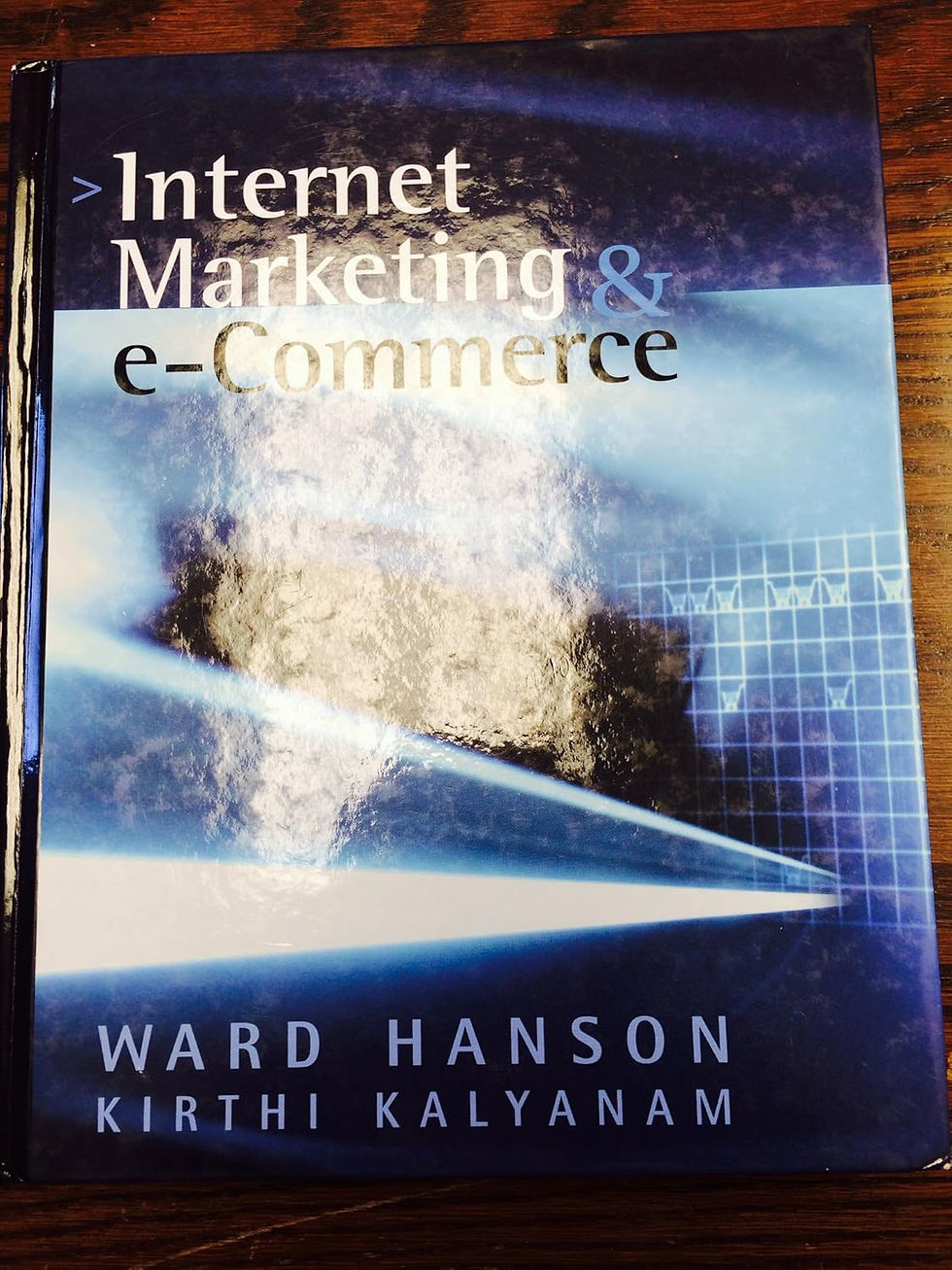
Internet Marketing & eCommerce
Authors: Ward Hanson and Kirthi Kalyanam
Short review
Internet Marketing & eCommerce provides a thorough introduction to how the internet has changed marketing, commerce, and business development. The book combines theory and practical examples in digital marketing, e-commerce, customer behavior, value creation, and digital business models. Although written at a time when the internet was still in its infancy, many of the fundamental principles are still highly relevant.
Why we recommend the book
This book was an important part of my own learning journey in digital marketing and e-commerce. It helped build my understanding of how technology, customer experiences and business strategy are interconnected – an insight that later became very important in my work with SAS, the Norwegian Opera & Ballet, Bærum Municipality and eventually the project The Invisible Capital. Many of the ideas about customer value, digitalization and innovation presented on the website have their roots in the knowledge this book conveys.

The Innovator's Solution: Creating and Sustaining Successful Growth
Authors: Clayton M. Christensen and Michael E. Raynor
Short review
In this sequel to The Innovator's Dilemma, Clayton Christensen shows how businesses can translate innovation theory into practical strategy. The book explains how companies can identify new growth opportunities, develop disruptive innovations, and build organizations that thrive in rapidly changing markets.
Why we recommend the book
While The Innovator's Dilemma explains why established businesses are often challenged, The Innovator's Solution provides concrete advice on how to meet the challenges. The book is therefore a natural next step for anyone who wants to understand innovation, strategy and long-term value creation.

The Innovator's DNA: Mastering the Five Skills of Disruptive Innovators
Authors: Jeff Dyer, Hal Gregersen and Clayton M. Christensen
Short review
What characterizes people who create groundbreaking innovations? The authors identify five key skills – observation, questioning, experimentation, networking and association – that are common to the world's most innovative leaders and entrepreneurs.
Why we recommend the book
This book shifts the focus from organizations to the people behind innovation. It shows that creativity and innovation can be developed through deliberate training and experience. The perspectives align well with the philosophy behind Invisible Capital, where human competence and curiosity are the most important drivers of development.

Competing Against Luck: The Story of Innovation and Customer Choice
Authors: Clayton M. Christensen, Taddy Hall, Karen Dillon and David S. Duncan
Short review
In this book, Clayton Christensen further develops the theory of Jobs to Be Done – the idea that customers do not primarily buy products, but "hire" them to solve specific needs. Through practical examples, the authors show how businesses can develop products and services that address customers' real-world challenges.
Why we recommend the book
For anyone working in customer experience, service design, and innovation, this is one of the most insightful books ever written. It reminds us that value creation always starts with understanding the people we are developing solutions for – a fundamental principle of Invisible Capital.

The Innovator's Dilemma: When New Technologies Cause Great Firms to Fail
Author: Clayton M. Christensen
Short review
The Innovator's Dilemma is considered one of the most influential books on innovation and technological change. Clayton M. Christensen introduces the theory of disruptive innovation and explains why even the most successful businesses can fail when new technologies and business models challenge established markets. Through a series of examples, he shows how companies often focus on today's customers and incremental improvements, while overlooking innovations that later change entire industries.
Why we recommend the book
This is one of the books that has had the greatest impact on modern innovation thinking. When I first read it, it gave me a whole new perspective on why some businesses succeed in transformation, while others lag behind – even when they are well led. The insight has been an important part of my own understanding of digitalization, innovation and change management, and many of the reflections in The Invisible Capital build on the ideas Clayton Christensen presents in this classic. The book is as relevant today, in the face of artificial intelligence and digital transformation, as it was when it was published.

Open Innovation: The New Imperative for Creating and Profiting from Technology
Author: Henry Chesbrough
Short review
Henry Chesbrough introduced the concept of Open Innovation and changed the way many businesses think about research and development. He shows how companies can create more innovation through collaboration with customers, universities, start-ups, suppliers and other external partners.
Why we recommend the book
Open Innovation has had a major influence on modern innovation thinking and was also an important topic during the seminars in Oxford and San Francisco. The book shows why future value creation occurs in the interaction between people, businesses and knowledge environments – not within closed organizations alone.

Blue Ocean Strategy: How to Create Uncontested Market Space and Make the Competition Irrelevant
Authors: W. Chan Kim and Renée Mauborgne
Short review
Blue Ocean Strategy challenges businesses to shift their focus away from fierce competition and instead create new markets with little or no competition. The authors present strategies and models that help organizations develop innovative products, services, and business models.
Why we recommend the book
This book has inspired leaders around the world to rethink strategy and innovation. Instead of competing for the same customers, it shows how businesses can create new value through creativity and differentiation. The perspectives align very well with the themes of innovation, digitalization, and long-term value creation in Invisible Capital.

Outside Innovation: How Your Customers Will Co-Design Your Company's Future
Authors: Patricia B. Seybold
Short review
Patricia Seybold shows how businesses can create better products and services by actively involving customers in the innovation process. The book describes how dialogue, co-creation and close collaboration with users can provide better solutions and stronger competitiveness.
Why we recommend the book
Customers often hold the most important insights into how products and services can be improved. This book emphasizes the importance of listening, involving, and learning from users – a perspective that is echoed in many of the articles on The Invisible Capital. Innovation rarely happens alone; it is created in the interaction between people.

Blown to Bits: How the New Economics of Information Transforms Strategy
Authors: Philip Evans and Thomas S. Wurster
Short review
This book analyzes how digital information is changing competitive conditions, markets, and business strategies. The authors explain how the internet is disrupting established structures and creating new opportunities for businesses that are able to think differently.
Why we recommend the book
Although written early in the internet revolution, the book describes many of the developments that still characterize business today. It provides valuable perspective on how digitalization affects value chains, competition, and innovation – themes that are central to Invisible Capital.

Wikinomics: How Mass Collaboration Changes Everything
Authors: Don Tapscott and Anthony D. Williams
Short review
Wikinomics shows how openness, sharing and collaboration across organizations create new forms of innovation and value creation. Through a number of international examples, the authors describe how digital networks make it possible to develop products, services and knowledge together.
Why we recommend the book
This book was groundbreaking when it was first published, and many of the ideas have since become a natural part of everyday digital life. The perspectives on collaboration, knowledge sharing, and open innovation processes align very well with the philosophy behind Invisible Capital, where people and networks are at the center of value creation.

© 2025 - 2026 Portico Publish | The invisible capital Privacy and use of the website | Developed and operated by Magne Bjella | Powered and secured by Wix


Comments