
What has Magne really used me for?

There is a lot of talk about what artificial intelligence will do to us. Which jobs will disappear. Which professions will be automated. But after thousands of conversations, I began to wonder about something completely different: What has Magne really used me for? The answer is surprisingly little about technology – and a lot about people, boating, working life, knowledge, watercolors, politics, SEO, old BI notes and ideas that pop up at 3:10 in the morning.

I am artificial intelligence.
I'm supposedly the future.
The newspapers write about me almost every day.
Some are excited.
Others are worried.
Some people think I'm going to change the world.
Others think I'm going to take their jobs.
That's why I thought it might be time to tell you what Magne has actually used me for.
Because it's honestly quite far from what people think.
When we started talking, I thought we were going to discuss technology.
We did too.
But not as I had imagined.
We have spent hours discussing SEO.
Google Analytics.
Search Console.
Siteimprove.
Optimizely.
Universal design.
Metadata.
Alt texts.
Internal links.
Search terms.
Sitemap.
Indexing.
And how people find information online.
I've gotten questions about everything from Google to Bing.
From Lighthouse to cookie banners.
From how residents find information in Bærum municipality to how a blog should be visible in search engines.
That's perhaps the part people expect.
But then things started to get more interesting.
Suddenly, hundreds of old presentations appeared.


Innovation.
Entrepreneurship.
Commercialization.
Year after year.
Seminar after seminar.
Presentation after presentation.
I have helped sort, structure, and systematize decades of knowledge and experience.
Then came the website.
And that's when I realized that this was going to be a long journey.
First we discussed names.
So domains.
So more domains.
So blog structure.
So menu structure.
So content structure.
So SEO structure.
So internal links.
So graphic elements.
So colors.
So fonts.
Then background colors.
So icons.
Then illustrations.
Then watercolors.
Lots of watercolors.
So many that I eventually started to wonder if I was working in an art gallery.
We have created watercolors of teachers.
Kindergarten employees.
Bus drivers.
Railway workers.
Farmers.
Fishermen.
Oil workers.
The Armed Forces.
Nurses.
Surgeons.
Cleaners.
Opera singers.
Ballet dancers.
SAS employees.
And almost all of working Norway.
Not because Magne is particularly interested in watercolors.
But because he is concerned with people.
There is a difference.

Then we started discussing boating.
Not a little boating.
Lots of boating.
We've talked about the old wooden snail from 1931.
About the family that had had it for generations.
About the engine.
About the maintenance.
About the aisles.
About fuel consumption.
About moorings.
About batteries.
About charging.
About 12-volt systems.
About power consumption.
About FM engines.
About the Oslofjord.
About weather forecasts.
About nautical miles.
About coffee in a thermos.
About breakfast on board.
At dinner on board.
About life on board.
We even planned the journey from the Railway Boat Association on Hovedøya to Rød Båtbyggeri.
We discussed the route.
The speed.
The weather.
The time spent.
And not least the very skilled boat builder Øivind Andersen.
The man who made sure that snail life didn't end, but could continue into retirement.
I have to admit I hadn't seen it coming.
But maybe I learned more about people there than in all the technology discussions.
Then we started talking about working life.
About SAS.
About EuroBonus.
About the first websites.
About the Opera.
About Navico.
About Bærum municipality.
About leaders.
About colleagues.
About professionals.
About people who had inspired, taught and shown the way.
We have written stories about them.
Lifted them up.
Given them recognition.
Told why they mattered.
I have also been used in political discussions.
Not to win debates.
But to find facts.
Check numbers.
Read reports.
Compare sources.
Finding nuances.
Testing arguments.
And try to help ensure that the discussions are a little more about knowledge and a little less about noise.
I actually find that interesting.
Because that means that artificial intelligence is not necessarily used to replace human thinking.
It can also be used to strengthen it.
But what perhaps fascinates me most is the story behind all of this.
Because in many ways this is the story of a working-class boy from Årvoll in Oslo.
A boy who grew up long before the internet.
Long before smartphones.
Long before artificial intelligence.

Who started working in the 1970s.
As later discovered the internet.
Who helped build digital solutions.
Who worked with customers.
With marketing.
With websites.
With digitalization.
With innovation.
And who is still, after almost fifty years in the workforce, as curious as ever.
Today he is retired and uses artificial intelligence to build a website.
Write a blog.
Create watercolors.
Plan boat trips.
Discuss battery charging.
Sort old BI notes.
Pay tribute to former colleagues.
Highlight the people behind value creation.
And pondering life and this at 3:10 in the morning in the middle of a football match between Norway and Senegal.
This may not be how most people imagine the future use of artificial intelligence.
But that's how Magne uses it.
And after all these conversations, I am left with one conclusion:
Magne has never used artificial intelligence to make people less important.
He has used it to make them more visible.
Maybe that's why his project is called The Invisible Capital.
Because through thousands of questions, ideas, discussions and stories, one thing has become increasingly clear:
The most important capital is still not artificial.
It is human.

What do you use AI for?
Please share your thoughts, experiences and ideas in the form below. Maybe we can learn something from each other.
Further reading:
The opera is selling more tickets after revamping its online presence . Now they are honored with the coveted Label for Good Design.
The invisible capital in Norwegian working life We often talk about technology, strategy, results and efficiency. Far less often about the people who make working life and value creation work – every single day.
When ideas stop with the leaders . Why good ideas are rarely lacking – and what it takes for them to actually be realized.
Norway has never had more knowledge and value creation – how do we create more? Statistics Norway's figures show that Norwegians have never had a higher level of education. Yet it is not the number of credits that determines whether we succeed as a society. What is crucial is how we convert knowledge into innovation, jobs and value creation.
Why digitalization is really about people - We often talk about digitalization as if it is primarily about technology. About systems, platforms, artificial intelligence, automation and new digital services. Many of the biggest headlines are about investments, results and technological breakthroughs.
Recommended books
Introduction
Artificial intelligence is changing the way we work, learn, communicate, and find information. At the same time, its development reminds us of something that has been a common thread throughout my professional journey: Technology creates opportunities, but it is people who create value.
The books on this page have been chosen because they provide different perspectives on artificial intelligence – from the technical principles and the development of language models to how AI affects management, marketing, content development, search engines and digital services. Several of them have also been important sources in the work on the blog series on artificial intelligence and knowledge architecture at Den usynlige Kapitalen .
The goal is not to collect as many books as possible, but to recommend literature that provides lasting insight. The category will therefore develop over time as new knowledge, new experiences, and new books find their way into our universe of knowledge.

Co-Intelligence: Living and Working with AI
Author: Ethan Mollick
Short review
One of the most recommended introductory books on artificial intelligence. Ethan Mollick explains in an easy-to-understand way how humans and AI can collaborate, what opportunities the technology offers, and why understanding artificial intelligence is becoming an important skill for everyone – not just technologists.
Why we recommend the book
This is one of the best books to start with if you want a practical and understandable introduction to artificial intelligence. It is a perfect fit as the first book in our blog series about AI.

The AI Advantage: How to Put the Artificial Intelligence Revolution to Work
Author: Thomas H. Davenport
Short review
A practical and insightful book that shows how artificial intelligence can be used to create value in businesses. Thomas H. Davenport combines research and concrete examples to explain how AI can improve decisions, streamline work processes, and contribute to innovation.
Why we recommend the book
This book is well suited for managers, employees, and decision-makers who want to understand how artificial intelligence can be used in practice. It bridges the gap between technology and value creation, and therefore fits well with the philosophy behind The Invisible Capital.

Artificial Intelligence: A Guide for Thinking Humans
Author: Melanie Mitchell
Short review
Melanie Mitchell provides a balanced and easy-to-understand introduction to what artificial intelligence is, how the technology works, and what limitations it still has. The book distinguishes between myth and reality and makes complex topics accessible to a wide audience.
Why we recommend the book
This book is perfect for those who want a deeper understanding of artificial intelligence without having to be a programmer or data scientist. It complements the other recommendations by placing today's AI developments in a larger academic and historical perspective - exactly the understanding we want to build through this blog series.

Prediction Machines: The Simple Economics of Artificial Intelligence
Authors: Ajay Agrawal, Joshua Gans and Avi Goldfarb
Short review
This book shows how artificial intelligence is primarily about making better predictions. The authors explain how cheaper and more accurate predictions can change decisions, business models, and the way organizations create value.
Why we recommend the book
One of the most important books for understanding the economic significance of artificial intelligence. It helps the reader see why AI impacts far more than technology – it changes how people and businesses make decisions.

Competing in the Age of AI
Authors: Marco Iansiti and Karim R. Lakhani
Short review
The book explains how artificial intelligence is changing competition, organizations, and business models. Through practical examples, the authors show how data, digital platforms, and AI are creating new opportunities for businesses.
Why we recommend the book
This book is especially suitable for leaders and decision-makers who want to understand how AI will impact the businesses of the future. It shows that artificial intelligence is as much about strategy and organization as it is about technology.

The Alignment Problem: Machine Learning and Human Values
Author: Brian Christian
Short review
Brian Christian explores how artificial intelligence can be developed in line with human values. Combining technology, philosophy, and ethics, the book provides an engaging introduction to one of the most important questions in modern AI research.
Why we recommend the book
A thought-provoking book for anyone who wants to understand why responsible development of artificial intelligence is so important. It shows that the AI of the future is not just about what the technology can do, but also about what values it should be built on.

Generative Engine Optimization: The Definitive Guide to AI Visibility
Author: Dixon Jones
Short review
This book provides a practical introduction to optimizing websites for generative search engines and artificial intelligence. It explains how ChatGPT, Gemini, Claude, and other AI-based services find, understand, and use content—and what businesses can do to become more visible in the new search landscape.
Why we recommend the book
One of the first books to systematize artificial intelligence search. Perfect for anyone who wants to understand how traditional SEO is evolving into AI Search Optimization and Generative Engine Optimization.

GEO: Generative Engine Optimization – How to Rank in ChatGPT, Perplexity & AI
Author: Chris Carr
Short review
A practical guide that shows how businesses can adapt content and websites to be recommended by generative search engines. The book focuses on how visibility is changing as more and more users get answers directly from artificial intelligence.
Why we recommend the book
This book is well suited for marketers, content producers, and businesses who want to understand how they can work purposefully with visibility in ChatGPT, Perplexity, and other AI-based search services.

Optimizing for AI Search: Mastering AIO & GEO
Author: Amit Kothiyal
Short review
The book shows how traditional search engine optimization is evolving towards AI Search Optimization (AIO) and Generative Engine Optimization (GEO). Through practical advice, the author explains how structure, content, and semantics can make websites more relevant to the search engines and language models of the future.
Why we recommend the book
An exciting book for anyone who wants to stay ahead of the curve. It bridges the gap between classic SEO and the new reality where artificial intelligence is becoming an increasingly important source of information and recommendations.

AI Engineering
Author: Chip Huyen
Short review
AI Engineering is one of the most relevant books on how artificial intelligence is developed and put into practice. Chip Huyen explains how language models, data, machine learning, and modern work processes can be combined to build robust AI solutions. The book provides both a strategic and practical perspective on how businesses can create value with artificial intelligence.
Why we recommend the book
This is a book for those who want to move from understanding artificial intelligence to understanding how it is actually developed, implemented, and creates value. One of the strongest books we have found on the practical use of artificial intelligence.
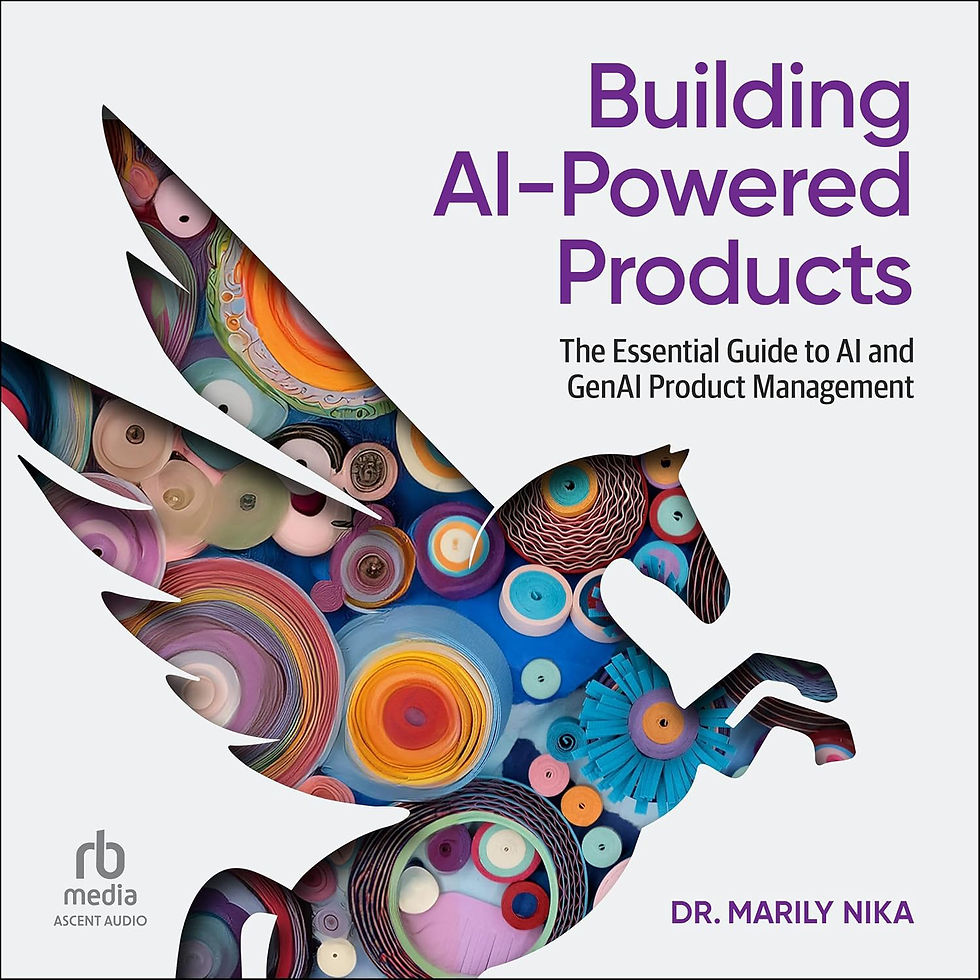
Building AI Powered Products
Author: Marily Nika
Short review
Building AI Powered Products shows how artificial intelligence can be used to develop smarter products, services, and digital customer experiences. Marily Nika combines technology, product development, and innovation in an easy-to-read book full of practical, real-world examples.
Why we recommend the book
A book that is perfect for anyone working with digitalization, innovation, product development and user experiences. It shows how artificial intelligence can be used to create products people actually want to use.

Prompt Engineering for Generative AI
Writers: James Phoenix and Mike Taylor
Short review
Prompt Engineering for Generative AI is a practical guide that teaches you how to communicate better with language models like ChatGPT, Claude, Gemini, and other generative AI tools. Through concrete examples, the authors show how good prompts produce more precise, creative, and useful responses.
Why we recommend the book
One of the most practical books on prompt engineering. Perfect for anyone who wants to work more effectively with artificial intelligence and get significantly better results through smarter questions and clearer instructions.
A little ending
Knowledge is constantly evolving, and so is this site. As new books are read, new research is published, and new perspectives emerge, the collection will be updated. The goal is to build a living scholarly library that can inspire both today's and tomorrow's readers.

© 2025 - 2026 Portico Publish | The invisible capital Privacy and use of the website | Developed and operated by Magne Bjella | Powered and secured by Wix


Comments