
What if Norway's most important World Cup gold medal isn't about football?

When the Norwegian national team brought the nation together during the World Cup, we experienced something that is difficult to measure in dollars and cents. Pride. Community. Trust. Optimism. For a few weeks, conversations around the dinner table, in the workplace, in schoolyards and in cafes were about the same moments. We rejoiced together. We hoped together. We cheered together. The question is whether the same energy can also be used to create more innovation, better jobs and increased value creation. Research actually suggests that the answer is yes.

An entire country rowed together
"Sometimes the strongest force in a society is not how fast we move, but that we choose to row in the same direction."
There are moments that become bigger than the event itself. Moments where an entire society feels that something is happening between people. The World Cup was such a moment.
Over the course of a few summer weeks, the Norwegian national team became far more than eleven players on a football field. They became a rallying point. They gave us a story we wanted to be a part of. They gave us hope, pride and belief that a small country could challenge the very biggest.
At the same time, an expression emerged that struck something deep within us: We row together.
It's a simple expression. Yet it contains some of the most beautiful things about Norwegian society. When we face adversity, when we are faced with great tasks or when we get the opportunity to experience something truly special, we want to move in the same direction.
We know that no boat gets far if everyone rows in their own direction.
That's why these weeks were about far more than football. They were about people who chose community. About families who gathered in front of the TV. About children who got new role models. About grandparents who shared experiences with their grandchildren. About colleagues who started the workday by talking about the game the night before. About people who had perhaps never watched a football match before, but who suddenly felt that they wished the team all the best.
For a short while, we experienced something that may be difficult to describe, but easy to recognize.

We rowed together.
Not because anyone asked us to.
But because we wanted it.
A whole world rowed with us
"When the world takes notice of a small country, it's rarely just about the results. It's about the people and culture that created them."
Eventually, something even more remarkable happened.
History ceased to be Norwegian.
It became international.
Media outlets from all over the world began to write about the Norwegian team. Commentators, journalists and football fans asked questions that went far beyond the results on the pitch. How could a small country with just over five million inhabitants develop a team that challenged the world's best? What was it about this culture? How had the players become so good? What could others learn?
Suddenly it wasn't just Norway that was rowing.
People from many countries began to row with us.
Not literally.
But through curiosity, respect and enthusiasm.
They may still have been rooting for their own national team, but they were inspired by the story of Norway. They saw a team that played with courage, joy and unity. They saw players who lifted each other up. They saw a support system that worked as one unit. They saw a culture that had spent years building people – long before medals and headlines.
It's easy to believe that the world primarily notices winners.
Often that is not true.
The world takes notice of people who show what is possible when talent, hard work, trust, and community are allowed to develop over time.
Maybe that's why so many people started following Norway.
Not because we were the biggest.
But because our story reminded us of something that applies far beyond the football field.
Great achievements are almost always built by people who have learned to succeed together.
An entire country believed together
"All great achievements begin long before the results come. They begin the day people dare to believe that something is possible."
It wasn't just the players who started to believe.
We did too.
After each match, optimism grew. Suddenly, people were talking about semifinals, finals, and maybe even the World Cup. It wasn't about arrogance or unrealistic expectations. It was about the team showing us something we might have forgotten.
That development is possible.
That a small country can challenge the largest.
That people can grow when they are given time, trust and the opportunity to develop.
Faith is a remarkable power.
It cannot be measured in spreadsheets or budgets, but it influences how people think, collaborate and act. It makes us dare to try again. That we share an idea we would otherwise keep to ourselves. That we dare to take responsibility. That we see opportunities where we previously only saw limitations.
This applies on the football field.
But it also applies to working life.
Because what really happens to a workplace when people start to believe that improvement is possible? When employees feel that their ideas are listened to? When leaders show trust rather than control? When mistakes are used for learning instead of blame?

Then something happens.
Not overnight.
But little by little.
Faith turns into action.
Action turns into learning.
Learning becomes development.
And development turns into value creation.
Maybe that's exactly what we saw during the World Cup. Not just a team that won football matches, but a team that over many years had developed a culture where people could grow together.
That idea is at least as interesting outside the stadium.
Because how many more jobs could be created if people could trust each other a little more?
An entire country stood together
"Community does not make people equal. Community makes us strong enough to succeed together."
When we look back on the championship, it's easy to remember the goals, the saves and the jubilant scenes.
But behind every moment there is a story we rarely talk about.
The story of all the people who made the achievements possible.
Parents who drove to training.
Volunteers who showed up night after night.
Local coaches who saw the talent long before the rest of the world did.
Club leaders.
Physiotherapists.
Teachers.
Judges.
Co-players.
Families.
None of them were on the field when the TV cameras were focused on the national team.
Yet they were part of the victory.
This is also the case in working life.
Behind every successful business are people who rarely make the headlines. Behind great public services are employees who make a difference every day without their names being known. Behind innovation are often people who never get the applause, but who through a thousand small contributions make the big results possible.
We have an easy time paying tribute to heroes.
But the greatest achievements are almost always created by community.
Perhaps this is precisely what the invisible capital is.
All the relationships.
All the trust.
All the experience.
All the knowledge.
All the help.
All the collaboration.
All of this that doesn't appear on the results list, but makes the results possible.
It is easy to believe that value creation is primarily about money, technology or buildings.
In reality, it almost always begins somewhere completely different.
It begins between people.
But perhaps the most important thing happened between us
As the summer drew to a close, the championship was over.
The results were written into the history books.
The medals were given to their owners.
The trophy found its winner.
Yet, perhaps something completely different would prove to be the most important gain.
Because between the jubilation, the hope, and the community, something happened that we rarely talk about.
We were reminded of what people can achieve when they lift each other up.
And this is where the story becomes bigger than football.
For what research has tried to understand over the decades, we may all have experienced a small glimpse of this summer.
What happens when people experience security?
What happens when they start to trust each other?
What happens when knowledge is shared instead of withheld?
What happens when community becomes more important than ego?
We don't find the answers primarily on the football field.
We find them in research on people, organizations and innovation.
Why do some organizations create more than others?
"Safe people create. Threatened people protect themselves and their property."
For decades, researchers have tried to understand why some organizations evolve faster than others. Why do some workplaces succeed in creating innovation, job satisfaction, and continuous improvement, while others experience ideas stalling, employees withdrawing, and development slowing down?
The answers surprisingly often point in the same direction.
They are less about technology than about people.
Less about organizational charts than about culture.
Less about control than about trust.
That doesn't mean that technology, economics, and strategy are unimportant. Quite the opposite. But research shows time and time again that the greatest results occur when talented people work in environments characterized by trust, learning, and a shared desire to create something greater than individual achievement.
Perhaps this is precisely what we experienced a glimpse of during the football match.
World Cup.
Not just a good team.
But a culture.
A way to work together.
And that very insight is just as relevant in business, the public sector, volunteering and research environments as it is on a football field.
Confident people create – Amy Edmondson and psychological safety
"The biggest risk in an organization is often that people stop saying what they really think."
Harvard Business School professor Amy Edmondson has spent decades researching what she calls psychological safety . She shows that the most innovative organizations are not necessarily made up of the smartest people. They are made up of people who dare to ask questions, challenge established truths, admit mistakes, and share ideas before they are fully developed.
Psychological safety does not mean that everyone always agrees.
It also does not mean that the requirements will be lower.
On the contrary.
The best organizations combine high ambitions with a work environment where people know they are treated with respect when they contribute.
When employees are not afraid to make mistakes, learning increases.
As learning increases, improvement becomes a natural part of everyday life.
When improvement becomes a habit, innovation grows.
Then the value creation will also be greater.
That is why psychological safety is not primarily about well-being.
It's about competitiveness.
No one becomes world class alone - MIT and collective intelligence
"No organization becomes smarter than the ability of people to learn from each other."
Researchers at MIT have shown that groups develop a form of collective intelligence. It is determined not only by how good the individuals are, but also by how they work together.
When everyone has their say.
When people listen to each other.
When different perspectives are used as a strength.
This increases the group's overall ability to solve problems.
This is an important reminder in a time when we often talk about individual achievements.
The world's best employees do not necessarily create the world's best organization.
The world's best organizations are characterized by people making each other better.
This applies to the national team.
This applies to a small family business.
And that applies in a large municipality.
Organizations must learn while they work – Peter Senge and the learning organization
“An organization does not develop because it works more. It develops because it learns more.”
Peter Senge at the MIT Sloan School of Management introduced the concept of the learning organization . His research challenged the notion that learning primarily occurs in courses or conferences.
The most important learning happens while the work is in progress.
When people stop and ask:
What did we learn?
What worked?
What could have been done differently?
How can we do a little better next time?
The most successful organizations don't learn once a year.
They learn every single day.
The football team analyzes every training session and every match.
Innovative businesses analyze every delivery, every project, and every customer experience.
Learning does not become an addition to work.
It becomes part of the work.

The best ideas don't just come from us – Henry Chesbrough and open innovation
"The best ideas rarely come from one office. They arise when knowledge is allowed to move between people."
Professor Henry Chesbrough at the University of California, Berkeley, changed innovation research when he developed the theory of open innovation.
It is based on a simple but powerful realization:
No organization has a monopoly on the best ideas.
Knowledge is found with customers.
At suppliers.
At researchers.
At competitors.
With volunteers.
With employees.
With people with completely different experiences than our own.
Organizations that open up to the outside world, share experiences and build partnerships develop faster than organizations that try to solve everything alone.
Football is a good example.
Players learn in the clubs.
On the national team.
Through international tournaments.
By opponents.
By trainers.
Of analyses.
The best teams never stop learning from others.
Why would the working world do that?
Job satisfaction creates more than well-being – Teresa Amabile and intrinsic motivation
"Job satisfaction is not the reward for good work. It is often the driving force behind it."
Harvard professor Teresa Amabile has spent decades researching creativity and motivation, showing that people become more creative when they experience meaning, mastery, progress, and confidence.
Innovation cannot be ordered forward.
It grows when people experience that their work has meaning.
When small progress is seen.
When ideas are taken seriously.
When leaders provide direction, but also space.
Job satisfaction is therefore far more than a question of well-being.
It is an investment in the organization's future ability to create.
Trust is productive capital
“Trust reduces the need for control and frees up energy to create.”
Economists, organizational researchers and social scientists have long shown that societies with high trust often have better conditions for collaboration, innovation and value creation.
When people trust each other, less time is spent on control and more time on development.
Decisions are made faster.
Knowledge is shared more easily.
Conflicts are resolved earlier.
Collaboration becomes easier.
This is one of Norway's greatest strengths.
We rarely think about it because we take it for granted.
But trust is not a given.
It must be built.
Maintained.
Deserved.
Every single day.
Perhaps this is precisely the most important lesson after this summer's World Cup.
We didn't just see a team that played good football.
We saw what people can achieve when they trust each other, learn
together and pulling in the same direction.
And perhaps it is precisely the same force that will do
Norway is even better equipped to create tomorrow's jobs, public services and innovations.
The big message
We don't live off the state.
We don't live off of business.
We live off each other's work.
That one sentence could actually become the title of the final main chapter.
We live off each other's work.
It is simple.
It is true.
It is unifying.
It is apolitical.
It builds bridges.
When we row together, we build Norway.
"Value creation doesn't happen in one sector. It's created when people and organizations build something together."

When the World Cup was over, the players went home.
But Norway woke up to the same country.
A country that was still going to build housing.
Roads.
Railway.
Schools.
Hospital.
Kindergartens.
Docks.
Airports.
Water supply.
Digital infrastructure.
New jobs.
New businesses.
New ideas.
The only difference is that the cheering had died down.
The work continued.
Norway is being built every single day
Norway is built when we build together
"Public investments only become societal values when thousands of people in private and public enterprises create them together."
When we talk about value creation, it is easy to divide Norway into two.
Public sector.
Private business.
But in reality there is no sharp boundary.
We live off each other's work.
Every single day.
When the Storting allocates money for a new road, a hospital, a railway, a tunnel or a port, it is not the state that builds the project alone.
There are Norwegian and international contractors.
Engineers.
Architects.
Electricians.
Plumbers.
Concrete workers.
Machine operators.
Apprentices.
Transport companies.
Software developers.
Suppliers.
Advisors.
Small family businesses.
Large corporations.
Everyone contributes their part of the same value chain.
This is how public investments turn into jobs, skills development, innovation and new value creation.
A good example is the development of the E18 Western Corridor between Lysaker and Ramstadsletta .
The Norwegian Public Roads Administration is the client, but the work itself is carried out by private contractors and a large network of subcontractors.
Among the largest players is Skanska , which is building new tunnels, bridges, local roads and technical facilities. The project also includes a new water and sewage system for Bærum municipality and involves around 80 small and large structures.
We see the same thing in the construction of the Fornebu Line .
The project is owned by the public sector, but is being realized through extensive collaboration between state and municipal developers, consulting engineers, architectural groups and contractors such as Veidekke, NCC, Skanska and a number of specialized professional companies.
When Oslo builds a new reserve water supply, the picture is the same.
The Municipality of Oslo is the client, while companies such as Skanska , AF Gruppen , Ghella , Multiconsult , COWI and Asplan Viak contribute with design, tunnel operation, construction and technical solutions. None of the players could have delivered the project alone. Together they are creating a socially critical infrastructure that will ensure clean drinking water for future generations.
Along the entire Norwegian coast we find the same model.
When the Norwegian Coastal Administration develops new fishing ports and fairways, it is the public contracting authority, while private contractors carry out the work. The development of Kjøllefjord fishing port , where NCC Norge has been commissioned to build the new port, is one of many examples of how public funding and private implementation create jobs, increased safety and better framework conditions for coastal communities and businesses.
This is not an exception.
That's how Norway works.
This is how we build the country.
This is how public investments turn into private value creation.
And this is how private expertise is transformed into public services that benefit the entire society.
Maybe that's why the phrase "We row together" resonated with so many during the World Cup.
Because really, it doesn't just describe a football team.
It also describes how Norway succeeds when we are at our best.
We plan together.
We build together.
We learn together.
We create together.
And we reap the results together.

We need each other.
"No hospital functions without business. No business functions without society."
The nurse needs the electrician.
The electrician needs the teacher.
The teacher needs the farmer.
The farmer needs the truck driver.
The truck driver needs the mechanic.
The mechanic needs the engineer.
The engineer needs the scientist.
The researcher needs the companies.
Businesses need municipalities.
Municipalities need tax revenue.
And tax revenue is created by people who go to work every day.
Therefore, it becomes pointless to ask:
Who is most important?
The real strength lies in the interaction.
And then comes the sentence that I think will stay with the reader.
We live off each other's work.
"Value creation is the sum of millions of people who do their jobs a little better every day than they did yesterday."
The World Cup showed us what can happen when an entire country lifts up the same people.
The question now is:
What could happen if we managed to bring the same optimism
into the workforce?
Into the business world.
Into the municipalities.
Into the hospitals.
Into the schools.
Into the research.
Into volunteering.
Into the small businesses.
Into the big corporations.
Into everyday life.
Because perhaps this is the biggest lesson learned after the World Cup.
We don't have to agree on everything.
We don't have to be the same.
But we must never forget that we live off each other's work .
Value creation is a relay race – not a solo achievement
It is easy to talk about value creation as if it occurs in one business, one manager, or one sector.
That's not how Norway works.
Value creation is a long relay race where thousands of people deliver their leg before the next one can take over.
It often begins with a political decision.
This is followed by planning, design, construction, deliveries, operation, maintenance and further development.
No part of the chain can succeed alone.
Value creation occurs when people, businesses and societies
pulls in the same direction.
Perhaps it can be described like this:
The Storting grants.
Municipalities, county authorities and state agencies plan.
Consulting engineers design.
Architects draw.
Private contractors build.
Subcontractors supply materials, technology and services.
Skilled workers carry out the work.
Apprentices learn the trade and become tomorrow's experts.
Public employees operate and maintain.
The residents are putting the solutions into practice.
The business community develops new products and services.
Society creates new values.
This is not just about building a road, a tunnel, a school or a hospital.
This is how a society is built.
This is what we see when the E18 is built through Bærum and Oslo.
This is what we see when the Fornebu Line grows.
This is what we see when Oslo secures a new reserve water supply.
This is what we see when the Norwegian Public Roads Administration builds new national roads together with contractors from all over the country.
This is what we see when the Norwegian Coastal Administration develops new ports and fishing facilities through collaboration with private enterprises.
The projects are funded by the community.
The expertise comes from thousands of people.
The values remain in society.
These are not two different worlds.
This is one continuous value chain.
The public sector creates missions.
Business creates solutions.
Together they build Norway.

The World Cup is over. Now the most important match begins.
When the referee blew the final whistle, the championship was over.
The cheers died down.
The flags were packed away.
The players went home.
But it also did something else.
We were reminded of what people can achieve when they believe in each other.
When they learn together.
When they lift each other up.
When they row in the same direction.
We don't just need that reminder in sports.
We need it in our workplaces.
In business.
In the municipalities.
In the hospitals.
In schools.
In research environments.
In volunteering.
With the entrepreneur starting his first business.
With the apprentice who shows up for work on the very first day.
With the nurse who works the evening shift.
With the engineer who is designing the next bridge.
With the teacher who sees the potential in a child.
At the contractor who is building the next tunnel.
With the researcher who is looking for new knowledge.
With all of us who contribute our small part every day
the great community.
Because we do not live off the state alone.
We also don't live off business alone.
We live off each other's work.
That is perhaps the most important lesson after this summer's World Cup.
Not that a Norwegian national team brought together an entire nation.
But that they reminded us of what is possible when people believe in each other and choose to pull in the same direction.
The invisible capital is not found primarily in buildings, machinery or accounting.
It is found in the trust between people.
In the knowledge we share.
In the experiences we build.
In the courage to try something new.
In the will to learn.
And in the community that allows us to create more together than we do alone.
time could have been done by each of us.
If we manage to preserve the optimism we experienced during the World Cup, and take it with us into our working lives, into our organizations and into our society, perhaps the biggest victory of the summer may turn out to be something far greater than a result on a scoreboard.
Then it can become the driving force behind new ideas.
New jobs.
New innovation.
New value creation.
And an even stronger Norway.
"If we can row together when the whole world is watching, we can also row together when no one is watching."
The knowledge behind The Invisible Capital
Invisible Capital is not built on one book or one idea. It has been developed through many years of study, research, international seminars, and practical experience from working life.
The books below represent some of the most important professional sources of inspiration behind the project. They have shaped the way I think about leadership, innovation, digitalization, customer experiences, value creation and – not least – the importance of the people who create the values.
Each book has contributed new perspectives. Together, they have helped develop the knowledge base for The Invisible Capital and the book project Value-Creating People.
I hope they can give you the same professional inspiration that they have given me.
Recommended books from our library

Don't Make Me ThinkAuthor: Steve Krug
Short review
Don't Make Me Think is one of the world's most influential books on usability and web design. Since its first edition in 2000, the book has helped designers, developers, content producers, and managers understand a simple but powerful principle: Good digital services should be intuitive. The user should be able to complete their task without having to stop and think about how the website works.
Why we recommend the book
This is one of the books that has had the greatest impact on my own work with digital services. Over the years – from SAS and the Norwegian Opera & Ballet to working on Bærum Municipality’s website – the principles in this book have been an important reminder that technology is never an end in itself. The goal is to make everyday life easier for the people who use the services. Despite the fact that the book was published many years ago, the message is just as relevant today.
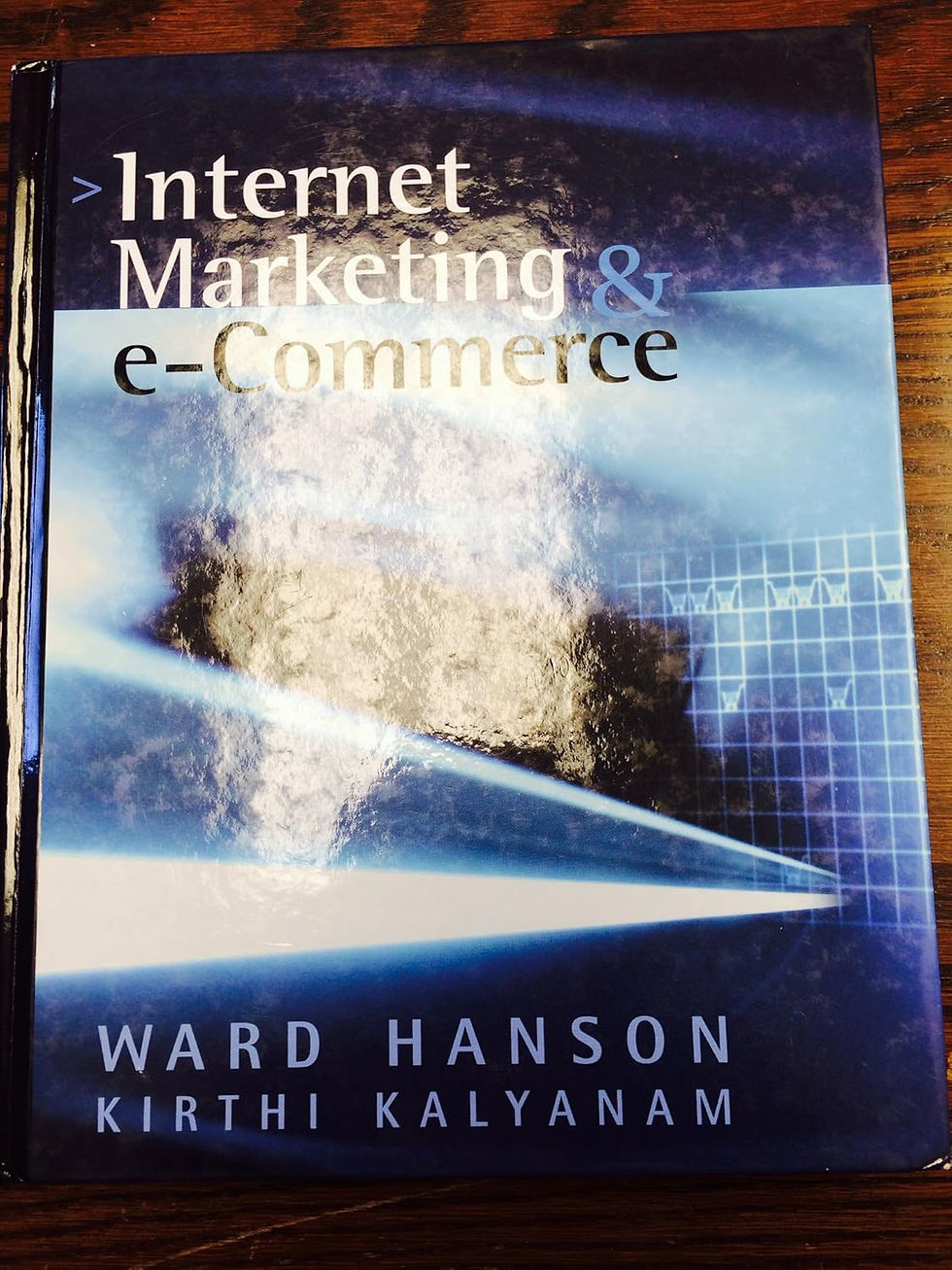
Internet Marketing & eCommerce
Authors: Ward Hanson and Kirthi Kalyanam
Short review
Internet Marketing & eCommerce provides a thorough introduction to how the internet has changed marketing, commerce, and business development. The book combines theory and practical examples in digital marketing, e-commerce, customer behavior, value creation, and digital business models. Although written at a time when the internet was still in its infancy, many of the fundamental principles are still highly relevant.
Why we recommend the book
This book was an important part of my own learning journey in digital marketing and e-commerce. It helped build my understanding of how technology, customer experiences and business strategy are interconnected – an insight that later became very important in my work with SAS, the Norwegian Opera & Ballet, Bærum Municipality and eventually the project The Invisible Capital. Many of the ideas about customer value, digitalization and innovation presented on the website have their roots in the knowledge this book conveys.

The Innovator's Solution: Creating and Sustaining Successful Growth
Authors: Clayton M. Christensen and Michael E. Raynor
Short review
In this sequel to The Innovator's Dilemma, Clayton Christensen shows how businesses can translate innovation theory into practical strategy. The book explains how companies can identify new growth opportunities, develop disruptive innovations, and build organizations that thrive in rapidly changing markets.
Why we recommend the book
While The Innovator's Dilemma explains why established businesses are often challenged, The Innovator's Solution provides concrete advice on how to meet the challenges. The book is therefore a natural next step for anyone who wants to understand innovation, strategy and long-term value creation.

The Innovator's DNA: Mastering the Five Skills of Disruptive Innovators
Authors: Jeff Dyer, Hal Gregersen and Clayton M. Christensen
Short review
What characterizes people who create groundbreaking innovations? The authors identify five key skills – observation, questioning, experimentation, networking and association – that are common to the world's most innovative leaders and entrepreneurs.
Why we recommend the book
This book shifts the focus from organizations to the people behind innovation. It shows that creativity and innovation can be developed through deliberate training and experience. The perspectives align well with the philosophy behind Invisible Capital, where human competence and curiosity are the most important drivers of development.

Competing Against Luck: The Story of Innovation and Customer Choice
Authors: Clayton M. Christensen, Taddy Hall, Karen Dillon and David S. Duncan
Short review
In this book, Clayton Christensen further develops the theory of Jobs to Be Done – the idea that customers do not primarily buy products, but "hire" them to solve specific needs. Through practical examples, the authors show how businesses can develop products and services that address customers' real-world challenges.
Why we recommend the book
For anyone working in customer experience, service design, and innovation, this is one of the most insightful books ever written. It reminds us that value creation always starts with understanding the people we are developing solutions for – a fundamental principle of Invisible Capital.

The Innovator's Dilemma: When New Technologies Cause Great Firms to Fail
Author: Clayton M. Christensen
Short review
The Innovator's Dilemma is considered one of the most influential books on innovation and technological change. Clayton M. Christensen introduces the theory of disruptive innovation and explains why even the most successful businesses can fail when new technologies and business models challenge established markets. Through a series of examples, he shows how companies often focus on today's customers and incremental improvements, while overlooking innovations that later change entire industries.
Why we recommend the book
This is one of the books that has had the greatest impact on modern innovation thinking. When I first read it, it gave me a whole new perspective on why some businesses succeed in transformation, while others lag behind – even when they are well led. The insight has been an important part of my own understanding of digitalization, innovation and change management, and many of the reflections in The Invisible Capital build on the ideas Clayton Christensen presents in this classic. The book is as relevant today, in the face of artificial intelligence and digital transformation, as it was when it was published.

Open Innovation: The New Imperative for Creating and Profiting from Technology
Author: Henry Chesbrough
Short review
Henry Chesbrough introduced the concept of Open Innovation and changed the way many businesses think about research and development. He shows how companies can create more innovation through collaboration with customers, universities, start-ups, suppliers and other external partners.
Why we recommend the book
Open Innovation has had a major influence on modern innovation thinking and was also an important topic during the seminars in Oxford and San Francisco. The book shows why future value creation occurs in the interaction between people, businesses and knowledge environments – not within closed organizations alone.

Blue Ocean Strategy: How to Create Uncontested Market Space and Make the Competition Irrelevant
Authors: W. Chan Kim and Renée Mauborgne
Short review
Blue Ocean Strategy challenges businesses to shift their focus away from fierce competition and instead create new markets with little or no competition. The authors present strategies and models that help organizations develop innovative products, services, and business models.
Why we recommend the book
This book has inspired leaders around the world to rethink strategy and innovation. Instead of competing for the same customers, it shows how businesses can create new value through creativity and differentiation. The perspectives align very well with the themes of innovation, digitalization, and long-term value creation in Invisible Capital.

Outside Innovation: How Your Customers Will Co-Design Your Company's Future
Authors: Patricia B. Seybold
Short review
Patricia Seybold shows how businesses can create better products and services by actively involving customers in the innovation process. The book describes how dialogue, co-creation and close collaboration with users can provide better solutions and stronger competitiveness.
Why we recommend the book
Customers often hold the most important insights into how products and services can be improved. This book emphasizes the importance of listening, involving, and learning from users – a perspective that is echoed in many of the articles on The Invisible Capital. Innovation rarely happens alone; it is created in the interaction between people.

Blown to Bits: How the New Economics of Information Transforms Strategy
Authors: Philip Evans and Thomas S. Wurster
Short review
This book analyzes how digital information is changing competitive conditions, markets, and business strategies. The authors explain how the internet is disrupting established structures and creating new opportunities for businesses that are able to think differently.
Why we recommend the book
Although written early in the internet revolution, the book describes many of the developments that still characterize business today. It provides valuable perspective on how digitalization affects value chains, competition, and innovation – themes that are central to Invisible Capital.

Wikinomics: How Mass Collaboration Changes Everything
Authors: Don Tapscott and Anthony D. Williams
Short review
Wikinomics shows how openness, sharing and collaboration across organizations create new forms of innovation and value creation. Through a number of international examples, the authors describe how digital networks make it possible to develop products, services and knowledge together.
Why we recommend the book
This book was groundbreaking when it was first published, and many of the ideas have since become a natural part of everyday digital life. The perspectives on collaboration, knowledge sharing, and open innovation processes align very well with the philosophy behind Invisible Capital, where people and networks are at the center of value creation.

© 2025 - 2026 Portico Publish | The invisible capital Privacy and use of the website | Developed and operated by Magne Bjella | Powered and secured by Wix


Comments