
Part 1 - What is a customer – and when are we not customers?

The customer has a natural place in the market economy, but the term is often used far more broadly than it is linguistically and professionally covered. A customer can be a person, a business or an organization that chooses and buys a product or service. The customer is thus part of a market relationship where something is offered, evaluated and exchanged.
It sounds simple. Yet it is necessary to start a series on customers with the definition itself. Because if we call the patient, the citizen, the student and the theater audience customers without examining what relationship they actually have with the institution, we risk making the concept of customer so comprehensive that it loses its meaning.
This series of articles therefore uses the term customer as a precise term. At the same time, we will examine why the customer is crucial in commercial markets, how businesses can understand customers better, and why the knowledge that arises in the encounter between the customer and the business can be of great importance for innovation and value creation.

The customer arises in a market relationship
The American Marketing Association describes marketing as the activities and processes associated with creating, communicating, delivering, and exchanging offerings that have value for, among others, customers. The AMA also describes customer behavior as how individuals and organizations attempt to satisfy needs and wants through selecting, purchasing, using, and disposing of goods, services, and ideas.
It points to several key characteristics of a customer.
A customer:
facing an offer
can assess the offer against needs and alternatives
involved in some form of exchange or transaction
can choose to buy or not
can choose between several providers in many markets
can end the relationship and choose a competitor
makes experiences that influence later choices
The customer can be a private individual purchasing groceries, a family booking a vacation, a business purchasing an IT system, or an industrial business entering into a long-term supplier agreement.
The concept of customer is therefore not limited to the consumer market. Businesses are also customers.
The decisive factor is not whether the buyer is a person or a company.
What is crucial is the relationship between the person who requests something and the person who offers it.
The customer is not necessarily the same as the user
An important distinction already arises in commercial markets.
The person who buys the product is not always the person who uses it.
A parent can buy a bicycle for a child. A company can buy software that a hundred employees will use. A purchasing department can select a supplier that employees elsewhere in the organization will later deal with.
We can therefore have several roles around the same product:
the customer purchases or enters into the agreement
the user uses the product or service
the payer finances the purchase
the decision maker decides what to choose
the influencer can influence the choice without buying themselves
In some situations, all of these roles are held by one person. In others, they may be distributed among several people or organizations.
This distinction becomes important later in the series when we discuss customer insights. It’s not enough to know who pays the bill if there are other people who actually use the solution and experience the consequences of it.
The customer makes an assessment of value
A company can develop a product that it considers to be excellent. It can invest significant resources in technology, design, production, distribution and marketing.
But the business does not alone decide whether the offer is perceived as valuable.
So does the customer.
The customer evaluates the product or service in relation to, among other things, needs, price, quality, availability, alternatives, previous experiences and expectations. This does not mean that the customer always makes a completely rational economic analysis. Customer behavior is also influenced by habits, emotions, brands, social relationships, trust and a number of other factors.
But the basic relationship remains:
A commercial offering depends on a sufficient number of people or businesses choosing it.
Peter Drucker's famous formulation goes directly to this point:
"The purpose of a business is to create a customer." - Peter Drucker
Drucker's perspective is important because it shifts the focus from the business alone to the relationship between the business and the market. Capital, production equipment, expertise, and technology may be necessary prerequisites, but a commercial business also needs demand.
The customer has a power that the business cannot take away.
A business can adopt a strategy.
Management can set goals.
The owners can contribute capital.
The product department can develop products.
The marketing department can build the brand.
But the business cannot normally decide that the customer should continue to buy.
In competitive markets, there is therefore a simple disciplinary mechanism: If, over time, the customer experiences that another offer provides better value, the customer can leave.
This does not mean that all customers have the same real freedom of choice. Competition may be weak, switching costs high, information incomplete or some providers very dominant. However, the basic market mechanism still makes customer understanding far more than a question of polite service.
Richard Branson has formulated this connection between customer experience and business results very simply:
"Focus on delivering a great customer experience, and success will come." - Richard Branson
Customer focus therefore does not mean that the business should fulfill every wish every customer may have. It means that it must understand which people it is trying to create value for, what problems it is solving and why someone should choose its offering.
Understanding the customer is different from obeying the customer
An important clarification is necessary here.
Customer focus can be misunderstood as "the customer is always right."
It's too simple a principle.
Customers may request solutions that are technically unrealistic, economically unsound, environmentally problematic, or directly in conflict with the interests of other customers. Nor does the customer necessarily know what solutions may be technically developed in the future.
Therefore, good customer insight involves more than asking people what they want and then delivering a wish list.
The business must understand:
what problem the customer is trying to solve
what the customer is trying to achieve
how the customer actually behaves
where the customer encounters obstacles
which options the customer is considering
what the customer values
what needs the customer may have difficulty formulating themselves
This is one of the reasons why user observation and UX research have subsequently gained great importance. Don Norman and Jakob Nielsen define user experience much more broadly than the interface itself: it encompasses the entire end user's interaction with the business, its services and products. They also emphasize that a good user experience begins with meeting the actual needs of the person.
"The first requirement for an exemplary user experience is to meet the exact needs of the customer." - Don Norman and Jakob Nielsen
Here begins the connection between customer insight, design, digitalization and innovation that we will follow further through
the series.

When are we not customers?
The fact that the concept of customer is important in the market does not mean that it should be used as a collective term for all people who receive services.
Relationships have different purposes, rights, and responsibilities. The words we use should reflect this.
The patient is more than a customer
A person receiving medical treatment has a different relationship to the health service than a customer who buys an ordinary product in a competitive market.
The patient may be ill, dependent on professional expertise and unable to consider all medical options on their own. Healthcare professionals have professional and ethical obligations that cannot be reduced to a question of customer satisfaction.
The patient's experiences, needs and wishes should be taken seriously. But that does not mean that the market term customer is the most precise description of the relationship.
The World Health Organization uses the terms patient-centred , person-centred and people-centred care, among other things . WHO describes quality in health care as, among other things, being people-centred and responding to the individual's needs, preferences and values.
The point is important:
You don't have to turn the patient into a customer to put the patient at the center.
The citizen is more than a customer of the state
The same applies to the public sector.
A citizen is not just an outsider to the state or municipality as a buyer of a service. The citizen is also a citizen, voter, rights holder, taxpayer and participant in a democratic community.
A public authority cannot process the citizen's
needs based on the profitability of the individual relationship.
The OECD's recent work on public services uses terms such as human-centred , citizen-centric and user needs .
The OECD recommendation on people-centred public administrative services was adopted in 2024, and Government at a Glance 2025 describes how countries are increasingly organising services around citizens' life events and needs.
Here we also find something the public sector can learn from customer research: people expect understandable, accessible and well-functioning services.
But this can be done without pretending that the relationship between the state and the citizen is the same as the relationship between a store and a customer.
The audience is not just a customer of art
Art and culture illustrate the border in a different way.
A theater sells tickets. A museum may have a museum shop. A concert hall has prices, payment, and marketing. So there are undoubtedly commercial transactions around culture.
But the person who encounters the artwork also has a different role.
It's the audience .
Arts Council England uses a broad concept of audience that can include visitors, readers, listeners, viewers, participants and learners. Audiences are developed through relationships with arts and culture, not just through the sales transaction.
Art can create joy and entertainment, but also challenge, provoke, convey history, develop identity and create reflection. A performance can therefore be artistically significant even if it does not maximize ticket revenue.
A person may indeed be a customer when the ticket is purchased , but an audience when the performance is experienced .
Both descriptions can be true at the same time. They just describe different parts of the relationship.

One person can have multiple roles
This is perhaps the easiest way to avoid conceptual confusion.
Think of a person visiting a hospital.
The person concerned may be:
patient during treatment
user of a digital login solution
next of kin when a family member is treated
citizen in the face of the publicly funded health system
customer when he buys a coffee at the kiosk
It's the same person.
But the relationship is changing.
Similarly, a person can be a customer when a ticket is purchased online, a user of the theater's digital booking system, and an audience member when the curtain goes up.
Precise language makes it possible to understand these differences.
Customer focus begins with understanding the relationship
Thus we arrive at a principle that will underlie this entire series:
Being customer-oriented does not mean calling everyone a customer.
On the contrary.
Real orientation towards people requires that the business or institution understands what relationship it actually has with them.
In the market, it can be the customer.
In healthcare, the patient.
In democracy the citizen.
In art, the audience.
In digital systems the user.
And sometimes the same person can have several of these roles at the same time.
This precision does not weaken the importance of the customer. It makes the concept of customer stronger.
Because once we enter the commercial market, the role of the customer is fundamental. The customer chooses, evaluates, uses, reacts and in many cases may leave the business.
Therefore, the business must learn.
From the customer to customer insight
This leads directly to the rest of the article series.
Once we know who the customer is, we can start asking the really interesting questions:
What creates value for the customer?
Why does the customer choose one business over another?
How does trust arise?
What can the business learn from the customer's experiences?
What does the employee who meets the customer every day know?
How can customer insights be translated into innovation?
What happens when the information never reaches management?
How are digitalization and AI changing the customer relationship?
The concept of customer is therefore just the beginning.
The key question for the business is not just who the customer is , but whether it actually manages to understand the people who choose, use and evaluate what it offers.
This will be the starting point for the next article:
Recommended literature
Customer focus, customer insight and customer relationships cannot be understood in isolation from developments in digitalisation, innovation and user experience. The way a business interacts with its customers is shaped today by people, technology, digital services, organisation and the ability to develop new solutions.
Therefore, this bibliography currently contains books that highlight several of these perspectives.
Here you will find literature on digitalization, innovation, user experience, usability and the development of digital services, among other things. Steve Krug's Don't Make Me Think is a natural example: The book is about usability on the web, but at the same time touches on a fundamental question in the entire Customer series – how easy or difficult the business makes it for people to succeed in what they are trying to do.
Similarly, literature on innovation can help us understand how observations, needs and problems of customers and users can be developed into better products, services and work processes.
The literature list will eventually be expanded with more books that specifically address customer focus, customer insight, customer relations, customer loyalty, e-commerce, service and customer experience.
The goal is not to collect as many books as possible, but to build a literature base that makes it possible to understand the customer from multiple professional perspectives.
From San Francisco and Oxford to the customer
Experiences from professional seminars and study trips in San Francisco and Oxford are also part of the background for this professional universe. Topics such as innovation, digitalization, e-commerce, user experience and new business models have over time contributed to a broader understanding of how technology and organizations must take as their starting point the people the solutions will actually work for.
The Customer Series continues this perspective: Technology is a tool. Innovation is a tool. Value arises when solutions actually work for the people they are designed for.

The Long Tail: Why the Future of Business Is Selling Less of More
Author(s): Chris Anderson
Short review
The Long Tail is one of the most influential books on how the internet has transformed commerce, marketing, and consumer behavior. Chris Anderson introduces the theory of the “Long Tail,” which explains how digital markets enable significant value creation through a large number of niche products, rather than relying on a few bestsellers.
The book shows how digital distribution, low inventory costs, search engines, and intelligent recommendation systems have made it profitable to offer an almost unlimited product range. Where traditional stores were limited by physical shelf space, online stores can offer millions of products and let customers find exactly what they are looking for.
Chris Anderson illustrates the theory with examples from Amazon, Netflix, Google, and the digital music industry, showing how the internet has changed the rules of competition for businesses around the world. Many of the insights have since become even more relevant through artificial intelligence, personalization, and modern search technology.
The authors take the reader through the entire process – from planning and organizing to publishing, managing and continuously improving content on websites and digital services. Although technology has evolved since the book was published, the principles of quality, relevance, management and long-term content work are at least as relevant in an era where search engines and artificial intelligence assess the credibility and usefulness of content.
Why we recommend the book
At The Invisible Capital, we consider The Long Tail to be one of the most important books in e-commerce, digitalization, and modern value creation.
The book explains why customers no longer just buy the most popular products, but increasingly find value in specialized products and services that meet individual needs. This insight has had enormous impact on the development of online stores, digital marketplaces, search engine optimization (SEO), information architecture, and content strategy.
Today we see that the theory also fits very well into the development of artificial intelligence. AI helps people discover relevant content, products and knowledge that were previously difficult to find. This has given the Long Tail principle a new dimension, where well-structured content and high professional quality are increasingly important for visibility, trust and value creation.
This is a book we believe everyone who works with e-commerce, digital marketing, customer experience, innovation, digital strategy or artificial intelligence should read.

Content Strategy for the Web (2nd Edition)
Author/authors: Kristina Halvorson and Melissa Rach
Short review
How do you create content that actually helps people – and at the same time supports your business goals? Content Strategy for the Web is considered one of the most influential books in the field of content strategy and digital communications. The book shows how good content does not arise by chance, but through a deliberate strategy where user needs, the organization's goals, structure, work processes and management are closely linked.
The authors take the reader through the entire process – from planning and organizing to publishing, managing and continuously improving content on websites and digital services. Although technology has evolved since the book was published, the principles of quality, relevance, management and long-term content work are at least as relevant in an era where search engines and artificial intelligence assess the credibility and usefulness of content.
Why we recommend the book
At The Invisible Capital, we believe that good content is one of the most important forms of invisible value creation. A website is far more than design and technology – it is the content that builds trust, creates great customer experiences and helps people find the answers they are looking for.
This book is perfect for leaders, communications consultants, content producers, web editors, UX designers, and anyone working with digital services. It shows why a clear content strategy leads to better user experiences, more effective interactions, and stronger digital results over time.
In an era where artificial intelligence is increasingly important in how information is discovered, understood, and communicated, this book is more relevant than ever. It reminds us that technology alone never creates value – it is good, structured, and relevant content that makes the difference.

Short review
Don't Make Me Think is one of the world's most influential books on usability and web design. Since its first edition in 2000, the book has helped designers, developers, content producers, and managers understand a simple but powerful principle: Good digital services should be intuitive. The user should be able to complete their task without having to stop and think about how the website works.
Why we recommend the book
This is one of the books that has had the greatest impact on my own work with digital services. Over the years – from SAS and the Norwegian Opera & Ballet to working on Bærum Municipality’s website – the principles in this book have been an important reminder that technology is never an end in itself. The goal is to make everyday life easier for the people who use the services. Despite the fact that the book was published many years ago, the message is just as relevant today.
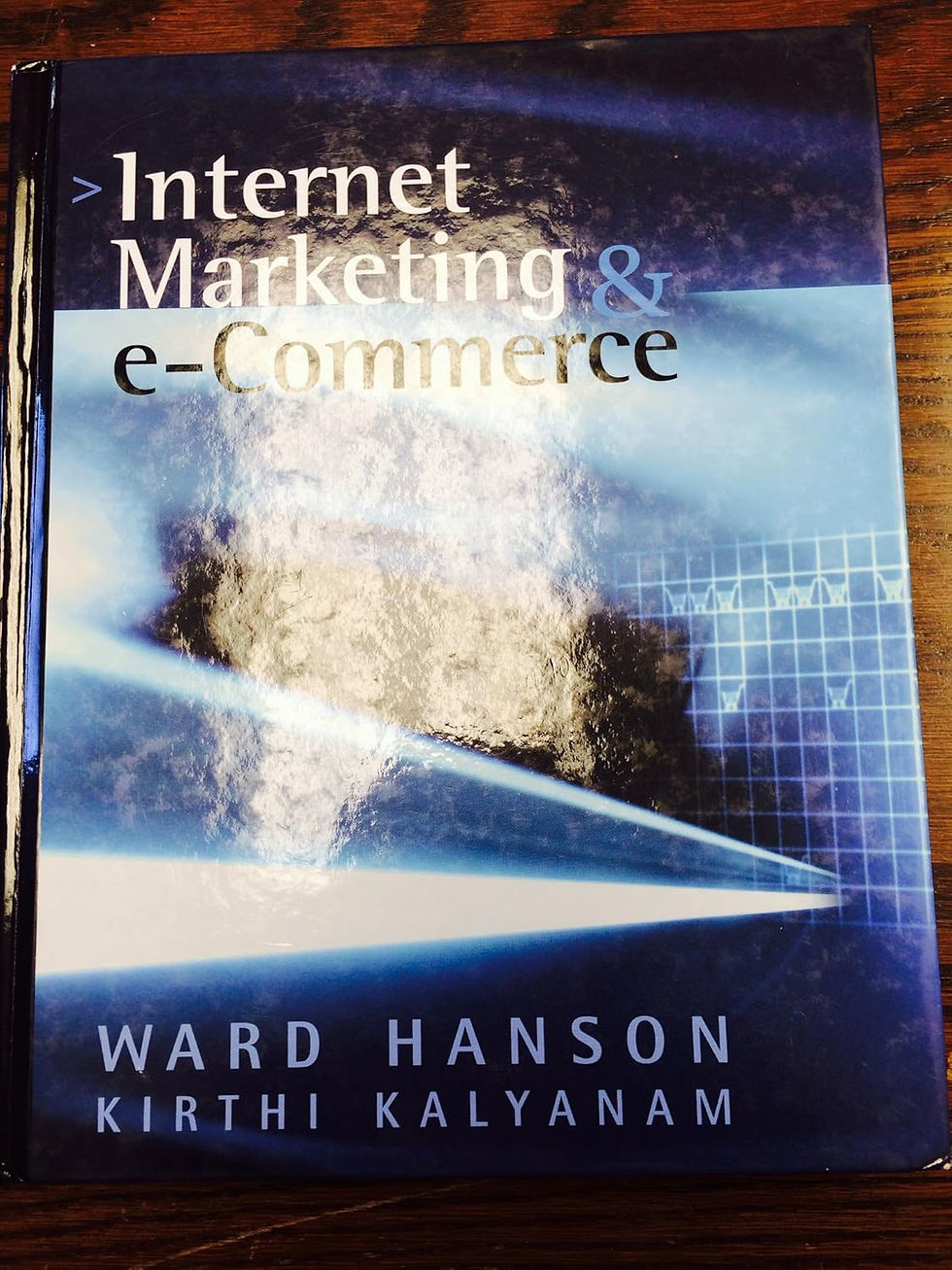
Internet Marketing & eCommerce
Authors: Ward Hanson and Kirthi Kalyanam
Short review
Internet Marketing & eCommerce provides a thorough introduction to how the internet has changed marketing, commerce, and business development. The book combines theory and practical examples in digital marketing, e-commerce, customer behavior, value creation, and digital business models. Although written at a time when the internet was still in its infancy, many of the fundamental principles are still highly relevant.
Why we recommend the book
This book was an important part of my own learning journey in digital marketing and e-commerce. It helped build my understanding of how technology, customer experiences and business strategy are interconnected – an insight that later became very important in my work with SAS, the Norwegian Opera & Ballet, Bærum Municipality and eventually the project The Invisible Capital. Many of the ideas about customer value, digitalization and innovation presented on the website have their roots in the knowledge this book conveys.

The Innovator's Solution: Creating and Sustaining Successful Growth
Authors: Clayton M. Christensen and Michael E. Raynor
Short review
In this sequel to The Innovator's Dilemma, Clayton Christensen shows how businesses can translate innovation theory into practical strategy. The book explains how companies can identify new growth opportunities, develop disruptive innovations, and build organizations that thrive in rapidly changing markets.
Why we recommend the book
While The Innovator's Dilemma explains why established businesses are often challenged, The Innovator's Solution provides concrete advice on how to meet the challenges. The book is therefore a natural next step for anyone who wants to understand innovation, strategy and long-term value creation.

The Innovator's DNA: Mastering the Five Skills of Disruptive Innovators
Authors: Jeff Dyer, Hal Gregersen and Clayton M. Christensen
Short review
What characterizes people who create groundbreaking innovations? The authors identify five key skills – observation, questioning, experimentation, networking and association – that are common to the world's most innovative leaders and entrepreneurs.
Why we recommend the book
This book shifts the focus from organizations to the people behind innovation. It shows that creativity and innovation can be developed through deliberate training and experience. The perspectives align well with the philosophy behind Invisible Capital, where human competence and curiosity are the most important drivers of development.

Authors: Clayton M. Christensen, Taddy Hall, Karen Dillon and David S. Duncan
Short review
In this book, Clayton Christensen further develops the theory of Jobs to Be Done – the idea that customers do not primarily buy products, but "hire" them to solve specific needs. Through practical examples, the authors show how businesses can develop products and services that address customers' real-world challenges.
Why we recommend the book
For anyone working in customer experience, service design, and innovation, this is one of the most insightful books ever written. It reminds us that value creation always starts with understanding the people we are developing solutions for – a fundamental principle of Invisible Capital.

The Innovator's Dilemma: When New Technologies Cause Great Firms to Fail
Author: Clayton M. Christensen
Short review
The Innovator's Dilemma is considered one of the most influential books on innovation and technological change. Clayton M. Christensen introduces the theory of disruptive innovation and explains why even the most successful businesses can fail when new technologies and business models challenge established markets. Through a series of examples, he shows how companies often focus on today's customers and incremental improvements, while overlooking innovations that later change entire industries.
Why we recommend the book
This is one of the books that has had the greatest impact on modern innovation thinking. When I first read it, it gave me a whole new perspective on why some businesses succeed in transformation, while others lag behind – even when they are well led. The insight has been an important part of my own understanding of digitalization, innovation and change management, and many of the reflections in The Invisible Capital build on the ideas Clayton Christensen presents in this classic. The book is as relevant today, in the face of artificial intelligence and digital transformation, as it was when it was published.

Open Innovation: The New Imperative for Creating and Profiting from Technology
Author: Henry Chesbrough
Short review
Henry Chesbrough introduced the concept of Open Innovation and changed the way many businesses think about research and development. He shows how companies can create more innovation through collaboration with customers, universities, start-ups, suppliers and other external partners.
Why we recommend the book
Open Innovation has had a major influence on modern innovation thinking and was also an important topic during the seminars in Oxford and San Francisco. The book shows why future value creation occurs in the interaction between people, businesses and knowledge environments – not within closed organizations alone.

Blue Ocean Strategy: How to Create Uncontested Market Space and Make the Competition Irrelevant
Authors: W. Chan Kim and Renée Mauborgne
Short review
Blue Ocean Strategy challenges businesses to shift their focus away from fierce competition and instead create new markets with little or no competition. The authors present strategies and models that help organizations develop innovative products, services, and business models.
Why we recommend the book
This book has inspired leaders around the world to rethink strategy and innovation. Instead of competing for the same customers, it shows how businesses can create new value through creativity and differentiation. The perspectives align very well with the themes of innovation, digitalization, and long-term value creation in Invisible Capital.

Outside Innovation: How Your Customers Will Co-Design Your Company's Future
Authors: Patricia B. Seybold
Short review
Patricia Seybold shows how businesses can create better products and services by actively involving customers in the innovation process. The book describes how dialogue, co-creation and close collaboration with users can provide better solutions and stronger competitiveness.
Why we recommend the book
Customers often hold the most important insights into how products and services can be improved. This book emphasizes the importance of listening, involving, and learning from users – a perspective that is echoed in many of the articles on The Invisible Capital. Innovation rarely happens alone; it is created in the interaction between people.

Blown to Bits: How the New Economics of Information Transforms Strategy
Authors: Philip Evans and Thomas S. Wurster
Short review
This book analyzes how digital information is changing competitive conditions, markets, and business strategies. The authors explain how the internet is disrupting established structures and creating new opportunities for businesses that are able to think differently.
Why we recommend the book
Although written early in the internet revolution, the book describes many of the developments that still characterize business today. It provides valuable perspective on how digitalization affects value chains, competition, and innovation – themes that are central to Invisible Capital.

Wikinomics: How Mass Collaboration Changes Everything
Authors: Don Tapscott and Anthony D. Williams
Short review
Wikinomics shows how openness, sharing and collaboration across organizations create new forms of innovation and value creation. Through a number of international examples, the authors describe how digital networks make it possible to develop products, services and knowledge together.
Why we recommend the book
This book was groundbreaking when it was first published, and many of the ideas have since become a natural part of everyday digital life. The perspectives on collaboration, knowledge sharing, and open innovation processes align very well with the philosophy behind Invisible Capital, where people and networks are at the center of value creation.

© 2025 - 2026 Portico Publish | The invisible capital Privacy and use of the website | Developed and operated by Magne Bjella | Powered and secured by Wix


Comments