
What is Strategy?

What is strategy?
Michael E. Porter – Harvard Business Review, November–December 1996
Michael E. Porter's What Is Strategy? was published in the Harvard Business Review in 1996. It may therefore be natural to ask whether an article almost thirty years old still has anything to teach businesses that today face artificial intelligence, digitalization, the platform economy, global markets and technological changes at a pace Porter could hardly have predicted.
The answer is yes. Technology has changed dramatically, but Porter's fundamental problem remains the same: Businesses continue to confuse operational improvement with strategy, copy best practices, follow competitors, and thus risk becoming increasingly similar. Porter's point was that strategy is not primarily about doing the same thing as others a little better, but about choosing a clear and valuable position, making real trade-offs, and building a system of activities that fit together and reinforce each other.
That's why What Is Strategy? is not a historical document we read for nostalgic reasons. It remains a precise framework for understanding why technology, efficiency, and continuous improvement alone can never replace strategy.

For nearly two decades, leaders had learned to compete by a new set of rules. Businesses were expected to be flexible, respond quickly to market changes, continuously benchmark themselves against the best, outsource to increase efficiency, and concentrate on a few core competencies. Strategic positioning, which had previously been central to the discipline of strategy, was at the same time considered too static in markets characterized by rapid technological change and increasingly fierce competition.
Porter believes this understanding is based on dangerous half-truths. Competition has indeed become stronger, markets more global and many previous barriers weaker. Businesses have also had good reason to become more efficient and flexible. But much of what is described as inevitable hyper-competition is, according to Porter, a result of the businesses' own actions. When competitors try to copy the same methods and move in the same direction, they themselves contribute to a competition in which the differences between them gradually disappear.
The core of the problem is that operational efficiency and strategy have become conflated . The quest for productivity, quality and speed has given businesses a wide range of methods and management tools: quality management, benchmarking, outsourcing, partnerships, reengineering and change management. Many of these measures have created significant improvements. However, businesses have often had difficulty translating these improvements into lasting profitability. Gradually, management tools have taken over the place of strategy.
I. Operational Effectiveness Is Not Strategy
Operational efficiency is not strategy
Operational efficiency and strategy are both necessary for achieving good results, but they work in fundamentally different ways. Businesses consist of a wide range of activities related to, among other things, development, production, sales and delivery. It is through these activities that value is created, and it is also where competitive advantage arises. Operational efficiency involves performing such activities better than competitors – faster, more productively, with lower resource use or with fewer errors.
Japanese companies demonstrated throughout the 1970s and 1980s how powerful the results of such improvements could be. Total quality management and continuous improvement made it possible to combine higher quality with lower costs. The problem arises when more and more competitors learn and adopt the same methods. Best practices can be copied. Thus, the entire industry moves forward without the individual company necessarily achieving a lasting comparative advantage.

Porter describes this through the concept of the productivity frontier . This represents the highest value a business can create at a given time at a given cost using available technology, expertise and management methods. When new technology and better working methods are adopted, the productivity frontier moves outward. Businesses can simultaneously reduce costs and increase the value they create.
The problem is that competitors can do the same thing. When everyone benchmarks the same businesses, implements the same technology, and learns the same methods, what Porter calls competitive convergence occurs . Businesses gradually become more similar to each other. Operational efficiency certainly improves, but the differences between competitors are reduced.
It is therefore not enough to be efficient. Operational efficiency may be necessary to compete, but it alone cannot form the basis of a lasting strategy.
II. Strategy Rests on Unique Activities
Strategy is based on unique activities
Strategic positioning has a different purpose. It seeks to establish a lasting competitive advantage by preserving what makes the business different from its competitors. This involves either performing different activities than its competitors , or performing similar activities in different ways .
Strategy is therefore not just about getting better. Strategy is about being different.
Porter identifies three basic sources of strategic positions.

Variety-based positioning – positioning based on product or service selection
The first form is based on the business concentrating on a specific range of products or services rather than specific customer groups. Such a position is economically attractive when the business can produce or deliver specific products or services through activities that are significantly different from the activities required for other products.
Jiffy Lube illustrates this form of positioning. The business specialized in oil changes and car lubrication rather than offering a full range of repair and maintenance services. The specialized activity system made it possible to provide the service faster and more affordably than broader auto repair shops. As a result, customers could purchase oil changes from Jiffy Lube and other services from other suppliers.
Needs-based positioning – positioning based on customer needs
The second form arises when the business seeks to meet most or all of the needs of a particular customer group. This is close to the traditional understanding of customer segmentation, but Porter emphasizes that a difference in customer needs only becomes strategically relevant if those needs require other activities .

IKEA is a key example. The business targets customers who want modern furniture at low prices and who are willing to trade off parts of the traditional service to get this. The customer walks through the showrooms, selects, transports the goods and assembles the furniture at home. The entire system of activities is organized around this position. The strategy therefore lies not only in low prices or specific products, but in the way the entire business is configured to serve this customer group.
Access-based positioning
The third form occurs when customers with similar needs must be served in different ways due to, for example, geography, size, or other factors that affect how the business can reach them.
Carmike Cinemas illustrates this form through its concentration on smaller American cities. The customers have essentially the same basic needs as movie theater customers in larger cities, but market size, location, and other geographic factors allow for the organization of activities differently.
The three forms can occur separately or in combination. The crucial thing is not which category the position belongs to. The crucial thing is that the positioning requires an adapted set of activities .
This leads Porter to the first basic definition of strategy:
Strategy is about creating a unique and valuable position through a different set of activities.
If there were only one ideal position in a market, strategy would be essentially redundant. Competition would simply be about who could identify and occupy that position the fastest. Strategic positioning exists precisely because businesses can create value in different ways. The essence lies in choosing activities that are different from those of their competitors.
III. A Sustainable Strategic Position Requires Trade-offs
A sustainable strategic position requires trade-offs
However, a unique position is not enough. If an attractive position can be easily copied, competitors will sooner or later do so. Porter describes two main forms of imitation. The competitor can reposition the entire business to copy the successful position, or attempt to combine its existing position with parts of the competitor's model. Porter terms the latter as straddling .
Continental Airlines' attempt to copy Southwest Airlines illustrates the problem. Continental wanted to maintain its established full-service model while also launching Continental Lite on select routes. There, the company attempted to copy parts of Southwest: no meals, lower fares, higher frequency of departures, and faster turnaround times on the ground. At the same time, Continental retained the activities necessary for the full-service model, including travel agency distribution, multiple aircraft types, baggage transfer, and seat reservations.
The problem was that the two strategic positions required different and partly incompatible activity systems.
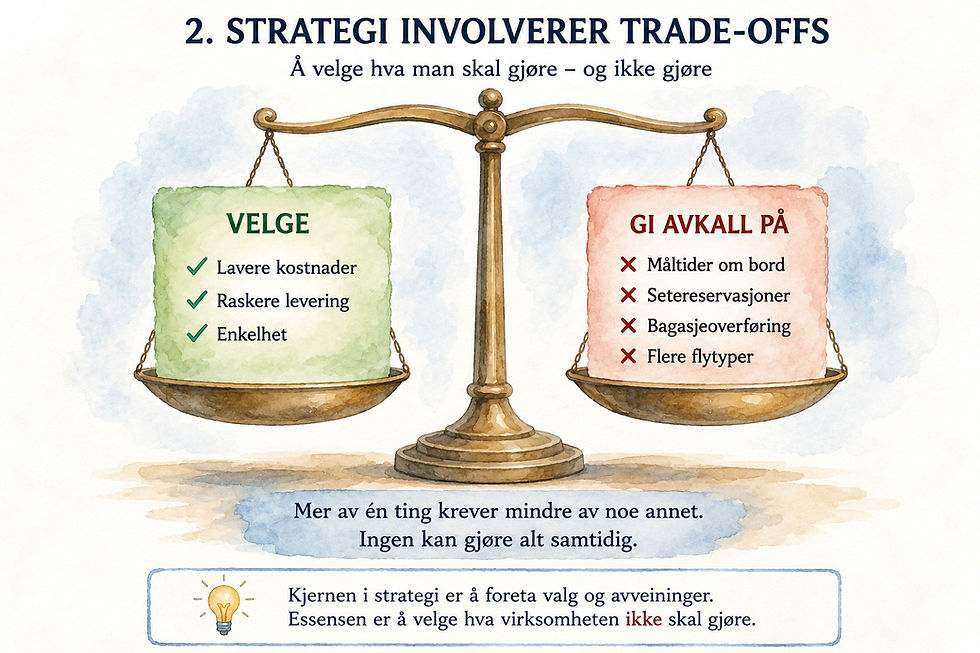
Here Porter introduces trade-offs – strategic trade-offs . A trade-off involves more of one thing requiring less of something else. An airline can offer meals, but this increases costs and slows down flight turnaround times. It can opt out of meals and reduce costs and time. However, it cannot easily achieve both benefits at the same time.
Trade-offs arise for three main reasons.
First, different positions may be incompatible with the company's image and reputation . A company that is known for one particular type of value may lose credibility if it simultaneously attempts to represent a completely different value.
Second, trade-offs arise through the activities themselves . Different strategic positions require different products, equipment, employee behavior, competencies, and management systems. IKEA, for example, has configured its activities around low costs and significant customer input. The more this system is optimized, the more difficult it becomes to simultaneously offer the kind of comprehensive service that other customer groups might want.
Third, trade-offs arise from limitations in internal coordination and governance . When management clearly chooses how the business will compete, it simultaneously establishes priorities for the entire organization. Businesses that try to be all things to all people, on the other hand, risk leaving employees making daily decisions without a clear strategic framework.
Continental Lite demonstrated the consequences. The company attempted to compete as a low-cost carrier on some routes while maintaining a full-service model elsewhere. The result was conflicts between operations, dissatisfied customers and travel agents, large financial losses, and ultimately the discontinuation of the model.
Porter's second fundamental conclusion follows directly from this:
Strategy involves making trade-offs in the competition. The essence of strategy is choosing what the business should not do.
Without trade-offs, there would be no real need for strategic choices. Any good idea could be copied, and competition would again be reduced to the question of who performed the same activities most efficiently.
IV. Fit Drives Both Competitive Advantage and Sustainability
Interaction between activities creates competitive advantage and durability
Strategic choices not only determine which activities the business will perform and how each activity will be performed. They also determine how the activities will relate to each other. Operational effectiveness is largely about outstanding performance in each activity. Strategy is about the combination of activities .

Southwest Airlines demonstrates this particularly clearly. The fast turnaround times make frequent departures and high aircraft utilization possible. But this result is not due to one isolated activity. No meals, no seat reservations, no baggage transfers between airlines, the choice of less congested airports, short routes, and a standardized fleet of Boeing 737 aircraft all contribute to the system working.
The question of what Southwest's actual core competence is therefore given a surprising answer by Porter:
Everything matters. Competitive advantage comes from the entire activity system and from the way the activities fit together and mutually reinforce each other.

Types of Fit – three forms of strategic interaction
Porter identifies three forms of fit . They are not mutually exclusive, and a business can have all three at the same time.

The first form is consistency between the individual activity and the overall strategy . Vanguard illustrates this through a series of activities that all support the company's low-cost position. Low portfolio turnover, direct distribution, limited advertising, and rewarding employees for cost savings all point in the same strategic direction. Consistency means that the benefits from the activities accumulate rather than counteract each other.
The second form occurs when the activities mutually reinforce each other . Neutrogena's marketing through upscale hotels supported the company's medical and premium-oriented position. When hotel guests encountered the product in this context, they were more likely to later purchase the product in a pharmacy or ask their doctor about it. The different marketing activities thus reinforced each other.
The third form goes even further and is about optimizing efforts across activities . The Gap, for example, used frequent replenishment from warehouses to reduce the need for large store inventories. Coordination and information exchange between activities can reduce duplication and waste, while product design can reduce the need for service and coordination with suppliers can make some internal activities redundant.

In all three cases, the whole is more important than the individual part . Competitive advantage emerges from the entire system of activities. Therefore, it can be misleading to explain a company's success through one specific resource, one core competency, or one activity. The value of the individual activity cannot be fully separated from the system of which it is a part.
Fit and Sustainability – interaction and lasting competitive advantage
Fit also makes the strategy harder to copy. It is relatively easy for a competitor to copy a product feature, a sales technique, or a manufacturing process. It is far more difficult to copy an entire system of interdependent activities.
The more the strategy is based on second- and third-order fit, the more difficult it becomes to imitate. The competitor must understand not only the individual activities but also the relationships between them and be able to reproduce the entire system. Copying individual parts may yield little gain and, at worst, reduce performance if the new activities do not fit with the rest of the business. Continental Lite's attempt to copy parts of Southwest is Porter's key example.

This also has an important time dimension. Porter argues that strategic positions should have a horizon of a decade or more , not just one planning period. Continuity makes it possible to improve activities, strengthen the connections between them and develop competencies that are specifically tailored to the strategy. At the same time, the identity of the organization is strengthened. Frequent strategic shifts have the opposite effect because both individual activities and entire activity systems must constantly be reconfigured.
Porter's third fundamental conclusion can thus be formulated as follows:
Strategy is about creating fit between the activities of the business. The success of the strategy depends on many activities being executed well and integrated into a coherent whole.
V. Rediscovering Strategy
Rediscovering the strategy
Why do so many businesses struggle to maintain a clear strategy? Porter points out that the threat does not necessarily come primarily from outside. Technological changes and the actions of competitors can certainly challenge a strategy, but an even greater threat often arises internally within the business .
The Failure to Choose – when business stops choosing
Managers can lose sight of why strategic choices are necessary. When companies are well within the productivity frontier, they can improve both costs and quality simultaneously. This can lead to a perception that trade-offs do not exist and that a well-run business should be able to beat its competitors on all dimensions simultaneously.
The pursuit of operational efficiency compounds the problem because it is concrete, measurable and actionable. Benchmarking and best practices provide visible improvements. At the same time, managers are bombarded with information about what other businesses are doing. The result can be that the business copies its competitors rather than developing and protecting its own strategic position.
The notion of customer focus can also contribute to the problem if it is interpreted as meaning that the business should satisfy all customer needs and desires . Other managers avoid clear choices because they want to maintain maximum flexibility. But strategy requires limits. Therefore, not choosing is not the same as maintaining strategic freedom of action.

The Growth Trap
Of all the forces that can undermine strategy, Porter considers the desire for growth to be one of the most problematic. Strategic choices and trade-offs necessarily set limits. When a business chooses certain customers, products, or needs, it simultaneously forgoes other potential sources of revenue.
The pressure for growth can therefore lead the business to gradually expand product lines, add new features, copy competitors' services, enter new customer groups or make acquisitions. Each individual measure may appear sensible in isolation, but the sum can gradually erode the business's strategic position.
Maytag illustrates this. The company’s initial success was built around reliable and durable washers and dryers. Over time, the product line expanded, and the company acquired several brands with different positions. Sales increased sharply, but profitability deteriorated significantly. Neutrogena experienced similar challenges as it expanded its distribution and product line into areas where the brand did not have the same strategic identity.
Reconnecting with Strategy – finding your way back to strategy
Many established businesses started with a clear strategic position and clear trade-offs. Over time, however, a series of small compromises can bring the business closer to its competitors. Products are added, new customer groups are served, and competitors’ activities are copied. Eventually, the original strategic identity can be difficult to see.
Porter therefore recommends that the business examine its existing core: Which products and services are most distinctive? Which are most profitable? Which customers are most satisfied? Which customers, channels and purchasing situations are most profitable? And which activities in the value chain are most clearly different from those of competitors?
Around this core, over the years, activities, products and customer groups may have accumulated that no longer strengthen the strategy. Porter compares them to fouling that must be removed to make the original strategic position visible again.
The business must refocus on its unique core and re-align its activities to it. History can also provide valuable insights: What was the founder's original vision? What products and customers created the business? Can the original position still be relevant if implemented with today's technology and working methods?
Profitable Growth
The alternative to diluting the strategy is to deepen the strategic position . The business can develop products, services and activities that build on the activity system it already has, and that competitors will find difficult or costly to copy in isolation.
Deepening the position means making the activities even more distinctive, strengthening the fit between them, and communicating the strategy more clearly to the customers who actually value it. Growth can thus come through stronger penetration of the needs, product areas, and markets where the business already has real distinctiveness, rather than chasing growth areas where it has no particular competitive advantage.
The Role of Leadership - the role of management
Developing or restoring a clear strategy is largely an organizational and managerial task. Organizations are constantly exposed to forces that pull them away from clear choices and trade-offs. Therefore, both a clear strategic framework and leaders who are actually willing to make choices are required.
Porter believes that the role of management cannot be reduced to managing operational improvements or executing agreements. The core of general management is strategy: defining and communicating the business's unique position, making trade-offs, and creating fit between activities .
The leader must decide which changes in the market and which customer needs the organization should respond to – and which it should not respond to. The pressure to compromise, copy competitors and weaken existing trade-offs will be continuous. One of the leader’s most important tasks will therefore be to teach the organization what the strategy entails and to be able to say no .
The choices about what the business will not do are just as important as the choices about what it will do. Setting boundaries is therefore a management task. At the same time, a clearly communicated strategy better enables employees to make daily decisions in line with the business's strategic priorities.
Emerging Industries and Technologies – new industries and technologies
Porter also considers businesses in new industries and periods of revolutionary technological change. Uncertainty is high: customer needs are unclear, it is difficult to know which products will win, and the optimal combination of activities and technology has not yet been established.
In such periods, imitation and strategic hedging through many parallel ventures become common. Companies copy features, offer the same new services, and explore the same technologies because they fear making the wrong choice or falling behind. A period of imitation can therefore be difficult to avoid. But it is a result of uncertainty, not a desirable permanent state of competition.
According to Porter, the businesses that succeed over time will be those that manage to define a unique competitive position as early as possible and build this into their activities. Technological change therefore does not eliminate the need for strategy. It makes the need for strategic choices all the more important.

Operational Effectiveness and Strategy
Two different management agendas
Porter concludes by returning to the point of the article. Improving operational efficiency is a necessary part of management, but it is not strategy . When the two are mixed together, a competition arises in which businesses move towards each other and become increasingly similar.

Management must therefore work with two different agendas.
The operational agenda is about continuous improvement in all areas where there are no strategic trade-offs. This includes flexibility, change, productivity improvements, and the pursuit of best practices. Even a business with an excellent strategy becomes vulnerable if it neglects operational efficiency.
The strategic agenda, on the other hand, is about defining a unique position, making clear trade-offs, and constantly strengthening the fit between activities. The business should look for ways to reinforce and further develop its uniqueness. This agenda requires discipline and continuity. Its greatest enemies are distraction and compromise.
Strategic continuity does not mean that the business should stand still. Operational efficiency should be continuously improved, and the business should contribute to moving the productivity frontier. At the same time, it should further develop what makes it unique and strengthen the connections between activities.
Major structural changes in an industry may necessitate a change in strategy. New technologies, new customer groups or fundamentally changed competitive conditions may open up new strategic positions. But even then, Porter's basic principle applies: a new position must be based on new trade-offs and a new system of complementary activities that together can create a lasting competitive advantage.
Porter's overall understanding of strategy
Porter's argument can ultimately be summarized in three interdependent principles. Strategy involves creating a unique and valuable position through a distinctive set of activities . Strategy requires trade-offs , because the business must choose what to do and what it deliberately should not do. And strategy requires fit between activities , because lasting competitive advantage lies not primarily in the individual activities, but in the system they form together.
That is precisely why operational efficiency cannot replace strategy. Competitors can copy a method. They can buy the same technology. They can benchmark the same process. They can copy a product or service.
What is far more difficult is to replicate a completely coherent system of strategic choices, trade-offs and mutually reinforcing activities .
That is where Porter places the core of strategy.
Further reading
For those who wish to move on from Porter's What Is Strategy?, we recommend the literature below. The selection deepens Porter's understanding of strategy and competitive advantage, while also drawing the lines further to innovation, digitalization, and how technological development affects companies' value creation and strategic choices.
From San Francisco and Oxford to the customer
Experiences from professional seminars and study trips in San Francisco and Oxford are also part of the background for this professional universe. Topics such as innovation, digitalization, e-commerce, user experience and new business models have over time contributed to a broader understanding of how technology and organizations must take as their starting point the people the solutions will actually work for.
Recommended literature

The Competitive Strategy: Techniques for Analyzing Industries and Competitors
Author(s): Author: Michael E. Porter
Short review
Competitive Strategy is Michael E. Porter's classic work on how companies can understand the competition they find themselves in and develop a position that provides a basis for long-term profitability. Porter shifts the focus from the individual competitor to the structure of the entire industry and shows how competition is affected by customers, suppliers, new entrants, substitutes and the rivalry between existing companies. This forms the basis for what has later become known as Porter's Five Forces. The book is also about how companies can choose a competitive strategy on the basis of this analysis. It thus established an analytical language for strategy that has gained great importance in both research, teaching and practical strategy work.
Why we recommend the book
We recommend Competitive Strategy because it provides the analytical foundation for much of the thinking Porter later develops in What Is Strategy?. If a company is to choose a unique strategic position, it must also understand the competitive forces, the industry structure and the factors that affect the ability to create and retain value. The book is particularly useful because it reminds us that strategy is not just about internal goals, plans and ambitions. Strategy must be developed in the face of customers, competitors, suppliers, technology and structural changes in the market. Together with What Is Strategy?, the book therefore provides a much richer picture: First, the company must understand the competitive arena. Then, it must choose how to be different.

Competitive Advantage: Creating and Sustaining Superior Performance
Author(s): Author: Michael E. Porter
Short review
In Competitive Advantage, Porter moves the analysis from the industry to the business itself. The main question is how competitive advantage is actually created. One of the book's most important contributions is the value chain, where the business is understood as a system of activities that collectively develop, produce, market, deliver and support a product or service. Competitive advantage cannot therefore be understood only through products or overall strategies; one must examine the activities that create costs, differentiation and value. This understanding later becomes central to Porter's argument about strategic fit: the activities must not only be good in isolation, but also fit together and reinforce each other.
Why we recommend the book
We recommend Competitive Advantage because it brings strategy right down to where value is actually created: in the activities the business performs. This makes the book particularly relevant together with What Is Strategy?. When Porter argues in 1996 that strategy consists of performing different activities than competitors, or performing similar activities in other ways, this builds on the thinking he developed here. For our perspective on value creation, this is particularly interesting. Value does not arise because the business has formulated a strategy on a document, but through people, expertise, technology, processes, collaboration and activities that together enable the business to create something that customers value. The book therefore provides an important connection between strategy, competitive advantage and actual value creation.

The Competitive Advantage of Nations
Author(s): Author: Michael E. Porter
Short review
In The Competitive Advantage of Nations, Porter raises the perspective from business to countries, regions and business environments. The book is based on extensive studies of the competitiveness of ten leading trading nations and examines why certain countries and business clusters are particularly successful in certain industries. A central premise is that national prosperity is not simply something a country inherits through natural resources or other given conditions. It is created, and productivity, innovation, competence, competition and the quality of the environment in which businesses operate are crucial. Here, Porter also develops the well-known diamond model to explain how different national and regional conditions can interact and stimulate competitiveness.
Why we recommend the book
We recommend The Competitive Advantage of Nations because here Porter extends the strategy perspective to the ecosystem surrounding the business itself. Value creation does not occur in a vacuum. Businesses develop in societies with education, research, infrastructure, capital, suppliers, demanding customers, competing businesses and public institutions. This makes the book particularly interesting for understanding value creation as an interaction between people, businesses and society. It also provides an important corrective to the notion that a country's competitiveness can mainly be understood through low costs or access to natural resources. Innovation, productivity and the ability to continuously develop are far more central to Porter's explanation.

Understanding Michael Porter: The Essential Guide to Competition and Strategy
Author: Joan Magretta
Short review
Understanding Michael Porter brings together and explains the most important parts of Michael Porter's strategic thinking in one accessible whole. Joan Magretta herself worked on strategy at the Harvard Business Review and organizes Porter's ideas around two fundamental questions: What is competition, and what is strategy? She explains, among other things, the Five Forces, competitive advantage, the value chain, value creation, trade-offs, fit, and strategic continuity. This makes the connection between Porter's various works clearer than when the concepts are studied separately. The book also includes an interview with Porter.
Why we recommend the book
We recommend Understanding Michael Porter because it helps the reader see the whole picture of Porter's understanding of strategy. Porter is often reduced to the Five Forces or a few models used in isolation. Magretta shows why this is too simple. Competition, value creation, strategic positioning, trade-offs, activity systems, fit and continuity are interconnected. This makes the book a particularly good supplement after reading What Is Strategy?. It makes it easier to understand why Porter does not view strategy as a plan or a collection of goals, but as a coherent system of choices about how the business will create value and compete over time.

HBR's 10 Must Reads on Strategy
Authors: Harvard Business Review, Michael E. Porter, W. Chan Kim, Renée A. Mauborgne and more
Short review
HBR's 10 Must Reads on Strategy brings together some of Harvard Business Review's most influential writings on strategy. The original collection from 2011 features Michael E. Porter's What Is Strategy? as its main article and combines it with works on competitive forces, Blue Ocean Strategy, the organization's vision, business models, strategy execution, and the Balanced Scorecard, among others. The result is not one unified theory of strategy, but multiple perspectives on how organizations can develop, formulate, and execute strategy.
Why we recommend the book
We recommend HBR's 10 Must Reads on Strategy because it places Porter in a broader strategic context. After reading What Is Strategy?, it will be interesting to encounter other central perspectives and see how they complement, challenge, or extend Porter's understanding. The collection also shows why strategy cannot be reduced to a single model. Competitive position, choice, innovation, business model, execution, priorities, and measurement must be seen in context. For the reader who wants to move on from Porter and into the strategy discipline more generally, this is therefore a very good introduction.

Content Strategy for the Web (2nd Edition)
Author/authors: Kristina Halvorson and Melissa Rach
Short review
How do you create content that actually helps people – and at the same time supports your business goals? Content Strategy for the Web is considered one of the most influential books in the field of content strategy and digital communications. The book shows how good content does not arise by chance, but through a deliberate strategy where user needs, the organization's goals, structure, work processes and management are closely linked.
The authors take the reader through the entire process – from planning and organizing to publishing, managing and continuously improving content on websites and digital services. Although technology has evolved since the book was published, the principles of quality, relevance, management and long-term content work are at least as relevant in an era where search engines and artificial intelligence assess the credibility and usefulness of content.
Why we recommend the book
At The Invisible Capital, we believe that good content is one of the most important forms of invisible value creation. A website is far more than design and technology – it is the content that builds trust, creates great customer experiences and helps people find the answers they are looking for.
This book is perfect for leaders, communications consultants, content producers, web editors, UX designers, and anyone working with digital services. It shows why a clear content strategy leads to better user experiences, more effective interactions, and stronger digital results over time.
In an era where artificial intelligence is increasingly important in how information is discovered, understood, and communicated, this book is more relevant than ever. It reminds us that technology alone never creates value – it is good, structured, and relevant content that makes the difference.

The Long Tail: Why the Future of Business Is Selling Less of More
Author(s): Chris Anderson
Short review
The Long Tail is one of the most influential books on how the internet has transformed commerce, marketing, and consumer behavior. Chris Anderson introduces the theory of the “Long Tail,” which explains how digital markets enable significant value creation through a large number of niche products, rather than relying on a few bestsellers.
The book shows how digital distribution, low inventory costs, search engines, and intelligent recommendation systems have made it profitable to offer an almost unlimited product range. Where traditional stores were limited by physical shelf space, online stores can offer millions of products and let customers find exactly what they are looking for.
Chris Anderson illustrates the theory with examples from Amazon, Netflix, Google, and the digital music industry, showing how the internet has changed the rules of competition for businesses around the world. Many of the insights have since become even more relevant through artificial intelligence, personalization, and modern search technology.
The authors take the reader through the entire process – from planning and organizing to publishing, managing and continuously improving content on websites and digital services. Although technology has evolved since the book was published, the principles of quality, relevance, management and long-term content work are at least as relevant in an era where search engines and artificial intelligence assess the credibility and usefulness of content.
Why we recommend the book
At The Invisible Capital, we consider The Long Tail to be one of the most important books in e-commerce, digitalization, and modern value creation.
The book explains why customers no longer just buy the most popular products, but increasingly find value in specialized products and services that meet individual needs. This insight has had enormous impact on the development of online stores, digital marketplaces, search engine optimization (SEO), information architecture, and content strategy.
Today we see that the theory also fits very well into the development of artificial intelligence. AI helps people discover relevant content, products and knowledge that were previously difficult to find. This has given the Long Tail principle a new dimension, where well-structured content and high professional quality are increasingly important for visibility, trust and value creation.
This is a book we believe everyone who works with e-commerce, digital marketing, customer experience, innovation, digital strategy or artificial intelligence should read.

Don't Make Me Think
Author: Steve Krug
Short review
Don't Make Me Think is one of the world's most influential books on usability and web design. Since its first edition in 2000, the book has helped designers, developers, content producers, and managers understand a simple but powerful principle: Good digital services should be intuitive. The user should be able to complete their task without having to stop and think about how the website works.
Why we recommend the book
This is one of the books that has had the greatest impact on my own work with digital services. Over the years – from SAS and the Norwegian Opera & Ballet to working on Bærum Municipality’s website – the principles in this book have been an important reminder that technology is never an end in itself. The goal is to make everyday life easier for the people who use the services. Despite the fact that the book was published many years ago, the message is just as relevant today.
Internet Marketing & eCommerce
Authors: Ward Hanson and Kirthi Kalyanam
Short review
Internet Marketing & eCommerce provides a thorough introduction to how the internet has changed marketing, commerce, and business development. The book combines theory and practical examples in digital marketing, e-commerce, customer behavior, value creation, and digital business models. Although written at a time when the internet was still in its infancy, many of the fundamental principles are still highly relevant.
Why we recommend the book
This book was an important part of my own learning journey in digital marketing and e-commerce. It helped build my understanding of how technology, customer experiences and business strategy are interconnected – an insight that later became very important in my work with SAS, the Norwegian Opera & Ballet, Bærum Municipality and eventually the project The Invisible Capital. Many of the ideas about customer value, digitalization and innovation presented on the website have their roots in the knowledge this book conveys.

The Innovator's Solution: Creating and Sustaining Successful Growth
Authors: Clayton M. Christensen and Michael E. Raynor
Short review
In this sequel to The Innovator's Dilemma, Clayton Christensen shows how businesses can translate innovation theory into practical strategy. The book explains how companies can identify new growth opportunities, develop disruptive innovations, and build organizations that thrive in rapidly changing markets.
Why we recommend the book
While The Innovator's Dilemma explains why established businesses are often challenged, The Innovator's Solution provides concrete advice on how to meet the challenges. The book is therefore a natural next step for anyone who wants to understand innovation, strategy and long-term value creation.

The Innovator's DNA: Mastering the Five Skills of Disruptive Innovators
Authors: Jeff Dyer, Hal Gregersen and Clayton M. Christensen
Short review
What characterizes people who create groundbreaking innovations? The authors identify five key skills – observation, questioning, experimentation, networking and association – that are common to the world's most innovative leaders and entrepreneurs.
Why we recommend the book
This book shifts the focus from organizations to the people behind innovation. It shows that creativity and innovation can be developed through deliberate training and experience. The perspectives align well with the philosophy behind Invisible Capital, where human competence and curiosity are the most important drivers of development.

Competing Against Luck: The Story of Innovation and Customer Choice
Authors: Clayton M. Christensen, Taddy Hall, Karen Dillon and David S. Duncan
Short review
In this book, Clayton Christensen further develops the theory of Jobs to Be Done – the idea that customers do not primarily buy products, but "hire" them to solve specific needs. Through practical examples, the authors show how businesses can develop products and services that address customers' real-world challenges.
Why we recommend the book
For anyone working in customer experience, service design, and innovation, this is one of the most insightful books ever written. It reminds us that value creation always starts with understanding the people we are developing solutions for – a fundamental principle of Invisible Capital.

The Innovator's Dilemma: When New Technologies Cause Great Firms to Fail
Author: Clayton M. Christensen
Short review
The Innovator's Dilemma is considered one of the most influential books on innovation and technological change. Clayton M. Christensen introduces the theory of disruptive innovation and explains why even the most successful businesses can fail when new technologies and business models challenge established markets. Through a series of examples, he shows how companies often focus on today's customers and incremental improvements, while overlooking innovations that later change entire industries.
Why we recommend the book
This is one of the books that has had the greatest impact on modern innovation thinking. When I first read it, it gave me a whole new perspective on why some businesses succeed in transformation, while others lag behind – even when they are well led. The insight has been an important part of my own understanding of digitalization, innovation and change management, and many of the reflections in The Invisible Capital build on the ideas Clayton Christensen presents in this classic. The book is as relevant today, in the face of artificial intelligence and digital transformation, as it was when it was published.

Open Innovation: The New Imperative for Creating and Profiting from Technology
Author: Henry Chesbrough
Short review
Henry Chesbrough introduced the concept of Open Innovation and changed the way many businesses think about research and development. He shows how companies can create more innovation through collaboration with customers, universities, start-ups, suppliers and other external partners.
Why we recommend the book
Open Innovation has had a major influence on modern innovation thinking and was also an important topic during the seminars in Oxford and San Francisco. The book shows why future value creation occurs in the interaction between people, businesses and knowledge environments – not within closed organizations alone.

Blue Ocean Strategy: How to Create Uncontested Market Space and Make the Competition Irrelevant
Authors: W. Chan Kim and Renée Mauborgne
Short review
Blue Ocean Strategy challenges businesses to shift their focus away from fierce competition and instead create new markets with little or no competition. The authors present strategies and models that help organizations develop innovative products, services, and business models.
Why we recommend the book
This book has inspired leaders around the world to rethink strategy and innovation. Instead of competing for the same customers, it shows how businesses can create new value through creativity and differentiation. The perspectives align very well with the themes of innovation, digitalization, and long-term value creation in Invisible Capital.

Outside Innovation: How Your Customers Will Co-Design Your Company's Future
Authors: Patricia B. Seybold
Short review
Patricia Seybold shows how businesses can create better products and services by actively involving customers in the innovation process. The book describes how dialogue, co-creation and close collaboration with users can provide better solutions and stronger competitiveness.
Why we recommend the book
Customers often hold the most important insights into how products and services can be improved. This book emphasizes the importance of listening, involving, and learning from users – a perspective that is echoed in many of the articles on The Invisible Capital. Innovation rarely happens alone; it is created in the interaction between people.

Blown to Bits: How the New Economics of Information Transforms Strategy
Authors: Philip Evans and Thomas S. Wurster
Short review
This book analyzes how digital information is changing competitive conditions, markets, and business strategies. The authors explain how the internet is disrupting established structures and creating new opportunities for businesses that are able to think differently.
Why we recommend the book
Although written early in the internet revolution, the book describes many of the developments that still characterize business today. It provides valuable perspective on how digitalization affects value chains, competition, and innovation – themes that are central to Invisible Capital.

Wikinomics: How Mass Collaboration Changes Everything
Authors: Don Tapscott and Anthony D. Williams
Short review
Wikinomics shows how openness, sharing and collaboration across organizations create new forms of innovation and value creation. Through a number of international examples, the authors describe how digital networks make it possible to develop products, services and knowledge together.
Why we recommend the book
This book was groundbreaking when it was first published, and many of the ideas have since become a natural part of everyday digital life. The perspectives on collaboration, knowledge sharing, and open innovation processes align very well with the philosophy behind Invisible Capital, where people and networks are at the center of value creation.

© 2025 - 2026 Portico Publish | The invisible capital Privacy and use of the website | Developed and operated by Magne Bjella | Powered and secured by Wix


Comments