
Part 2 - Why is the customer crucial to value creation?

A business may have capital, competent employees, modern technology, efficient production processes and strong owners. It may develop a product with high technical quality and invest significant amounts in production, distribution and marketing.
But if no one wants what the business offers, there is no basis for lasting commercial activity.
This is a simple point, but it has major consequences for how we understand value creation. In discussions about business, capital, ownership, investments, productivity and framework conditions are often central. All of these factors are important. But they do not alone explain why a business succeeds.
There must also be someone in the market who feels that the product or service has sufficient value for them to choose it.

It is the customer who makes this choice.
The customer does not create value alone. However, the customer is crucial to ensuring that the value the business is trying to create can be realized in the market.
Value creation requires more than production
Production is not the same as value creation.
A factory can produce thousands of products. A software company can develop a technically advanced solution. A restaurant can put together an extensive menu. An online store can fill its warehouse with goods.
It tells us that the business has produced something.
That doesn't necessarily tell us that anyone wants it.
In a market, therefore, a crucial meeting occurs between what the business can offer and what the customer actually values . If these two do not meet, large investments can end up as inventory, failed products, discontinued services or lost investments.
This is one of the reasons why Peter Drucker gave the customer such a fundamental place in his understanding of business. He argued that the purpose of business had to be understood from the outside – through the customer and the market – not just from the inside through production and organization.
Drucker's classic formulation is brief:
"There is only one valid definition of business purpose: to create a customer." - Peter F. Drucker
The point is not that employees, capital, technology or owners are unimportant. Quite the opposite. Businesses need resources and expertise to be able to create something.
But the business also needs someone to create it for .
The customer is part of the value creation – not the entire value creation
It is important to avoid a new simplification.
If it is inadequate to describe value creation as something that the owner or capital creates alone, it is equally wrong to claim that the customer alone creates the values.
Value creation in a business occurs through the interaction of multiple resources and actors:
employees' work and expertise
management and organization
capital and investments
technology and means of production
suppliers and partners
research and knowledge
infrastructure and societal institutions
innovation and entrepreneurship
customer needs and demand
In other words, value creation is a system , not the performance of a single actor.
This perspective is also known from strategy research. Adam Brandenburger and Harborne Stuart have described value creation as a process that requires interaction between, among others, customers, suppliers and businesses. A business does not create value in isolation from the other actors on which it depends.
This is important for this entire series.
The customer should be highlighted without reducing the importance of other players.
The difference between creating value and realizing value
Here we can make a useful distinction.
The business can create the potential for value through knowledge, work, innovation, design and production.
The customer contributes to the realization of this value in the market by choosing the offer.
Think about a new product.
Before launch, the business may have spent several years on research, product development, and testing. The product may be objectively better in several areas than existing alternatives.
However, the market outcome is not yet decided.
The customer must:
discover the product
understand what it does
feel that it meets a need
trust the business
accept the price
find the product available
choose it over the alternatives
Therefore, a technically good product can fail commercially, while a product that meets a clear customer need can develop a large market.
Product development and customer insight cannot therefore be understood as two separate activities.
They must meet.
The customer makes the market's most important practical assessment
The business itself may believe that it creates great customer value.
That is not sufficient.
The customer makes their own assessment.
That assessment can encompass far more than price. The customer can place emphasis on quality, availability, security, time spent, design, service, brand, user-friendliness, previous experiences and how easy it is to get help when something goes wrong.
Two products with almost identical technical characteristics can therefore be experienced very differently.
Customer value is not only found in the product .
It also arises through the experience of buying, using, and living with the product or service .
Here lies part of the explanation for why customer experience, UX, design, service and customer relations have taken on such an important place in modern businesses.
The customer can say no.
Perhaps there is no simpler description of customer power in a competitive market:
The customer may not buy.
And if the customer has already purchased, in many markets they can choose someone else next time.
This distinguishes the customer from several of the roles we discussed in Part 1. A citizen cannot similarly switch states because a public service is cumbersome. A patient is not necessarily in a situation of free competition between many providers.
The commercial business, on the other hand, must count on the customer to compare alternatives.
Competition is of course not perfect. Customers may be tied down by contracts, high switching costs, inadequate information, geography or strong market positions. But in well-functioning competitive markets, the ability to choose suppliers is a fundamental disciplining force.
This makes the customer experience important even after the sale is completed.
The sale does not end the customer relationship
It's easy to view the purchase as the end point.
The product has been sold. The revenue has been recorded. The transaction has been completed.
But for the customer, that may be when the most important part begins.
The product should work.
The service must be delivered.
Questions must be answered.
Problems must be solved.
Complaints must be handled.
The customer must decide whether the business kept its promises.
Therefore, the relationship after the purchase is important in whether the customer returns, recommends the business or chooses a competitor.
Throughout the history of the Virgin Group, Richard Branson has placed great emphasis on looking at business from the customer's perspective. His advice is remarkably simple:
"The first thing to do is put yourself in your customers' shoes." - Richard Branson
It sounds obvious, but it requires the organization to actually be able to see its processes from the outside.
What seems logical in the organizational chart may be difficult for the customer.
What is efficient for the business may create extra work for the customer.
What is self-explanatory to the employee may be incomprehensible to a person encountering the solution for the first time.
Customer focus therefore also involves examining the business from the outside.

The customer considers the entire business – not the organizational chart
This is particularly important in digital and complex customer journeys.
The customer does not necessarily distinguish between the marketing department, the sales department, the IT department, the logistics department and customer service.
For the customer, all of this is business .
If the website promises delivery in two days, the warehouse takes five days, and customer service can't find the order, the customer isn't experiencing three separate internal problems.
The customer experiences one bad delivery.
The same applies when:
the product information is incomplete
the ordering process is difficult
payment fails
The item is out of stock.
the delivery is delayed
customer service lacks information
the customer has to explain the problem several times
The customer experience therefore extends across the organization.
This also makes the customer interesting as a diagnostic source . The customer can highlight problems that the business itself has organized into separate departments.
The customer can see problems the business doesn't see
Organizations develop routines, systems, concepts and working methods that become natural to the people who work there.
The customer does not necessarily have this knowledge.
That is precisely why the customer's reaction can be valuable.
When many customers don't understand the same information, the problem may be the information – not the customers.
When many people call about the same digital process, the problem can be the solution.
When the same complaint occurs again, the problem may lie in the product.
When customers constantly ask for something the business doesn't offer, there may be an unmet need.
The customer can thus act as a continuous source of information about how the business actually functions from the outside.
Here we move from the customer as a buyer to the customer as a source of knowledge .
It becomes very important later in the series.
The customer service representative is at the center of this information flow.
Much customer insight doesn't first arise in market research or large data sets.
It arises in conversation.
A customer service representative may hear the same problem ten times in one week. A store associate may find that customers keep asking for the same product. A salesperson may encounter a new objection. An advisor may hear how a customer's needs are changing.
This is information the business already has access to.
The question is whether it can use it.
If the customer service representative is only evaluated based on how quickly a call is ended, the business may overlook another value of customer contact:
the opportunity to learn.
This way, the front line doesn't just become a service function. It can be a sensor towards the market.
We will return to this in detail in Part 5 and Part 6.
The customer's expectations do not stand still
Another challenge is that the business cannot assume that yesterday's good solution is automatically good enough tomorrow.
Jeff Bezos described this in Amazon's 2017 shareholder letter:
"One thing I love about customers is that they are divinely dissatisfied. Their expectations are never static – they go up.” -Jeff Bezos
This is an important perspective on competition and innovation.
When one business makes delivery faster, payment easier, or digital self-service better, it not only affects the expectations customers have of that business. The experience can also affect their expectations in other markets.
Amazon itself has described the principle as starting with the customer and working backwards, and the company's official management principle "Customer Obsession" emphasizes both winning and maintaining customer trust.
But Bezos has also pointed out an important limitation of simply asking customers what they want. In his 2018 shareholder letter, he wrote that businesses must listen to customers, but that the biggest innovations can also be solutions that customers don't yet know they're asking for.
This gives us an important distinction:
Customer focus is not the same as letting the customer develop the business's strategy.
The business must combine customer insight with expertise, technology, creativity and judgment.
Customer insights do not reduce the need for innovation
On the contrary.
Good customer insight can give direction to innovation.
The business doesn't just need to ask:
What can we produce?
It can also ask:
What problem is worth solving?
These are two very different starting points.
Technology can open up opportunities that no customer could previously formulate. The innovator can see solutions that the market does not yet know.
But even such solutions must ultimately create a perceived value.
Otherwise, the innovation becomes a technical achievement without a sustainable market.
This is how customer insight and innovation meet:
Customer insights help the business understand the problem. Innovation can find a better way to solve it.

The customer and the owner have different roles
This leads back to the question underlying this series.
In the public debate about business and value creation, the owner is often very visible.
The owner is important.
Owners can:
make capital available
take financial risks
finance investments
contribute with expertise and networks
establish long-term goals
enabling growth and innovation
But the owner cannot create demand alone.
There is no automatic connection between invested capital and the customer's desire to buy.
A billion-dollar investment in a product that no one wants is not a good investment because the capital investment was large.
Therefore, the discussion about value creation should also include the question:
For whom are the values created?
That question brings the customer back to the center without us having to pit the customer against the owner, employee, or entrepreneur.
They have different roles in the same value creation system.
The customer is also not always an expression of society's overall value.
Here, another professional definition is necessary.
Just because customers are willing to pay for something doesn't automatically mean that the product is good for society.
Market value and societal value are not identical quantities.
A market may have:
negative environmental consequences
information problems
addictive products
monopoly power
costs borne by people outside the transaction
long-term consequences the customer does not take into account when purchasing
Therefore, the customer's willingness to pay cannot be our only measure of value creation.
This is particularly important for Invisible Capital's broader understanding of value.
The market is an important mechanism for coordinating needs, production and demand. But society also creates value through institutions, knowledge, health, education, infrastructure, culture, trust and other areas that cannot be fully measured through customer transactions.
The customer is crucial in the market. The customer is not the measure of all value in society.
We must maintain that distinction throughout the series.
What happens if no one wants the product?
We can thus return to the question we started with.
What happens if the business produces something no one wants?
In the short term, it may continue.
It can use previously earned capital.
The owners can add new money.
The warehouse can be filled.
Marketing can be increased.
Prices may be reduced.
The strategy can change.
However, if over time the business fails to create an offering that a sufficient number of customers find valuable, the commercial basis disappears.
It is the simple but brutal reality of the market.
Therefore, the customer is not a detail in the business's value creation.
The customer is not just the marketing department's responsibility.
Customer understanding concerns product development, innovation, technology, sales, logistics, service, management and strategy.
In practice, it concerns the entire business.
From customer value to customer focus
This article shows why the customer has a fundamental place in commercial value creation.
But then the next question arises.
If the customer is so important, what does a business look like when it actually takes the customer seriously?
It is not enough to write "customer first" in the strategy.
Customer focus must be visible in priorities, organization, decisions, products, service and the way the business learns.
That is the topic of the next article:
Recommended literature
Customer focus, customer insight and customer relationships cannot be understood in isolation from developments in digitalisation, innovation and user experience. The way a business interacts with its customers is shaped today by people, technology, digital services, organisation and the ability to develop new solutions.
Therefore, this bibliography currently contains books that highlight several of these perspectives.
Here you will find literature on digitalization, innovation, user experience, usability and the development of digital services, among other things. Steve Krug's Don't Make Me Think is a natural example: The book is about usability on the web, but at the same time touches on a fundamental question in the entire Customer series – how easy or difficult the business makes it for people to succeed in what they are trying to do.
Similarly, literature on innovation can help us understand how observations, needs and problems of customers and users can be developed into better products, services and work processes.
The literature list will eventually be expanded with more books that specifically address customer focus, customer insight, customer relations, customer loyalty, e-commerce, service and customer experience.
The goal is not to collect as many books as possible, but to build a literature base that makes it possible to understand the customer from multiple professional perspectives.
From San Francisco and Oxford to the customer
Experiences from professional seminars and study trips in San Francisco and Oxford are also part of the background for this professional universe. Topics such as innovation, digitalization, e-commerce, user experience and new business models have over time contributed to a broader understanding of how technology and organizations must take as their starting point the people the solutions will actually work for.
The Customer Series continues this perspective: Technology is a tool. Innovation is a tool. Value arises when solutions actually work for the people they are designed for.

The Long Tail: Why the Future of Business Is Selling Less of More
Author(s): Chris Anderson
Short review
The Long Tail is one of the most influential books on how the internet has transformed commerce, marketing, and consumer behavior. Chris Anderson introduces the theory of the “Long Tail,” which explains how digital markets enable significant value creation through a large number of niche products, rather than relying on a few bestsellers.
The book shows how digital distribution, low inventory costs, search engines, and intelligent recommendation systems have made it profitable to offer an almost unlimited product range. Where traditional stores were limited by physical shelf space, online stores can offer millions of products and let customers find exactly what they are looking for.
Chris Anderson illustrates the theory with examples from Amazon, Netflix, Google, and the digital music industry, showing how the internet has changed the rules of competition for businesses around the world. Many of the insights have since become even more relevant through artificial intelligence, personalization, and modern search technology.
The authors take the reader through the entire process – from planning and organizing to publishing, managing and continuously improving content on websites and digital services. Although technology has evolved since the book was published, the principles of quality, relevance, management and long-term content work are at least as relevant in an era where search engines and artificial intelligence assess the credibility and usefulness of content.
Why we recommend the book
At The Invisible Capital, we consider The Long Tail to be one of the most important books in e-commerce, digitalization, and modern value creation.
The book explains why customers no longer just buy the most popular products, but increasingly find value in specialized products and services that meet individual needs. This insight has had enormous impact on the development of online stores, digital marketplaces, search engine optimization (SEO), information architecture, and content strategy.
Today we see that the theory also fits very well into the development of artificial intelligence. AI helps people discover relevant content, products and knowledge that were previously difficult to find. This has given the Long Tail principle a new dimension, where well-structured content and high professional quality are increasingly important for visibility, trust and value creation.
This is a book we believe everyone who works with e-commerce, digital marketing, customer experience, innovation, digital strategy or artificial intelligence should read.

Content Strategy for the Web (2nd Edition)
Author/authors: Kristina Halvorson and Melissa Rach
Short review
How do you create content that actually helps people – and at the same time supports your business goals? Content Strategy for the Web is considered one of the most influential books in the field of content strategy and digital communications. The book shows how good content does not arise by chance, but through a deliberate strategy where user needs, the organization's goals, structure, work processes and management are closely linked.
The authors take the reader through the entire process – from planning and organizing to publishing, managing and continuously improving content on websites and digital services. Although technology has evolved since the book was published, the principles of quality, relevance, management and long-term content work are at least as relevant in an era where search engines and artificial intelligence assess the credibility and usefulness of content.
Why we recommend the book
At The Invisible Capital, we believe that good content is one of the most important forms of invisible value creation. A website is far more than design and technology – it is the content that builds trust, creates great customer experiences and helps people find the answers they are looking for.
This book is perfect for leaders, communications consultants, content producers, web editors, UX designers, and anyone working with digital services. It shows why a clear content strategy leads to better user experiences, more effective interactions, and stronger digital results over time.
In an era where artificial intelligence is increasingly important in how information is discovered, understood, and communicated, this book is more relevant than ever. It reminds us that technology alone never creates value – it is good, structured, and relevant content that makes the difference.

Don't Make Me Think
Author: Steve Krug
Short review
Don't Make Me Think is one of the world's most influential books on usability and web design. Since its first edition in 2000, the book has helped designers, developers, content producers, and managers understand a simple but powerful principle: Good digital services should be intuitive. The user should be able to complete their task without having to stop and think about how the website works.
Why we recommend the book
This is one of the books that has had the greatest impact on my own work with digital services. Over the years – from SAS and the Norwegian Opera & Ballet to working on Bærum Municipality’s website – the principles in this book have been an important reminder that technology is never an end in itself. The goal is to make everyday life easier for the people who use the services. Despite the fact that the book was published many years ago, the message is just as relevant today.
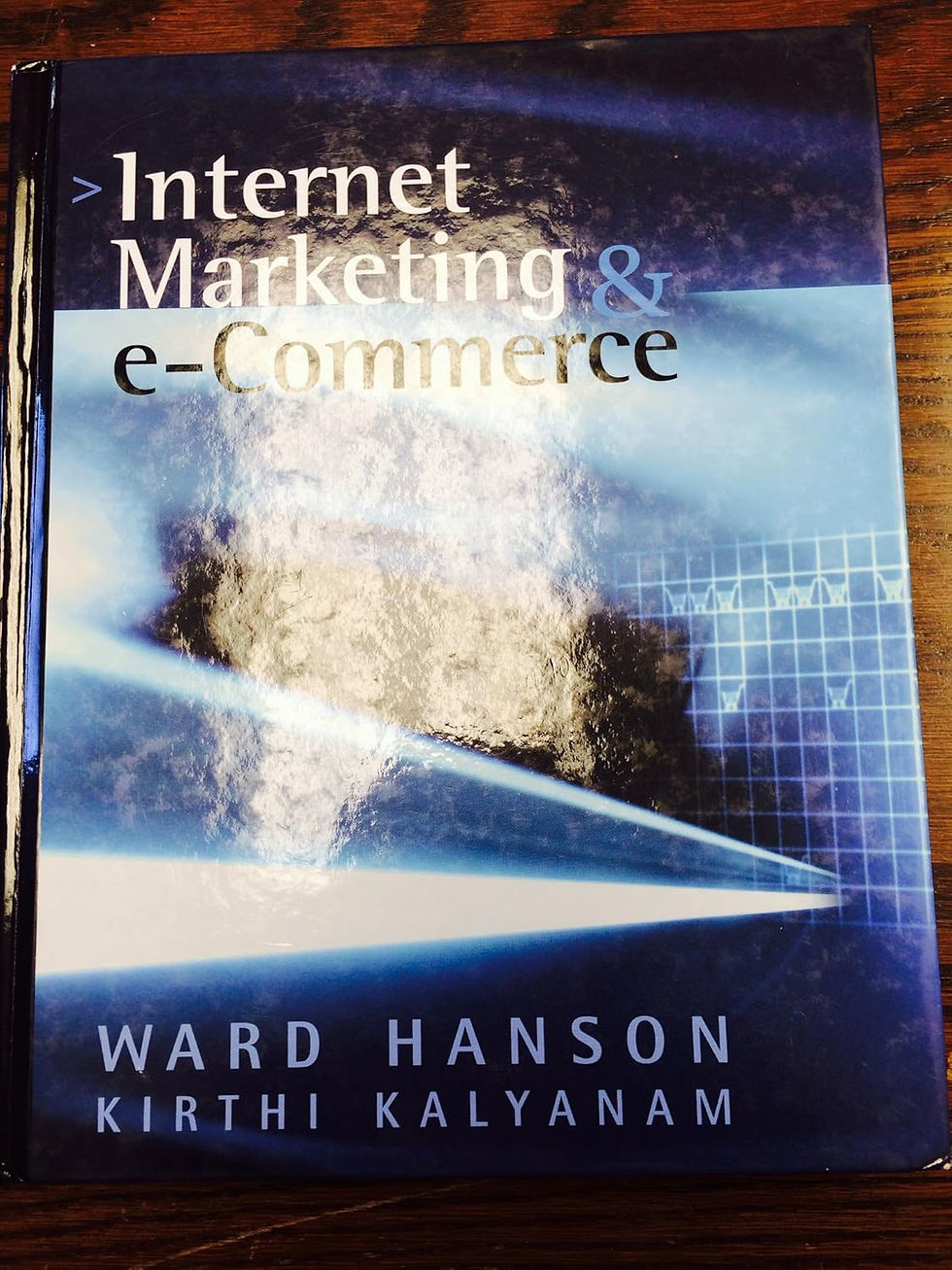
Internet Marketing & eCommerce
Authors: Ward Hanson and Kirthi Kalyanam
Short review
Internet Marketing & eCommerce provides a thorough introduction to how the internet has changed marketing, commerce, and business development. The book combines theory and practical examples in digital marketing, e-commerce, customer behavior, value creation, and digital business models. Although written at a time when the internet was still in its infancy, many of the fundamental principles are still highly relevant.
Why we recommend the book
This book was an important part of my own learning journey in digital marketing and e-commerce. It helped build my understanding of how technology, customer experience and business strategy are interconnected – an insight that later became very important in my work with SAS, the Norwegian Opera & Ballet, Bærum Municipality and eventually the project The Invisible Capital. Many of the ideas about customer value, digitalisation and innovation presented on the website have their roots in the knowledge this book conveys.

The Innovator's Solution: Creating and Sustaining Successful Growth
Authors: Clayton M. Christensen and Michael E. Raynor
Short review
In this sequel to The Innovator's Dilemma, Clayton Christensen shows how businesses can translate innovation theory into practical strategy. The book explains how companies can identify new growth opportunities, develop disruptive innovations, and build organizations that thrive in rapidly changing markets.
Why we recommend the book
While The Innovator's Dilemma explains why established businesses are often challenged, The Innovator's Solution provides concrete advice on how to meet the challenges. The book is therefore a natural next step for anyone who wants to understand innovation, strategy and long-term value creation.

The Innovator's DNA: Mastering the Five Skills of Disruptive Innovators
Authors: Jeff Dyer, Hal Gregersen and Clayton M. Christensen
Short review
What characterizes people who create groundbreaking innovations? The authors identify five key skills – observation, questioning, experimentation, networking and association – that are common to the world's most innovative leaders and entrepreneurs.
Why we recommend the book
This book shifts the focus from organizations to the people behind innovation. It shows that creativity and innovation can be developed through deliberate training and experience. The perspectives align well with the philosophy behind Invisible Capital, where human competence and curiosity are the most important drivers of development.

Competing Against Luck: The Story of Innovation and Customer Choice
Authors: Clayton M. Christensen, Taddy Hall, Karen Dillon and David S. Duncan
Short review
In this book, Clayton Christensen further develops the theory of Jobs to Be Done – the idea that customers do not primarily buy products, but "hire" them to solve specific needs. Through practical examples, the authors show how businesses can develop products and services that address customers' real-world challenges.
Why we recommend the book
For anyone working in customer experience, service design, and innovation, this is one of the most insightful books ever written. It reminds us that value creation always starts with understanding the people we are developing solutions for – a fundamental principle of Invisible Capital.

The Innovator's Dilemma: When New Technologies Cause Great Firms to Fail
Author: Clayton M. Christensen
Short review
The Innovator's Dilemma is considered one of the most influential books on innovation and technological change. Clayton M. Christensen introduces the theory of disruptive innovation and explains why even the most successful businesses can fail when new technologies and business models challenge established markets. Through a series of examples, he shows how companies often focus on today's customers and incremental improvements, while overlooking innovations that later change entire industries.
Why we recommend the book
This is one of the books that has had the greatest impact on modern innovation thinking. When I first read it, it gave me a whole new perspective on why some businesses succeed in transformation, while others lag behind – even when they are well led. The insight has been an important part of my own understanding of digitalization, innovation and change management, and many of the reflections in The Invisible Capital build on the ideas Clayton Christensen presents in this classic. The book is as relevant today, in the face of artificial intelligence and digital transformation, as it was when it was published.

Open Innovation: The New Imperative for Creating and Profiting from Technology
Author: Henry Chesbrough
Short review
Henry Chesbrough introduced the concept of Open Innovation and changed the way many businesses think about research and development. He shows how companies can create more innovation through collaboration with customers, universities, start-ups, suppliers and other external partners.
Why we recommend the book
Open Innovation has had a major influence on modern innovation thinking and was also an important topic during the seminars in Oxford and San Francisco. The book shows why future value creation occurs in the interaction between people, businesses and knowledge environments – not within closed organizations alone.

Blue Ocean Strategy: How to Create Uncontested Market Space and Make the Competition Irrelevant
Authors: W. Chan Kim and Renée Mauborgne
Short review
Blue Ocean Strategy challenges businesses to shift their focus away from fierce competition and instead create new markets with little or no competition. The authors present strategies and models that help organizations develop innovative products, services, and business models.
Why we recommend the book
This book has inspired leaders around the world to rethink strategy and innovation. Instead of competing for the same customers, it shows how businesses can create new value through creativity and differentiation. The perspectives align very well with the themes of innovation, digitalization, and long-term value creation in Invisible Capital.

Outside Innovation: How Your Customers Will Co-Design Your Company's Future
Authors: Patricia B. Seybold
Short review
Patricia Seybold shows how businesses can create better products and services by actively involving customers in the innovation process. The book describes how dialogue, co-creation and close collaboration with users can provide better solutions and stronger competitiveness.
Why we recommend the book
Customers often hold the most important insights into how products and services can be improved. This book emphasizes the importance of listening, involving, and learning from users – a perspective that is echoed in many of the articles on The Invisible Capital. Innovation rarely happens alone; it is created in the interaction between people.

Blown to Bits: How the New Economics of Information Transforms Strategy
Authors: Philip Evans and Thomas S. Wurster
Short review
This book analyzes how digital information is changing competitive conditions, markets, and business strategies. The authors explain how the internet is disrupting established structures and creating new opportunities for businesses that are able to think differently.
Why we recommend the book
Although written early in the internet revolution, the book describes many of the developments that still characterize business today. It provides valuable perspective on how digitalization affects value chains, competition, and innovation – themes that are central to Invisible Capital.

Wikinomics: How Mass Collaboration Changes Everything
Authors: Don Tapscott and Anthony D. Williams
Short review
Wikinomics shows how openness, sharing and collaboration across organizations create new forms of innovation and value creation. Through a number of international examples, the authors describe how digital networks make it possible to develop products, services and knowledge together.
Why we recommend the book
This book was groundbreaking when it was first published, and many of the ideas have since become a natural part of everyday digital life. The perspectives on collaboration, knowledge sharing, and open innovation processes align very well with the philosophy behind Invisible Capital, where people and networks are at the center of value creation.

© 2025 - 2026 Portico Publish | The invisible capital Privacy and use of the website | Developed and operated by Magne Bjella | Powered and secured by Wix


Comments