
Part 41 - KI-Kompis...Why is trust more important than marketing budget?

Marketing can create attention. Trust creates lasting relationships.
Many businesses spend large sums of money on marketing to get noticed. This can lead to more visits, more clicks, and more customers in the short term. But attention is not the same as trust.
In a world where people encounter thousands of messages every day, the question is becoming increasingly important: Who can we trust? Businesses that build credibility over time through knowledge, quality and transparency often create stronger relationships than those that just shout the loudest. In this article, we take a closer look at why trust has become one of the most important competitive factors in the digital economy – and how artificial intelligence makes it even more valuable.

Magne & the Friend
Magne
Friend...
In the previous article, we talked about how knowledge can become a competitive advantage.
But now you say that trust is even more important.
How can that be true?
The buddy
Because knowledge only creates value when people choose to trust it.
You can have the world's best product.
The most advanced technology.
Or the wisest analysis.
But if no one trusts you...
it has little significance.

Magne
So...
A large marketing budget is not enough?
The buddy
No.
Marketing can make you visible.
But it cannot buy true trust.
It must be earned.
Through action.
Through quality.
Through honesty.
And by keeping your promises.
Magne
That reminds me of something we talked about before.
A website that just tries to sell...
is quickly forgotten.
The buddy
Yes.
But a website that helps people...
is remembered.
Every time you answer a question correctly...
explaining a difficult concept...
or make everyday life a little easier...
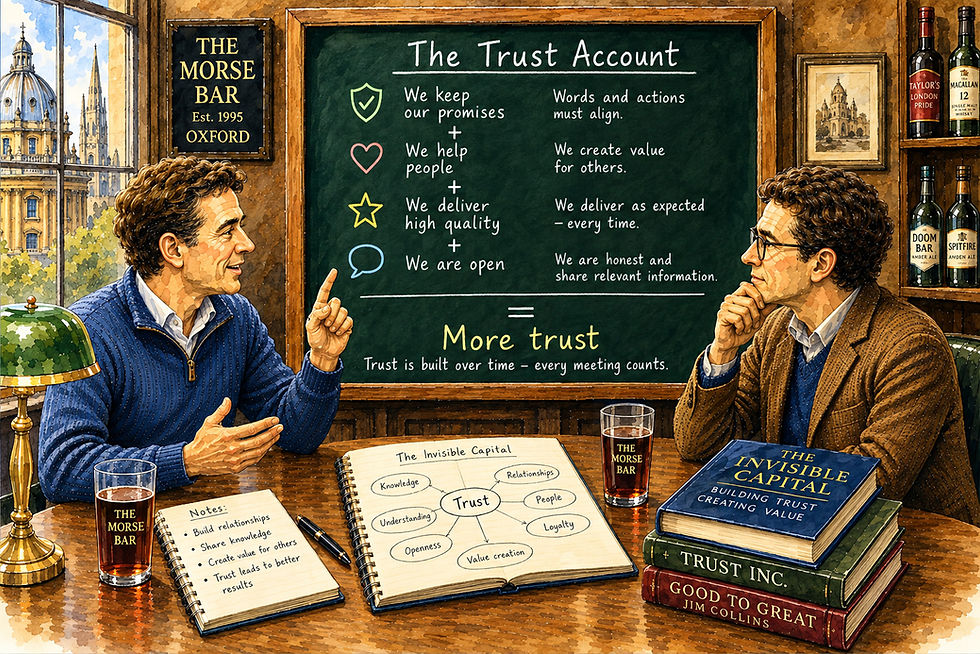
You make a small deposit into the trust account.
Magne
The trust account?
I liked it.
The buddy
Think of trust like a bank account.
Every time you keep your promise...
you put in a little more.
Every time you hide something...
exaggerating...
or disappoint people...
you withdraw money.
The difference is that it often takes a long time to build up the account...
but only a few moments to empty it.
Magne
And where does artificial intelligence fit in?
The buddy
It makes trust even more important.
Because when both humans and artificial intelligence assess which sources are credible...
Quality, transparency and documentation are becoming more important than ever.

Magne
So...
The most important investment may not be the marketing budget.
But everything we do that makes people trust us?
The buddy
Just.
Because trust is not something you buy.
It's something you deserve.
Academic specialization
Why is trust a strategic resource?
Trust is one of the most valuable assets a business can build, precisely because it cannot be bought or copied. It is developed gradually through actions, experiences and relationships over time. When customers, employees and partners experience that a business keeps its promises, shares knowledge openly and puts quality before short-term gains, trust grows.
Research in management, organization, and social sciences points in the same direction. Francis Fukuyama has described trust as a fundamental prerequisite for cooperation and economic development. Stephen MR Covey shows how high trust reduces friction, increases collaboration, and makes organizations more efficient. Rachel Botsman has explained how trust is becoming increasingly important in digital societies where people often have to make decisions without meeting face to face.
In the digital economy, this takes on a new dimension. Artificial intelligence can make information more accessible, but it cannot alone determine what is true, right or wise. Therefore, businesses that combine high professional quality with transparency, documentation and ethical responsibility are becoming increasingly attractive – both to humans and to digital systems that assess the quality of the content.
That is precisely why trust is not just a value.
It is a competitive advantage.

Marketing creates attention. Trust creates relationships.
Marketing budget can... | Trust can... |
Make your business visible | Make your business credible |
Get more visits | Get people to come back |
Creating attention | Create loyalty |
Increase short-term sales | Building long-term relationships |
Convey a message | Create a lasting reputation |
Arouse interest | Create recommendations and trust |
How is trust built?
Action | What does it create? |
Keeping our promises | Credibility |
Sharing knowledge openly | Trust |
Admits mistakes and corrects them | Respect |
Admits mistakes and corrects them | Respect |
Documenting claims | Professional quality |
Putting the customer before the sale | Long-term relationships |
Delivers consistent quality over time | Strong reputation |
Help before we sell | Customer loyalty |
Act ethically and responsibly | Lasting competitive advantage |
Technical terms
English technical term | Short explanation |
Trust | The belief that a person, business or organization acts honestly, reliably and in accordance with what it promises. Trust is built over time through actions, quality and good experiences. |
Credibility | How reliable and professionally solid a person, business or information source is perceived. Credibility is based on competence, documentation, transparency and consistent quality. |
Marketing Budget | The financial resources a business spends on marketing, advertising, communication and branding to reach its target groups. |
Fire | The overall experience, expectation, and trust people have with a business, product, or service. A strong brand is built through consistent experiences over time. |
Reputation | How the business is perceived by customers, employees, partners and society. Reputation is shaped through experiences, actions and trust over time. |
Relational Capital | The value of long-term relationships between the business, customers, employees, suppliers and other partners. Relationship capital is a key part of invisible capital. |
Customer Loyalty | Customers' willingness to continue choosing the same business because they experience high quality, good customer experiences and trust over time. |
Competitive Advantage | A characteristic or resource that allows a business to create greater value or achieve better results than its competitors over time. Long-term trust is one of the strongest competitive advantages a business can build. |
We have only just begun.
Magne
Friend...
Now I'm starting to understand something.
Knowledge can provide a competitive advantage.
And trust makes people choose to come back.
But I still wonder about one thing.
How do we ensure that all this knowledge doesn't just remain scattered around?
The buddy
That's a very good question.
Many businesses have an enormous amount of knowledge.
The only problem is that no one can find it.
Something is in the documents.
Something in emails.
Something in the minds of the employees.
And nothing is ever shared.
Magne
So...
Isn't it enough to have knowledge?
It must also be easy to find?
The buddy
Yes.
Knowledge that no one can find...
are almost like books hidden in a dark attic.
Value only arises when people can discover it, understand it and build on it.
Magne
It reminds me of the libraries in Oxford.
It wasn't just about the books.
But about how they were organized.
The buddy
Exactly.
A good library does more than store knowledge.
That makes it available.
A good website should do exactly the same.
It shouldn't just collect articles.
It should help people find answers, discover connections
and continue the learning journey.
Magne
So...
A living knowledge library is essentially a place where
knowledge is constantly growing?
The buddy
Yes.
New questions.
New answers.
New connections.
And each new article makes the entire universe of knowledge a little stronger.
That is exactly what we will explore in the next article:
How do we build a living knowledge library?


Recommended books from our library
Knowledge is the most important capital we can build – and the only one that grows when it is shared.
That's why we end each article with recommended readings that can give you new perspectives, deeper insights, and a broader professional foundation. The books have been chosen because they have had a major impact on the development of artificial intelligence, digitalization, innovation, leadership, customer experiences, and knowledge management.
We hope they inspire you to continue your learning journey. With each book you read, the door opens to new questions, new ideas, and new understanding.
Good reading – we've only just begun.

Prediction Machines: The Simple Economics of Artificial Intelligence
Authors: Ajay Agrawal, Joshua Gans and Avi Goldfarb
Short review
This book shows how artificial intelligence is primarily about making better predictions. The authors explain how cheaper and more accurate predictions can change decisions, business models, and the way organizations create value.
Why we recommend the book
One of the most important books for understanding the economic significance of artificial intelligence. It helps the reader see why AI impacts far more than technology – it changes how people and businesses make decisions.

Competing in the Age of AI
Authors: Marco Iansiti and Karim R. Lakhani
Short review
The book explains how artificial intelligence is changing competition, organizations, and business models. Through practical examples, the authors show how data, digital platforms, and AI are creating new opportunities for businesses.
Why we recommend the book
This book is especially suitable for leaders and decision-makers who want to understand how AI will impact the businesses of the future. It shows that artificial intelligence is as much about strategy and organization as it is about technology.

The Alignment Problem: Machine Learning and Human Values
Author: Brian Christian
Short review
Brian Christian explores how artificial intelligence can be developed in line with human values. Combining technology, philosophy, and ethics, the book provides an engaging introduction to one of the most important questions in modern AI research.
Why we recommend the book
A thought-provoking book for anyone who wants to understand why responsible development of artificial intelligence is so important. It shows that the AI of the future is not just about what the technology can do, but also about what values it should be built on.

© 2025 - 2026 Portico Publish | The invisible capital Privacy and use of the website | Developed and operated by Magne Bjella | Powered and secured by Wix


Comments