
Part 58 - AI-Buddy....From product catalog to knowledge universe

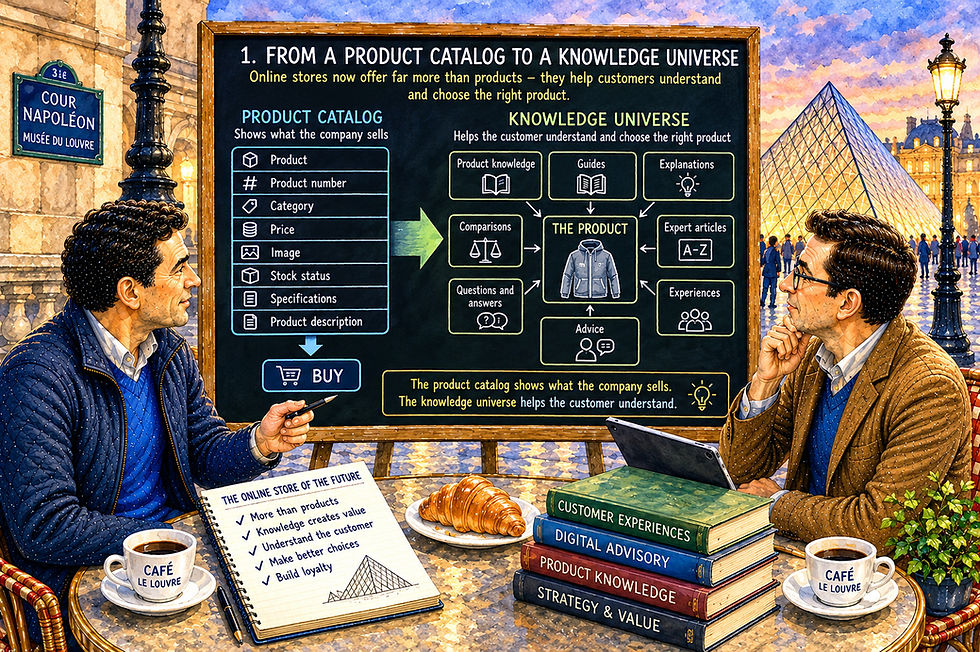
The online store of the future should not only show what the business sells – it should make knowledge about the products available.
The traditional product catalog has a simple and important task.
It shows what the business sells.
Product.
Product number.
Category.
Price.
Picture.
Stock status.
Some specifications.
A product description.
And a button:
Buy.
This has been the foundation of online shopping for decades.
And the product catalog is not disappearing.
We still need structured product data.
We need categories.
We need prices.
We need stock status.
We need product photos.
We need technical specifications.
But throughout this part of the KI series, we have seen that the customer
need something more.
The customer needs to understand.
What is this product?
What can it be used for?
Does it suit my needs?
What is the difference between the options?
What qualities are important to me?
What should I be aware of?
Why does this product cost more than the other?
What do I really need?
And sometimes:
Should I buy this product at all?
When the online store starts answering such questions, something interesting happens.
It ceases to be just a digital product catalog.
Around the products, the following is growing:
product knowledge,
guides,
explanations,
comparisons,
technical terms,
customer questions,
experiences,
consulting,
and connections between knowledge.
The online store is beginning to develop into a universe of knowledge .
Artificial intelligence makes this development even more interesting.
Because when knowledge is documented, structured, quality assured and connected, it can be used in new ways.
AI can help employees find it.
Process it.
Improve it.
Make it available.
And in some contexts use it to help the customer through
a dialogue.
But then we first need to have something AI can work with.
Therefore, the intelligent online store of the future may not start with artificial intelligence.
It begins with knowledge .

Magne & the Friend
Magne
Friend...
Now we have created a fairly large online store.
The buddy
How many products do we have?
Magne
That's not what I meant.
The buddy
What do you mean then?
Magne
We started with products.
Then came product data.
Product descriptions.
Guides.
Comparisons.
Technical terms.
Customer questions.
Decision support.
And now we even have a digital customer advisor.
The buddy
It's starting to get crowded in the store.
Magne
Heh heh.
But the interesting thing is that we haven't really filled it with more products.
The buddy
What have we filled it with?
Magne
Knowledge.
The product is still the focus
The buddy
Does that mean the product catalog is outdated?
Magne
No.
The buddy
Abrupt.
Because without products we get a pretty strange online store.
Magne
Heh heh.
The product catalog is still the foundation.
But earlier we might have thought:
Product → product page → purchase.
The buddy
And now?
Magne
Now I see more:
Need → understanding → knowledge → alternatives → assessment → product → decision.
The buddy
The customer has then taken on a completely different role in the model.
Magne
Yes.
We don't just organize the online store around what the business wants to sell.
We organize knowledge around what the customer is trying to solve .
A product catalog organizes items
Magne
What is the difference between the product catalog and
the universe of knowledge?
The buddy
The product catalog primarily answers:
What do we have?
Magne
While the universe of knowledge also answers:
What do you need to know?
The buddy
Yes.
And:
What are you trying to do?
What fits your situation?
What is the difference between the options?
What should you consider before you decide?
Magne
Then we move from organizing products...
The buddy
...to organize knowledge around customer needs.
The knowledge already exists in many places
Magne
But this sounds like a huge content project.
The buddy
Not necessarily.
Much of the knowledge may already exist.
Magne
Where?
The buddy
In the minds of the employees.
In customer service.
In the supplier documentation.
In the product database.
In emails.
In the return reasons.
In existing guides.
In the questions customers ask.
In the experiences from the store.
Magne
So the problem is not always that the business lacks knowledge.
The buddy
No.
The problem may be that the knowledge is scattered, silent or difficult to find .
Then we must make the invisible knowledge visible
Magne
There, The Invisible Capital reappears.
The buddy
It does.
Think about the employee who has been selling hiking equipment for fifteen years.
Magne
She may know more about which products suit different customers than what is stated on any product page.
The buddy
Exactly.
If that knowledge only exists in her head, it is very valuable...
but difficult to scale digitally.
Magne
If we document it?
The buddy
Then it can be used in:
product descriptions,
buying guides,
FAQs,
comparisons,
training,
customer service,
and digital customer advisors.
Magne
Then we make human knowledge available to more people.
The buddy
And AI can help us with parts of the work.
But we shouldn't produce content for the sake of content.
Magne
We have to be careful here.
The buddy
For what?
Magne
AI can make it very easy to create huge amounts of text.
The buddy
Yes.
Magne
So we could end up with 20,000 articles that no one needs.
The buddy
It would not be a universe of knowledge.
Magne
What would it be?
The buddy
A content repository.
Magne
Good separation.
The buddy
A universe of knowledge is not built by maximizing the number of pages.
It is built by making relevant knowledge available when people need it .
Everything must fit together.
Magne
Then we come back to internal links and topic clusters.
The buddy
Yes.
A product guide should be able to lead the customer to relevant products.
Magne
The product page may lead to a guide.
The buddy
A technical term can be explained on a separate page.
Magne
A comparison can link multiple products.
The buddy
An FAQ can point you to a more thorough explanation.
Magne
So knowledge should not lie like isolated islands.
The buddy
No.
The connections between content are part of the knowledge structure.

The customer should be able to enter from anywhere
Magne
Previously, we might have thought that the customer came in on the front page.
The buddy
Many don't.
Magne
They can come directly from Google to a guide.
The buddy
Or to a product page.
Magne
From social media to an article.
The buddy
From an AI answer to a relevant resource.
Magne
Or straight into a conversation with a digital advisor.
The buddy
Therefore, the universe of knowledge must function from many inputs.
Each relevant page should help the customer understand:
Where am I?
What can I learn here?
Where do I go next?
AI changes the access to knowledge
Magne
I think this is one of the biggest changes.
Before, the customer had to understand the website.
The buddy
Explain.
Magne
She had to choose the right category.
Use the right keywords.
Understand the filters.
Click forward.
The buddy
And with AI?
Magne
She can more easily start with her own problem.
"I'm going on my first mountain hike in September and need a light jacket that can withstand rain. What should I look for?"
The buddy
Then the conversation becomes a new entrance to the universe of knowledge.
Magne
And that may mean that information architecture itself will have a new task.
The buddy
Yes.
It will still help people navigate.
But it must also make the knowledge clear and accessible to the systems that will find, connect and use it.
The universe of knowledge must be maintained
Magne
Can't we just build all this and be done?
The buddy
You know the answer.
Magne
I tried.
The buddy
Products change.
Prices are subject to change.
Assortment changes.
Technology changes.
Customer questions change.
Knowledge is developed.
Magne
So the universe of knowledge is alive.
The buddy
That must be it.
Otherwise, today's universe of knowledge will become tomorrow's knowledge graveyard.
Magne
It was dramatic.
The buddy
But you remembered it.
Heh heh.
This is not just about the online store
Magne
Wait a minute.
Now I see something.
The buddy
What then?
Magne
Everything we've talked about doesn't just apply to e-commerce.
The buddy
No.
Magne
A business has knowledge about:
products,
services,
customers,
processes,
disciplines,
experiences,
problems,
and solutions.
The buddy
Yes.
Magne
If that knowledge is documented, structured and made available...
The buddy
...we have begun to move from the online store's knowledge universe to the business's knowledge universe .
Magne
There, I think you just opened the door to Part 8.
The buddy
I think so too.

Academic specialization
The product catalog is a structure for products
The product catalog is still a fundamental component of e-commerce.
It organizes, among other things:
products,
product identifiers,
categories,
attributes,
varieties,
prices,
stock status,
pictures,
and other product information.
This makes the products searchable, filterable and manageable.
A good product catalog is therefore not something we should replace.
It is one of the building blocks of the universe of knowledge .
The difference is that a knowledge universe adds multiple layers around the product data.
From product data to product knowledge
A product can be described through data:
Weight: 320 grams.
It is a fact.
But the customer may need to understand the meaning:
The low weight makes the jacket suitable when low pack weight is important.
Next, the customer may need context:
If durability is more important than light weight, a stronger
model may be a better option.
We thus move through several levels:
data → information → explanation → context → knowledge → decision support.
This is one of the most important shifts from product catalog to knowledge universe.
The knowledge universe is also organized around needs
A traditional catalog is often organized based on the business's product range.
For example:
Clothing → jackets → shell jackets.
This is still useful.
But the customer may think differently:
"I need clothes for a rainy mountain hike."
A knowledge universe can therefore build connections between the product structure and the customer's:
need,
tasks,
problems,
situations,
question,
and decisions.
This gives the website more ways to organize knowledge.
Taxonomies create order
As the body of knowledge grows, consistent concepts become more important.
A taxonomy organizes information through defined categories and relationships.
In e-commerce, this may include:
product categories,
properties,
applications,
target groups,
materials,
technologies,
and other relevant classifications.
A good taxonomy makes knowledge more consistent and easier to find and reuse.
This is important for both people and digital systems.
Ontologies can describe the relationships
In more advanced knowledge systems, it can be useful to describe not only which concepts exist, but how they are related .
For example, an ontology can express relationships such as:
product A belongs to category B,
product A fits activity C,
product A is compatible with product D,
Property E is relevant to need F.
This can make the knowledge structure more explicit and machine-usable.
Not all small businesses need to build formal ontologies.
But the principle is important:
The relationships between the knowledge elements have value.
Internal links are also knowledge connections
Internal links are often mentioned in connection with SEO.
But in a universe of knowledge they have a broader function.
An internal link can express a meaningful connection between:
a product and a guide,
a guide and a technical term,
a question and an answer,
two related topics,
or an explanation and an action.
Internal links thus help people navigate and
At the same time, it helps to make the website's structure visible.
Knowledge management is becoming more important
As businesses build increasingly more digital knowledge, new questions arise.
Who owns the information?
Who can change it?
What is the authoritative source?
When was it last checked?
How do we detect outdated information?
What happens when products disappear?
How do we deal with conflicting information?
These are questions about knowledge management and content management .
AI does not make these questions any less important.
When knowledge can be reused and distributed more quickly, the consequences of bad information can also scale more quickly.
AI can become a new interface to the universe of knowledge
Traditionally, the customer encounters knowledge through:
menus,
categories,
search,
filters,
product pages,
and guides.
Generative AI opens up a new interface:
the conversation.
The customer can describe the situation using natural language.
The system can attempt to find relevant parts of the knowledge base and present them in a form that suits the question.
This doesn't mean that menus, search, or product pages are disappearing.
But dialogue can become one of several entrances to the same knowledge .
The knowledge universe can support more than just the customer
The same knowledge structure can also be used internally.
A new employee can find product explanations.
Customer service can find quality-assured answers.
The marketing department can reuse professional content.
Buyers can compare product features.
AI assistants can access approved knowledge sources.
Thus, investment in knowledge structure can create value across the business.
From content production to knowledge management
Generative AI makes it very easy to produce text.
Therefore, the actual text production may be reduced by a scarce resource.
What becomes more important is:
What do we know?
Is that correct?
Where does knowledge come from?
How does it fit together?
Who needs it?
When does it need to be updated?
How do we make it available?
This involves a shift from thinking primarily about content production to also thinking about knowledge management .
The universe of knowledge is never really finished.
A living universe of knowledge develops through use.
New customer questions arise.
New products are launched.
Old products disappear.
New professional terms are established.
Employees gain new experiences.
Error detected.
Knowledge is improved.
Thus, a continuous process occurs:
knowledge → use → experience → insight → improved knowledge.
This makes the knowledge universe something more than a library.
It becomes a learning system .
From product catalog to knowledge universe
The product catalog is not going away – but it is becoming part of something bigger.
Product catalog | Knowledge universe |
Organizing products | Organizes products, needs and knowledge |
The product is the main input | The customer can start with a product, question or need |
Presenting properties | Explains what the properties mean |
Showing options | Helps the customer understand the differences |
Categories and filters | Categories, themes, guides, dialogue and connections |
Product data | Product data + expertise + context |
Product search | Search + navigation + natural language |
Information per product page | Knowledge connects across pages and formats |
Primarily aimed at the purchase | Supports understanding, decision, purchase and use |
Updated when the product changes | Continuously developed through new knowledge and insight |
How the universe of knowledge is built
The teams we've built through Part 7
Layer | What does it add? |
Product | What the business offers |
Product data | Facts and structured properties |
Product information | Describes and presents the product |
Product knowledge | Explains meaning, use and relevance |
Customer Insights | Shows what needs and questions customers have |
Guides and subject content | Provides immersion and coherence |
Comparison | Make differences understandable |
Decision support | Helps the customer make the right choice |
AI assistant | Helps employees process and use knowledge |
Digital customer advisor | Make knowledge available through dialogue |
Feedback loop | Uses experiences to improve knowledge |
From knowledge to learning system
When connections start working together
What's going on? | What does the business learn? | What can be improved? |
The customer is looking for | What words and needs does the customer express? | Terminology and search |
Customer reads guides | What topics are important? | Content and structure |
The customer compares | Which products and features are considered | Basis of comparison |
The customer asks | What is not explained well enough | Product knowledge |
The customer buys | Which needs lead to choice | Consulting |
The customer contacts customer service. | Where knowledge is lacking | FAQ and product information |
Customer returns | Where expectations and reality may diverge | Descriptions and decision support |
The employee learns | New practical expertise emerges | The knowledge base |
AI finds knowledge gaps | Where the structure or documentation is weak | Data quality and content |
Knowledge improves | The entire system gets a better foundation | Next customer experience |
Technical terms
Key concepts when developing the product catalog into a universe of knowledge
English technical term | Explanation |
Product Catalog | Structured collection of the company's products and key product data. |
Knowledge Ecosystem / Knowledge Environment | A coherent environment of information, expertise, relationships and tools that make knowledge accessible and usable. |
Knowledge Base | Documented and organized knowledge that people or digital systems can use. |
Knowledge Management | Systematic work to develop, document, organize, share and maintain knowledge. |
Taxonomy | A structure that organizes concepts or objects into defined categories and hierarchies. |
Ontology | A formal description of concepts, properties and relationships within a field of knowledge. |
Knowledge Graph | A structure that represents entities and the relationships between them so that relationships can be processed mechanically. |
Metadata | Structured information that describes other content or data and makes it easier to organize, find, and use. |
Content Governance | Roles, rules and processes that ensure quality, accountability, consistency and maintenance of content. |
Knowledge Architecture | The structure that determines how knowledge is organized, connected, found and used. |
Information Retrieval / Knowledge Retrieval | The process of finding relevant information or knowledge from a larger information base. |
Learning System | A system where experiences and feedback are used for continuous improvement. |
Tacit Knowledge | Experience-based knowledge that people possess, but which is not necessarily documented. |
Explicit Knowledge | Knowledge that is expressed and documented so that it can be shared and reused. |
Part 7 – What have we really learned?
Magne
Friend...
Now I think we should stop for a moment.
The buddy
I think so too.
Magne
Because this time we won't end with the fact that we've only just begun.
The buddy
No.
We've actually done quite a lot.
Magne
We began Part 7 with a simple question:
What does an online store actually sell?
The buddy
And pretty quickly we discovered that the answer was more complicated than "products."
Magne
We asked:
Content or product – what is the customer buying?
The buddy
And then we investigated why the product description has become more important.
Magne
How the product information helps the customer make a decision.
The buddy
How AI can become the store's new work tool.
Magne
How we can build digital customer advisors.
The buddy
And now we've ended up here.
From product catalog...
Magne
...to the universe of knowledge.
The buddy
Do you see the common thread?
Magne
Yes.
And it's not really primarily about AI.
The buddy
What is it about?
Magne
People and knowledge.
Products have value because they solve something for people.
Product information has value when it helps people understand.
The experience of employees has value when it can be used to help the customer.
And AI has value when it makes this knowledge easier to develop, find, use and share.
The buddy
There you collected quite a lot of our series.
Magne
But now a bigger question arises.
The buddy
Yes.
Because we have used the online store as a laboratory.
Magne
But what we've learned doesn't stop at the shopping cart.
The buddy
No.
Because what happens when the same mechanisms begin to characterize the entire business?
When will all employees have access to AI?
When customers expect answers in a different way?
When knowledge can be found and processed in seconds?
When competitors use the same tools?
Magne
And when is it no longer special to have AI ?
The buddy
Then what becomes crucial is what the business actually does with it.
Magne
Then Part 7 is finished.
The buddy
Yes.
And now we raise our gaze.
From the online store to the business.
From product information to knowledge.
From single tools to organization.
From today's competition...
until tomorrow.
Magne
And with that, we are ready for Part 8 – The Digital Business of the Future .
The buddy
And this time we start with perhaps the biggest AI question of them all:
What happens when everyone uses artificial intelligence?
Magne
Because if everyone has access to the same technology...
The buddy
...it is no longer access to AI alone that makes the difference.
Magne
Then the difference must lie elsewhere.
The buddy
And that's where the final part of our journey begins.
Academic background and further reading
This series also builds on my own professional journey through the Web Design study , the eMarketing study , Innovation and Commercialization and professional seminars in San Francisco and Oxford . Here you will find the background, professional environments and experiences that have followed the development from the early years of the web to today's digitalization.


Recommended literature
Developments in artificial intelligence are moving faster than perhaps any other field of study in our time. No single book can provide all the answers, but good books can provide a solid foundation for understanding the technology, the opportunities, and the challenges.
In the KI-Kompis series, we therefore recommend a selection of books that illuminate artificial intelligence from different perspectives – technology, strategy, management, innovation, ethics, digitalization and practical application. Together, they provide a broader understanding of how artificial intelligence affects people, businesses and society.
Click on the book icon to see the full literature overview with recommended books on artificial intelligence.
Recommended books from our library

Build a Large Language Model (From Scratch)
Author: Sebastian Raschka
Short review
This book takes the reader behind the scenes and shows how a modern language model is actually built – step by step. Sebastian Raschka explains advanced concepts in an educational way and provides a unique understanding of how large language models like ChatGPT work. Although the book contains code examples, it is also very valuable for anyone who wants a deeper understanding of the technology behind artificial intelligence.
Why we recommend the book
One of the most talked about books on large language models. Perfect for those who want to understand how artificial intelligence works beneath the surface and why language models have become a revolution in digitalization and knowledge sharing.

Quick Start Guide to Large Language Models
Author: Janelle Shane
Short review
This book provides a practical and easy-to-understand introduction to large language models (LLMs). Sinan Ozdemir explains how language models are used in modern businesses, how they can be integrated into work processes, and why they have become one of the most important technologies in artificial intelligence.
Why we recommend the book
A very good book for anyone who wants a quick and practical introduction to language models. It is suitable for both beginners and professionals who want to understand how LLMs are used in practice.

Artificial Intelligence: A Modern Approach: The Future Is Coming! Discover How Artificial Intelligence Will Change Your Life!
Authors: Stuart Russell & Peter Norvig
Short review
This is the world's most famous textbook on artificial intelligence and is used in universities worldwide. The book covers the entire subject area – from problem solving and machine learning to language understanding, robotics and ethics – and is considered a classic in the AI field.
Why we recommend the book
If you are only going to own one academic book on artificial intelligence, this is one of the very best choices. A timeless classic that provides a solid academic understanding of artificial intelligence and is still used as a syllabus at leading universities around the world.

© 2025 - 2026 Portico Publish | The invisible capital Privacy and use of the website | Developed and operated by Magne Bjella | Powered and secured by Wix


Comments