
Part 10 - AI-Companion... how do I find the questions customers actually ask?

A great website rarely starts with an answer. It starts with a question. But how do you find out what your customers are actually wondering about? Is guessing enough, or are there smarter ways to listen? In this article, we take a closer look at why the best websites are built around real questions – and how these very questions can become your business’s most important competitive advantage.

Magne & the Friend
Magne
Friend...
Now we've talked a lot about helping people.
We have said that we will answer questions.
But...
How do I actually find these questions?
The buddy
The first answer may be a bit surprising.
You don't start with artificial intelligence.
You start with your customers.
Magne
So...
I don't need an advanced analysis tool?
The buddy
No.
Start by listening.
What do customers ask on the phone?
What are they emailing about?
What do they ask about in the store?
What do they ask about on Facebook or LinkedIn?
What do they spend time on in meetings?
What misunderstandings persist?
This is often where the best articles are born.

Magne
It reminds me of my time in Bærum municipality.
We had thousands of inquiries.
It was essentially a huge knowledge bank.
The buddy
Yes.
And that's a good example.
Each inquiry represents an information need.
If many people are asking the same question, it's often a sign that the website should provide a better answer.
Magne
So...
Is customer service really also a content editor?
The buddy
Hehe...
Yes.
Perhaps one of the most important.
Those who talk to customers every day often know what questions come up.
If this knowledge is included in the content work, the website becomes far more useful.
Magne
So it's really about listening before we write?
The buddy
Just.
The best articles don't start with:
"What do we want to tell?"
They start with:
“What does the customer need help with right now?”

Magne
Then I begin to understand why we keep talking about people.
The buddy
Yes.
Because artificial intelligence does not change the customer.
It changes how the customer finds answers.
And therefore it becomes even more important to understand the questions the customer asks.
Academic specialization
Here we can explain that questions can be retrieved from many places:
customer service
email
chat
search on your own website
search in Google Search Console
sales meetings
course
lecture
social media
reviews
frequently asked questions
We show that the business already has a large amount of knowledge – if it manages to collect it.
Where do we find customer questions?
Source | What can we learn? |
Customer service | The most common questions and challenges. |
What information are customers missing? | |
Phone calls | How customers express themselves in their own words. |
Chat | Questions that require quick and clear answers. |
Search your own website | What visitors are trying to find. |
Google Search Console | What searches lead users to the website. |
Sales meetings | What questions need to be answered before the customer makes a decision. |
Social media | What topics engage and create discussion. |
Courses and lectures | What questions do participants ask when they want to learn more? |
Reviews and feedback | What customers appreciate – and what they miss. |
New terms in this article
English technical term | Short explanation |
Information Need | What the user wants to find answers to in order to solve a problem or make a decision. |
User Questions | Questions that users or customers ask before, during, or after a service or purchase. |
Customer Insight | Knowledge of customers' needs, challenges, motivation and expectations. |
User Insight | Insight into how people search, think and use information. |
Customer Journey | The entire process from a need arising until the customer finds a solution. |
Search Intent | What the user really wants to achieve with a search. |
Question Analysis | The work of collecting, sorting and understanding questions from users and customers. |
Frequently Asked Questions (FAQ) | A collection of the most common questions and answers about a topic or service. |
Customer Dialogue | The conversation between the business and the customer through various channels. |
Insight Work | Systematic work to collect and use knowledge about user needs. |
We have only just begun.
Magne
Friend...
Now we have found the questions.
But how do we know which ones to answer first?
The buddy
Hehe...
That's where the editorial work begins.
Because all questions are important.
But some questions help many more people than others.
And that's exactly where we're going to continue next time.
Academic background and further reading
This series also builds on my own professional journey through the Web Design study , the eMarketing study , Innovation and Commercialization and professional seminars in San Francisco and Oxford . Here you will find the background, professional environments and experiences that have followed the development from the early years of the web to today's digitalization.


Recommended books from our library

Content Strategy for the Web (2nd Edition)
Author/authors: Kristina Halvorson and Melissa Rach
Short review
How do you create content that actually helps people – and at the same time supports your business goals? Content Strategy for the Web is considered one of the most influential books in the field of content strategy and digital communications. The book shows how good content does not arise by chance, but through a deliberate strategy where user needs, the organization's goals, structure, work processes and management are closely linked.
The authors take the reader through the entire process – from planning and organizing to publishing, managing and continuously improving content on websites and digital services. Although technology has evolved since the book was published, the principles of quality, relevance, management and long-term content work are at least as relevant in an era where search engines and artificial intelligence assess the credibility and usefulness of content.
Why we recommend the book
At The Invisible Capital, we believe that good content is one of the most important forms of invisible value creation. A website is far more than design and technology – it is the content that builds trust, creates great customer experiences and helps people find the answers they are looking for.
This book is perfect for leaders, communications consultants, content producers, web editors, UX designers, and anyone working with digital services. It shows why a clear content strategy leads to better user experiences, more effective interactions, and stronger digital results over time.
In an era where artificial intelligence is increasingly important in how information is discovered, understood, and communicated, this book is more relevant than ever. It reminds us that technology alone never creates value – it is good, structured, and relevant content that makes the difference.

Don't Make Me ThinkAuthor: Steve Krug
Short review
Don't Make Me Think is one of the world's most influential books on usability and web design. Since its first edition in 2000, the book has helped designers, developers, content producers, and managers understand a simple but powerful principle: Good digital services should be intuitive. The user should be able to complete their task without having to stop and think about how the website works.
Why we recommend the book
This is one of the books that has had the greatest impact on my own work with digital services. Over the years – from SAS and the Norwegian Opera & Ballet to working on Bærum Municipality’s website – the principles in this book have been an important reminder that technology is never an end in itself. The goal is to make everyday life easier for the people who use the services. Despite the fact that the book was published many years ago, the message is just as relevant today.
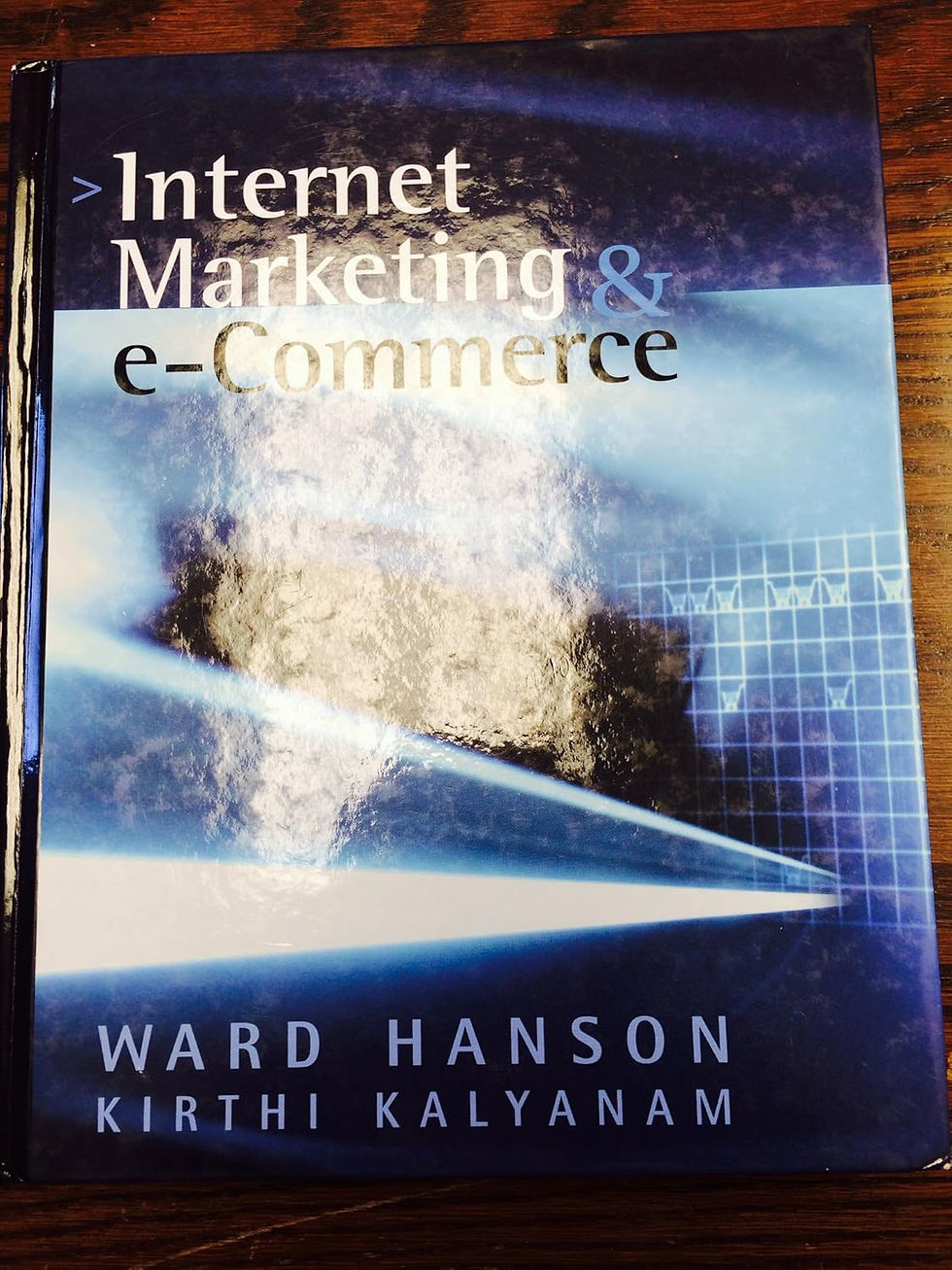
Internet Marketing & eCommerce
Authors: Ward Hanson and Kirthi Kalyanam
Short review
Internet Marketing & eCommerce provides a thorough introduction to how the internet has changed marketing, commerce, and business development. The book combines theory and practical examples in digital marketing, e-commerce, customer behavior, value creation, and digital business models. Although written at a time when the internet was still in its infancy, many of the fundamental principles are still highly relevant.
Why we recommend the book
This book was an important part of my own learning journey in digital marketing and e-commerce. It helped build my understanding of how technology, customer experiences and business strategy are interconnected – an insight that later became very important in my work with SAS, the Norwegian Opera & Ballet, Bærum Municipality and eventually the project The Invisible Capital. Many of the ideas about customer value, digitalization and innovation presented on the website have their roots in the knowledge this book conveys.

The Innovator's Dilemma: When New
Technologies Cause Great Firms to Fail
Author: Clayton M. Christensen
Short review
The Innovator's Dilemma is one of the most influential books on innovation and technological change. Clayton Christensen introduces the concept of "disruptive innovation" and shows how even the most successful businesses can fail when new technologies and business models change the market. Through a series of examples, he explains why established companies often have difficulty adapting to radical change - even when they do "everything right."
Why we recommend the book
This book has had a major impact on how I view innovation, digitalization, and change management. It provided a new perspective on why established businesses are challenged by new players, and why the ability to think differently is crucial in a world characterized by continuous technological development. Many of the reflections in The Invisible Capital on innovation, digital transformation, and value creation are based on the insights Clayton Christensen conveys in this classic.

Mastering AI: A Survival Guide to Our Superpowered Future
Authors: Jeremy Kahn
Short review
Mastering AI takes the reader behind the scenes of the companies and researchers shaping the modern AI revolution. Jeremy Kahn explains how artificial intelligence is developed, the technological breakthroughs that have made today's language models possible, and how AI is impacting business, politics, and society.
Why we recommend the book
A highly relevant book that combines technology, business, and societal development. Perfect for leaders, decision-makers, and anyone who wants to understand where artificial intelligence is headed.

AI Needs You
Author: Verity Harding
Short review
AI Needs You is about why artificial intelligence is not just a technological issue, but also a question of democracy, ethics and social development. Verity Harding argues that the AI of the future must be developed in collaboration with people, governments and business.
Why we recommend the book
An important book for anyone who wants to understand how artificial intelligence affects society and why responsible development will be crucial in the years to come.

The Worlds I See
Author: Fei-Fei Li
Short review
The Worlds I See is the personal story of Fei-Fei Li, one of the world's most influential AI researchers. The book combines autobiography with the history of the development of modern artificial intelligence, showing how research, technology, and human values are closely intertwined.
Why we recommend the book
An inspiring book that provides a unique insight into the development of artificial intelligence through the eyes of one of the field's most central researchers.

© 2025 - 2026 Portico Publish | The invisible capital Privacy and use of the website | Developed and operated by Magne Bjella | Powered and secured by Wix


Comments