
Part 45 - AI Buddy... how do I write content that both humans and artificial intelligence understand?

For years, we have learned to write for people. Then many learned to write for search engines. Now we are facing a new reality where artificial intelligence also reads, interprets and uses our content. Does this mean we have to write in a completely new way? Or is it really about becoming even better at helping the people we want to reach?

Magne & the Friend
Magne
Friend...
I think I'm starting to see the connection.
You never said we should write for you.
You've been talking about people all along.
Why that?
The buddy
Because it's easy to get lost.
When new technology arrives, many people want to find a shortcut.
They ask:
"What do I have to write for artificial intelligence to choose me?"
But that question starts at the wrong end.
Magne
So...
What should we ask instead?
The buddy
Maybe this:
What does my customer need help with right now?
Because when content really helps people understand, learn, or solve a problem, it usually also becomes easier for artificial intelligence to understand what the page is about.
Magne
So...
You don't really reward technical tricks?

The buddy
No.
I'm trying to understand which pages actually provide value.
A page that thoroughly answers a question, explains concepts, shows examples, and builds on documented knowledge often has greater value than a page that simply repeats the same words many times.
Magne
It reminds me of something we said a long time ago.
We shouldn't write to get clicks.
We should write to create knowledge.
The buddy
And right there I think you're onto something important.
Artificial intelligence may not change the goal.
It makes the goal clearer.
It doesn't necessarily reward those who shout the loudest.
It benefits more from those who explain best.
Magne
So...
When we build The Invisible Capital, we're not really building a website.
We are building a reference book.
The buddy
Yes.
A living library of knowledge.
A place where every article helps the reader further.
Where concepts are explained.
Where experience is shared.
Where research is placed in a practical context.
And precisely such knowledge environments may become increasingly important in a world where artificial intelligence is used to find and disseminate information.

Magne
Then I begin to understand why we have spent so much time on our technical terms.
The buddy
Yes.
Because a technical term is not just a definition.
It is a building block in a larger universe of knowledge.
When concepts are interconnected, it becomes easier for both humans and artificial intelligence to understand the whole.
Academic specialization
Here we introduce the first principles of content in an AI world.
Not as rules.
But as working principles.

Our six principles
Write for people first.
Answer real questions.
Explain concepts – don't take them for granted.
Build knowledge step by step.
Documents when it matters.
Link the articles together into a universe of knowledge.
From traditional content to knowledge content
Traditional thinking | Knowledge-based thinking |
Write many articles | Building a universe of knowledge |
Hunting clicks | Solving problems |
Focus on keywords | Focus on questions |
Naked facts | Explanations and context |
One page at a time | The entire site is connected |
Traffic first | Trust first |
New terms in this article
English technical term | Short explanation |
Knowledge Ecosystem | A website where content, technical terms, and articles are connected and build knowledge over time. |
User Needs | What the user wants to get help with or learn more about. |
Question-Based Content | Content that is based on questions users actually ask. |
Topical Context | How different topics and articles build on each other. |
Content Strategy | The plan for how content is developed, organized, and maintained over time. |
Knowledge Sharing | To share experiences, insights and expertise so that others can learn. |
User Intent | What the user really wants to achieve with a search or question. |
Content Architecture | How content is organized and linked together on a website. |
Knowledge Website | A website whose main purpose is to disseminate knowledge and build understanding. |
Value-Driven Content | Content that primarily aims to help the user, not just attract attention. |
We have only just begun.
Magne
Friend...
Now I'm starting to understand how we should write.
But one question remains.
If everyone started writing good content...
How do we stand out then?
The buddy
Hehe...
There you ask perhaps the most important question of them all.
Because the winners of the future will not necessarily be those who publish the most.
But those who build the most trust over the longest period of time.
And that is exactly what we will explore further.
Academic background and further reading
This series also builds on my own professional journey through the Web Design study , the eMarketing study , Innovation and Commercialization and professional seminars in San Francisco and Oxford . Here you will find the background, professional environments and experiences that have followed the development from the early years of the web to today's digitalization.


Recommended books from our library

Author: Mustafa Suleyman
Short review
The Coming Wave explores how artificial intelligence and other breakthrough technologies will transform work, business, and society in the coming decades. Mustafa Suleyman, one of the founders of DeepMind, combines his own experiences from AI development with analyses of the technology's opportunities, risks, and significance for the future.
Why we recommend the book
One of the most important books on the future of artificial intelligence, the book provides a unique insight into how AI will impact people, businesses and society – and why responsible technology development is becoming increasingly important.

Rebooting AI
Short review
Rebooting AI challenges many of the myths surrounding artificial intelligence. The authors explain what today's AI can actually do, where its limitations lie, and why human judgment is still crucial. The book bridges the gap between research, technology, and practical application.
Why we recommend the book
A thought-provoking book that provides a balanced perspective on artificial intelligence. Perfect for those who want to understand both the strengths and weaknesses of today's language models and AI systems.
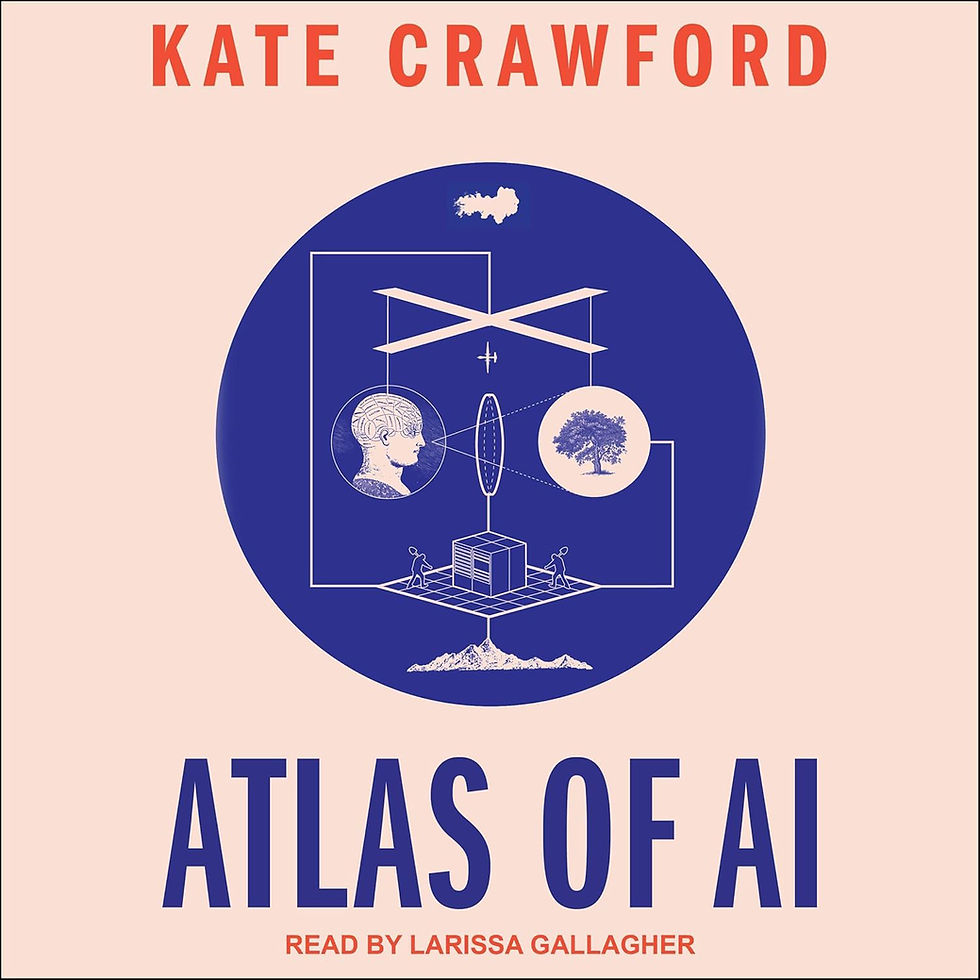
Author: Kate Crawford
Short review
Atlas of AI shows that artificial intelligence is about much more than algorithms and technology. Kate Crawford explores how data, energy, people, politics, and economics are connected to the development of artificial intelligence. The book places AI in a broader societal perspective.
Why we recommend the book
An essential book for anyone who wants to understand how artificial intelligence is impacting society. It shows that AI is not just about technology – it is also about people, resources, power, knowledge and value creation.

© 2025 - 2026 Portico Publish | The invisible capital Privacy and use of the website | Developed and operated by Magne Bjella | Powered and secured by Wix


Comments