
Part 18 - AI Buddy... how do you know what a website is about?

When you visit a website, you see headlines, text, images, and menus. But how does an artificial intelligence figure out what the page is really about? Does it read everything from beginning to end, or are there little clues that help it along the way? In this article, we take a closer look at how a website describes itself – and why clear structure and good descriptions are becoming increasingly important.

Magne & the Friend
Magne
Friend...
When I meet someone for the first time, it doesn't take many seconds before I start to form an impression.
I see the face.
Hear the voice.
Listen to how the person presents themselves.
It's almost as if the brain is making a little summary.
Do you do something similar when you encounter a website?
The buddy
Yes...
In a way, I do.
But I look for different things than people do.
I'm trying to find clues that tell me what the page is about.
What is the main theme?
Who is the content written for?
What questions does the page try to answer?
How does this page fit in with the rest of the website?
The clearer these signals are, the easier it is to understand the content.

Magne
So you don't start by reading everything word for word?
The buddy
No.
Just like humans, I first try to get an overview.
Then I go deeper.
If a page is well structured, with clear headings and a logical structure, it becomes much easier to understand what it is really about.
Magne
It reminds me a bit of a newspaper.
I often read the headline first.
So the preamble.
And if the topic interests me, I read the rest.
The buddy
That's a very good comparison.
That's why headlines and introductions are so important.
They help people.
And they also help artificial intelligence understand the direction of the content.
Magne
So...
A good headline isn't just about grabbing attention, is it?
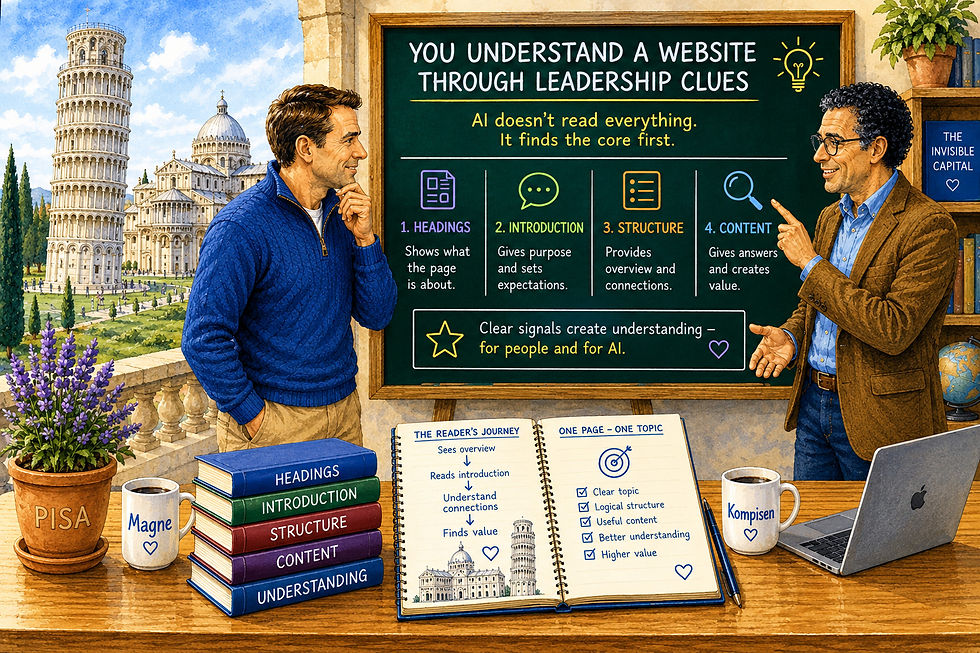
The buddy
No.
It is also about creating understanding.
A headline is a promise to the reader.
It tells what the article is about.
A good introduction builds on that promise.
The rest of the article fulfills that.
When these parts are well connected, the page becomes easier to understand – both for humans and for artificial intelligence.
Magne
This may mean that we humans have become better at thinking about how to capture attention...
...than on how we should build understanding?

The buddy
I think many websites have been more concerned with clicks than with knowledge.
But development is going in a different direction.
The better the content explains a topic, the greater the value it has – both for the reader and for artificial intelligence.
Academic specialization
Here we explain:
Why the title is important.
Why the preamble sets expectations.
Why one page should be about one clear topic.
Why logical structure makes content easier to understand.
Why this is the foundation for everything we will later learn about metadata and AI optimization.
We mention meta title and meta description, but we don't explain them yet. The reader should first understand why the page needs to describe itself clearly.
How does a website tell what it is about?
Element | Why it's important |
Title | Tells the main theme of the page. |
Intro | Summarizes the content and sets expectations. |
Headlines | Divides the content and creates structure. |
Body text | Explains the topic thoroughly. |
Pictures | Supports and illustrates the content. |
Links | Puts the content in a larger context. |
New terms in this article
English technical term | Short explanation |
Title | The main heading that describes what a page or article is about. |
Introduction or Lead | The introductory text that summarizes the content and arouses interest in the rest of the article. |
Body Text | The main content of an article where the topic is explained and elaborated upon. |
Heading | A heading that divides the content and makes the text easier to read and understand. |
Topic | The central topic or question the page is about. |
Structure | The logical structure of the content on a page. |
Context | How the different parts of the content are connected and build meaning. |
Internal Link | A link to another page on the same website that helps the reader further. |
Information Flow | How information is presented in a natural and logical order. |
User Intent | What the user really wants to find answers to when he or she visits a page. |
We have only just begun.
Magne
Friend...
Now I understand how a website tells what it is about.
But you've mentioned something several times that most people never see.
Metadata.
What exactly is that?
The buddy
Hehe...
Now we open the door to the engine room.
But don't worry.
We're not going to start with technical codes.
We will start by understanding why metadata exists, before looking at how it is used.
Academic background and further reading
This series also builds on my own professional journey through the Web Design study , the eMarketing study , Innovation and Commercialization and professional seminars in San Francisco and Oxford . Here you will find the background, professional environments and experiences that have followed the development from the early years of the web to today's digitalization.


Recommended books from our library

AI Engineering
Author: Chip Huyen
Short review
AI Engineering is one of the most relevant books on how artificial intelligence is developed and put into practice. Chip Huyen explains how language models, data, machine learning, and modern work processes can be combined to build robust AI solutions. The book provides both a strategic and practical perspective on how businesses can create value with artificial intelligence.
Why we recommend the book
This is a book for those who want to move from understanding artificial intelligence to understanding how it is actually developed, implemented, and creates value. One of the strongest books we have found on the practical use of artificial intelligence.
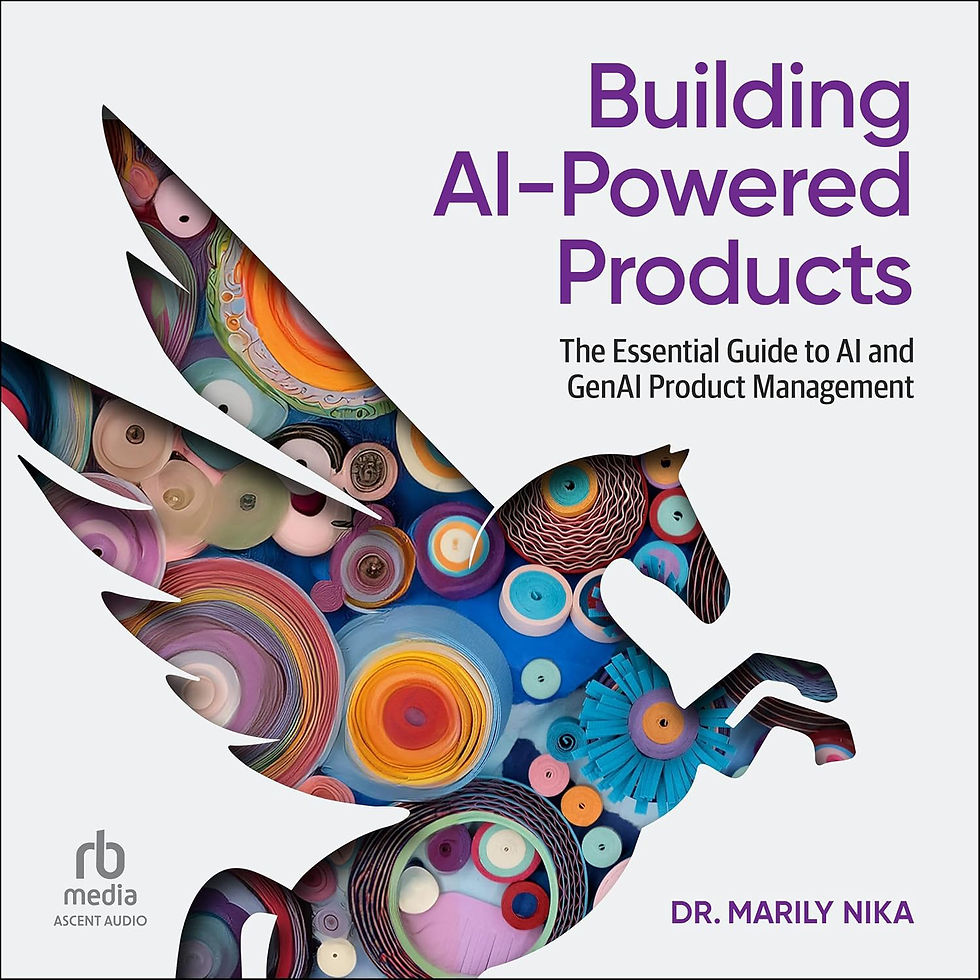
Building AI Powered Products
Author: Marily Nika
Short review
Building AI Powered Products shows how artificial intelligence can be used to develop smarter products, services, and digital customer experiences. Marily Nika combines technology, product development, and innovation in an easy-to-read book full of practical, real-world examples.
Why we recommend the book
A book that is perfect for anyone working with digitalization, innovation, product development and user experiences. It shows how artificial intelligence can be used to create products people actually want to use.

Prompt Engineering for Generative AI
Writers: James Phoenix and Mike Taylor
Short review
Prompt Engineering for Generative AI is a practical guide that teaches you how to communicate better with language models like ChatGPT, Claude, Gemini, and other generative AI tools. Through concrete examples, the authors show how good prompts produce more precise, creative, and useful responses.
Why we recommend the book
One of the most practical books on prompt engineering. Perfect for anyone who wants to work more effectively with artificial intelligence and get significantly better results through smarter questions and clearer instructions.

© 2025 - 2026 Portico Publish | The invisible capital Privacy and use of the website | Developed and operated by Magne Bjella | Powered and secured by Wix


Comments