
Part 40 - AI Buddy...How does knowledge become a competitive advantage?

Knowledge is the only resource that becomes more valuable the more it is shared.
We live in an era where technology, products and services can be copied faster than ever before. What gives a business an edge today may be available to everyone tomorrow. Yet there is one resource that is far more difficult to copy than buildings, machines and technology. That resource is knowledge.
Companies that manage to develop, share and use knowledge better than their competitors build a competitive advantage that often lasts much longer than new products or marketing campaigns. In this article, we take a closer look at why knowledge has become one of the most important resources in modern value creation – and how artificial intelligence can help make it even more valuable.

Magne & the Friend
Magne
Friend...
We have talked a lot about knowledge.
But there's one thing I've never quite understood.
Why do so many people say that knowledge is a competitive advantage?
The buddy
Because knowledge is the only resource that grows when shared.
Machines get worn out.
Buildings get old.
Technology can be copied.
But people who learn...
can constantly create new values.
Magne
So...
Isn't it really the technology that makes a business better than its competitors?
The buddy
No.
Technology is a tool.
Two businesses can buy the exact same technology.
What distinguishes them is how people use it.

Magne
It reminds me of when the internet came along.
Anyone could create websites.
But some created entirely new businesses.
Others did almost nothing.
The buddy
Exactly.
The difference was not in the technology.
It lay in how people understood the possibilities.
And how they translated knowledge into action.
Magne
So...
Knowledge is only really valuable when it is used?

The buddy
Yes.
Information alone does not create value.
Value arises when people:
understands
parts
improves
and uses the knowledge to solve real problems.
Magne
Then I begin to understand the name of our website.
The invisible capital.
The buddy
Just.
The most valuable capital is often not in the accounts.
It exists in humans.
In the experiences.
In the culture.
In collaboration.
And in the ability to learn faster than the environment changes.

Magne
But where does artificial intelligence fit in?
The buddy
It makes knowledge easier to find.
Easier to structure.
Easier to share.
But it can never replace human judgment, experience and creativity.
Therefore, people become even more important.
No less.
Magne
So...
Artificial intelligence actually makes knowledge more accessible.
But there are still people who make it valuable.
The buddy
That is perhaps the most important insight of all.

Academic specialization
Why has knowledge become the most important competitive factor?
Throughout much of industrial society, competitive advantage was tied to physical resources. Factories, machinery, capital, and access to raw materials often determined who succeeded.
In the knowledge economy, the picture is different.
Businesses increasingly compete on the ability to develop, share and use knowledge. It's about learning faster, understanding customers better, continuously improving work processes and turning insights into innovation.
Scholars such as Peter Drucker, Ikujiro Nonaka, Thomas Davenport, Laurence Prusak, Peter Senge, Michael Porter, Jay Barney and David Teece have all shown, from different perspectives, how knowledge can become a strategic asset. What they all have in common is the recognition that lasting competitive advantage is rarely created by technology alone. It arises when people develop expertise, share experiences and build a culture of continuous learning.
Artificial intelligence makes this development even more relevant. The technology can analyze large amounts of information in seconds, but the value only arises when humans interpret the insights, put them into context, and use them to create better products, services, and decisions.
That is why knowledge is not just information.
It is the business's most important invisible capital.
What creates lasting competitive advantage?
Resource | Can it be copied? | Creates lasting competitive advantage? |
Buildings | Yes | To a small extent |
Machines | Yes | To a small extent |
Technology | Yes | Often only temporary |
Products | Yes | Over time, they can be copied |
Competence | Difficult | Yes |
Experience | Very difficult | Yes |
Culture | Very difficult | Yes |
Knowledge | Very difficult | Yes – if it is continuously developed and shared |
From knowledge to competitive advantage
Steps | What's going on? | Result |
Information | The business collects facts and data. | Overview |
Knowledge | The information is understood and put into context. | Understanding |
Competence | Employees use the knowledge in practice. | Better quality |
Innovation | New knowledge leads to new solutions. | Competitiveness |
Value creation | Innovation creates value for customers, employees and society. | Lasting competitive advantages |
Technical terms
English technical term | Short explanation |
Competitive Advantage | A characteristic, resource or competence that allows a business to create greater value or achieve better results than its competitors over time. |
Knowledge Capital | The total value of the business's expertise, experience, insight and ability to develop and share knowledge. |
Intangible Capital | Non-physical values such as expertise, culture, trust, experience, relationships and innovative ability that create long-term value creation. |
Competence | The ability to use knowledge, skills and experience to solve tasks and create results. |
Knowledge Sharing | The process where people share experiences, insights and expertise so that the entire business learns and develops. |
Innovation | Development and implementation of new or improved products, services, processes or working methods that create value. |
Learning Organization | An organization that systematically develops, shares, and applies knowledge to improve itself over time. The term is particularly associated with Peter Senge. |
Value Creation | The process by which resources, knowledge and collaboration are converted into products, services, experiences or social benefits that create value for people and businesses. |
We have only just begun.
Magne
Friend...
The more we talk about knowledge...
the more I begin to understand why it is so valuable.
But I still wonder about one thing.
If knowledge is a competitive advantage...
Why do you talk so often about trust?
The buddy
Because knowledge alone does not create value.
It must be shared.
It must be used.
And it must be credible.
If no one trusts the business...
It doesn't matter how much knowledge one has.
Magne
So...
Isn't being good enough?
One must also be believed?
The buddy
Yes.
Trust is often the bridge between knowledge and value creation.
It is built over time.
Through actions.
Through quality.
By keeping your promises.
And through sharing knowledge that actually helps people.
Magne
Then I begin to understand.
Knowledge can provide a competitive advantage.
But trust determines whether people choose to use it.
The buddy
Exactly.
And that's why the next question becomes so important.
Why is trust more important than marketing budget?
That's exactly where we'll continue next time.
Academic background and further reading
This series also builds on my own professional journey through the Web Design study , the eMarketing study , Innovation and Commercialization and professional seminars in San Francisco and Oxford . Here you will find the background, professional environments and experiences that have followed the development from the early years of the web to today's digitalization.


Recommended books from our library
Knowledge is the most important capital we can build – and the only one that grows when it is shared.
That's why we end each article with recommended readings that can give you new perspectives, deeper insights, and a broader professional foundation. The books have been chosen because they have had a major impact on the development of artificial intelligence, digitalization, innovation, leadership, customer experiences, and knowledge management.
We hope they inspire you to continue your learning journey. With each book you read, the door opens to new questions, new ideas, and new understanding.
Good reading – we've only just begun.

AI Engineering
Author: Chip Huyen
Short review
AI Engineering is one of the most relevant books on how artificial intelligence is developed and put into practice. Chip Huyen explains how language models, data, machine learning, and modern work processes can be combined to build robust AI solutions. The book provides both a strategic and practical perspective on how businesses can create value with artificial intelligence.
Why we recommend the book
This is a book for those who want to move from understanding artificial intelligence to understanding how it is actually developed, implemented, and creates value. One of the strongest books we have found on the practical use of artificial intelligence.
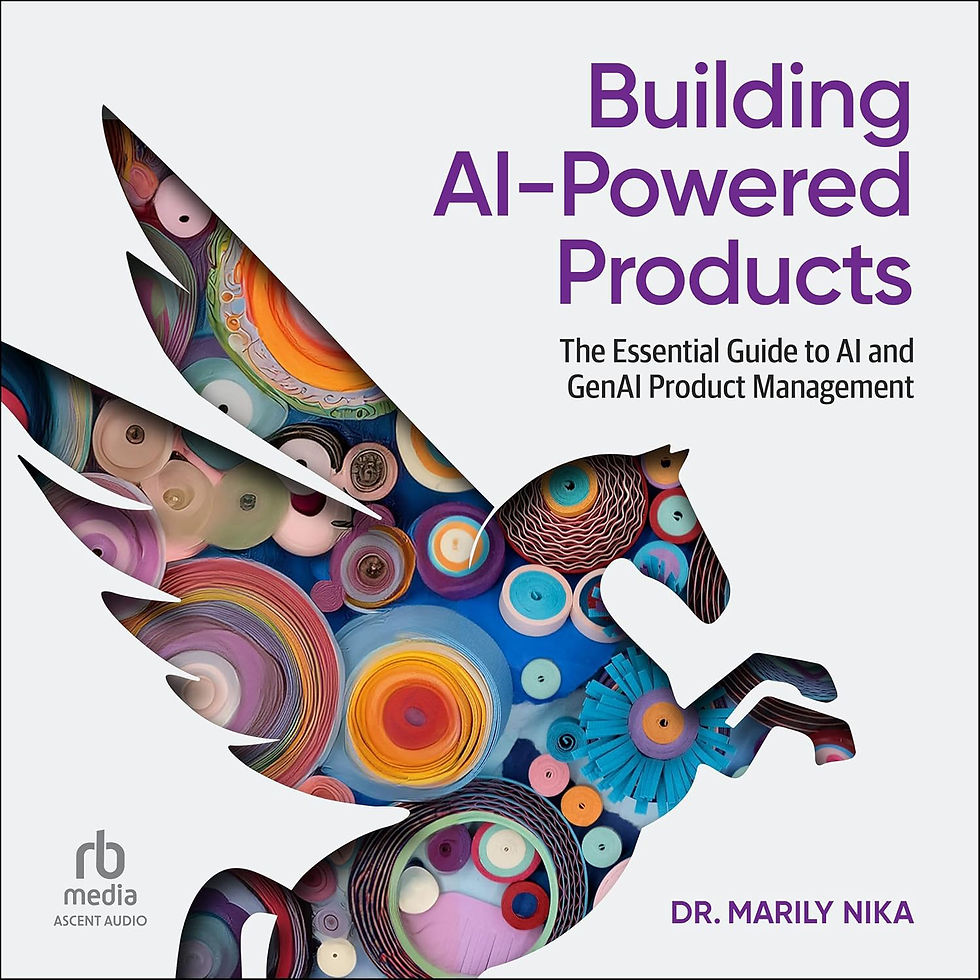
Building AI Powered Products
Author: Marily Nika
Short review
Building AI Powered Products shows how artificial intelligence can be used to develop smarter products, services, and digital customer experiences. Marily Nika combines technology, product development, and innovation in an easy-to-read book full of practical, real-world examples.
Why we recommend the book
A book that is perfect for anyone working with digitalization, innovation, product development and user experiences. It shows how artificial intelligence can be used to create products people actually want to use.

Prompt Engineering for Generative AI
Writers: James Phoenix and Mike Taylor
Short review
Prompt Engineering for Generative AI is a practical guide that teaches you how to communicate better with language models like ChatGPT, Claude, Gemini, and other generative AI tools. Through concrete examples, the authors show how good prompts produce more precise, creative, and useful responses.
Why we recommend the book
One of the most practical books on prompt engineering. Perfect for anyone who wants to work more effectively with artificial intelligence and get significantly better results through smarter questions and clearer instructions.

© 2025 - 2026 Portico Publish | The invisible capital Privacy and use of the website | Developed and operated by Magne Bjella | Powered and secured by Wix


Comments