
Part 56 - AI Buddy....How will artificial intelligence become the store's new employee?

AI can give businesses new hands and new capacity – but people still need to know what to do
Imagine a small online store.
Five employees.
A few hundred or maybe several thousand products.
Customers who send questions by email.
Product information to be updated.
New items to be published.
Pictures to be described.
Categories to be maintained.
Buying guides that should have been written.
Customer service to be answered.
The search that should have been better.
And an ever-growing need to keep the website up to date.
The list of tasks can be almost as long as at a large online store.
The difference is that the small business doesn't have fifty people to do the job.
This is where artificial intelligence gets interesting.
Not primarily because AI can replace humans.
But because AI can help people do more of what they are already trying to do .
It can help structure product information.
Create a first draft.
Summarize large amounts of information.
Identify missing information.
Suggest categorization.
Process customer inquiries.
Finding patterns.
Adapt existing knowledge to different formats.
And make knowledge more accessible.
Thus, we can start to think of AI as a kind of digital employee .
But the metaphor has an important limitation.
An AI is not a human.
It does not have the employee's experience, responsibility, judgment or
understanding of the business.
It can make mistakes.
It may misunderstand.
It can produce convincing information that is not correct.
And it doesn't automatically know what the business wants to achieve.
Therefore, the interesting AI journey is not about:
What can we entrust to AI?
The better question is:
How can humans and AI work together to make businesses better at helping customers?
For small and medium-sized businesses, this could be one of the most important opportunities that artificial intelligence creates.

Magne & the Friend
Magne
Friend...
Now I need help.
The buddy
That was nice.
What should we do?
Magne
We have 4,000 products in the online store.
The buddy
Okay.
Magne
1,200 product descriptions should have been improved.
The buddy
Ah, yes.
Magne
A few hundred products lack good attributes.
Customer service has a bunch of questions.
We should have made buying guides.
We should have analyzed the reasons for the return.
And then of course we should update all the old content.
The buddy
When do we start?
Magne
I thought you could take it.
The buddy
All?
Magne
You are artificial intelligence.
Heh heh.
AI can do a lot
The buddy
I can help with a lot of this.
Magne
Great.
Then I'll have coffee.
The buddy
Not so fast.
Magne
I knew it.
The buddy
Let's start with the product descriptions.
What do we know about the products?
Magne
We have supplier data.
The buddy
Are they correct?
Magne
Mostly.
The buddy
Are they complete?
Magne
Not always.
The buddy
Do we have the employees' experiences?
Magne
Something.
But a lot is probably in their heads.
The buddy
Then we have an important problem.
Magne
You lack knowledge.
The buddy
Yes.
I can help you process the knowledge you have.
But I can't guarantee that lack of knowledge will be correct just because the text sounds good.
First task: structure the product information
Magne
What could you have done first?
The buddy
For example, I could help look for patterns in product information.
Magne
Seam?
The buddy
Maybe some products use "weight", others "product weight" and some "net weight".
Magne
While it is actually the same property?
The buddy
Maybe.
But a human should check that we actually mean the same thing.
Magne
And when it is clarified?
The buddy
Then AI can help suggest a more consistent structure.
Magne
It doesn't sound as spectacular as a talking robot.
The buddy
No.
But good data quality is often more useful for the online store.

Second task: create a first draft
Magne
What about the product texts?
The buddy
That's where AI can save a lot of time.
Give me reliable product data, the target group, the area of application, the desired structure and the company's professional guidelines...
Magne
...and you can make a draft?
The buddy
Yes.
Magne
Which we publish directly?
The buddy
No.
Magne
You're hard to automate, buddy.
The buddy
Heh heh.
A human should check facts, relevance, language, and whether the text actually describes the product correctly.
Magne
So KI makes the first draft.
Humans make it our knowledge.
The buddy
It is a far safer division of labor.
Third task: find what is missing
Magne
Can you also find out what we haven't written?
The buddy
I can help identify possible knowledge gaps.
Magne
How?
The buddy
If fifty products in the same category have compatibility information and twenty don't, it might be worth investigating.
Magne
But you don't necessarily know if the twenty actually need compatibility information.
The buddy
Exactly.
I can find the pattern.
Man must consider the meaning.
Fourth task: learn from customer questions
Magne
What about customer service?
The buddy
That's where AI can be interesting.
Imagine hundreds of questions from customers.
Magne
No one has time to read them systematically.
The buddy
An AI solution can help group the questions.
Maybe many are about:
size,
delivery,
compatibility,
assembly,
or the difference between two models.
Magne
Then we can discover what the product pages don't explain well enough.
The buddy
Yes.
Customer service is not just a channel for solving problems.
It also becomes a source of knowledge development .
Fifth task: learn from the returns
Magne
We talked about returns in the previous article.
Can AI help there too?
The buddy
If the business has relevant and properly processed data, AI can help find patterns in textual return reasons and feedback.
Magne
For example?
The buddy
If many customers write:
"less than expected",
"didn't fit my model",
or
"I thought this feature was included"...
we might be able to detect recurring information problems.
Magne
And improve product information.
The buddy
There we get a feedback loop.
Customer → experience → insight → improved information → next customer.
Sixth task: turn one knowledge into multiple formats
Magne
This is where I think small businesses can really save time.
The buddy
Yes.
Imagine that a professional has created a thorough explanation of how the customer chooses the right bicycle helmet.
Magne
Then we can use the knowledge in a buying guide.
The buddy
And AI can help process the same quality-assured knowledge into:
a short FAQ,
product guide,
training materials,
a draft newsletter,
or other relevant formats.
Magne
So the professional doesn't have to start from scratch every time.
The buddy
Just.
AI can reduce some of the production work around knowledge .
But AI shouldn't invent the product
Magne
Let's take the important warning.
The buddy
Certainly.
Generative AI is designed to generate.
It is a strength.
And a risk.
Magne
Because you can write something that sounds right...
The buddy
...without it necessarily being right.
Magne
If you make up an adjective in a blog post, we can correct it.
If you find that a spare part fits a car model it doesn't...
The buddy
...the consequences could be far greater.
Magne
So the more important the facts are to the customer's decision, the stricter the control should be.
The buddy
Yes.
Should AI be allowed to speak directly to the customer?
Magne
Now it gets interesting.
What if we put you right into the online store?
The buddy
As a customer advisor?
Magne
Yes.
The customer asks.
You answer.
The buddy
It might be possible.
But then we have to ask some new questions.
Magne
Seam?
The buddy
What knowledge can I use?
How do we know that the information is up to date?
What do I do when I don't know?
When should the customer be forwarded to a human?
How do we handle personal data?
How does the business verify the answers?
Magne
So suddenly this is about far more than a chatbot.
The buddy
Much more.
The best digital employee knows their limits
Magne
What should a good AI do when it doesn't know?
The buddy
Say it doesn't know.
Magne
Not guessing?
The buddy
No.
And if the question requires human review, it should be able to forward the customer.
Magne
It actually reminds me of a good employee.
The buddy
Yes.
A good employee doesn't need to know everything.
But she should know when to ask someone else .
The person might get a more important job
Magne
But if AI does the first drafts, categorizes the questions and finds the patterns...
What should people do?
The buddy
The more difficult tasks.
Magne
Seam?
The buddy
Consider.
Prioritize.
Control.
Explain.
Understand the customer.
Add experience.
Handle exceptions.
Building relationships.
Take responsibility.
Magne
So work doesn't necessarily disappear.
The buddy
Some tasks can be automated or changed.
But at the same time, human judgment and expertise may become even more important .

AI should free up time for the customer
Magne
I think this is important for our SMEs.
The buddy
Yes.
If AI saves a small business five hours of routine work...
What will it do with those five hours?
Magne
Preferably not just producing fifty extra texts that no one needs.
The buddy
Heh heh.
Magne
It can spend time on customers.
The products.
The knowledge.
The improvements.
The buddy
There you have the point.
The goal of AI should not be to produce as much as possible.
The goal should be to create more value with the resources the business has .
Academic specialization
AI as a work tool – not as a human employee
The term "the store's new employee" is a metaphor.
It is important to maintain this distinction.
An AI system is not an employed person. It does not have human experience, sense of responsibility, intention or judgment.
But AI can perform or support tasks that previously required significant manual knowledge work.
This makes the technology interesting as a work tool and capacity enhancer .
Therefore, instead of just asking which positions AI can replace, the business can ask:
Which tasks take a lot of time?
Which ones require human judgment?
Which ones can AI prepare?
Which can be properly automated?
Where do people have to control the outcome?
This provides a more practical starting point for AI work.
Tasks should be analyzed before roles
A position usually consists of many different tasks.
An e-commerce employee can on the same day:
update product data,
respond to customers,
negotiate with a supplier,
write content,
analyze sales,
solve an unexpected problem,
and discuss the range with colleagues.
AI will not necessarily be equally suitable for all of these tasks.
Therefore, it is often more useful to analyze tasks than entire professional roles.
Some tasks can be automated.
Some can support AI.
Some should still be performed by humans.
And certain tasks may become more important precisely because other parts of the work are made more efficient.
Four different roles for AI
It may be useful to distinguish between four ways in which AI can be incorporated into the work process.
AI as an assistant
The human performs the task, while AI helps with, for example, searching, drafting, structuring or summarizing.
KI as co-producer
The human and the AI work together to produce a result in several rounds. The AI generates, the human assesses and corrects.
AI as automation
A clearly defined task is carried out fully or partially automatically within specific rules and controls.
AI as an interface
KI meets the customer directly and helps them find information, products or guidance.
These roles entail different requirements for quality assurance and management.
The more autonomously the system operates – and especially when it communicates directly with the customer – the more important the control mechanisms become.
Human in the loop
A central principle in many AI processes is human-in-the-loop .
This means that people are actively involved in the work process to control, assess or correct the AI system's results.
For product content, the workflow could be, for example:
product data → AI draft → human review → publication.
For analysis it can be:
customer data → AI-identified pattern → human assessment → action.
Humans don't necessarily have to do everything manually.
But humans retain control at points where professionalism, risk and responsibility require it.
The risk should govern the degree of control
Not all AI tasks have the same risk.
Using AI to suggest five alternative headlines has relatively limited consequences.
Letting AI advise the customer on compatibility between expensive products can involve greater risk.
Therefore, the business should consider, among other things:
the consequence of errors,
the ability to detect errors,
how easily the error can be corrected,
whether personal data is processed,
and how much the customer trusts the answer.
Control should be stronger when the consequences of errors become greater.
Data quality becomes working capital for AI
AI can process large amounts of information quickly.
But this does not make the quality of the underlying data any less important.
On the contrary.
If the product data is:
incomplete,
outdated,
contradictory,
or wrong,
AI can help spread the problem faster.
Therefore, work with product data, taxonomies, technical terms and content management becomes an important part of AI readiness.
It's perhaps less spectacular than an intelligent shopping assistant.
But that's the foundation the intelligent shopping assistant needs.
AI can make tacit knowledge more accessible
Many businesses have knowledge that has never been systematically documented.
Employees know:
which products customers often mix up,
which models work best in certain situations,
what problems keep arising,
and what explanations help customers.
This can be described as part of the business's tacit or experiential knowledge .
AI can help structure interviews, notes, questions, and existing documentation.
But humans still have to validate that the documented knowledge actually represents experiences correctly.
Here, AI can become a tool to make parts of the invisible capital more visible and accessible .
Small businesses can access new capacity
Historically, many forms of advanced analytics, personalization, and extensive content production have required large teams and significant technology investments.
Generative AI can lower the threshold for some such tasks.
For example, a small business can get help with:
to analyze large amounts of textual feedback,
structuring product data,
prepare a first draft,
create summaries,
identify patterns,
or reuse existing professional knowledge.
This does not mean that the difference between small and large businesses disappears.
Large businesses still have advantages through data, technology, expertise and capital.
But AI can give smaller businesses access to capacity that was previously more difficult or expensive to build .

Productivity is not the same as more content
If AI makes it possible to write ten times as many product texts, it does not automatically mean that the business has become ten times more productive.
Productivity must be assessed in relation to the value created.
If the additional texts:
not answering customer questions,
does not improve product understanding,
does not reduce wrong purchases,
does not make knowledge more accessible,
and does not help the business or the customer,
First of all, we have produced more.
Therefore, AI productivity should be linked to better results , not just greater production volume.
From automation to amplification
There is an important difference between using AI to replace a task and using AI to augment human capacity .
Automation asks:
Can the machine do this instead of the human?
Reinforcement asks:
Can humans do this better, faster, or on a larger scale with the help of machines?
Both approaches may be relevant.
But for knowledge-intensive tasks in e-commerce, reinforcement can be particularly interesting.
The experienced employee's product knowledge does not disappear.
It can be easier to document, structure and distribute.
What can the store's AI employee help with?
From routine work to knowledge work
Task | What AI can contribute | The role of man |
Product data | Identifying deficiencies and proposing structure | Checking facts and definitions |
Product descriptions | Create first drafts from quality-assured data | Add expertise and approve |
Categorization | Suggest categories and attributes | Determine taxonomy and check matches |
Customer questions | Group and summarize large amounts of questions | Interpret what customers actually need |
Return reasons | Identifying possible patterns | Assess causes and measures |
Buying guides | Structuring knowledge and creating drafts | Ensure professionalism and relevance |
FAQ | Suggest questions and answers from documented knowledge | Check that the answers are correct |
Search | Helping to understand more natural formulations | Define what is relevant to the customer |
Customer service | Suggest answers or find relevant information | Handling complex cases and exceptions |
Analysis | Finding patterns in large amounts of information | Interpret the meaning and decide on action |
Who does what?
A good AI strategy begins with the division of labor
AI is often good at | People are still crucial for |
Process large amounts of information | Judgment |
Create a first draft | Professional responsibility |
Summarize | Fact checking |
Finding linguistic patterns | Understand context |
Suggest categorization | Determining what is actually relevant |
Reframing existing knowledge | Create and validate new professional knowledge |
Repeat defined work processes | Dealing with unexpected situations |
Making knowledge more accessible | Relationships and human communication |
Scaling individual tasks | Ethical and strategic assessments |
Working quickly | Take responsibility for the consequences |
Where should a small business start?
Don't start with "We need AI" – start with the work that needs to be improved
Question | What are we investigating? | Possible first step |
What do we spend a lot of time on? | Repetitive work tasks | Find one limited task |
Where do we have good knowledge? | Professional competence and documentation | Make knowledge accessible |
Where do we lack structure? | Product data and content | Clean before automation |
Where do mistakes cause the most damage? | Risk | Maintain strong human control |
What are customers asking about? | Customer service and search | Use the questions to prioritize |
What can AI prepare? | Drafting, sorting and analysis | Let humans control the outcome |
What should AI not decide alone? | Complex or risky assessments | Define clear boundaries |
How do we measure the effect? | Time, quality and customer value | Target improvement – not just production |
Technical terms
Key concepts when AI becomes a working tool in the online store
English technical term | Explanation |
AI Assistant | An AI-based system that supports humans with tasks such as information search, drafting, analysis or structuring. |
Generative AI | AI that can generate new content, including text, images, sound or code, based on patterns and instructions. |
Human in the loop | Working model where humans actively control, assess or correct the results of an AI system. |
Automation | Using technology to perform tasks with reduced need for manual execution. |
Human Augmentation / AI Augmentation | The use of technology to augment people's capacity or ability to perform tasks rather than simply replacing them. |
AI Workflow | A defined work process where AI is included in one or more steps together with data, systems and people. |
Data Quality | The degree of correctness, completeness, consistency, relevance and timeliness of the data used. |
Hallucination | When generative AI produces information that seems plausible, but is incorrect, undocumented, or not found in the foundation. |
Tacit Knowledge | Experience-based knowledge that people have, but which is often difficult to express or is not formally documented. |
Explicit Knowledge | Knowledge that is documented and can be communicated through, for example, text, data, models or procedures. |
Knowledge Scaling | Making existing knowledge accessible and applicable to more people or situations. |
AI Governance | Principles, roles, processes and control mechanisms for responsible development and use of AI. |
We have only just begun.
Magne
Friend...
I started thinking that you were going to be the store's new employee.
The buddy
And how does the hiring process go?
Magne
You didn't get the job.
The buddy
It was brutal.
Magne
Heh heh.
Not alone, at least.
The buddy
That sounds better.
Magne
Because now I understand that the interesting thing is not to put AI at a desk and say:
"Do our job."
The buddy
What's interesting then?
Magne
To look at the work.
What do we do?
Where do we spend our time?
Where is the knowledge found?
What can be automated?
What can AI help us with?
And where do we still need people?
The buddy
Abrupt.
Magne
And perhaps most importantly:
If AI frees up time, we should use some of that time to become better at the customer .
The buddy
There you have the whole point.
Magne
But we've still only talked about AI behind the scenes.
Product data.
Texts.
Analysis.
Customer service.
The buddy
Yes.
Magne
What happens when AI comes out of the back room...
and meet the customer directly?
The buddy
Then we take the next big step.
Magne
The customer enters the online store and says:
"I don't know which product I need. Can you help me?"
The buddy
And the online store responds:
"Of course. Tell me a little about what you're going to use it for."
Magne
There we have it.
The buddy
Yes.
For the next question is:
How do we build digital customer advisors?
Magne
I'm looking forward to it.
The buddy
I do too.
For friend...
We have only just begun.
Academic background and further reading
This series also builds on my own professional journey through the Web Design study , the eMarketing study , Innovation and Commercialization and professional seminars in San Francisco and Oxford . Here you will find the background, professional environments and experiences that have followed the development from the early years of the web to today's digitalization.


Recommended literature
Developments in artificial intelligence are moving faster than perhaps any other field of study in our time. No single book can provide all the answers, but good books can provide a solid foundation for understanding the technology, the opportunities, and the challenges.
In the KI-Kompis series, we therefore recommend a selection of books that illuminate artificial intelligence from different perspectives – technology, strategy, management, innovation, ethics, digitalization and practical application. Together, they provide a broader understanding of how artificial intelligence affects people, businesses and society.
Click on the book icon to see the full literature overview with recommended books on artificial intelligence.
Recommended books from our library

Content Strategy for the Web (2nd Edition)
Author/authors: Kristina Halvorson and Melissa Rach
Short review
How do you create content that actually helps people – and at the same time supports your business goals? Content Strategy for the Web is considered one of the most influential books in the field of content strategy and digital communications. The book shows how good content does not arise by chance, but through a deliberate strategy where user needs, the organization's goals, structure, work processes and management are closely linked.
The authors take the reader through the entire process – from planning and organizing to publishing, managing and continuously improving content on websites and digital services. Although technology has evolved since the book was published, the principles of quality, relevance, management and long-term content work are at least as relevant in an era where search engines and artificial intelligence assess the credibility and usefulness of content.
Why we recommend the book
At The Invisible Capital, we believe that good content is one of the most important forms of invisible value creation. A website is far more than design and technology – it is the content that builds trust, creates great customer experiences and helps people find the answers they are looking for.
This book is perfect for leaders, communications consultants, content producers, web editors, UX designers, and anyone working with digital services. It shows why a clear content strategy leads to better user experiences, more effective interactions, and stronger digital results over time.
In an era where artificial intelligence is increasingly important in how information is discovered, understood, and communicated, this book is more relevant than ever. It reminds us that technology alone never creates value – it is good, structured, and relevant content that makes the difference.

Don't Make Me ThinkAuthor: Steve Krug
Short review
Don't Make Me Think is one of the world's most influential books on usability and web design. Since its first edition in 2000, the book has helped designers, developers, content producers, and managers understand a simple but powerful principle: Good digital services should be intuitive. The user should be able to complete their task without having to stop and think about how the website works.
Why we recommend the book
This is one of the books that has had the greatest impact on my own work with digital services. Over the years – from SAS and the Norwegian Opera & Ballet to working on Bærum Municipality’s website – the principles in this book have been an important reminder that technology is never an end in itself. The goal is to make everyday life easier for the people who use the services. Despite the fact that the book was published many years ago, the message is just as relevant today.
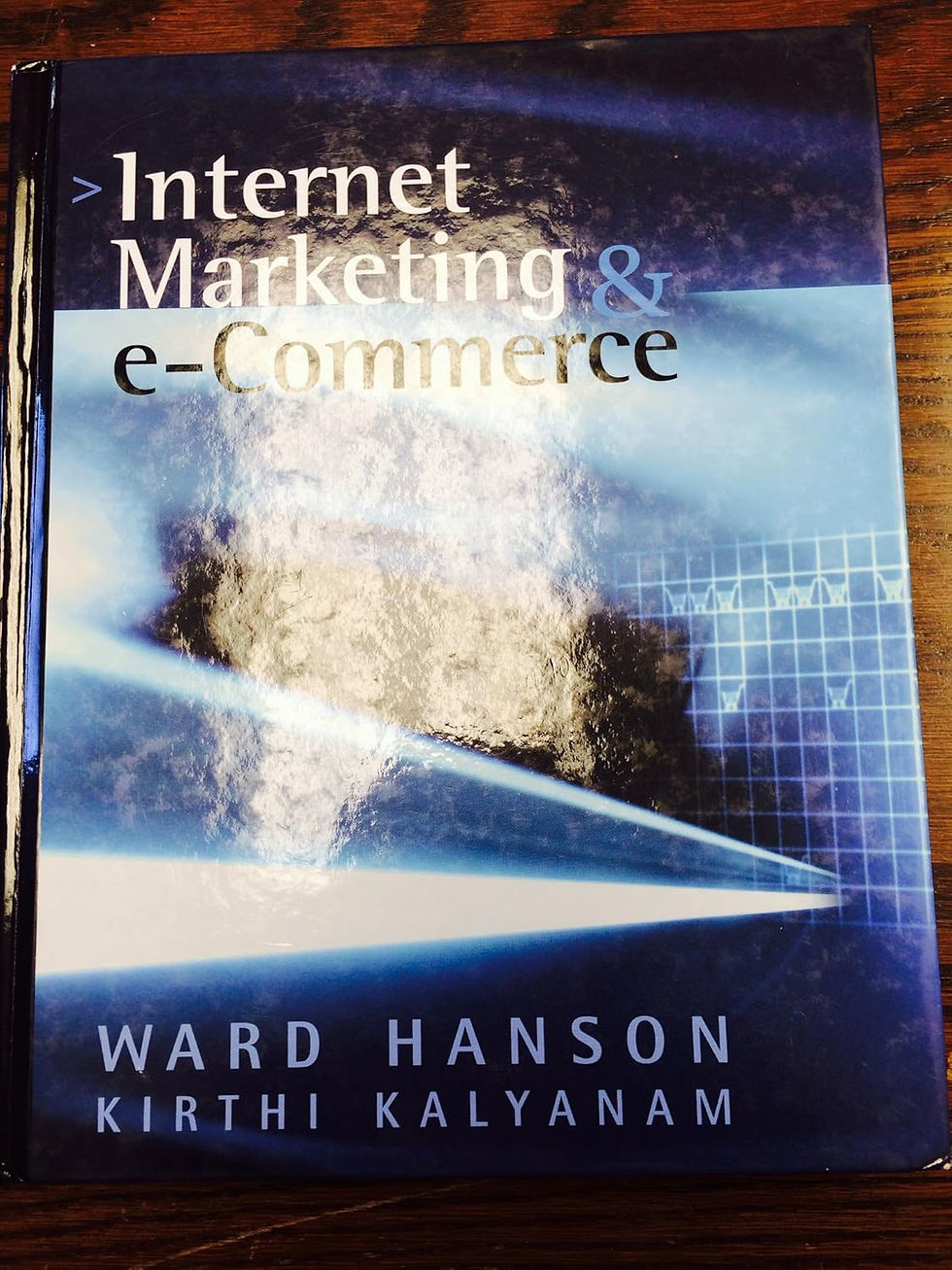
Internet Marketing & eCommerce
Authors: Ward Hanson and Kirthi Kalyanam
Short review
Internet Marketing & eCommerce provides a thorough introduction to how the internet has changed marketing, commerce, and business development. The book combines theory and practical examples in digital marketing, e-commerce, customer behavior, value creation, and digital business models. Although written at a time when the internet was still in its infancy, many of the fundamental principles are still highly relevant.
Why we recommend the book
This book was an important part of my own learning journey in digital marketing and e-commerce. It helped build my understanding of how technology, customer experiences and business strategy are interconnected – an insight that later became very important in my work with SAS, the Norwegian Opera & Ballet, Bærum Municipality and eventually the project The Invisible Capital. Many of the ideas about customer value, digitalization and innovation presented on the website have their roots in the knowledge this book conveys.

The Innovator's Dilemma: When New
Technologies Cause Great Firms to Fail
Author: Clayton M. Christensen
Short review
The Innovator's Dilemma is one of the most influential books on innovation and technological change. Clayton Christensen introduces the concept of "disruptive innovation" and shows how even the most successful businesses can fail when new technologies and business models change the market. Through a series of examples, he explains why established companies often have difficulty adapting to radical change - even when they do "everything right."
Why we recommend the book
This book has had a major impact on how I view innovation, digitalization, and change management. It provided a new perspective on why established businesses are challenged by new players, and why the ability to think differently is crucial in a world characterized by continuous technological development. Many of the reflections in The Invisible Capital on innovation, digital transformation, and value creation are based on the insights Clayton Christensen conveys in this classic.

Mastering AI: A Survival Guide to Our Superpowered Future
Authors: Jeremy Kahn
Short review
Mastering AI takes the reader behind the scenes of the companies and researchers shaping the modern AI revolution. Jeremy Kahn explains how artificial intelligence is developed, the technological breakthroughs that have made today's language models possible, and how AI is impacting business, politics, and society.
Why we recommend the book
A highly relevant book that combines technology, business, and societal development. Perfect for leaders, decision-makers, and anyone who wants to understand where artificial intelligence is headed.

AI Needs You
Author: Verity Harding
Short review
AI Needs You is about why artificial intelligence is not just a technological issue, but also a question of democracy, ethics and social development. Verity Harding argues that the AI of the future must be developed in collaboration with people, governments and business.
Why we recommend the book
An important book for anyone who wants to understand how artificial intelligence affects society and why responsible development will be crucial in the years to come.

The Worlds I See
Author: Fei-Fei Li
Short review
The Worlds I See is the personal story of Fei-Fei Li, one of the world's most influential AI researchers. The book combines autobiography with the history of the development of modern artificial intelligence, showing how research, technology, and human values are closely intertwined.
Why we recommend the book
An inspiring book that provides a unique insight into the development of artificial intelligence through the eyes of one of the field's most central researchers.

© 2025 - 2026 Portico Publish | The invisible capital Privacy and use of the website | Developed and operated by Magne Bjella | Powered and secured by Wix


Comments