
Part 1 - Peter Drucker – the human being, the customer and value creation

Who was Peter Drucker?
Peter Ferdinand Drucker (1909–2005) is considered one of the most influential thinkers in modern management and organization. Through books, articles, teaching, and consulting, he worked for more than six decades on a fundamental question: How can businesses be organized and managed so that people and resources create results?
Born in Vienna in 1909, Drucker grew up in an intellectual environment characterized by discussions of politics, economics, science, and society. He studied law in Frankfurt and worked as a journalist, among other things, before the Nazi takeover led him to Britain and later the United States.
It was in the United States that he developed much of the work that would make him a central figure in modern management theory.

From business as a machine to business as an organization
A major turning point came when Drucker had the opportunity to study General Motors from the inside. The result was the book Concept of the Corporation. from 1946.
Drucker was not only concerned with how a large industrial company produced goods. He examined how the business was organized, how responsibilities and decisions were distributed, how management functioned, and what role the business had in society.
This perspective would follow him further.
The business was not just an economic or technical production machine. It was also a social organization consisting of people who had to collaborate, make decisions, develop knowledge and create results.
Management as a separate field of study
When Drucker wrote The Practice of Management In 1954, management was not yet established as the comprehensive field we know today. Drucker helped make management something that could be studied, described, and practiced systematically.
He was concerned with the responsibilities of the manager, the goals and results of the business, organization, decision-making, and the role of employees. But he did not limit management to the business world. The same fundamental questions were relevant to public agencies, universities, hospitals, and non-profit organizations.
Management was thus not just about administration. It was about enabling an organization to fulfill its purpose and create results.
He saw the knowledge society coming
One of the most far-sighted aspects of Drucker's work was his attention to the increasing importance of knowledge.
As early as the 1950s, he used the term knowledge worker to describe people for whom knowledge was a central part of their work and value creation.
This represented an important change from industrial society.
In the factory, the means of production could be largely owned by the business: machinery, buildings, raw materials and capital.
The knowledge worker, on the other hand, carried a crucial part of the means of production with him in the form of competence, experience, judgment and knowledge.
This also raised new questions about productivity, management and organization. How do you manage people when the most important resource is not just in the machines the business owns, but in the people who work there?
This question would become increasingly important throughout the rest of Drucker's writings.
An unusually long professional perspective
Drucker's writings spanned much of the twentieth century and into the twenty-first. He analyzed the transition from industrial to knowledge society and wrote about, among other things, management, organizations, entrepreneurship, innovation, productivity, social change, and knowledge work.
He taught for many years at Claremont Graduate University in California, where the management school was later named the Peter F. Drucker and Masatoshi Ito Graduate School of Management.
Drucker died in 2005, aged 95.
He did not leave behind a single theory of how businesses should be run. Rather, what is interesting is how a number of ideas in his work are interconnected: the purpose of the business, the customer, innovation, knowledge, people, leadership, and results.
And this is precisely where the part of Drucker's thinking that is still particularly interesting begins.
Because before we can discuss how a business should be managed, we need to ask an even more fundamental question:
Why does the business exist in the first place?
2. What is the purpose of the business?
When Peter Drucker asked the question of what is the purpose of business, he challenged a notion that is still widespread: that the fundamental purpose of a business is to make money.
Drucker did not reject the importance of profitability. A business that does not generate sufficient financial results over time will have difficulty investing, developing, or surviving. But profitability was not, for him, a sufficient explanation for why the business exists.
In The Practice of Management from 1954, he formulated an idea that would become one of the most famous in his writings: the purpose of the business must be found outside the business itself.
That's why he pointed at the customer.
"There is only one valid definition of business purpose: to create a customer." - Peter F. Drucker, The Practice of Management (1954)
The customer is located outside the organization
This may seem obvious at first glance. A business needs customers to be able to sell goods and services.
But Drucker's argument goes deeper.
The business may own capital, buildings, and technology. It may employ skilled people, develop products, streamline production, and establish distribution. All of these represent resources and opportunities.
But none of these resources alone creates a market.
It only happens when people outside the business perceive what is being offered as sufficiently valuable for them to choose it.
The customer thus becomes not only the recipient of what the business has produced. The customer is a crucial prerequisite for the business's economic activity to be maintained.
The business must understand the world from the outside
Drucker's perspective also implies a shift in how business views itself.
It's easy to start from within:
What can we produce?
What technology do we have?
How is the organization built?
What do we want to sell?
How can we become more efficient?
Drucker shifted his attention outward.
Who is the customer?
What does the customer need?
What does the customer perceive as value?
Why does the customer choose one solution over another?
The difference is fundamental.
A business can be very efficient at producing something the market no longer wants. It can have advanced technology, competent employees, and good internal processes, and yet fail if it does not create something that people outside the organization perceive as valuable.
Efficiency alone is therefore no guarantee of value creation.
Profitability is necessary – but not the purpose itself
Drucker's view of profit is sometimes presented as too simplistic. He did not argue that financial results were unimportant.
On the contrary.
Profitability enables a business to continue, invest, manage risk, and develop new products and services. It also serves as an important measure of whether a business's resources are being used in a financially sustainable manner.
But there is a difference between a prerequisite for existence and an explanation of why the business exists .
For Drucker, the purpose of a business had to be found in the society and market it was a part of. It had to create something that had value for others.
It is through this that the business can create financial results.
A perspective that is also about value creation
Drucker's argument thus gives us an important connection between customer and value creation.
Value creation does not necessarily begin when the business
produces something.
A factory can produce thousands of products. A software company can write millions of lines of code. A bank can develop new services. An online store can build advanced technology and logistics.
All of this may be necessary.
But commercial value creation only becomes sustainable when someone outside the business experiences the result as having sufficient value that they want to use, buy or pay for it.
This means that the customer is not at the end of the value chain as a passive recipient.
The customer is part of the very reason why the value chain exists.
But what is value?
Here Drucker's perspective opens up a new question.
If the purpose of the business exists outside the business, and the customer is crucial to whether the business succeeds, the business cannot alone determine what is valuable.
It can decide what it wants to produce.
It can determine how the product will look.
It can decide what technology it wants to use, how the organization will work and what price it wants to charge.
But it cannot determine how the customer perceives the result.
That brings us to the next key part of Drucker's thinking:
Value is not determined solely by what the business creates. It must be understood from the customer's perspective.

3. The customer defines the value
If the purpose of the business exists outside the business, an important consequence of Peter Drucker's thinking follows: The business cannot alone define the value of what it offers.
It is the customer who encounters the product or service, considers the alternatives and decides whether the offer is relevant.
This makes the distinction between product and value important.
The business produces a product or delivers a service. But the value does not necessarily arise in the product itself. It must be understood from what the product or service does for the customer.
The customer does not necessarily buy what the business thinks it is selling.
Drucker was concerned that businesses had to understand the customer from the customer's own point of view.
It sounds simple, but it involves a significant challenge.
A manufacturer may be concerned with technical features. A bank may be concerned with financial products. An airline may be concerned with seats and routes. An online store may be concerned with assortment, technology and logistics.
The customer may see something completely different.
The customer may be concerned with arriving on time, solving a problem quickly, reducing risk, saving time, gaining greater security, making a good purchase or making everyday life easier.
This means that what the business sells and what the customer experiences as buying are not always the same.
Value must be understood from the outside
In Drucker's perspective, the business must therefore try to see itself from the outside.
What the customer values cannot simply be deduced from the production cost, technology or how much work the business has put into the product.
A technologically advanced product may have little value if it does not solve a relevant problem. A simple solution may have great value if it does something the customer perceives as important.
This has a significant consequence:
More product does not necessarily mean more value.
More features, greater complexity, or more advanced technology can improve an offering. But it can also make the solution harder to understand and use. What matters is not how much the business has built into the product, but what the customer gets out of it.
The customer compares alternatives
The customer also does not consider the business's offer in isolation.
There are alternatives.
They may come from a direct competitor, from a different technology, or from a completely different way of solving the same need. In some cases, the customer's alternative may simply be to not buy.
Thus, the business must understand more than its own product and its existing competitors. It must understand what problem the customer is trying to solve.
This perspective becomes particularly important when markets change.
Businesses that define themselves by what they produce risk overlooking new solutions to customer needs. Businesses that understand what needs they are actually meeting have a broader starting point for detecting change.
Customer insights become a strategic resource
If the customer is the one who ultimately assesses value, knowledge about the customer becomes far more than a question for the marketing department.
Customer insights become part of the business's strategic knowledge base.
It is about understanding, among other things:
what problems the customer is trying to solve
which needs are important
which options the customer is considering
why the customer chooses or rejects the business
how customer expectations are changing
This does not mean that the customer can always tell the business which product it should develop.
Customers know their own experiences, needs, and problems, but they don't necessarily know the technologies, business models, or solutions that don't yet exist.
The business's task is therefore not just to ask the customer what they want. It must combine insight into the customer's situation with its own expertise, creativity and ability to develop new solutions.
From customer insight to value creation
Here several parts of Drucker's thinking begin to converge.
Businesses need people who can understand problems.
It needs knowledge of the market and the customer. It needs expertise to develop solutions. And it needs the ability to translate this knowledge into something that creates value outside the organization. The customer thus becomes interesting not only at the moment of sale. The customer influences what the business should develop, how it should prioritize and where new opportunities can be found.
This leads to two functions:
Drucker gave a very special place to business. Because if the business's task is to create a customer and create value for the customer, it must both understand the market and create something new . That brings us to marketing and innovation.

4. Innovation and marketing as the basic functions of the business
When Peter Drucker took as his starting point the purpose of business is to create a customer, it also had consequences for how he viewed the most important tasks of business.
In The Practice of Management from 1954 he highlighted two fundamental functions: marketing and innovation .
This must be understood more broadly than the everyday use of the terms. For Drucker, marketing was not primarily advertising and communication. Nor was innovation limited to technology, research, or inventions.
Both were about the relationship between the business and the world outside it.
Marketing begins with the customer
In many businesses, marketing is considered what happens once the product has already been developed.
The product is produced first. Then the market must be informed, influenced and convinced to buy it.
Drucker reversed this perspective.
If the customer is the starting point for the business, understanding the customer must come before the sale. The business must know who the customer is, what their needs are, what the customer values, and what options the customer has.
Marketing thus becomes not just an activity that is intended to create demand for what the business has already decided to produce.
It becomes a way of understanding the market.
In Drucker's ideal, the company's understanding of the customer is so good that the product or service fits the customer's needs and to a large extent makes the sales process easier.
This does not mean that communication and sales disappear. It means that the business should not be dependent on pushing a poorly adapted offer into the market.
Innovation creates new opportunities
But it is not sufficient to understand today's customers and today's needs.
Markets are changing.
Technologies develop. New competitors emerge. Populations change. Knowledge develops. Customer expectations shift. What created value yesterday may not do so tomorrow.
Therefore, innovation becomes the second fundamental function.
For Drucker, innovation was about creating new opportunities for value creation.
It may involve a new product or new technology, but innovation can also arise through new services, work processes, forms of distribution, markets or ways of organizing business.
Innovation must therefore be distinguished from invention.
An invention can be technologically impressive without creating much value. Innovation requires that something new is actually put into use and has economic or social significance.
Innovation is more than creativity
Drucker also challenged the notion of innovation as the result of sudden brilliant ideas.
In Innovation and Entrepreneurship from 1985, he described innovation as something that businesses can work on systematically.
Opportunities are often found in changes that are already happening around the business.
It could be:
unexpected successes or failures
differences between what was expected and what actually happens
problems or weaknesses in existing processes
changes in markets and industry structures
demographic changes
changes in how people perceive and evaluate the world
new knowledge and new technologies
The innovator's task is therefore not just to come up with something that no one has thought of before.
It involves discovering changes and understanding what new opportunities for value creation they open up .
Technology is an opportunity – not the goal
This distinction becomes particularly interesting in periods of rapid technological change.
New technology can make things possible that were previously impossible or too expensive. But technology does not automatically create successful innovation.
The business must still ask the questions:
What problem does this solve?
For whom?
What will be better?
What value is created?
And is this value big enough that people or businesses will actually use the solution?
This means that technological development and innovation are not the same thing.
Technology can be the tool .
Innovation lies in how the opportunity is converted into new value.
Marketing and innovation go together
Here the connection between Drucker's two basic functions becomes clear.
Marketing in this broad sense is about understanding the customer and the market.
Innovation is about converting changes, knowledge and opportunities into new forms of value.
One turns the business's attention outward.
The second enables the business to act on what it discovers.

Customer insight → opportunity → innovation → customer perceived value
This is not necessarily a linear process. New solutions can also uncover needs that the customer previously could not articulate, and innovation can create entirely new markets. But the connection between the customer, the innovation and the value creation remains.
The business must create both today's and tomorrow's value
It also presents us with an important strategic dilemma. A business must deliver well to today's customers while developing what will be relevant tomorrow. If all attention is focused on today's operations, the business can become very effective at delivering something the market is gradually moving away from.
If all attention is focused on new ideas without understanding customers, finances and implementation, innovation can become an activity without value creation.
Drucker's perspective ties the two together.
The business must understand what creates value today – and at the same time be able to discover how this value can be created in new ways tomorrow.
But the ability to do this depends on a resource that gained increasing importance in Drucker's thinking:
knowledge.
And with the increasing importance of knowledge, a new type of employee also emerged – the knowledge worker .
Further: From innovation to the knowledge worker
Peter Drucker's thoughts on the customer, marketing and innovation lead to another key question: Who will create this value?
Drucker saw early on that knowledge was becoming an increasingly important resource in businesses. With this also grew the importance of what he called the knowledge worker – people who create value through expertise, experience, problem-solving and judgment.
In the next part of the mini-series, we take a closer look at the knowledge worker, the role of humans in value creation, and what this means for management and organization.
Academic background and further reading
This series also builds on my own professional journey through the Web Design study , the eMarketing study , Innovation and Commercialization and professional seminars in San Francisco and Oxford . Here you will find the background, professional environments and experiences that have followed the development from the early years of the web to today's digitalization.
Recommended literature – books that have inspired the universe of knowledge
Peter Drucker's writings are extensive, but two books are particularly relevant to the topics in this mini-series: The Practice of Management (1954), where he develops his views on the purpose of business, the customer, and management, among other things, and Innovation and Entrepreneurship (1985), where innovation is treated as a systematic activity and a source of new opportunities for value creation.
But the universe of knowledge The Invisible Capital is not based on one author or one theory. It is inspired by many years of reading, studying and meeting with professional perspectives on, among other things, management, innovation, digitalization, the customer, organizations and value creation.
Therefore, I also recommend books by other authors who have influenced how I have understood these relationships. Some are about people and organizations, others about innovation, customer experience, technology and the digital economy. Together, they represent different professional approaches to the same fundamental question that runs through this universe of knowledge:
How can people, knowledge, technology and organizations together create value?

Short review
In The Concept of the Corporation, Peter F. Drucker examines how a large corporation functions as an organization. The book builds on his study of General Motors and focuses on organizational structure, decentralization, leadership, responsibility, and the role of the corporation in society, among other things.
Why we recommend the book
The book is interesting because it shows an early and important feature of Drucker's thinking: The business is more than production, capital and financial results. It is also an organization of people, responsibilities and decisions. The Concept of the Corporation therefore provides a good starting point for understanding how Drucker's later thoughts on management, knowledge work and value creation developed.

Short review
The Practice of Management is one of Peter F. Drucker's most important books on modern management. In it, he discusses, among other things, the purpose of the business, the customer, management's responsibilities, goals, organization, and how people and resources can be directed towards results.
Why we recommend the book
The book provides a good starting point for understanding several of the ideas that later became important for modern management theory. Particularly relevant is Drucker's view that the purpose of the business must be understood from the outside, the importance of the customer, and the connection between goals, responsibility, and results. It thus also provides an important academic basis for understanding the connection between management, the customer, and value creation.

Short review
Innovation and Entrepreneurship shows how innovation can be understood as a systematic activity, not just the result of creativity, technology, or random ideas. Drucker examines how changes in markets, demographics, knowledge, and environments can create new opportunities for innovation and entrepreneurship.
Why we recommend the book
The book is particularly relevant because Drucker connects innovation to opportunity, action, and value creation. It provides a good professional perspective on how businesses can work systematically to detect change and translate it into new products, services, and solutions. It is therefore also a natural bridge between Drucker's thinking and the work on innovation in Invisible Capital.

Author(s): Chris Anderson
Short review
The Long Tail is one of the most influential books on how the internet has transformed commerce, marketing, and consumer behavior. Chris Anderson introduces the theory of the “Long Tail,” which explains how digital markets enable significant value creation through a large number of niche products, rather than relying on a few bestsellers.
The book shows how digital distribution, low inventory costs, search engines, and intelligent recommendation systems have made it profitable to offer an almost unlimited product range. Where traditional stores were limited by physical shelf space, online stores can offer millions of products and let customers find exactly what they are looking for.
Chris Anderson illustrates the theory with examples from Amazon, Netflix, Google, and the digital music industry, showing how the internet has changed the rules of competition for businesses around the world. Many of the insights have since become even more relevant through artificial intelligence, personalization, and modern search technology.
The authors take the reader through the entire process – from planning and organizing to publishing, managing and continuously improving content on websites and digital services. Although technology has evolved since the book was published, the principles of quality, relevance, management and long-term content work are at least as relevant in an era where search engines and artificial intelligence assess the credibility and usefulness of content.
Why we recommend the book
At The Invisible Capital, we consider The Long Tail to be one of the most important books in e-commerce, digitalization, and modern value creation.
The book explains why customers no longer just buy the most popular products, but increasingly find value in specialized products and services that meet individual needs. This insight has had enormous impact on the development of online stores, digital marketplaces, search engine optimization (SEO), information architecture, and content strategy.
Today we see that the theory also fits very well into the development of artificial intelligence. AI helps people discover relevant content, products and knowledge that were previously difficult to find. This has given the Long Tail principle a new dimension, where well-structured content and high professional quality are increasingly important for visibility, trust and value creation.
This is a book we believe everyone who works with e-commerce, digital marketing, customer experience, innovation, digital strategy or artificial intelligence should read.

Author/authors: Kristina Halvorson and Melissa Rach
Short review
How do you create content that actually helps people – and at the same time supports your business goals? Content Strategy for the Web is considered one of the most influential books in the field of content strategy and digital communications. The book shows how good content does not arise by chance, but through a deliberate strategy where user needs, the organization's goals, structure, work processes and management are closely linked.
The authors take the reader through the entire process – from planning and organizing to publishing, managing and continuously improving content on websites and digital services. Although technology has evolved since the book was published, the principles of quality, relevance, management and long-term content work are at least as relevant in an era where search engines and artificial intelligence assess the credibility and usefulness of content.
Why we recommend the book
At The Invisible Capital, we believe that good content is one of the most important forms of invisible value creation. A website is far more than design and technology – it is the content that builds trust, creates great customer experiences and helps people find the answers they are looking for.
This book is perfect for leaders, communications consultants, content producers, web editors, UX designers, and anyone working with digital services. It shows why a clear content strategy leads to better user experiences, more effective interactions, and stronger digital results over time.
In an era where artificial intelligence is increasingly important in how information is discovered, understood, and communicated, this book is more relevant than ever. It reminds us that technology alone never creates value – it is good, structured, and relevant content that makes the difference.

Short review
Don't Make Me Think is one of the world's most influential books on usability and web design. Since its first edition in 2000, the book has helped designers, developers, content producers, and managers understand a simple but powerful principle: Good digital services should be intuitive. The user should be able to complete their task without having to stop and think about how the website works.
Why we recommend the book
This is one of the books that has had the greatest impact on my own work with digital services. Over the years – from SAS and the Norwegian Opera & Ballet to working on Bærum Municipality’s website – the principles in this book have been an important reminder that technology is never an end in itself. The goal is to make everyday life easier for the people who use the services. Despite the fact that the book was published many years ago, the message is just as relevant today.
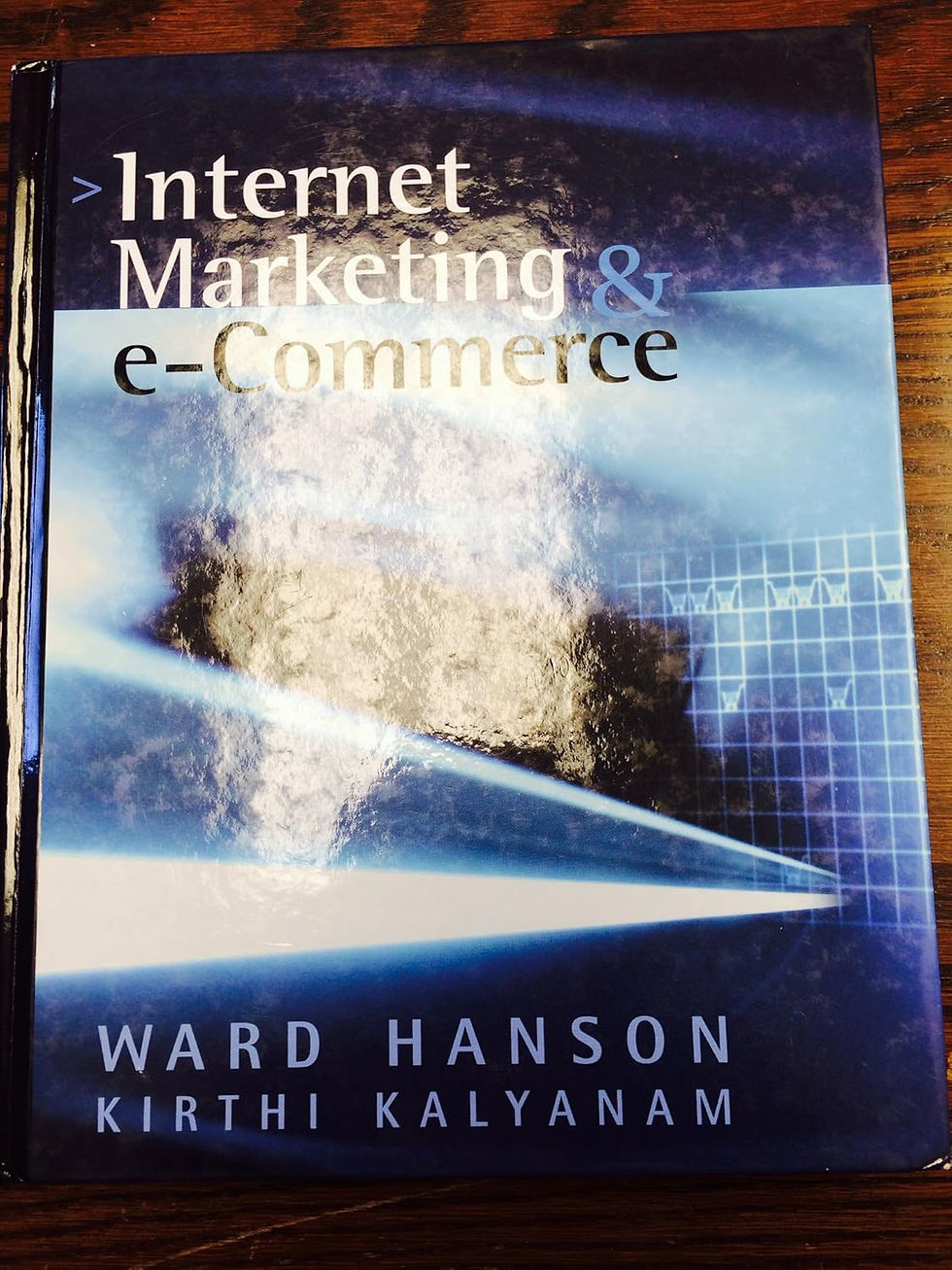
Authors: Ward Hanson and Kirthi Kalyanam
Short review
Internet Marketing & eCommerce provides a thorough introduction to how the internet has changed marketing, commerce, and business development. The book combines theory and practical examples in digital marketing, e-commerce, customer behavior, value creation, and digital business models. Although written at a time when the internet was still in its infancy, many of the fundamental principles are still highly relevant.
Why we recommend the book
This book was an important part of my own learning journey in digital marketing and e-commerce. It helped build my understanding of how technology, customer experiences and business strategy are interconnected – an insight that later became very important in my work with SAS, the Norwegian Opera & Ballet, Bærum Municipality and eventually the project The Invisible Capital. Many of the ideas about customer value, digitalization and innovation presented on the website have their roots in the knowledge this book conveys.

Authors: Clayton M. Christensen and Michael E. Raynor
Short review
In this sequel to The Innovator's Dilemma, Clayton Christensen shows how businesses can translate innovation theory into practical strategy. The book explains how companies can identify new growth opportunities, develop disruptive innovations, and build organizations that thrive in rapidly changing markets.
Why we recommend the book
While The Innovator's Dilemma explains why established businesses are often challenged, The Innovator's Solution provides concrete advice on how to meet the challenges. The book is therefore a natural next step for anyone who wants to understand innovation, strategy and long-term value creation.

Authors: Jeff Dyer, Hal Gregersen and Clayton M. Christensen
Short review
What characterizes people who create groundbreaking innovations? The authors identify five key skills – observation, questioning, experimentation, networking and association – that are common to the world's most innovative leaders and entrepreneurs.
Why we recommend the book
This book shifts the focus from organizations to the people behind innovation. It shows that creativity and innovation can be developed through deliberate training and experience. The perspectives align well with the philosophy behind Invisible Capital, where human competence and curiosity are the most important drivers of development.

Authors: Clayton M. Christensen, Taddy Hall, Karen Dillon and David S. Duncan
Short review
In this book, Clayton Christensen further develops the theory of Jobs to Be Done – the idea that customers do not primarily buy products, but "hire" them to solve specific needs. Through practical examples, the authors show how businesses can develop products and services that address customers' real-world challenges.
Why we recommend the book
For anyone working in customer experience, service design, and innovation, this is one of the most insightful books ever written. It reminds us that value creation always starts with understanding the people we are developing solutions for – a fundamental principle of Invisible Capital.

Author: Clayton M. Christensen
Short review
The Innovator's Dilemma is considered one of the most influential books on innovation and technological change. Clayton M. Christensen introduces the theory of disruptive innovation and explains why even the most successful businesses can fail when new technologies and business models challenge established markets. Through a series of examples, he shows how companies often focus on today's customers and incremental improvements, while overlooking innovations that later change entire industries.
Why we recommend the book
This is one of the books that has had the greatest impact on modern innovation thinking. When I first read it, it gave me a whole new perspective on why some businesses succeed in transformation, while others lag behind – even when they are well led. The insight has been an important part of my own understanding of digitalization, innovation and change management, and many of the reflections in The Invisible Capital build on the ideas Clayton Christensen presents in this classic. The book is as relevant today, in the face of artificial intelligence and digital transformation, as it was when it was published.

Author: Henry Chesbrough
Short review
Henry Chesbrough introduced the concept of Open Innovation and changed the way many businesses think about research and development. He shows how companies can create more innovation through collaboration with customers, universities, start-ups, suppliers and other external partners.
Why we recommend the book
Open Innovation has had a major influence on modern innovation thinking and was also an important topic during the seminars in Oxford and San Francisco. The book shows why future value creation occurs in the interaction between people, businesses and knowledge environments – not within closed organizations alone.

Authors: W. Chan Kim and Renée Mauborgne
Short review
Blue Ocean Strategy challenges businesses to shift their focus away from fierce competition and instead create new markets with little or no competition. The authors present strategies and models that help organizations develop innovative products, services, and business models.
Why we recommend the book
This book has inspired leaders around the world to rethink strategy and innovation. Instead of competing for the same customers, it shows how businesses can create new value through creativity and differentiation. The perspectives align very well with the themes of innovation, digitalization, and long-term value creation in Invisible Capital.

Authors: Patricia B. Seybold
Short review
Patricia Seybold shows how businesses can create better products and services by actively involving customers in the innovation process. The book describes how dialogue, co-creation and close collaboration with users can provide better solutions and stronger competitiveness.
Why we recommend the book
Customers often hold the most important insights into how products and services can be improved. This book emphasizes the importance of listening, involving, and learning from users – a perspective that is echoed in many of the articles on The Invisible Capital. Innovation rarely happens alone; it is created in the interaction between people.

Authors: Philip Evans and Thomas S. Wurster
Short review
This book analyzes how digital information is changing competitive conditions, markets, and business strategies. The authors explain how the internet is disrupting established structures and creating new opportunities for businesses that are able to think differently.
Why we recommend the book
Although written early in the internet revolution, the book describes many of the developments that still characterize business today. It provides valuable perspective on how digitalization affects value chains, competition, and innovation – themes that are central to Invisible Capital.

Authors: Don Tapscott and Anthony D. Williams
Short review
Wikinomics shows how openness, sharing and collaboration across organizations create new forms of innovation and value creation. Through a number of international examples, the authors describe how digital networks make it possible to develop products, services and knowledge together.
Why we recommend the book
This book was groundbreaking when it was first published, and many of the ideas have since become a natural part of everyday digital life. The perspectives on collaboration, knowledge sharing, and open innovation processes align very well with the philosophy behind Invisible Capital, where people and networks are at the center of value creation.

Author(s): Author: Michael E. Porter
Short review
Competitive Strategy is Michael E. Porter's classic work on how companies can understand the competition they find themselves in and develop a position that provides a basis for long-term profitability. Porter shifts the focus from the individual competitor to the structure of the entire industry and shows how competition is affected by customers, suppliers, new entrants, substitutes and the rivalry between existing companies. This forms the basis for what has later become known as Porter's Five Forces. The book is also about how companies can choose a competitive strategy on the basis of this analysis. It thus established an analytical language for strategy that has gained great importance in both research, teaching and practical strategy work.
Why we recommend the book
We recommend Competitive Strategy because it provides the analytical foundation for much of the thinking Porter later develops in What Is Strategy?. If a company is to choose a unique strategic position, it must also understand the competitive forces, the industry structure and the factors that affect the ability to create and retain value. The book is particularly useful because it reminds us that strategy is not just about internal goals, plans and ambitions. Strategy must be developed in the face of customers, competitors, suppliers, technology and structural changes in the market. Together with What Is Strategy?, the book therefore provides a much richer picture: First, the company must understand the competitive arena. Then, it must choose how to be different.

Author(s): Author: Michael E. Porter
Short review
In Competitive Advantage, Porter moves the analysis from the industry to the business itself. The main question is how competitive advantage is actually created. One of the book's most important contributions is the value chain, where the business is understood as a system of activities that collectively develop, produce, market, deliver and support a product or service. Competitive advantage cannot therefore be understood only through products or overall strategies; one must examine the activities that create costs, differentiation and value. This understanding later becomes central to Porter's argument about strategic fit: the activities must not only be good in isolation, but also fit together and reinforce each other.
Why we recommend the book
We recommend Competitive Advantage because it brings strategy right down to where value is actually created: in the activities the business performs. This makes the book particularly relevant together with What Is Strategy?. When Porter argues in 1996 that strategy consists of performing different activities than competitors, or performing similar activities in other ways, this builds on the thinking he developed here. For our perspective on value creation, this is particularly interesting. Value does not arise because the business has formulated a strategy on a document, but through people, expertise, technology, processes, collaboration and activities that together enable the business to create something that customers value. The book therefore provides an important connection between strategy, competitive advantage and actual value creation.

Author(s): Author: Michael E. Porter
Short review
In The Competitive Advantage of Nations, Porter raises the perspective from business to countries, regions and business environments. The book is based on extensive studies of the competitiveness of ten leading trading nations and examines why certain countries and business clusters are particularly successful in certain industries. A central premise is that national prosperity is not simply something a country inherits through natural resources or other given conditions. It is created, and productivity, innovation, competence, competition and the quality of the environment in which businesses operate are crucial. Here, Porter also develops the well-known diamond model to explain how different national and regional conditions can interact and stimulate competitiveness.
Why we recommend the book
We recommend The Competitive Advantage of Nations because here Porter extends the strategy perspective to the ecosystem surrounding the business itself. Value creation does not occur in a vacuum. Businesses develop in societies with education, research, infrastructure, capital, suppliers, demanding customers, competing businesses and public institutions. This makes the book particularly interesting for understanding value creation as an interaction between people, businesses and society. It also provides an important corrective to the notion that a country's competitiveness can mainly be understood through low costs or access to natural resources. Innovation, productivity and the ability to continuously develop are far more central to Porter's explanation.

Author: Joan Magretta
Short review
Understanding Michael Porter brings together and explains the most important parts of Michael Porter's strategic thinking in one accessible whole. Joan Magretta herself worked on strategy at the Harvard Business Review and organizes Porter's ideas around two fundamental questions: What is competition, and what is strategy? She explains, among other things, the Five Forces, competitive advantage, the value chain, value creation, trade-offs, fit, and strategic continuity. This makes the connection between Porter's various works clearer than when the concepts are studied separately. The book also includes an interview with Porter.
Why we recommend the book
We recommend Understanding Michael Porter because it helps the reader see the whole picture of Porter's understanding of strategy. Porter is often reduced to the Five Forces or a few models used in isolation. Magretta shows why this is too simple. Competition, value creation, strategic positioning, trade-offs, activity systems, fit and continuity are interconnected. This makes the book a particularly good supplement after reading What Is Strategy?. It makes it easier to understand why Porter does not view strategy as a plan or a collection of goals, but as a coherent system of choices about how the business will create value and compete over time.

Authors: Harvard Business Review, Michael E. Porter, W. Chan Kim, Renée A. Mauborgne and more
Short review
HBR's 10 Must Reads on Strategy brings together some of Harvard Business Review's most influential writings on strategy. The original collection from 2011 features Michael E. Porter's What Is Strategy? as its main article and combines it with works on competitive forces, Blue Ocean Strategy, the organization's vision, business models, strategy execution, and the Balanced Scorecard, among others. The result is not one unified theory of strategy, but multiple perspectives on how organizations can develop, formulate, and execute strategy.
Why we recommend the book
We recommend HBR's 10 Must Reads on Strategy because it places Porter in a broader strategic context. After reading What Is Strategy?, it will be interesting to encounter other central perspectives and see how they complement, challenge, or extend Porter's understanding. The collection also shows why strategy cannot be reduced to a single model. Competitive position, choice, innovation, business model, execution, priorities, and measurement must be seen in context. For the reader who wants to move on from Porter and into the strategy discipline more generally, this is therefore a very good introduction.

Author: Joseph E. Stiglitz and Bruce C. Greenwald
Short review:
Creating a Learning Society examines how knowledge, learning, and technological development contribute to economic growth and long-term value creation. Joseph E. Stiglitz and Bruce C. Greenwald challenge the notion that economic development is primarily about accumulating more physical capital. They argue that society's ability to create, disseminate, and apply knowledge is crucial for productivity growth and increased living standards. A key point is that learning does not only occur in schools and universities. It also occurs in businesses, through work, production, innovation, and interaction between people and organizations. Knowledge can also spread from one business and one part of the economy to others.
The book thus provides an important perspective on why human capital, competence, innovation and learning must be understood as central parts of a society's ability to create value over time.
Why we recommend the book
We recommend Creating a Learning Society because it expands the understanding of what lies behind economic value creation.
Machines, technology and financial capital are important, but they do not create productivity growth alone. Behind the development are people who learn, develop knowledge, improve work processes, share experiences and find new solutions.
This makes the book particularly relevant to Invisible Capital and our perspective on value creation: A significant part of society's value-creating capacity is found in the knowledge, competence, and learning ability of the people who participate in the economy.
Stiglitz and Greenwald thus provide an academic foundation for one of the most important relationships in modern value creation:

Author: Mariana Mazzucato
Short review
In The Value of Everything, Mariana Mazzucato asks a fundamental question: What exactly is value – and who creates it? Mazzucato returns to the historical discussions of value in economics and shows how the understanding of value creation has changed. She challenges the notion that high income, high prices or large profits necessarily mean that correspondingly large values have been created. One of the book's most important contributions is the distinction between value creation and value extraction . Mazzucato examines the financial sector, the pharmaceutical industry, innovation and the public sector, among others, and argues that we must become better at distinguishing between activities that actually create new values, and activities that primarily extract values that have already been created.
The book also challenges the traditional notion that the private sector creates value while the public sector mainly consumes or redistributes it. Innovation and economic development often arise through a complex interaction between public investment, research, businesses, capital and people.

Author: Philippe Aghion, Céline Antonin and Simon Bunel
Short review
The Power of Creative Destruction is about one of the most important drivers of long-term economic growth: innovation.
Philippe Aghion, Céline Antonin and Simon Bunel build on Joseph Schumpeter's classic idea of "creative destruction" – the process by which new technologies, businesses, products and ideas challenge and replace existing solutions.
But the book is not just about the disappearance of the old. The authors examine why some economies manage to create continuous innovation and productivity growth, while others stagnate. Competition, entrepreneurship, research, education, institutions and public policy thus become important parts of the explanation.
Creative destruction also comes at a cost. New technologies and businesses create opportunities and jobs, but can also make existing skills, tasks and business models less relevant. The challenge is therefore to create societies that both promote innovation and enable people to participate in the transition.
Why we recommend the book
We recommend The Power of Creative Destruction because it shows why innovation is a fundamental driver of value creation .
Value creation is not just about producing more of what we already produce. It also occurs when people develop new ideas, technology, and ways of working that enable us to solve tasks better than before.
This makes the book particularly relevant to The Invisible Capital. Behind innovation are people with knowledge, expertise, creativity and experience. But Aghion's perspective also shows that human capital must be part of a larger system where competition, institutions, research, investment and policy create the conditions for new ideas to actually turn into economic and social development.
The book thus provides an important context in our understanding of value creation:
Knowledge → new ideas → innovation → productivity growth → long-term value creation.

Author: Philippe Aghion, Céline Antonin and Simon Bunel
Short review
Institutions, Institutional Change and Economic Performance is one of Douglass C. North's most important works on why some societies are more successful than others in creating economic development over time.
North shifts attention from traditional factors of production such as capital and labor to the institutions that shape how people, businesses, and governments act and cooperate. Institutions are society's formal and informal rules of the game – including laws, regulations, norms, traditions, and established ways of organizing interaction.
These rules of the game affect the incentives that people and organizations face. They also affect investments, knowledge development, cooperation, transaction costs, and which economic activities emerge.
North also shows that institutions develop over time. History therefore matters: Today's economic opportunities are influenced by institutional choices and development paths that can stretch far back in time.
Why we recommend the book
We recommend Institutions, Institutional Change and Economic Performance because it explains a crucial aspect of value creation that easily becomes invisible:
Value creation needs good rules of the game.
People may have knowledge. Businesses may have capital. Entrepreneurs may have great ideas. A society may have natural resources and advanced technology. But outcomes are also influenced by the institutions that determine how people can collaborate, invest, compete, make deals, and develop businesses.
This makes North particularly interesting for our understanding of trust as part of invisible capital. Trust is not the same as institutions, but stable rules of the game, credible agreements, and well-functioning institutions can reduce uncertainty and make economic interaction easier.
North thus gives us another important part of the value creation picture:
Institutions → predictability and incentives → cooperation and investment → productive activity → long-term value creation.

© 2025 - 2026 Portico Publish | The invisible capital Privacy and use of the website | Developed and operated by Magne Bjella | Powered and secured by Wix


Comments