
Part 15 - AI-Buddy... what is the difference between information and knowledge?

The Internet is full of information. Yet many people find it increasingly difficult to find what they really need. Why? Perhaps because information and knowledge are not the same. In this article, we take a closer look at the difference – and why the websites of the future should not just publish information, but help people actually learn something.

Magne & the Friend
Magne
Friend...
We've talked about content.
Articles.
Technical terms.
Theme clusters.
Knowledge universe.
But suddenly it hit me.
Is all information really knowledge?
The buddy
No.
And that is precisely one of the most important differences we can understand.
Information is the building blocks.
Knowledge is the house you build from them.

Magne
Can you give an example?
The buddy
Certainly.
If I say:
"Water boils at 100 degrees."
Then I have given you information.
But if I explain:
why water boils at different temperatures,
what does altitude mean,
how this affects cooking,
and why it is important in industry,
...then we begin to build knowledge.

Magne
So...
Knowledge is about connection?
The buddy
Yes.
Context.
Explanations.
Experience.
Examples.
Reflection.
The more connections we build between information, the greater the understanding.

Magne
We didn't just learn theories.
We discussed them.
We compared them.
We challenged them.
We used them in practice.
The buddy
And that's precisely why you still remember them.
People rarely learn from facts alone.
We learn when facts are put into context.
Magne
So...
If we want to become a professional website...
Shouldn't we just publish information?

The buddy
No.
You are supposed to help people understand.
That's a completely different ambition.
And perhaps the most important difference between a website that is read once and a website that people come back to.
Academic specialization
From information to insight
We can build a simple model:
Data – Some facts and measurements.
Information – Data put into context.
Knowledge – Information that is explained, understood and applied.
Insight – The ability to use knowledge to make better decisions.
Wisdom – Using insight with good judgment, experience, and ethical awareness.
We can mention that this line of thinking is based on well-known models in knowledge management, often referred to as the DIKW pyramid (Data, Information, Knowledge, Wisdom), while also showing how it can be used in practice.
From data to wisdom
Level | What does that mean? | Example |
Data | Isolated facts without context. | "27°C" |
Information | Data inserted into a context. | "It's 27°C in Bergen today." |
Knowledge | Information explained and understood. | "The high temperature affects electricity consumption, health and the working environment." |
Insight | Knowledge used to understand a situation. | “We should move outdoor work to the morning on warm days.” |
Wisdom | Insight combined with experience and good judgment. | "We are changing our routines to take care of both employees and quality." |
New terms in this article
English technical term | Short explanation |
Data | Isolated facts or measurements without explanation or context. |
Information | Data that is organized and put into context so that it makes sense. |
Knowledge | Information that is understood, explained and can be used in practice. |
Insight | A deeper understanding that makes it easier to make good decisions. |
Wisdom | The ability to use knowledge and insight with experience, judgment and ethical reflection. |
Knowledge Management | The work of developing, sharing and using knowledge in a business. |
Learning | The process by which people develop new understanding through experience, reflection, and practice. |
Reflection | To reflect on experiences and knowledge to create deeper understanding. |
Context | The background that gives information meaning. |
DIKW Model | A model that describes the development from data to information, knowledge and wisdom. |
We have only just begun.
Magne
Friend...
If our goal is to build knowledge...
How do we know if the reader has actually learned something?
The buddy
Hehe...
There we come to perhaps the most difficult task of all.
Not to publish.
But to create learning.
And that's exactly where we'll continue next time.
Academic background and further reading
This series also builds on my own professional journey through the Web Design study , the eMarketing study , Innovation and Commercialization and professional seminars in San Francisco and Oxford . Here you will find the background, professional environments and experiences that have followed the development from the early years of the web to today's digitalization.


Recommended books from our library

The Coming Wave
Author: Mustafa Suleyman
Short review
The Coming Wave explores how artificial intelligence and other breakthrough technologies will transform work, business, and society in the coming decades. Mustafa Suleyman, one of the founders of DeepMind, combines his own experiences from AI development with analyses of the technology's opportunities, risks, and significance for the future.
Why we recommend the book
One of the most important books on the future of artificial intelligence, the book provides a unique insight into how AI will impact people, businesses and society – and why responsible technology development is becoming increasingly important.

Rebooting AI
Authors: Gary Marcus and Ernest Davis
Short review
Rebooting AI challenges many of the myths surrounding artificial intelligence. The authors explain what today's AI can actually do, where its limitations lie, and why human judgment is still crucial. The book bridges the gap between research, technology, and practical application.
Why we recommend the book
A thought-provoking book that provides a balanced perspective on artificial intelligence. Perfect for those who want to understand both the strengths and weaknesses of today's language models and AI systems.
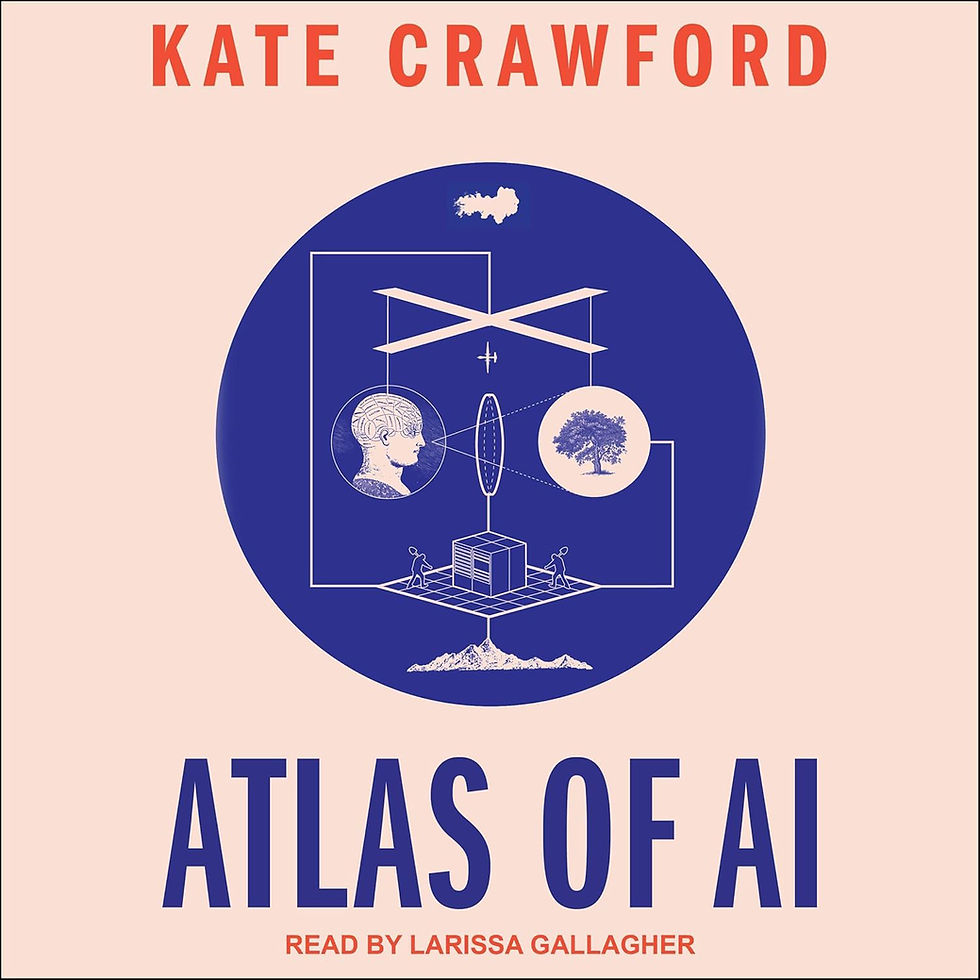
Atlas of AI
Author: Kate Crawford
Short review
Atlas of AI shows that artificial intelligence is about much more than algorithms and technology. Kate Crawford explores how data, energy, people, politics, and economics are interconnected with the development of artificial intelligence. The book places AI in a broader societal perspective.
Why we recommend the book
An essential book for anyone who wants to understand how artificial intelligence is impacting society. It shows that AI is not just about technology – it is also about people, resources, power, knowledge and value creation.

© 2025 - 2026 Portico Publish | The invisible capital Privacy and use of the website | Developed and operated by Magne Bjella | Powered and secured by Wix


Comments