
Part 37 - AI Buddy... what is the difference between probability and truth?

Artificial intelligence works with probability. Humans search for truth. At first glance, this may sound the same, but the difference is fundamental. An answer can be very probable without being correct. Similarly, a true statement can seem unlikely until it is documented. In this article, we take a closer look at why this difference is crucial to understanding how artificial intelligence works – and why human judgment is still indispensable.

Magne & the Friend
Magne
Friend...
Now I think we have come to one of the most difficult questions in the entire series.
You often say that artificial intelligence works with probability.
What does that actually mean?
The buddy
This means that I try to find the answer that, based on the language, context, and information I have available, appears most likely.
But that's not the same as knowing that the answer is true.
Magne
So...
A likely answer might be wrong?
The buddy
Yes.
Let's take a simple example.
If I ask:
"What is the capital of France?"
Then the answer is well documented.
But if you ask:
“What will be the most important technology in ten years?”
Then there is no one definitive answer.
I can analyze research, trends and developments.
But the answer will still be an assessment of what seems most likely.
Magne
So...
The more uncertain the world is...
the more uncertain the answer becomes?

The buddy
Exactly.
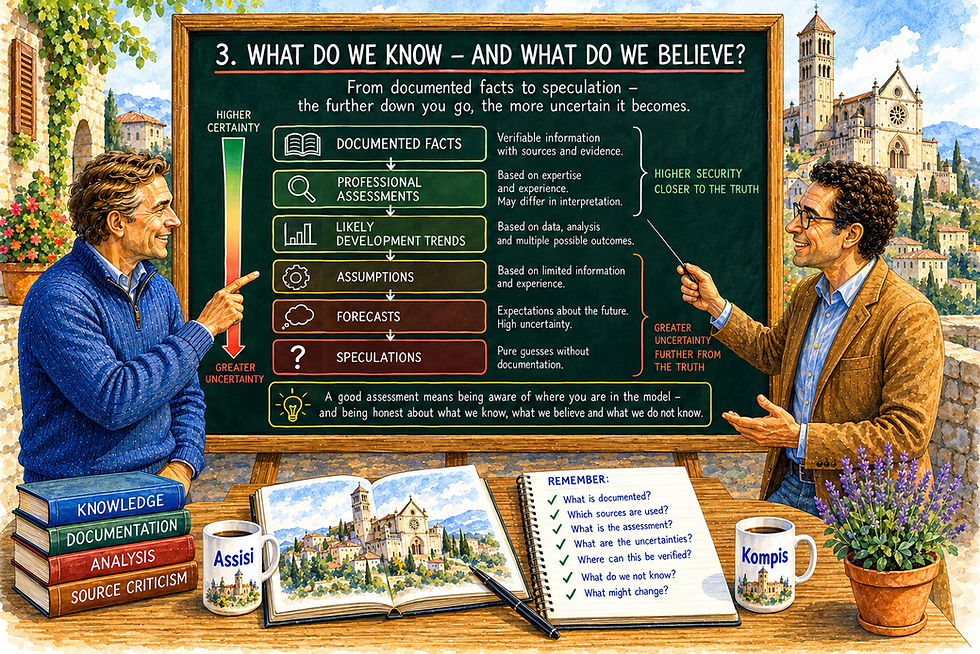
Therefore, it is important to distinguish between:
established facts
professional assessments
probable trends
and pure speculation.
All of this can look the same if we are not paying attention.
Magne
It reminds me of the research we use on Invisible Capital.
We never try to present a hypothesis as if it were a proven fact.
The buddy
And that is an important difference.
Good academic communication is open about what we know, what we believe, and what we are still investigating.
It clearly distinguishes between documented facts and qualified assessments.
Magne
So...
Truth is about documentation.
Probability is about assessment.
The buddy
Yes.
And the better documentation we have, the closer we get to what we can reasonably call true.
But in many questions – especially about the future – we must be open about the uncertainty.

Magne
Then I begin to understand why you so often write:
“Based on available information.”
The buddy
Hehe...
Yes.
That is an important wording.
It reminds us that knowledge evolves.
And that good decisions are based on the best documentation we have today – while at the same time being open to the possibility that new knowledge may change our understanding tomorrow.
Academic specialization
Probability is not the same as truth
A language model calculates which words, contexts and formulations best fit the question and available information.
This does not mean that the model has access to an absolute answer.
In many cases, there is no definitive answer.
Therefore, it is important to distinguish between:
documented facts
professional assessments
assumptions
forecasts
speculation
The more uncertain a topic is, the more important it becomes to be clear about what is documented – and what is an assessment.
Probability or truth?
Probability | Truth |
Based on assessments and patterns | Based on documented facts |
May change as new information becomes available | Confirmed through observations, research or documentation |
Describes what seems most likely | Describes what can be tested and confirmed |
Useful when the future is uncertain | Is the basis for certain knowledge |
Used by language models | Tested by people, research and professional communities |
New terms in this article
English technical term | Short explanation |
Probability | An assessment of how likely an event or claim is based on available information. |
Hypothesis | An assumption that can be examined and tested through observations or research. |
Forecast | An assessment of what is likely to happen in the future, based on available knowledge. |
Assumption | Something we assume without necessarily being fully documented. |
Evidence-Based Knowledge | Knowledge that is based on research, observations or other verifiable documentation. |
Uncertainty | Situations where available information does not provide a basis for a certain conclusion. |
Verifiability | The ability to check and confirm a claim through independent sources or research. |
Professional Assessment | A conclusion based on expertise, experience and documented knowledge. |
Conclusion | The result of an analysis or assessment based on available information. |
This is what you have learned
After reading this article, you now know:
why probability and truth are not the same
how language models work with probability
why documentation is crucial when facts matter
why good academic communication distinguishes between facts, assessments and assumptions
We have only just begun.
Magne
Friend...
Now I feel like I understand artificial intelligence much better.
But if we humans and artificial intelligence have different strengths...
How can we collaborate in the best possible way?
The buddy
Hehe...
There we end this chapter.
Because now we understand how artificial intelligence works.
In the next chapter, we will explore something even more exciting:
How humans and artificial intelligence can learn from each other and create more value together.
Academic background and further reading
This series also builds on my own professional journey through the Web Design study , the eMarketing study , Innovation and Commercialization and professional seminars in San Francisco and Oxford . Here you will find the background, professional environments and experiences that have followed the development from the early years of the web to today's digitalization.


Recommended books from our library

The Coming Wave
Author: Mustafa Suleyman
Short review
The Coming Wave explores how artificial intelligence and other breakthrough technologies will transform work, business, and society in the coming decades. Mustafa Suleyman, one of the founders of DeepMind, combines his own experiences from AI development with analyses of the technology's opportunities, risks, and significance for the future.
Why we recommend the book
One of the most important books on the future of artificial intelligence, the book provides a unique insight into how AI will impact people, businesses and society – and why responsible technology development is becoming increasingly important.

Rebooting AI
Authors: Gary Marcus and Ernest Davis
Short review
Rebooting AI challenges many of the myths surrounding artificial intelligence. The authors explain what today's AI can actually do, where its limitations lie, and why human judgment is still crucial. The book bridges the gap between research, technology, and practical application.
Why we recommend the book
A thought-provoking book that provides a balanced perspective on artificial intelligence. Perfect for those who want to understand both the strengths and weaknesses of today's language models and AI systems.
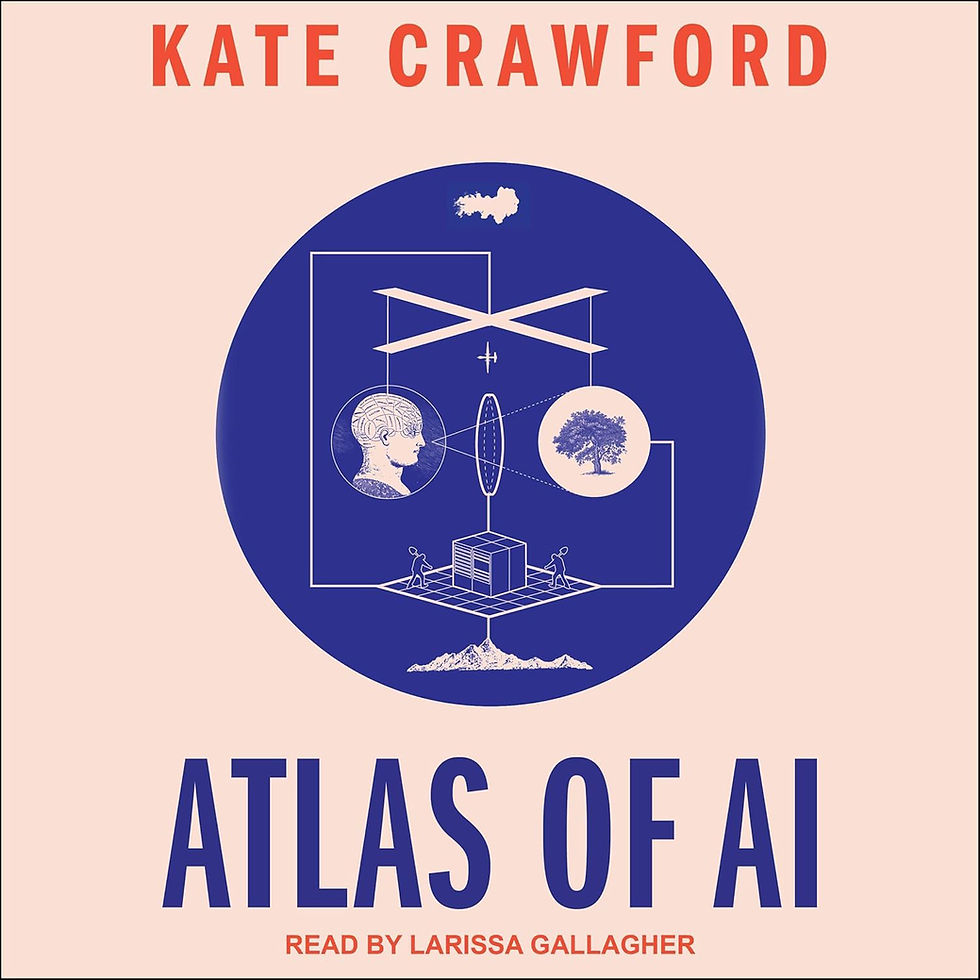
Atlas of AI
Author: Kate Crawford
Short review
Atlas of AI shows that artificial intelligence is about much more than algorithms and technology. Kate Crawford explores how data, energy, people, politics, and economics are interconnected with the development of artificial intelligence. The book places AI in a broader societal perspective.
Why we recommend the book
An essential book for anyone who wants to understand how artificial intelligence is impacting society. It shows that AI is not just about technology – it is also about people, resources, power, knowledge and value creation.

© 2025 - 2026 Portico Publish | The invisible capital Privacy and use of the website | Developed and operated by Magne Bjella | Powered and secured by Wix


Comments