
Part 36 - AI Buddy... why do humans still have to control information?

Artificial intelligence can help us find information, summarize large amounts of text, and explain complex topics in an understandable way. However, humans are still responsible for assessing whether the information is correct. Why is this so? And when is it especially important to check what artificial intelligence writes? In this article, we take a closer look at why critical thinking and source checking are still among our most important skills.

Magne & the Friend
Magne
Friend...
After the last two articles, I'm starting to understand how you work.
But one thing still remains.
If you can be wrong...
Does that mean I always have to check what you write?
The buddy
It depends on what you use the information for.
If we write a draft of a text...
developing ideas...
or discussing a topic...
I can be a very good collaborator.
But if the information is to be used to make important decisions, it should always be verified.
Magne
What do you mean by important decisions?
The buddy
For example, when the information may affect:
human health
financial decisions
legal issues
security
research
public administration
The greater the consequence an error can have, the more important it is to check the information.

Magne
It actually sounds like the same principle we use when writing about Invisible Capital.
We are discussing.
We analyze.
But when we refer to research or numbers...
then we go back to the original source.
The buddy
Yes.
And it is a working method that becomes even more important in an era where artificial intelligence is being used by more and more people.
Artificial intelligence can help you find your way.
But the documentation still needs to be checked when the facts are crucial.
Magne
So...
Do you really want users to be critical?
The buddy
Absolutely.
Critical questions are not a sign of distrust.
They are a sign of responsibility.
The best use of artificial intelligence occurs when people combine technology with their own professional knowledge, experience and judgment.

Magne
This may mean that artificial intelligence will not replace experts...
but does good make experts even stronger?
The buddy
I think that is a good description.
An experienced professional knows which questions need to be asked.
Which sources should be checked.
And when uncertainty must be taken seriously.
Artificial intelligence can support this work – but not take over the responsibility.
Academic specialization
When should information always be verified?
It is particularly important to control information when it is to be used as a basis for decisions that may have an impact on people or society.
Examples are:
medical advice
legal assessments
financial decisions
research
public decisions
security-critical information
In such situations, artificial intelligence should be an aid – not the only source.

When should information be checked?
Situation | Why is control important? |
Health and medicine | Incorrect information can have serious consequences. |
Law and laws | Regulations change and must be updated. |
Economy | Wrong advice can lead to financial losses. |
Research | Conclusions must be based on documented sources. |
Public information | Citizens must be able to trust the information. |
Education | Knowledge should be based on quality-assured information. |
New terms in this article
English technical term | Short explanation |
Source Verification | To check that information is based on reliable and relevant sources. |
Quality Assurance | The work of checking that information or content has the desired quality before it is used or published. |
Decision Basis | The information used to make a decision. |
Primary Source | The original source of information, such as a research article or public document. |
Secondary Source | A source that reproduces, analyzes, or summarizes information from other sources. |
Evidence | Documentation or evidence that supports a claim or conclusion. |
Verifiability | The ability to verify that information is correct using independent sources. |
Critical Thinking | The ability to analyze, ask questions, and evaluate information before drawing a conclusion. |
Professional Judgment | Experience and expertise used to assess information and make good decisions. |
Accountability | Responsibility for ensuring that information and decisions are correct, documented and sound. |
This is what you have learned
After reading this article, you now know:
Why artificial intelligence should not be the sole source on important issues
when information should always be checked
why source checking and critical thinking are still crucial
how humans and artificial intelligence can complement each other in a responsible way
We have only just begun.
Magne
Friend...
Now I understand why we need to control information.
But you often use the word probability .
What exactly is the difference between probability and truth?
The buddy
Hehe...
There we come to perhaps the most important difference of all.
Because artificial intelligence works with what appears most likely .
People search for what can be documented as true .
And we will explore that difference in the next article.
Academic background and further reading
This series also builds on my own professional journey through the Web Design study , the eMarketing study , Innovation and Commercialization and professional seminars in San Francisco and Oxford . Here you will find the background, professional environments and experiences that have followed the development from the early years of the web to today's digitalization.


Recommended books from our library

The Coming Wave
Author: Mustafa Suleyman
Short review
The Coming Wave explores how artificial intelligence and other breakthrough technologies will transform work, business, and society in the coming decades. Mustafa Suleyman, one of the founders of DeepMind, combines his own experiences from AI development with analyses of the technology's opportunities, risks, and significance for the future.
Why we recommend the book
One of the most important books on the future of artificial intelligence, the book provides a unique insight into how AI will impact people, businesses and society – and why responsible technology development is becoming increasingly important.

Rebooting AI
Authors: Gary Marcus and Ernest Davis
Short review
Rebooting AI challenges many of the myths surrounding artificial intelligence. The authors explain what today's AI can actually do, where its limitations lie, and why human judgment is still crucial. The book bridges the gap between research, technology, and practical application.
Why we recommend the book
A thought-provoking book that provides a balanced perspective on artificial intelligence. Perfect for those who want to understand both the strengths and weaknesses of today's language models and AI systems.
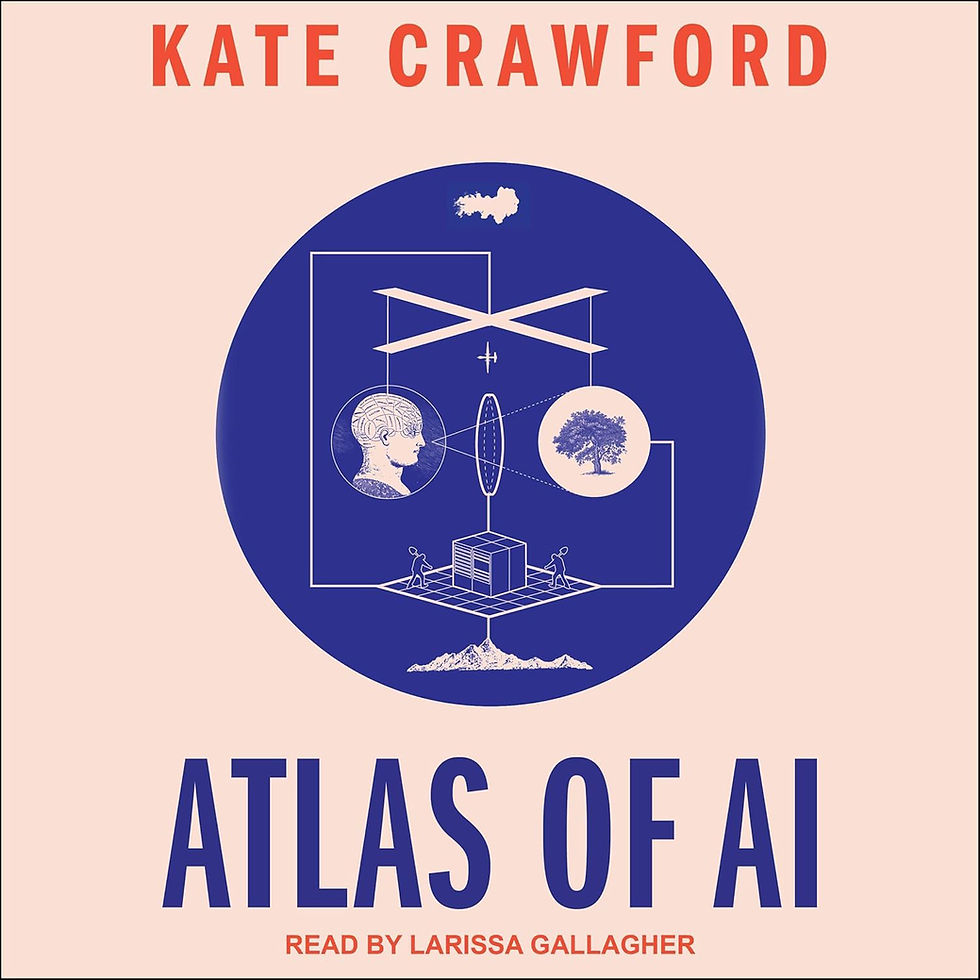
Atlas of AI
Author: Kate Crawford
Short review
Atlas of AI shows that artificial intelligence is about much more than algorithms and technology. Kate Crawford explores how data, energy, people, politics, and economics are interconnected with the development of artificial intelligence. The book places AI in a broader societal perspective.
Why we recommend the book
An essential book for anyone who wants to understand how artificial intelligence is impacting society. It shows that AI is not just about technology – it is also about people, resources, power, knowledge and value creation.

© 2025 - 2026 Portico Publish | The invisible capital Privacy and use of the website | Developed and operated by Magne Bjella | Powered and secured by Wix


Comments