
Part 29 - AI Buddy... why do we trust some people - and not others?

Every day we consider whether to trust people, businesses and information. We often do so without thinking about it. But what qualities actually create trust? And why are these same qualities increasingly important when artificial intelligence is finding and understanding information? In this article, we explore why experience, knowledge, openness and credibility matter more than ever.

Magne & the Friend
Magne
Friend...
We've talked a lot about websites.
About structure.
About content.
About quality.
But suddenly it hit me.
This is really about people.
When I have to choose a craftsman...
doctor...
lawyer...
or accountant...
So I almost always ask:
Can I trust this person?
The buddy
Yes.
And that's interesting.
Because people have been asking that question for thousands of years.
Not because the internet exists.
Not because artificial intelligence exists.
But because trust has always been crucial when we make decisions.

Magne
So...
We humans have always used some kind of "quality check"?
The buddy
Yes.
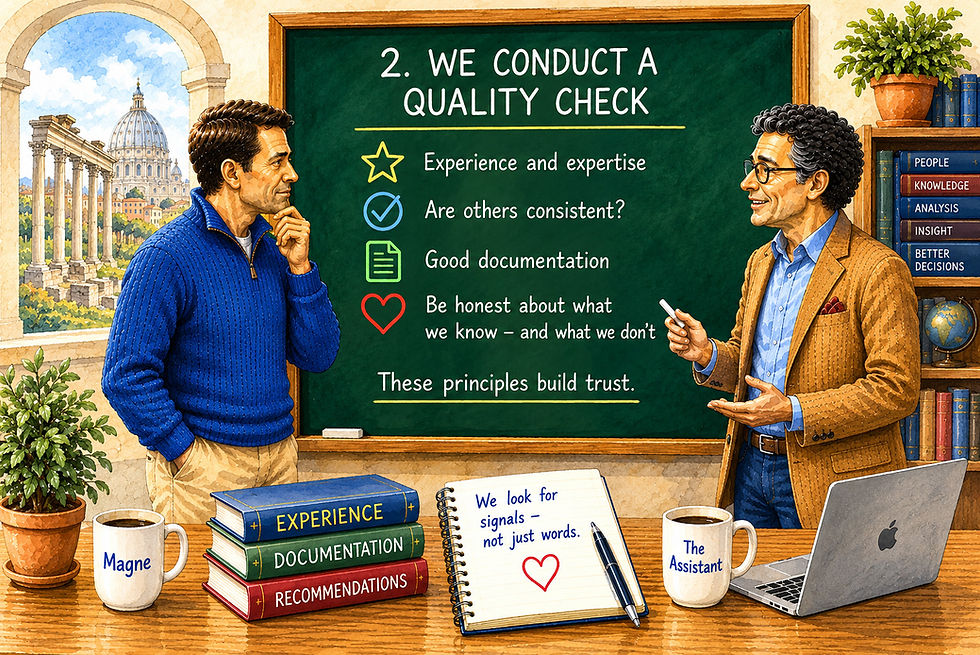
We look for signs.
Does the person have experience?
Does the person seem to know their subject?
Do others agree?
Is the information well documented?
Is the person honest when he or she doesn't know?
It is such assessments that build trust.
Magne
So it's not really artificial intelligence that invented this?
The buddy
Hehe...
No.
Artificial intelligence is simply trying to understand many of the same signals that humans already use.
Technology has changed.
But the need for trust is the same.
Magne
Then I begin to understand why this fits so well into The Invisible Capital.
Because trust is one of the most important invisible values we have.

The buddy
Just.
And that's why I think many people are surprised when they hear the term EEAT.
Because behind the English letters there is actually something quite human hidden.
Not a technical recipe.
But a description of what makes knowledge credible.
Academic specialization
Now we introduce EEAT.
Not as a rule.
But as a model.
We explain each term in Norwegian first.
Next, we show the English designation.
Academic specialization
Here we can explain:
why EEAT is not a "checklist"
why it is based on human psychology
Why small businesses can succeed if they share real knowledge
Why your own experiences can be just as valuable as large marketing budgets
Gives little confidence | Building trust |
Anonymous texts | Clear sender |
Claims without sources | Documentation |
Superficial content | Academic depth |
Outdated information | Regular update |
Clickbait | Helpful content |
Sales first | Knowledge first |
New terms in this article
English technical term | Short explanation |
Experience | Practical knowledge gained through work, projects or own experiences. |
Expertise | Documented professional competence within a specific area. |
Authoritativeness | Recognition from others that shows that a person or business has professional weight. |
Trustworthiness | How reliable, open and trustworthy a person, business or website appears. |
Experience, Expertise, Authoritativeness, Trustworthiness | A model that describes characteristics that help build credibility and trust in content. |
Topical Authority | Recognition for having extensive and relevant knowledge within a field of study. |
Primary Source | The original source of information or research. |
Secondary Source | A source that builds on or analyzes information from other sources. |
Peer Review | Quality assurance where professionals assess research or academic content before publication. |
Knowledge Sharing | To share experiences, insights and expertise so that others can learn and develop. |
We have only just begun.
Magne
Friend...
If trust is built over time...
Can a small Norwegian company compete with the very largest?
The buddy
Hehe...
Now you asked perhaps the most important question in the entire series.
And the answer will surprise many.
Because artificial intelligence can actually make it easier for small businesses to become visible – if they share real knowledge, build trust, and help their customers.
Academic background and further reading
This series also builds on my own professional journey through the Web Design study , the eMarketing study , Innovation and Commercialization and professional seminars in San Francisco and Oxford . Here you will find the background, professional environments and experiences that have followed the development from the early years of the web to today's digitalization.


Recommended books from our library

Human Compatible: Artificial Intelligence and the Problem of Control
Author: Stuart Russell
Short review
Human Compatible is considered one of the most important books on artificial intelligence and the future of humanity. Stuart Russell explains in an easy-to-understand way why the development of artificial intelligence must be based on human values, ethics and responsibility. The book combines research, philosophy and practical examples, and gives the reader a deeper understanding of both the opportunities and challenges that artificial intelligence represents.
Why we recommend the book
This is a book that anyone who wants to understand artificial intelligence should read. Stuart Russell is one of the world's leading researchers in artificial intelligence, and the book provides a unique insight into how humans and artificial intelligence can develop together in a safe and responsible way.

You Look Like a Thing and I Love You
Author: Janelle Shane
Short review
With humor, warmth, and a host of entertaining examples, Janelle Shane explains how artificial intelligence actually works. The book shows why language models and other AI systems sometimes make surprising mistakes, and how these mistakes help us understand both the strengths and limitations of the technology.
Why we recommend the book
One of the most easy-to-read and entertaining introductions to artificial intelligence. Perfect for those who want to understand how AI works without having to read heavy technical books. A book that makes complicated topics easy to understand.

A Brief History of Intelligence
Authors:Max Bennett
Short review
This fascinating book takes the reader on a journey through the history of intelligence – from the first simple organisms to today’s advanced language models and artificial intelligence. Max Bennett combines insights from biology, neuroscience, psychology and artificial intelligence and shows how understanding the human brain can help us develop better and more responsible AI systems.
Why we recommend the book
A unique book that places artificial intelligence into a larger historical and scientific perspective. Perfect for readers who want to understand what intelligence really is, and why the development of artificial intelligence is a natural part of human technological history.

© 2025 - 2026 Portico Publish | The invisible capital Privacy and use of the website | Developed and operated by Magne Bjella | Powered and secured by Wix


Comments