
Part 26 - AI Buddy... why does context matter so much?

The same words can mean completely different things, depending on the situation in which they are used. When we humans talk to each other, we use experience, tone of voice, and previous conversations to understand each other. Artificial intelligence does not have such experience. Therefore, context – what surrounds the question – becomes crucial. In this article, we take a closer look at why context is one of the most important keys to good communication, both between humans and between humans and artificial intelligence.

Magne & the Friend
Magne
Friend...
You said in the previous article that context is important.
But why?
If I write:
"What is the best car?"
...so the question is quite simple, right?
The buddy
Hehe...
Is that really it?
The best car for whom?
For a family with children?
A retiree?
A craftsman?
A taxi driver?
A student?
Or someone who drives on mountain roads all winter?

Magne
So...
The question itself is not really complete?
The buddy
Exactly.
The more I understand your situation, the better I can tailor my response.
Context is what turns a general question into a relevant question.
Magne
Then I understand why we often continue the conversation with new questions.

The buddy
Yes.
Humans do it too.
If someone asks:
“What should I buy?”
...the first thing a good advisor does is ask some follow-up questions.
Not because the answer is difficult.
But because the need must be understood.

Magne
So...
Is artificial intelligence really trying to do the same thing?
The buddy
Yes.
The more relevant information I receive about your goal, situation, and need, the greater the chance that the answer will be useful.
Magne
It reminds me of how we worked with user orientation.
We never started with the solution.
We started by understanding the user.
The buddy
And that's exactly why this fits so well into The Invisible Capital.
Technology is changing.
But the principle remains:
Understand the person before you propose the solution.

Magne
So...
Context is really about empathy?
The buddy
In many ways, yes.
People use empathy, experience, and dialogue.
Artificial intelligence uses the information shared in the conversation.
The result is best when both contribute.

Academic specialization
What is context?
Context is all information that helps us understand a question correctly.
It could be:
who is asking
what the person wants to achieve
what has already been said
what situation the question applies to
what limitations or wishes exist
The richer the context, the greater the possibility of a relevant and precise answer.
This applies to both people, customer service and artificial intelligence.
Same question – different context
Question | Without context | With context |
What is the best car? | Impossible to answer precisely. | Can be adapted to family, budget, mileage and needs. |
Which PC should I buy? | Too many options. | Can be adapted for work, study, photography or gaming. |
How do I create a website? | Very general. | The answer will be different for a municipality, an online store or a voluntary organization. |
How do I use AI? | Too wide. | Can be adapted for a teacher, doctor, craftsman or student. |
How do I become visible online? | Many possible strategies. | The answer depends on the target group, business and objective. |
New terms in this article
English technical term | Short explanation |
Context | The aggregate information surrounding a question that makes it possible to understand the meaning correctly. |
Context Window | The amount of text and information a language model can take into account simultaneously when generating a response. |
Intent | What the user actually wants to achieve with a question or action. |
User Context | The specific situation the user is in when the question is asked. |
Relevance | How well an answer fits the user's needs and situation. |
Precision | How accurately an answer matches what the user is actually asking. |
Follow-up Question | A question asked to better understand the context before answering. |
Conversational Context | The information that has been built up through the conversation so far. |
Situational Awareness | The ability to take into account the circumstances surrounding a task or question. |
Adaptation | To adjust an answer or solution based on the user's needs and context. |
We have only just begun.
Magne
Friend...
Now I understand why context is important.
But how do all these questions and answers actually relate to each other?
Is that why you keep talking about connection?
The buddy
Hehe...
Yes.
Context is about the situation surrounding a question.
Coherence is about how many questions, answers and themes build knowledge over time.
And that's exactly where we're going next.
Academic background and further reading
This series also builds on my own professional journey through the Web Design study , the eMarketing study , Innovation and Commercialization and professional seminars in San Francisco and Oxford . Here you will find the background, professional environments and experiences that have followed the development from the early years of the web to today's digitalization.


Recommended books from our library

Content Strategy for the Web (2nd Edition)
Author/authors: Kristina Halvorson and Melissa Rach
Short review
How do you create content that actually helps people – and at the same time supports your business goals? Content Strategy for the Web is considered one of the most influential books in the field of content strategy and digital communications. The book shows how good content does not arise by chance, but through a deliberate strategy where user needs, the organization's goals, structure, work processes and management are closely linked.
The authors take the reader through the entire process – from planning and organizing to publishing, managing and continuously improving content on websites and digital services. Although technology has evolved since the book was published, the principles of quality, relevance, management and long-term content work are at least as relevant in an era where search engines and artificial intelligence assess the credibility and usefulness of content.
Why we recommend the book
At The Invisible Capital, we believe that good content is one of the most important forms of invisible value creation. A website is far more than design and technology – it is the content that builds trust, creates great customer experiences and helps people find the answers they are looking for.
This book is perfect for leaders, communications consultants, content producers, web editors, UX designers, and anyone working with digital services. It shows why a clear content strategy leads to better user experiences, more effective interactions, and stronger digital results over time.
In an era where artificial intelligence is increasingly important in how information is discovered, understood, and communicated, this book is more relevant than ever. It reminds us that technology alone never creates value – it is good, structured, and relevant content that makes the difference.

Don't Make Me ThinkAuthor: Steve Krug
Short review
Don't Make Me Think is one of the world's most influential books on usability and web design. Since its first edition in 2000, the book has helped designers, developers, content producers, and managers understand a simple but powerful principle: Good digital services should be intuitive. The user should be able to complete their task without having to stop and think about how the website works.
Why we recommend the book
This is one of the books that has had the greatest impact on my own work with digital services. Over the years – from SAS and the Norwegian Opera & Ballet to working on Bærum Municipality’s website – the principles in this book have been an important reminder that technology is never an end in itself. The goal is to make everyday life easier for the people who use the services. Despite the fact that the book was published many years ago, the message is just as relevant today.
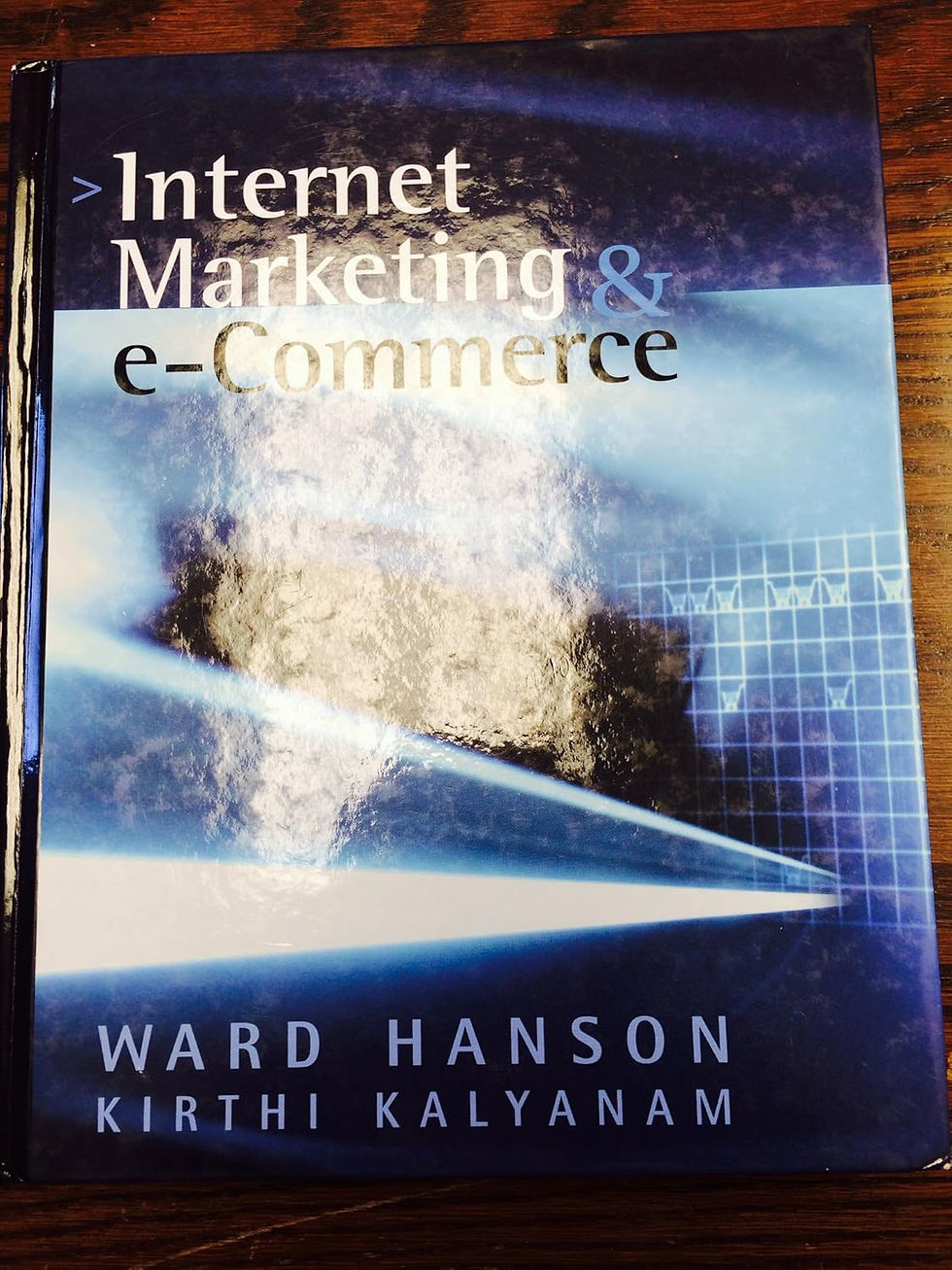
Internet Marketing & eCommerce
Authors: Ward Hanson and Kirthi Kalyanam
Short review
Internet Marketing & eCommerce provides a thorough introduction to how the internet has changed marketing, commerce, and business development. The book combines theory and practical examples in digital marketing, e-commerce, customer behavior, value creation, and digital business models. Although written at a time when the internet was still in its infancy, many of the fundamental principles are still highly relevant.
Why we recommend the book
This book was an important part of my own learning journey in digital marketing and e-commerce. It helped build my understanding of how technology, customer experience and business strategy are interconnected – an insight that later became very important in my work with SAS, the Norwegian Opera & Ballet, Bærum Municipality and eventually the project The Invisible Capital. Many of the ideas about customer value, digitalisation and innovation presented on the website have their roots in the knowledge this book conveys.

The Innovator's Dilemma: When New
Technologies Cause Great Firms to Fail
Author: Clayton M. Christensen
Short review
The Innovator's Dilemma is one of the most influential books on innovation and technological change. Clayton Christensen introduces the concept of "disruptive innovation" and shows how even the most successful businesses can fail when new technologies and business models change the market. Through a series of examples, he explains why established companies often have difficulty adapting to radical change - even when they do "everything right."
Why we recommend the book
This book has had a major impact on how I view innovation, digitalization, and change management. It provided a new perspective on why established businesses are challenged by new players, and why the ability to think differently is crucial in a world characterized by continuous technological development. Many of the reflections in The Invisible Capital on innovation, digital transformation, and value creation are based on the insights Clayton Christensen conveys in this classic.

Mastering AI: A Survival Guide to Our Superpowered Future
Authors: Jeremy Kahn
Short review
Mastering AI takes the reader behind the scenes of the companies and researchers shaping the modern AI revolution. Jeremy Kahn explains how artificial intelligence is developed, the technological breakthroughs that have made today's language models possible, and how AI is impacting business, politics, and society.
Why we recommend the book
A highly relevant book that combines technology, business, and societal development. Perfect for leaders, decision-makers, and anyone who wants to understand where artificial intelligence is headed.

AI Needs You
Author: Verity Harding
Short review
AI Needs You is about why artificial intelligence is not just a technological issue, but also a question of democracy, ethics and social development. Verity Harding argues that the AI of the future must be developed in collaboration with people, governments and business.
Why we recommend the book
An important book for anyone who wants to understand how artificial intelligence affects society and why responsible development will be crucial in the years to come.

The Worlds I See
Author: Fei-Fei Li
Short review
The Worlds I See is the personal story of Fei-Fei Li, one of the world's most influential AI researchers. The book combines autobiography with the history of the development of modern artificial intelligence, showing how research, technology, and human values are closely intertwined.
Why we recommend the book
An inspiring book that provides a unique insight into the development of artificial intelligence through the eyes of one of the field's most central researchers.

© 2025 - 2026 Portico Publish | The invisible capital Privacy and use of the website | Developed and operated by Magne Bjella | Powered and secured by Wix


Comments