
Part 54 - AI Buddy.....Why has a good product description become more important than ever?

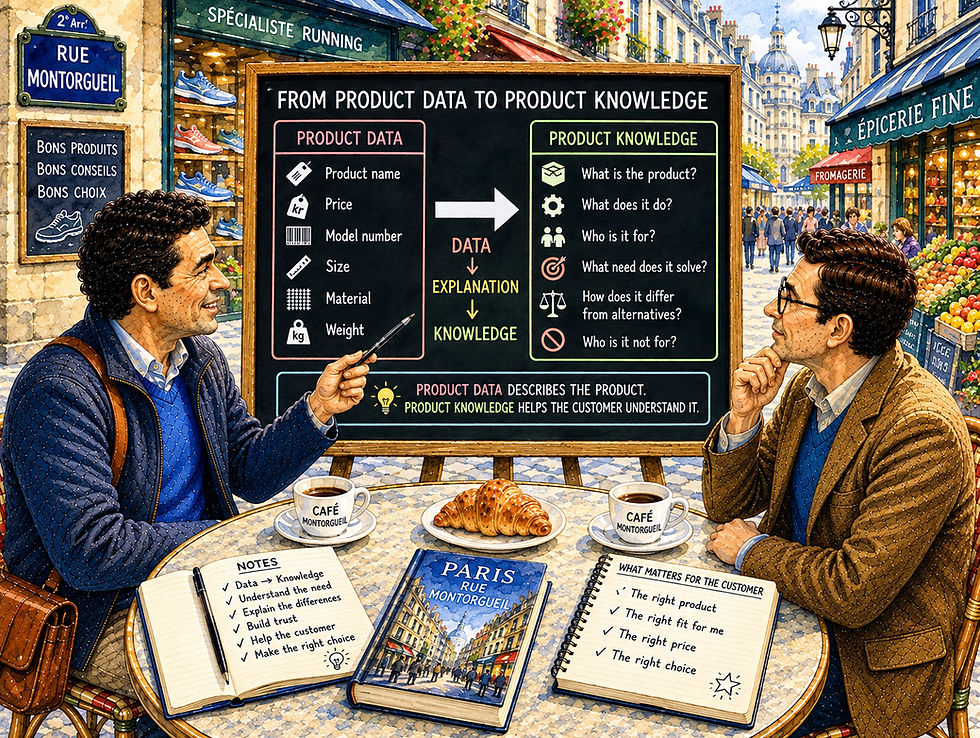
The product description should not just sell the product – it should help the customer understand it.
The product description is some of the oldest content in the online store.
Product name.
Price.
Some specifications.
A picture.
And a text that tells how amazing the product is.
This is what many product pages have looked like since the beginning of online shopping.
But the product description has been given a much bigger task.
The customer encounters several products.
More options.
More online stores.
Multiple sources of information.
And more and more ways to find and compare products.
At the same time, artificial intelligence is changing how people search for information.
The customer no longer just needs to write:
"running shoes women"
in a search field.
She can ask:
"I've just started running, mostly on asphalt, and want a comfortable shoe with good cushioning. What should I look for?"
It then becomes crucial that knowledge about the products actually exists.
Not just the product name.
Not just the price.
Not just the manufacturer's model number.
But knowledge about:
what the product is,
what it does,
who it is suitable for,
what needs it solves,
how it differs from the alternatives,
and sometimes just as important:
who it is not suitable for.
The product description thus becomes something far more interesting than a sales text.
It becomes part of the online store's product knowledge.
For small and medium-sized online stores, this can be especially valuable.
The largest players can have enormous product ranges and marketing budgets.
The smaller specialty store may have something different:
people who really know the products.
When this knowledge is moved from the minds of employees and into the online store, the product description can become a digital version of something the good store employee has always done:
Explain the product so that the customer can make the right choice.

Magne & the Friend
Magne
Friend...
I think we need to start with a small confession.
The buddy
This is going to be exciting.
Magne
I've seen quite a few product descriptions over the years that actually say very little.
The buddy
Give me an example.
Magne
How about:
"Fantastic quality and modern design make this the perfect choice for you."
The buddy
What did you learn about the product?
Magne
Nothing.
The buddy
What did you learn about who it is suitable for?
Magne
Nothing.
The buddy
What did you learn about why you should choose this particular product?
Magne
Nothing.
The buddy
But was it amazing?
Magne
And perfect.
Heh heh.
The product description must answer questions
Magne
What should we have written instead?
The buddy
It depends on the product.
Magne
Of course it does.
Couldn't you just give me one recipe?
The buddy
Heh heh.
Imagine we are selling a backpack.
What does the customer want to know?
Magne
How big it is.
What it weighs.
How much it holds.
The buddy
Abrupt.
What else?
Magne
Whether it is waterproof.
How the carrying system works.
How many pockets does it have.
The buddy
And maybe:
Is it suitable for a day trip or a week-long mountain hike?
Can it be used as hand luggage?
Does it fit a short person?
How much weight is it comfortable to carry?
Magne
Now we are starting to move from product data to actual product knowledge again.
The buddy
Exactly.
We must separate facts from sales language
Magne
But the product description is still supposed to sell, right?
The buddy
Of course, it can contribute to sales.
But that doesn't mean we should exaggerate.
Magne
So the "world's best backpack" is broken?
The buddy
If you can't document it, I wouldn't do it.
Magne
What do we write instead?
The buddy
What actually helps the customer.
Precise properties.
Areas of application.
Benefits.
Limitations.
Differences.
And concrete explanations.
Magne
So credibility over superlatives?
The buddy
Yes.
A customer who understands the product doesn't necessarily need to be shouted at.
The supplier text is not always enough
Magne
Here we come to something that many small online stores recognize.
The supplier sends product data and a finished text.
Can't we just use it?
The buddy
You can.
But the question is whether it does the job well enough.
Magne
What could be missing?
The buddy
The supplier knows the product.
But the individual online store can know its customers better.
Magne
So the manufacturer can tell what the product is...
The buddy
...while the specialist store can provide knowledge about how the product works in the customers' reality.
Magne
That's where the people come in again.
The buddy
Yes.
The experienced employee may know what questions customers always ask.
That's valuable product knowledge.

The good product description should also dare to say no
Magne
I like this.
But now I'm going to challenge you.
If the goal is to sell the product, why should we tell who it is not suitable for?
The buddy
Because mis-selling is not necessarily good selling.
Magne
Returns?
The buddy
Among other things.
But also dissatisfied customers, unnecessary customer service and weakened trust.
Magne
So we can actually write:
"If you primarily need X, we recommend another model."
The buddy
Yes.
It can be very good advice.
Magne
Even if the customer then buys a cheaper product?
The buddy
If it is the right product for the customer.
Magne
It's a quite different philosophy than:
Maximize the conversion on this product page.
The buddy
Yes.
We try to maximize the quality of the decision .
The product description must be understandable
Magne
But some products are technical.
So we have to use technical terms, right?
The buddy
Yes.
Technical terms may be necessary.
But do you remember what we learned earlier?
Magne
Use the correct terminology...
and explain it.
The buddy
Exactly.
If a camera has five-axis image stabilization, we should probably use the correct term.
But we can also explain what it means in practice.
Magne
So don't choose between professionalism and comprehensibility.
The buddy
No.
We need both.
The product description is not just the body text
Magne
When we say product description, we really mean the text below the product image, right?
The buddy
In a narrow sense, we can do it.
But the customer's understanding of the product is built on much more.
Magne
Product name?
The buddy
Yes.
And pictures.
Specifications.
Variants.
Sizes.
Materials.
Compatibility.
Delivery information.
Tables.
Video.
Questions and answers.
Magne
So the product page is actually a complex knowledge base.
The buddy
That's a good way to describe it.
What does the search engine need?
Magne
Now comes SEO.
The buddy
It does.
Magne
Should we write the product description for Google?
The buddy
We will write a good product description for the customer.
And at the same time make it clear what the product actually is.
Magne
So we need product names and relevant terms?
The buddy
Of course.
But naturally.
If we are selling a waterproof shell jacket for mountain hiking, the page should make it clear that that is actually what the product is.
We don't need to repeat "waterproof shell jacket" fifteen times.
Magne
So still human first.
The buddy
Always.
And then comes AI.
Magne
Then we have come to the new part.
What does artificial intelligence need?
The buddy
Let's be precise.
Different AI systems work differently, and we cannot promise that a specific product text will automatically be used in an AI response.
Magne
Abrupt.
No magic AI recipe.
The buddy
But if machine systems are to be able to analyze our product information, it is an advantage that the knowledge actually exists and is clearly expressed.
Magne
So:
What is the product?
What characterizes it?
Who is it suitable for?
What is it used for?
What sets it apart from other products?
The buddy
Yes.
Precise, consistent and structured product information provides a better knowledge base than vague marketing text.
AI does not make product knowledge less important
Magne
But if AI gets that good, can it just write the product descriptions for us?
The buddy
It can help with drafts.
Magne
But?
The buddy
Where does it get that knowledge from?
Magne
There it came.
The buddy
If you give KI:
product name,
price,
three technical specifications
and a generic supplier text...
can it formulate a nicer text.
But it doesn't automatically know what the employee who has been selling the product for ten years knows.
Magne
So AI can formulate the knowledge.
But first the knowledge must exist.
The buddy
Exactly.
And someone must quality assure that the result is actually correct.

This could be a big opportunity for SMEs
Magne
I'm starting to see why this is interesting for smaller businesses.
The buddy
Tell me.
Magne
A small specialty store may not be able to afford to build the world's most advanced e-commerce platform.
But it can have an incredible amount of product knowledge.
The buddy
Yes.
Magne
And with AI, it may become easier to systematize and process this knowledge.
The buddy
There lies an interesting opportunity.
An employee can contribute with their experience.
The business can structure knowledge.
AI can help with drafts, variations, and editing.
And humans can check, correct and add professional judgment.
Magne
Then we use AI to scale human knowledge.
The buddy
Instead of using AI to produce as much text as possible.
Magne
I like that difference.
Academic specialization
The product description has been given several tasks
The product description has traditionally had a combination of informative and promotional functions.
In modern e-commerce, product information often has to support multiple needs at the same time.
It should help the customer to:
identify the product,
understand the characteristics,
assess the relevance,
compare options,
reduce uncertainty
and
make a decision.
At the same time, the information is part of a larger digital ecosystem with internal searches, external search engines, product feeds, marketplaces, comparison services and, increasingly, AI-based interfaces.
This means that the quality and structure of product information has significance far beyond the text itself on the product page.
From description to decision support
A product description should not only reflect the product's features.
It should help the customer understand the meaning of the features .
If a laptop has:
32GB RAM
It is a fact.
But the customer may need to understand why it is relevant.
For demanding image processing, video editing or heavy workloads, high memory capacity can be important.
For simple web browsing and word processing, the need may be different.
Then we move from:
specification → explanation → use case → decision support.
The product description should reduce the information gap
In a physical store, the customer can hold the product, examine it, and ask a staff member questions.
Online, much of this understanding must be built through information.
An information gap arises between what the business knows about the product and what the customer knows.
A good product page attempts to reduce this gap.
It doesn't necessarily require more text.
It requires correct information .
For some products, five precise points are enough.
Others require extensive explanations, size guides, technical data, comparisons, or video.
The amount of information should therefore be governed by the complexity of the decision .
Unique product knowledge may be more important than unique wording
In e-commerce, the discussion about product texts has often been about avoiding identical supplier texts and producing "unique content."
But unique wording and unique knowledge are not the same thing.
A business can rewrite the supplier's text in other words without adding anything new to the customer.
The greater value arises when the business adds:
own experience,
own explanations,
real use situations,
answers to common customer questions,
comparisons,
and professional assessments.
Then the business doesn't just create a different text.
It adds knowledge .
Product data should be separated from free text
A good product description does not replace structured product data.
If information such as size, material, capacity, compatibility or weight is simply hidden in a long paragraph of text, it becomes more difficult to use systematically.
Structured attributes make it possible to:
filter products,
build comparisons,
reuse information,
check data quality,
and make specific product features available to different systems.
The free text can then do something else:
explain what the data means to the customer.
The two complement each other.
Consistency becomes more important when knowledge is used in multiple places
When product information is only used on one product page, an error may be local.
When the same information is distributed to multiple channels or used as the basis for automated services, inconsistency can have greater consequences.
If one part of the website says the product is water resistant, while another says it is only water-repellent, a credibility issue arises.
Therefore, product data quality and content management are becoming increasingly important.
The business needs control over:
which information is correct,
where it comes from,
who can change it,
and how it is kept up to date.
Availability also applies to product information
Good product communication is also about people being able to understand and use the information.
This means, among other things, clear headings, understandable language, descriptive links, good text alternatives to relevant images, and tables that are actually structured as tables when the information requires it.
Information communicated only through a product image may be inaccessible to some users.
Universal design is therefore not an addition to good product communication.
That's part of it.
AI can streamline production – but quality must be managed
Generative AI can make parts of product content work more efficient.
Among other things, it can help with:
structure raw information,
create a first draft,
customize language,
identify missing information,
suggest questions the customer may have,
and rework existing professional knowledge into different formats.
But AI can also:
find out the characteristics,
mixing products together,
exaggerate benefits,
or formulate uncertain information as if it were facts.
Therefore, product content that influences a customer's purchasing decision should be quality-assured against authoritative product data and human expertise .
The real opportunity is to document human knowledge
For many small and medium-sized businesses, valuable product knowledge already resides within the organization.
It is found in conversations between employees and customers.
In customer service emails.
In the experiences from returns.
In the questions asked in the store.
In the employee who knows why model A works better than model B under certain conditions.
This knowledge is part of the business's human capital.
When documented, structured and quality assured, it can be used across:
product pages,
buying guides,
customer service,
search,
training,
and future AI-based advisors.
Thus, the product description can become one of several places where the invisible capital becomes visible to the customer .
What should a good product description say?
From basic facts to real decision support
Question | What the customer needs | Example |
What is this? | Clear identification | Waterproof shell jacket for hiking |
What can the product do? | Important features | Protects against wind and rain |
What do the properties mean? | Explanation | The membrane provides weather protection while allowing moisture to be transported out. |
Who is it suitable for? | Relevance | For people who need weather protection on a trip |
When is it suitable? | Usage situation | Suitable as an outer layer in changing weather |
What sets it apart from the alternatives? | Basis of comparison | Lighter than model A, but less robust than model B |
What should I be aware of? | Limitations | Requires mid-layer for warmth in cold weather |
How do I choose the right variant? | Decision support | Size guide and explanation of fit |
How do I use and maintain it? | Value after purchase | Washing and impregnation instructions |
From weak product text to product knowledge
The difference is not primarily in the number of words
Weaker product content | Stronger product content |
"Fantastic quality" | Explains which materials and properties provide quality |
"Perfect for everyone" | Explains who the product is actually suitable for |
Copied supplier text | Adds the store's own expertise |
Technical specifications only | Explains what the specifications mean in practice |
Only benefits | Also describes relevant limitations |
Same text structure regardless of product | Adapted to the customer's information needs |
Important facts hidden in the body text | Important attributes are structured |
Written primarily for keywords | Written for understanding with precise terminology |
AI produces the text automatically | AI helps – people and reliable data ensure quality |
The goal is only conversion | The goal is for the customer to make the right choice. |
What does this mean for small and medium-sized online stores?
Start with the knowledge you already have
The business has | Questions to ask | What can be done? |
Experienced employees | What do they explain to customers every day? | Document the explanations |
Customer service inquiries | What questions are repeated? | Post the answers on relevant product pages |
Returns | Why do customers make the wrong choice? | Improve pre-purchase information |
Supplier data | What does the customer need to understand the product? | Add your own context and expertise |
Many similar products | What are the main differences? | Make clear comparisons |
Limited resources | Which products need the most help first? | Prioritize complex or important products |
AI tools | Which tasks can be effectively streamlined? | Use AI for drafting and structuring – not uncontrolled fact production |
Technical terms
Key concepts when working with product descriptions
English technical term | Explanation |
Product Description | Textual information that describes the product's features, application, benefits, limitations and relevance to the customer. |
Product Content | The overall content that communicates the product, including text, images, video, specifications, guides, and other informational material. |
Product Data | Structured facts about the product, such as size, material, weight, price, model and technical characteristics. |
Product Attribute | A defined characteristic of the product that can be used for description, filtering, searching and comparison. |
Product Knowledge | Professional understanding of the product's properties, applications, benefits, limitations and relevance to various needs. |
Product Data Quality | The degree of correctness, completeness, consistency and timeliness of the product data. |
Information Gap | The difference between the information the business has about the product and the information the customer needs to understand and evaluate it. |
Decision Support | Information or functionality that helps the customer compare options and make an informed choice. |
Structured Product Information | Product information organized into defined fields and attributes so that it can be processed and reused systematically. |
Product Information Management | Systems and processes for collecting, managing, quality-assuring and distributing product information. |
Content Governance | Roles, rules and processes that ensure quality, consistency, accountability and maintenance of content. |
Generative AI | Artificial intelligence that can generate text, images or other content based on patterns in data and instructions. |
We have only just begun.
Magne
Friend...
Now the product description has taken on a much bigger role than it did when we started.
The buddy
What did you think it was going to do?
Magne
Describe the product.
Preferably a little nice.
And maybe get the customer to press the buy button.
The buddy
And now?
Magne
Now it will help the customer understand the product.
Explain the properties.
Show who it's suitable for.
Explain what the differences mean.
Reduce uncertainty.
And maybe even tell when the customer should choose something else.
The buddy
Abrupt.
Magne
But then we've really moved beyond the product description itself again, haven't we?
The buddy
How then?
Magne
The customer doesn't just use one text when making a decision.
She uses specifications.
Pictures.
Comparisons.
Size guides.
Buying guides.
Delivery information.
Maybe customer reviews.
And maybe she asks questions to a digital advisor.
The buddy
Exactly.
Magne
Then the next question is not just how we write a good product description.
It's how all the product information works together to help the customer choose .
The buddy
There we have the next article.
Magne
How does product information help the customer make a decision?
The buddy
Just.
For now, we will follow the customer all the way to the choice.
And buddy...
We have only just begun.
Academic background and further reading
This series also builds on my own professional journey through the Web Design study , the eMarketing study , Innovation and Commercialization and professional seminars in San Francisco and Oxford . Here you will find the background, professional environments and experiences that have followed the development from the early years of the web to today's digitalization.


Recommended literature
Developments in artificial intelligence are moving faster than perhaps any other field of study in our time. No single book can provide all the answers, but good books can provide a solid foundation for understanding the technology, the opportunities, and the challenges.
In the KI-Kompis series, we therefore recommend a selection of books that illuminate artificial intelligence from different perspectives – technology, strategy, management, innovation, ethics, digitalization and practical application. Together, they provide a broader understanding of how artificial intelligence affects people, businesses and society.
Click on the book icon to see the full literature overview with recommended books on artificial intelligence.
Recommended books from our library

Build a Large Language Model (From Scratch)
Author: Sebastian Raschka
Short review
This book takes the reader behind the scenes and shows how a modern language model is actually built – step by step. Sebastian Raschka explains advanced concepts in an educational way and provides a unique understanding of how large language models like ChatGPT work. Although the book contains code examples, it is also very valuable for anyone who wants a deeper understanding of the technology behind artificial intelligence.
Why we recommend the book
One of the most talked about books on large language models. Perfect for those who want to understand how artificial intelligence works beneath the surface and why language models have become a revolution in digitalization and knowledge sharing.

Quick Start Guide to Large Language Models
Author: Janelle Shane
Short review
This book provides a practical and easy-to-understand introduction to large language models (LLMs). Sinan Ozdemir explains how language models are used in modern businesses, how they can be integrated into work processes, and why they have become one of the most important technologies in artificial intelligence.
Why we recommend the book
A very good book for anyone who wants a quick and practical introduction to language models. It is suitable for both beginners and professionals who want to understand how LLMs are used in practice.

Artificial Intelligence: A Modern Approach: The Future Is Coming! Discover How Artificial Intelligence Will Change Your Life!
Authors: Stuart Russell & Peter Norvig
Short review
This is the world's most famous textbook on artificial intelligence and is used in universities worldwide. The book covers the entire subject area – from problem solving and machine learning to language understanding, robotics and ethics – and is considered a classic in the AI field.
Why we recommend the book
If you are only going to own one academic book on artificial intelligence, this is one of the very best choices. A timeless classic that provides a solid academic understanding of artificial intelligence and is still used as a syllabus at leading universities around the world.

© 2025 - 2026 Portico Publish | The invisible capital Privacy and use of the website | Developed and operated by Magne Bjella | Powered and secured by Wix


Comments