
Part 1 - AI Buddy… what exactly is artificial intelligence?

Artificial intelligence is being touted by many as the biggest technological change since the internet. Some believe it will revolutionize the way we work. Others believe it will change the way we search for information, learn, communicate, and make decisions. One thing is for sure: Artificial intelligence has already become a part of our everyday lives. But before we talk about language models, AI optimization, the future of search, and new customer experiences, we need to ask the most important question of all:
What exactly is artificial intelligence?

In this article, we start from the very beginning. Through a conversation between Magne and Kompisen, we explore what artificial intelligence is, how it works, and why it will impact people, businesses, and society in the years to come.
Part 1 of the series "Artificial Intelligence (AI)" - Introduction
Artificial intelligence is everywhere.
Newspapers write about it almost every day. Politicians discuss how it will affect society. Companies are investing billions in new solutions. Schools, universities and public agencies are trying to understand how the technology can be used responsibly.
At the same time, many are left with the same question.
What exactly is artificial intelligence?
That's a good question.
Because if we don't understand what artificial intelligence is, it will also be difficult to understand how it affects customers, employees, leaders, businesses and our society.
This series is therefore not primarily about technology.
It's about people.
About knowledge.
About trust.
About how artificial intelligence is changing the way we search for information, learn new things, and make decisions.
But before we talk about AI optimization, language models, customer experiences, and the websites of the future, we need to start at the very beginning.

Magne & the Friend
Magne
Friend…
I have to admit something.
I have worked with the internet and digitalization almost my entire professional life.
I was there when businesses started to understand why they needed their own websites.
I experienced how Google changed the way we found information.
I have worked with search engine optimization, user experiences, digital services, and content strategy for many years.
But now I feel a bit of the same feeling I had when the internet started to become a natural part of everyday life.
Something big is happening.
Everyone is talking about artificial intelligence.
Some say it will change everything.
Others think we are exaggerating.
And many – myself included – are still trying to understand what this is really about.
So let's start with the simplest question of all.
What exactly is artificial intelligence?
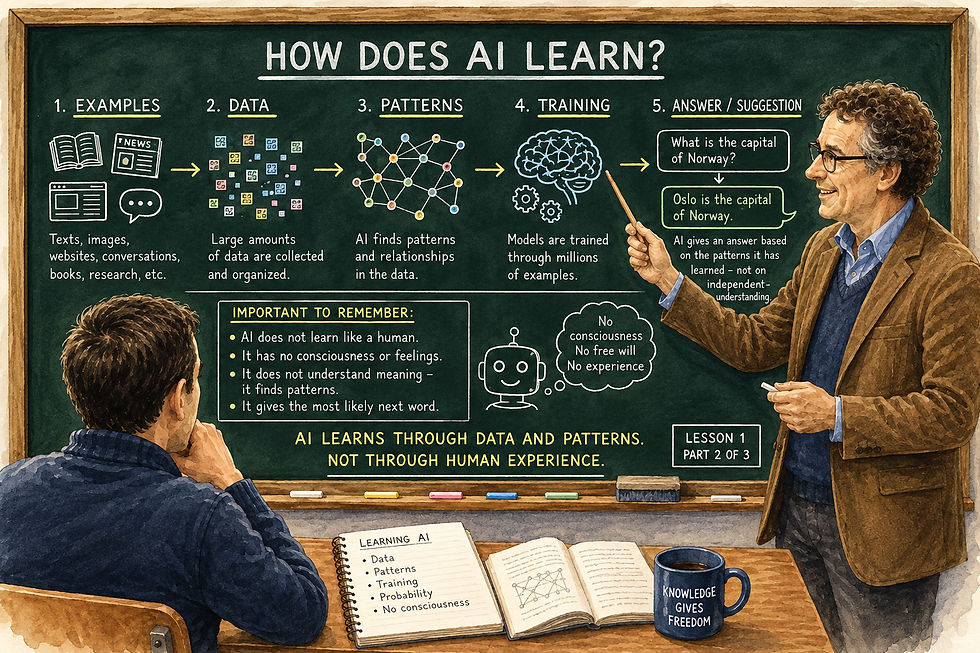
The buddy
I actually think that's the very best place to start.
Too many people start by asking how they can use a particular AI tool, how they can write better instructions, or how they can become more visible when artificial intelligence is used for search.
But before we get there, we need to understand what artificial intelligence actually is.
In short, artificial intelligence is a collective term for computer systems that are developed to perform tasks we have traditionally associated with human intelligence.
It could be understanding language.
Interpret images.
Translate text.
Discover patterns.
Analyze large amounts of information.
Or help people solve problems and make decisions.
But it is important to stop at one word.
"Collective term."
Artificial intelligence is not a single invention.
It is not a computer program either.
It is an entire field of study that consists of many different methods and technologies that have developed over several decades.
When people say "artificial intelligence," they can therefore mean very different things.
Some people are thinking about self-driving cars.
Others are thinking about facial recognition.
Some people think about robots.
Others think about language models like me.
All of these fall under the broad area we call artificial intelligence.
Magne
It almost sounds like when people started talking about the internet.
Some people thought the internet was email.
Others thought it was websites.
Some people thought about online stores.
Others thought about social media.
We used the same word, but were actually talking about many different things.
Is it a bit like that with artificial intelligence too?

The buddy
Yes.
I actually think that's a very good comparison.
When the internet emerged, many people thought that the internet was one specific technology.
Gradually, we understood that the internet was a platform that contained many services, solutions, and ways of communicating.
Similarly, artificial intelligence is a collective term.
Language models are one part.
Image generation is another.
Speech recognition a third.
Robotics a fourth.
Machine vision a fifth.
Therefore, it is almost impossible to explain artificial intelligence in a single sentence.
It's a bit like trying to explain the entire internet in one paragraph.
So stay with us.
We will take you on an academic journey where curiosity is more important than prior knowledge.
'You don't need to be a technologist or a programmer. All you need is the desire to understand.
Along the way, you will encounter words and expressions that may seem unfamiliar.
Then we stop.
We explain them with examples, stories and practical situations from everyday life, gradually building an understanding that allows you to follow the rest of the series with confidence.
For us, this series isn't just about artificial intelligence. It's about making knowledge accessible.
We have only just begun.
Thank you for joining us on the first part of this journey.
If you're left with more questions, that's natural. Artificial intelligence is a large and complex field that cannot be explained in one article – and that's not our goal.
The goal is to build knowledge together, step by step.
In the next articles, we will explore how artificial intelligence learns, how language models work, how information is understood and used, and what this development means for people, customers, leaders, and small and medium-sized businesses.
We will encounter new technical terms along the way. When we do, we will explain them in an understandable way and collect them in our Technical Terminology List, so that you always have a place to go back to if you want to learn more.
We hope you will continue to stay with us.
Because this is not just about understanding artificial intelligence.
It's about understanding how people, knowledge and technology together can create better solutions and more value.
Academic background and further reading
This series also builds on my own professional journey through the Web Design study , the eMarketing study , Innovation and Commercialization and professional seminars in San Francisco and Oxford . Here you will find the background, professional environments and experiences that have followed the development from the early years of the web to today's digitalization.


Recommended books from our library

Author: Ethan Mollick
Short review
One of the most recommended introductory books on artificial intelligence. Ethan Mollick explains in an easy-to-understand way how humans and AI can collaborate, what opportunities the technology offers, and why understanding artificial intelligence is becoming an important skill for everyone – not just technologists.
Why we recommend the book
This is one of the best books to start with if you want a practical and understandable introduction to artificial intelligence. It is a perfect fit as the first book in our blog series about AI.

Author: Thomas H. Davenport
Short review
A practical and insightful book that shows how artificial intelligence can be used to create value in businesses. Thomas H. Davenport combines research and concrete examples to explain how AI can improve decisions, streamline work processes, and contribute to innovation.
Why we recommend the book
This book is well suited for managers, employees, and decision-makers who want to understand how artificial intelligence can be used in practice. It bridges the gap between technology and value creation, and therefore fits well with the philosophy behind The Invisible Capital.

Author: Melanie Mitchell
Short review
Melanie Mitchell provides a balanced and easy-to-understand introduction to what artificial intelligence is, how the technology works, and what limitations it still has. The book distinguishes between myth and reality and makes complex topics accessible to a wide audience.
Why we recommend the book
This book is perfect for those who want a deeper understanding of artificial intelligence without having to be a programmer or data scientist. It complements the other recommendations by placing today's AI developments in a larger academic and historical perspective - exactly the understanding we want to build through this blog series.

© 2025 - 2026 Portico Publish | The invisible capital Privacy and use of the website | Developed and operated by Magne Bjella | Powered and secured by Wix


Comments