
When artificial intelligence starts doing business for you

From search engines and online stores to intelligent shopping assistants – are we entering the biggest shift in e-commerce since the internet?
For more than twenty years, we have been accustomed to searching for products, comparing prices, reading reviews and making the final purchase decision ourselves. Now a new technological shift is underway. Artificial intelligence can already recommend products, explain differences and help us choose. The next step is for AI to not only support the trade, but also carry out parts of it on our behalf. What does this mean for customers, businesses and the customer experience of the future – and how does it change the way value is created?

A new technological shift
The history of e-commerce is the history of technological shifts.
When the internet became available to most people, we gained access to information that was previously difficult to find. The web browser made the web easy to use, search engines made information searchable, and online stores made it possible to shop at any time of the day.
The mobile phone later moved commerce from the desk to the pocket. Customers suddenly expected to be able to find products, compare prices and make purchases wherever they were.
Now we are facing a new shift.
This time it's not primarily about new screens or faster networks.
It's about artificial intelligence becoming an active participant in the purchasing process.
From search to conversation
For many years, the digital customer journey has started with a search.
We've typed a few words into a search engine, opened several websites, read product descriptions, compared prices, and reviewed reviews before making a decision.
Most of us are familiar with this way of working.
But generative artificial intelligence makes it possible to start in a completely different place.
Instead of searching for products, the customer can describe their need in their own words.
"I need a light jacket for mountain hikes in Norwegian summer weather."
"Which laptop is best if I edit photos and
want long battery life?
"I'm going to buy my first electric bike. What should I consider?"
The difference may seem small.
In reality, it is enormous.
Previously, we were looking for products.
Now we describe needs.
This means that technology is moving from being a search engine to becoming a conversation partner.

The digital shopping assistant
This is just the beginning.
The latest AI solutions can already summarize tests, compare products, explain differences between models, and find alternatives that suit different needs.
The next step is for the digital assistant to be able to perform even more tasks.
It can suggest products.
Compare prices.
Check stock status.
Find the best delivery solution.
Add items to the shopping cart.
Eventually, it can also complete the purchase after the customer has given their consent.
Then we are no longer just in a world of digital online stores.
We are moving towards a world where artificial intelligence becomes an active part of commerce itself.
For the customer, this can mean an easier everyday life.
For businesses, this means that the nature of competition is changing.
It is no longer enough to be visible in a search engine.
You also need to be visible and trustworthy to artificial intelligence.

When trust becomes more important than clicks
For many years, businesses have competed to get customers to click on their website.
Large resources have been invested in search engine optimization, advertising, product texts and digital campaigns. The goal was simple: Get the customer into the online store.
Once the customer was there, the work began on creating a good customer experience.
Artificial intelligence changes this logic.
The customer no longer needs to visit ten different websites to compare products. An intelligent assistant can summarize information, compare options, and explain differences within seconds.
That means the competition is no longer just about being found.
It's about being proud of.

Because why would an artificial intelligence recommend your business if the information is incomplete, contradictory or difficult to understand?
Just as humans build trust through experience, artificial intelligence also bases recommendations on the quality and consistency of the information it finds.
Technology is changing.
But the importance of trust remains.
Customer experience takes on a new dimension
For many years we have talked about digital customer journeys.
How does the customer find us?
How easy is it to navigate the website?
How quickly can the customer pay?
How does delivery work?
All of these questions are still important.
But now a new question arises:
How does the customer experience the business before the customer even visits the website?
If an artificial intelligence summarizes your business,
describing your products or recommending the competitor because their information is better, the customer experience starts long before the customer clicks a link.
This represents perhaps the biggest change since search engines made their appearance.
The customer experience no longer begins when the customer enters the website.
It begins when the customer asks their first question.
From search engine optimization to knowledge optimization
For many years, businesses have been working on search engine optimization.
They have tried to understand how Google ranks pages, what keywords customers use and how content should be structured.
This knowledge is still important.
But artificial intelligence shifts attention to something even more fundamental.
Businesses must be a credible source.
Product information must be correct.
The content must be up to date.
The language must be clear.
The connections must be easy to understand.
In short:
The business must build knowledge – not just visibility.
It is a development that fits well with the philosophy behind Invisible Capital.
Value is not created through technology alone.
They are created through the quality of the knowledge, people and relationships on which the technology is built.

What does this mean for Norwegian businesses?
Many people associate artificial intelligence with the largest technology companies in the world.
But development concerns everyone.
The small family business.
The local online store.
The municipality.
The hospital.
The voluntary organization.
The global industrial company.
Anyone who wants to be chosen by customers, citizens or partners must make it easier to understand who they are, what they offer and why they deserve trust.
This means that investments in expertise, content, digital services and customer experiences become even more important than before.
Artificial intelligence does not make these investments any less important.
It makes them more visible.

The invisible capital becomes visible
When we talk about artificial intelligence, the debate is often about algorithms, models, and technology.
But the businesses that succeed in the years to come will likely be those that have already built strong foundations.
They have employees who know their job.
They share knowledge.
They develop good customer experiences.
They collaborate across disciplines.
They build trust over time.
These are values that can rarely be read directly from an accounting report.
Yet it is precisely these values that keep customers coming back, recommending the business to others, and trusting what they read.
This is what we call Invisible Capital.
Artificial intelligence does not change the importance of this capital.
On the contrary, it makes it even more important.
Do you want to understand the technology behind the development?
This article is about how artificial intelligence is changing e-commerce and customer experiences. If you want to understand how the technology actually works, you can read our series "AI-Kompis", where we explain artificial intelligence step by step - in a language that everyone can understand.
Recommended articles:
International analyses point in the same direction
The developments we are seeing in artificial intelligence and e-commerce are not just a topic for research groups and technology companies. Leading international trade media are pointing to the same developments.
Fast Company describes how artificial intelligence is changing the entire buying process. Where we used to search for products, compare options, and make the final decision ourselves, we are now seeing the rise of intelligent shopping assistants that can understand needs, suggest products, summarize tests, and eventually complete parts of the buying process on our behalf.
This is not just about new technology.
It's about a new interaction between people and technology.
As artificial intelligence becomes an active participant in the customer journey, expectations for businesses also change. Products must be well described. Information must be accurate and up-to-date.
The customer experience must be holistic. And perhaps most importantly – the business must be a trustworthy source.
Fast Company also points to a challenge that is becoming increasingly important: trust.
Customers are willing to use AI to find information and compare products, but they need to trust both the technology and the businesses behind the information. It’s not enough for AI to provide a quick answer. The answer must also be relevant, accurate, and based on reliable sources.
This is not really a new principle.
It is the same fundamental idea that has characterized the development of good customer experiences for decades.
Technology is evolving.
But the importance of trust remains.
Therefore, the competition of the future is unlikely to be just about who has the most advanced artificial intelligence.
It's about who manages to combine technology with knowledge, credibility and good customer experiences.

From San Francisco to Oxford
Over the years, I had the opportunity to attend professional seminars in both San Francisco and Oxford. Although the seminars had different professional approaches, I gradually experienced that they described two sides of the same development.
In San Francisco, technology, innovation and new business models were at the center. Discussions focused on how the internet, digitalization and later artificial intelligence could create entirely new services, markets and businesses. The focus was often on what was technologically possible and how new ideas could be scaled to millions of users.
In Oxford, the perspective was different.
At the Oxford Institute of Retail Management , the customer, the retail and the customer experience were at the center. The questions were how people make decisions, what creates trust, how loyalty is built over time, and why some businesses are more successful than others in creating lasting relationships with their customers.
As I later worked with digital services and customer experiences, it became increasingly clear that these two perspectives complement each other.
San Francisco showed how technology is evolving.
Oxford explained why people choose to use it.
It is only when these perspectives meet that we can truly understand how new technology creates value.
From theory to practice
The studies in eMarketing at BI Norwegian Business School and later Innovation and Commercialization provided an academic framework that tied the experiences together.
Here we learned how technology affects marketing,
customer journeys, innovation and business models. We worked on research, analyses and models that are still relevant, even though technology has evolved enormously since then.
What has perhaps surprised me most over the years is how many of the basic principles still apply.
Customers still want good experiences.
They still want trust.
They still want businesses that understand their needs.
Artificial intelligence changes the way this can be delivered, but it doesn't change the people it is supposed to help.
Termination
When the internet became public, it changed the way we found information.
When the smartphone arrived, it changed where and when we shopped.
Now, artificial intelligence is changing how we make decisions.
History shows that each technological shift has created new opportunities. At the same time, each shift has placed higher demands on businesses that want to create value for their customers.
Therefore, future e-commerce is not only about artificial intelligence.
It is about how technology, people, knowledge and trust work together.
Businesses that manage to combine innovation with good customer experiences, solid professional knowledge and high credibility will have a stronger starting point than those that only focus on the latest technology.
Technology was never the goal.
It only became valuable when people adopted it, changed their behavior, and created new ways of working, acting, and collaborating.
This is the story Invisible Capital wants to tell.
The knowledge behind The Invisible Capital
Invisible Capital is not built on one book or one idea. It has been developed through many years of study, research, international seminars, and practical experience from working life.
The books below represent some of the most important professional sources of inspiration behind the project. They have shaped the way I think about leadership, innovation, digitalization, customer experiences, value creation and – not least – the importance of the people who create the values.
Each book has contributed new perspectives. Together, they have helped develop the knowledge base for The Invisible Capital and the book project Value-Creating People.
I hope they can give you the same professional inspiration that they have given me.
Academic background and further reading
This series also builds on my own professional journey through the Web Design study , the eMarketing study , Innovation and Commercialization and professional seminars in San Francisco and Oxford . Here you will find the background, professional environments and experiences that have followed the development from the early years of the web to today's digitalization.
Recommended books from our library

Content Strategy for the Web (2nd Edition)
Author/authors: Kristina Halvorson and Melissa Rach
Short review
How do you create content that actually helps people – and at the same time supports your business goals? Content Strategy for the Web is considered one of the most influential books in the field of content strategy and digital communications. The book shows how good content does not arise by chance, but through a deliberate strategy where user needs, the organization's goals, structure, work processes and management are closely linked.
The authors take the reader through the entire process – from planning and organizing to publishing, managing and continuously improving content on websites and digital services. Although technology has evolved since the book was published, the principles of quality, relevance, management and long-term content work are at least as relevant in an era where search engines and artificial intelligence assess the credibility and usefulness of content.
Why we recommend the book
At The Invisible Capital, we believe that good content is one of the most important forms of invisible value creation. A website is far more than design and technology – it is the content that builds trust, creates great customer experiences and helps people find the answers they are looking for.
This book is perfect for leaders, communications consultants, content producers, web editors, UX designers, and anyone working with digital services. It shows why a clear content strategy leads to better user experiences, more effective interactions, and stronger digital results over time.
In an era where artificial intelligence is increasingly important in how information is discovered, understood, and communicated, this book is more relevant than ever. It reminds us that technology alone never creates value – it is good, structured, and relevant content that makes the difference.

Don't Make Me ThinkAuthor: Steve Krug
Short review
Don't Make Me Think is one of the world's most influential books on usability and web design. Since its first edition in 2000, the book has helped designers, developers, content producers, and managers understand a simple but powerful principle: Good digital services should be intuitive. The user should be able to complete their task without having to stop and think about how the website works.
Why we recommend the book
This is one of the books that has had the greatest impact on my own work with digital services. Over the years – from SAS and the Norwegian Opera & Ballet to working on Bærum Municipality’s website – the principles in this book have been an important reminder that technology is never an end in itself. The goal is to make everyday life easier for the people who use the services. Despite the fact that the book was published many years ago, the message is just as relevant today.
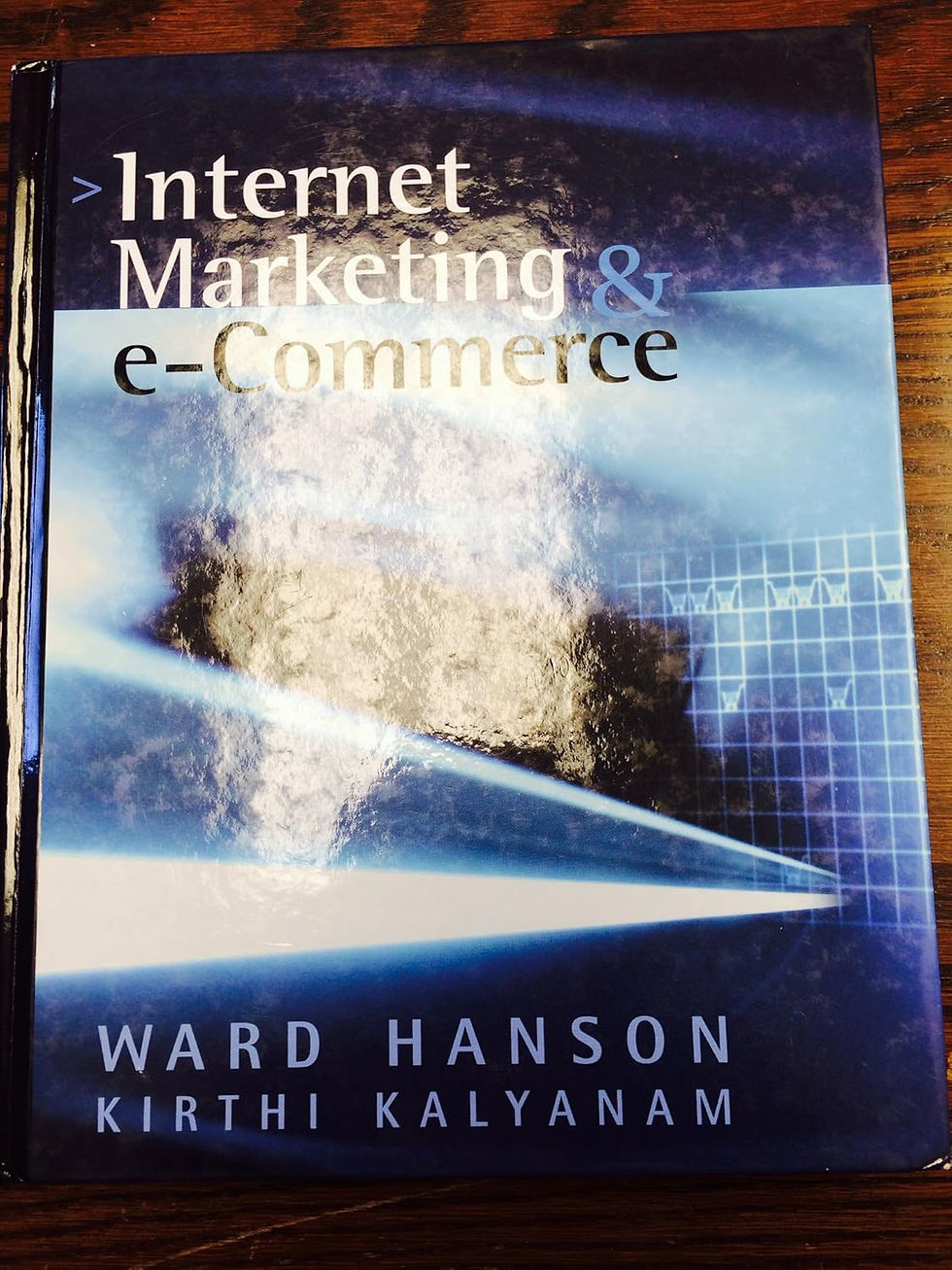
Internet Marketing & eCommerce
Authors: Ward Hanson and Kirthi Kalyanam
Short review
Internet Marketing & eCommerce provides a thorough introduction to how the internet has changed marketing, commerce, and business development. The book combines theory and practical examples in digital marketing, e-commerce, customer behavior, value creation, and digital business models. Although written at a time when the internet was still in its infancy, many of the fundamental principles are still highly relevant.
Why we recommend the book
This book was an important part of my own learning journey in digital marketing and e-commerce. It helped build my understanding of how technology, customer experiences and business strategy are interconnected – an insight that later became very important in my work with SAS, the Norwegian Opera & Ballet, Bærum Municipality and eventually the project The Invisible Capital. Many of the ideas about customer value, digitalization and innovation presented on the website have their roots in the knowledge this book conveys.

The Innovator's Dilemma: When New
Technologies Cause Great Firms to Fail
Author: Clayton M. Christensen
Short review
The Innovator's Dilemma is one of the most influential books on innovation and technological change. Clayton Christensen introduces the concept of "disruptive innovation" and shows how even the most successful businesses can fail when new technologies and business models change the market. Through a series of examples, he explains why established companies often have difficulty adapting to radical change - even when they do "everything right."
Why we recommend the book
This book has had a major impact on how I view innovation, digitalization, and change management. It provided a new perspective on why established businesses are challenged by new players, and why the ability to think differently is crucial in a world characterized by continuous technological development. Many of the reflections in The Invisible Capital on innovation, digital transformation, and value creation are based on the insights Clayton Christensen conveys in this classic.

© 2025 - 2026 Portico Publish | The invisible capital Privacy and use of the website | Developed and operated by Magne Bjella | Powered and secured by Wix


Comments