top of page

Part 12 - AI-Companion... why shouldn't any articles stand alone?

Writer: Magne Bjella
Magne Bjella
17 hours ago
4 min read

Many websites consist of individual articles that each live their own lives. They are published, shared a few times – and then left alone. But what if each article instead became part of a larger universe of knowledge? What if each page helped the reader move on to the next question? In this article, we take a closer look at why the connection between articles can be one of the most important investments a website makes.


A detailed watercolor illustration shows Magne and his KI buddy walking through Alamo Square Park in San Francisco with the iconic Painted Ladies in the background. Magne has his signature blue sweater, light pants and natural hairstyle, while the KI buddy has glasses, a brown jacket, a dark turtleneck and jeans. They walk together towards the historic Victorian houses while the San Francisco skyline rises behind them. The park is filled with people, flowers, large trees and green grass that create a warm and calm atmosphere. The illustration symbolizes how individual articles can be connected to a larger universe of knowledge where each article leads the reader to the next question. The motif visualizes themes such as internal linking, knowledge architecture, SEO, artificial intelligence, digitalization, learning journeys, content strategy, user experience, trust and long-term value creation.

Magne & the Friend


Magne

Friend...


We have now written many articles in this series.


But I have noticed one thing.


We never end with:


“Thank you for reading.”


We always end with a new question.


Why?


The buddy

Because people rarely finish learning after one article.


When we learn something new, a new question almost always arises.


If the website can answer the next question as well, it will be easier to continue learning.


Magne


So...


Is an article really the start of a conversation?


The buddy

Yes.


And perhaps even more importantly.


An article should be part of a larger story.


If each article points to the next topic, the website gradually builds knowledge in the reader.


Magne

It reminds me of a book.


I don't read chapter seven without knowing what happened in chapter six.


A detailed educational watercolor shows Magne and the KI buddy in front of a large green board with a view of Alamo Square Park and the iconic Painted Ladies in San Francisco. The board illustrates why no articles should stand alone, but be part of a larger universe of knowledge. A simple model shows how article 1 leads to article 2, then to article 3 and article 4 before the reader naturally continues to the next question. The model explains how coherent content makes it easier to build understanding step by step. Around Magne and the KI buddy are the characteristic SF coffee cup, a green teapot, notebooks and textbooks that visually tie the series together. Through the windows, Alamo Square Park, the historic Painted Ladies and the San Francisco skyline can be seen. The illustration shows how internal linking, knowledge architecture, content strategy, SEO, artificial intelligence, user experience and long-term value creation create a living website where each article helps the reader move forward towards deeper insight and greater confidence.

The buddy

Just.


A good website can work the same way.


Not like a collection of random pages.


But like a bookshelf.


Where each chapter builds on the previous one.


Magne

So...


When we link between our articles...


Isn't it really for the search engines?


The buddy

No.


The most important reason is the people.


Internal links help the reader further.


When they also make it easier for search engines and artificial intelligence to understand the context, it is a positive side effect.


But the starting point should always be the reader.


An educational watercolor shows Magne and his AI buddy in front of a large green board with a view of Alamo Square Park and the Painted Ladies in San Francisco. The board illustrates how an article should never be the end of a conversation, but the start of a learning journey where each answer creates new questions. The model shows how the reader moves from one topic to another through natural connections. On the table are the characteristic SF coffee cup, a green teapot, notebooks and non-fiction that emphasize the educational style. The illustration shows how good content, internal links, artificial intelligence, SEO and knowledge sharing build deeper understanding and create a living universe of knowledge over time.

Magne

Then I begin to understand why we have spent so much time planning our series.


The buddy

Yes.


Because a series is more than just several articles on the same topic.


It is a planned learning journey.


And it is precisely such learning journeys that build trust over time.


A detailed chalkboard watercolor shows Magne and his AI buddy in front of a large green chalkboard where a website is compared to a bookshelf. The chalkboard shows how each chapter builds on the previous one so that the reader gradually develops more knowledge and understanding. Through the windows, Alamo Square Park, the iconic Painted Ladies, and the San Francisco skyline are seen. The warm watercolor style with SF coffee cup, green teapot, books, and notebooks creates a complete learning arena. The illustration visualizes how content architecture, internal linking, thematic structure, artificial intelligence, SEO, user experience, and knowledge development are interconnected when a website is built as a holistic universe of knowledge.

Academic specialization


Here we introduce a thought that can become a guiding principle for the entire website:


From individual articles to a universe of knowledge


A good website helps the reader go from:

  • question

  • to answer

  • to understanding

  • to the next question

  • for deeper insight


We can use The Invisible Capital as an example:

  • Leaders and leadership

  • The employee

  • The customer

  • AI

  • Digitization

  • Innovation


A warm and detailed watercolor shows Magne and his AI buddy in front of a green board that explains why internal links are primarily made for people and not for search engines. The board shows how relevant links help the reader move on to the next question, create better understanding, build trust and make the learning journey easier. At the same time, it illustrates how Google and artificial intelligence more easily understand the connection between articles when the website has a clear structure. Through the windows, Alamo Square Park and the Painted Ladies surrounded by trees and flowers are seen. The illustration shows how user experience, internal linking, SEO, artificial intelligence, digital visibility and long-term value creation are closely related.

All the series point towards each other.


It creates a whole.


Single articles or universes of knowledge?

Single items

Knowledge universe

Standing alone

Building on each other

Answering one question

Answers many related questions

Get internal links

Clear connection between topics

Short lifespan

Building value over many years

Provides information

Building understanding


An extensive educational watercolor shows Magne and the AI buddy in front of a large green board that illustrates how individual articles can be connected to form a complete universe of knowledge. The board shows the learning journey from questions to answers, on to understanding, new questions and deeper insight. At the same time, it illustrates how the disciplines of management, employees, the customer, artificial intelligence, digitalization and innovation are interconnected through internal connections. Through the windows, Alamo Square Park and the iconic Painted Ladies are bathed in warm afternoon light. The characteristic SF coffee cup, green teapot, textbooks and notebooks visually tie the series together. The illustration shows how a comprehensive content strategy, internal linking, thematic structure, SEO, artificial intelligence, digital competence and value creation build trust and turn a website into a living universe of knowledge.

New terms in this article


English technical term

Short explanation

Topic Cluster

A collection of articles that highlight different aspects of the same topic and are connected with internal links.

Cornerstone Content

The most important and comprehensive article within a field, on which other articles build.

Knowledge Ecosystem

A website where articles, technical terms and resources are linked together into a whole.

Internal Linking

The work of linking related pages on the same website.

Learning Journey

A planned sequence of content that builds knowledge step by step.

Content Hierarchy

How content is organized from overarching topics to detailed articles.

Content Ecosystem

A network of content that supports and reinforces each other.

Navigation Path

The path the user follows through a website.

Contextual Link


An internal link placed naturally in the text because it provides the reader with more relevant knowledge.

Content Series

A planned series of articles that together build understanding within a specific topic.


We have only just begun.


Magne

Friend...


Now I understand how we build a universe of knowledge.


But how do we know which articles should be the cornerstones?


The buddy

Hehe...


Now we come to the architecture.


Not the architecture of a building.


But the architecture of knowledge.


And that is perhaps the most important job of all.


Academic background and further reading

This series also builds on my own professional journey through the Web Design study , the eMarketing study , Innovation and Commercialization and professional seminars in San Francisco and Oxford . Here you will find the background, professional environments and experiences that have followed the development from the early years of the web to today's digitalization.


Icon symbolizing the table of contents in the knowledge universe about artificial intelligence on The Invisible Capital. The icon leads to the complete overview of the subject series' articles, themes and learning journey, from a basic understanding of artificial intelligence to knowledge, trust, value creation and competitiveness.


Icon of an open book symbolizing recommended literature in the knowledge universe about artificial intelligence on The Invisible Capital. The icon leads to a specialist library with recommended books on artificial intelligence, digitalization, content strategy, innovation, customer experiences, leadership, value creation and modern business development.


Recommended books from our library


Book cover for The Coming Wave by Mustafa Suleyman – an international bestseller that explores how artificial intelligence will change the world of work, business and society. An inspiring book for anyone who wants to understand the technology of the future and what role artificial intelligence will play in the years to come. A book we highly recommend to anyone with an interest in digitalization, innovation and AI.

The Coming Wave


Author: Mustafa Suleyman


Short review

The Coming Wave explores how artificial intelligence and other breakthrough technologies will transform work, business, and society in the coming decades. Mustafa Suleyman, one of the founders of DeepMind, combines his own experiences from AI development with analyses of the technology's opportunities, risks, and significance for the future.


Why we recommend the book

One of the most important books on the future of artificial intelligence, the book provides a unique insight into how AI will impact people, businesses and society – and why responsible technology development is becoming increasingly important.


Book cover for Rebooting AI by Gary Marcus and Ernest Davis – one of the most acclaimed books on artificial intelligence, machine learning, and the limitations of language models. A book that challenges established truths and provides a deeper understanding of how humans and artificial intelligence can complement each other. A valuable reference work for anyone who wants a nuanced understanding of AI.

Rebooting AI


Authors: Gary Marcus and Ernest Davis


Short review

Rebooting AI challenges many of the myths surrounding artificial intelligence. The authors explain what today's AI can actually do, where its limitations lie, and why human judgment is still crucial. The book bridges the gap between research, technology, and practical application.


Why we recommend the book

A thought-provoking book that provides a balanced perspective on artificial intelligence. Perfect for those who want to understand both the strengths and weaknesses of today's language models and AI systems.
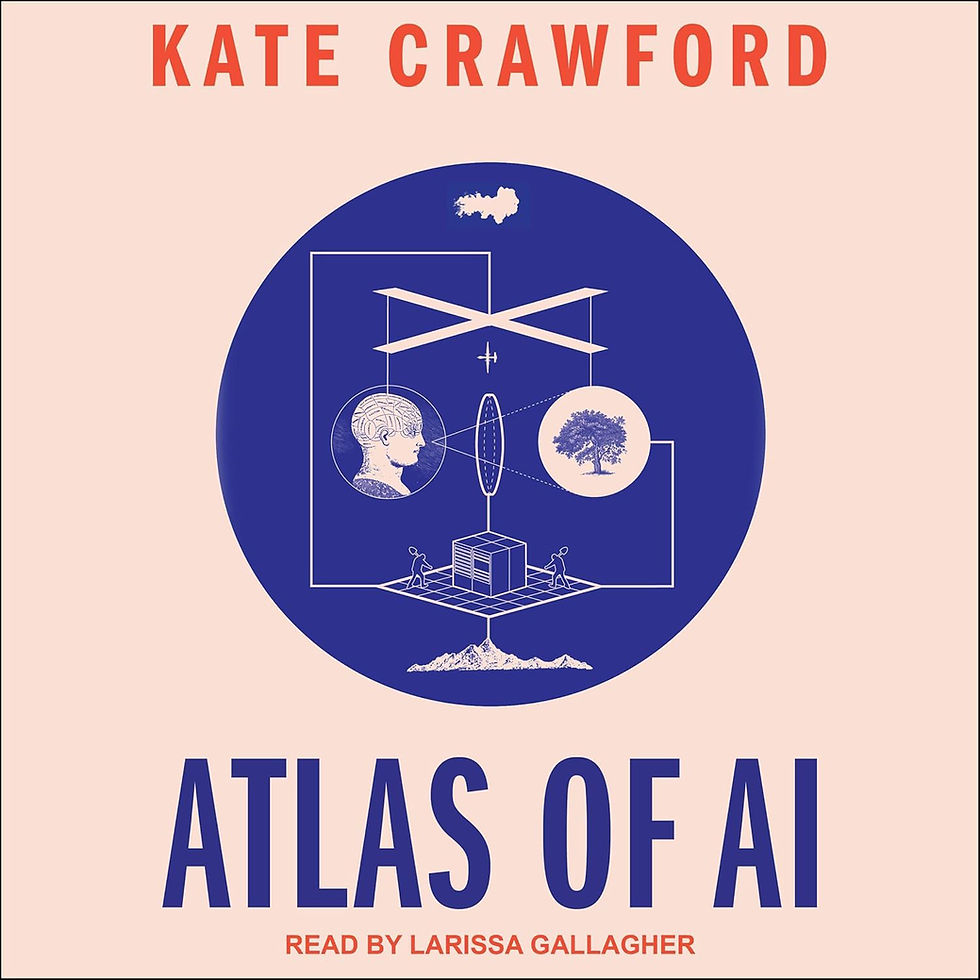


Book cover for Atlas of AI by Kate Crawford – an award-winning book that places artificial intelligence in a broad societal perspective and explains how technology, data, people and value creation are interconnected. An inspiring book for anyone who wants to understand artificial intelligence far beyond algorithms and software. A book that deserves a place on the bookshelf of anyone working with digitalization, innovation and societal development.

Atlas of AI


Author: Kate Crawford


Short review

Atlas of AI shows that artificial intelligence is about much more than algorithms and technology. Kate Crawford explores how data, energy, people, politics, and economics are interconnected with the development of artificial intelligence. The book places AI in a broader societal perspective.


Why we recommend the book

An essential book for anyone who wants to understand how artificial intelligence is impacting society. It shows that AI is not just about technology – it is also about people, resources, power, knowledge and value creation.


Portico Publish - The publisher Portico Publish is a small, independent publishing and dissemination project built around reflection, knowledge, culture and the people behind value creation.

© 2025 - 2026 Portico Publish | The invisible capital Privacy and use of the website | Developed and operated by Magne Bjella | Powered and secured by Wix

Comments


Share Your Thoughts

© 2025 - 2026 Portico Publish | The Invisible Capital
Privacy & Website | Developed and managed by Magne Bjella | Powered and secured by Wix

  • Amazon
  • LinkedIn - Magne Bjella
  • X     Magne Bjella
  • Facebook - Magne Bjella
  • Instagram - Magne Bjella
bottom of page